
Yemen Government Forces Seize Strategic Heights in Al-Jawf as Taiz Siege Deepens and UN Warns 260,000 Displaced

Yemeni government forces say they have seized a chain of strategic mountain heights in the northern governorate of al-Jawf, opening a new front in their counteroffensive against the Houthis, as the month-long siege of the city of Taiz deepens and the United Nations warns that nearly 260,000 people have been displaced since August.
Field commanders told Al Jazeera that government troops had taken complete control of the Huwaishan mountain range east of al-Hazm, the provincial capital of al-Jawf, and then pushed further into the al-Dahida heights on Wednesday, storming Houthi fortifications and barracks with support from fighter jets and drones and seizing weapons and military equipment, according to an armed forces statement.
The reported gains are the latest claimed in Operation Dawn of Yemen, the government offensive launched on 5 October to reverse Houthi territorial gains and restore the internationally recognised government’s authority across the country. Rashad al-Alimi, head of the Presidential Leadership Council, has said the operation will continue until state institutions and the government’s authority are restored over the whole of Yemen.
At the same time, fighting is escalating on several other fronts. A Houthi ballistic missile struck a military training camp in the southern province of al-Dhalea, killing eight people and wounding more than 15, a military source told Al Jazeera. The missile hit a gathering of recruits at the al-Jumaima camp in northern al-Dhalea, according to Al Jazeera’s correspondent, citing field sources. No official toll has been released, and some Yemeni media reported higher figures.
Government forces said they had also recaptured positions in al-Maqatira district in northern Lahij, which lies on a key defensive line linking Taiz with Aden, the internationally recognised government’s seat. Houthi-affiliated media, meanwhile, reported four air strikes on a Central Security Forces camp in the city of al-Bayda and a strike on a health centre in al-Silw district in Taiz. The Houthis claimed that strikes from Saudi Arabia, which backs the Aden government, had killed civilians over two days this week.
The United Nations Office for the Coordination of Humanitarian Affairs (OCHA) said in a report released late on Wednesday that almost 260,000 people have been displaced since August, with about half of them taking refuge in Taiz, where the fighting is now concentrated. The UN Human Rights Office has verified 251 civilian casualties in the latest fighting, including 57 people killed and 194 injured, and half of those killed were children, according to OCHA.
Humanitarian partners have reached more than 174,000 displaced people since August, nearly six in 10 displaced households, providing food, hygiene kits and emergency cash in the first days after they were uprooted, OCHA said. “Newly displaced families say that their most pressing need is shelter, followed by food and cash,” the agency said.
The Red Cross said on Wednesday it had delivered four truckloads of essential medical supplies to the besieged city of Taiz after renewed fighting cut off access for weeks, according to Reuters. Taiz has been largely isolated for a month, with fighting preventing humanitarian supplies from entering the city and restricting the movement of civilians, after an escalation in clashes between the Saudi-backed government and the Iran-aligned Houthi movement.
Key supply routes, including the Taiz-Aden corridor, have been blocked by Houthi forces, exacerbating shortages of water, food and fuel, while hospitals said they were under significant pressure and faced scarce medical supplies, Reuters reported. The city hosts about half of the 300,000 people displaced across Yemen by the latest fighting, according to the United Nations, and intensified fighting along multiple front lines has cut off vital aid to around 800,000 people, humanitarian agencies have said.
The battle for the heights
Al-Jawf has become a new focal point in the conflict, highlighting the strategic importance of a governorate that borders Saudi Arabia and connects directly with five pivotal governorates: Hadramout, Saada, Sanaa, Amran and oil-rich Marib. It also acts as a vital defensive shield for Marib, which is controlled by government forces, preventing the Houthis from advancing into the eastern regions, and as a gateway to major Houthi strongholds in northern Yemen.
Field Commander Colonel Rabie al-Qurashi said government forces had won complete control over the strategic Huwaishan mountain range, describing it as the first line of defence for the Houthis on the eastern axis. Control over the rugged region would give government forces the ability to disrupt rebel supply routes, he said.
“Government forces succeeded in breaking that defensive format with partial control over the al-Alam front road,” al-Qurashi said. “The government advance represents a beginning to tighten the noose on the Houthis in the upper al-Labanat camp,” which he described as a vital eastern gateway to Sanaa.
Ali al-Dahab, a military and strategic affairs researcher, told Al Jazeera there were immense tactical benefits to holding the elevated terrain. “The recent advances of government forces in al-Jawf are a military transformation that serves the course of future operations for their arrival to al-Hazm city,” he said, adding that recovering the heights provided a military and psychological morale advantage, confused Houthi decision-making, and gave government forces the ability to monitor Houthi supply lines and secure their own.
Military spokesman Majed Abdullah al-Nuzaili said on X that recent military operations against Houthi positions in al-Jawf were “inflicting losses on the militia’s capabilities”. Government forces spokesperson Majid al-Nazili said on Wednesday that they had launched 835 targeting operations against the Houthis, killing or injuring 285 of the armed group’s members and destroying battle tanks and weapons stores. Al Jazeera could not independently verify the government’s battlefield casualty claims, and the Houthis said they had thwarted advances by government forces in al-Jawf and neighbouring Marib.
The government dominates the vast eastern desert district of Khabb wa ash Sha’af, which represents 82 percent of the governorate’s total area. The Houthis control the provincial capital, al-Hazm, and 10 other districts. Control over al-Hazm has shifted several times during 12 years of war, with the Houthis seizing the city in March 2020.
Security and political affairs researcher Brigadier General Ahmed al-Awadhi stressed the importance of “continuous but not rapid” government advances in the area. “The advances of government forces in al-Jawf cannot be ignored or their importance underestimated,” he told Al Jazeera. “Control over heights or mountain ranges in the desert al-Jawf governorate represents points of military strength regardless of their proximity to or distance from the governorate capital.” The advances highlight a historical vulnerability for the Houthis, who have suffered repeated defeats in battles in desert and open areas, he added.
The developments coincide with the Presidential Council’s appointment of Major General Amin Ali al-Akimi as governor and military commander of al-Jawf. “[His] reappointment… comes within the context of restructuring the theatre of operations and unifying the front,” Ibrahim Jalal, a Yemen-focused analyst, told Al Jazeera. “Hailing from Dhu Hussein, a branch of the Daham Bakil tribe, al-Akimi possesses tribal and military influence that could help mobilise tribes, overcome divisions and bolster momentum on the ground. However, translating this influence into sustainable gains remains contingent upon unifying command and control, coordinating operations across all battlefronts, securing military and logistical support and strengthening anti-corruption efforts to improve the efficient management of military resources.”
Taiz: a city under siege
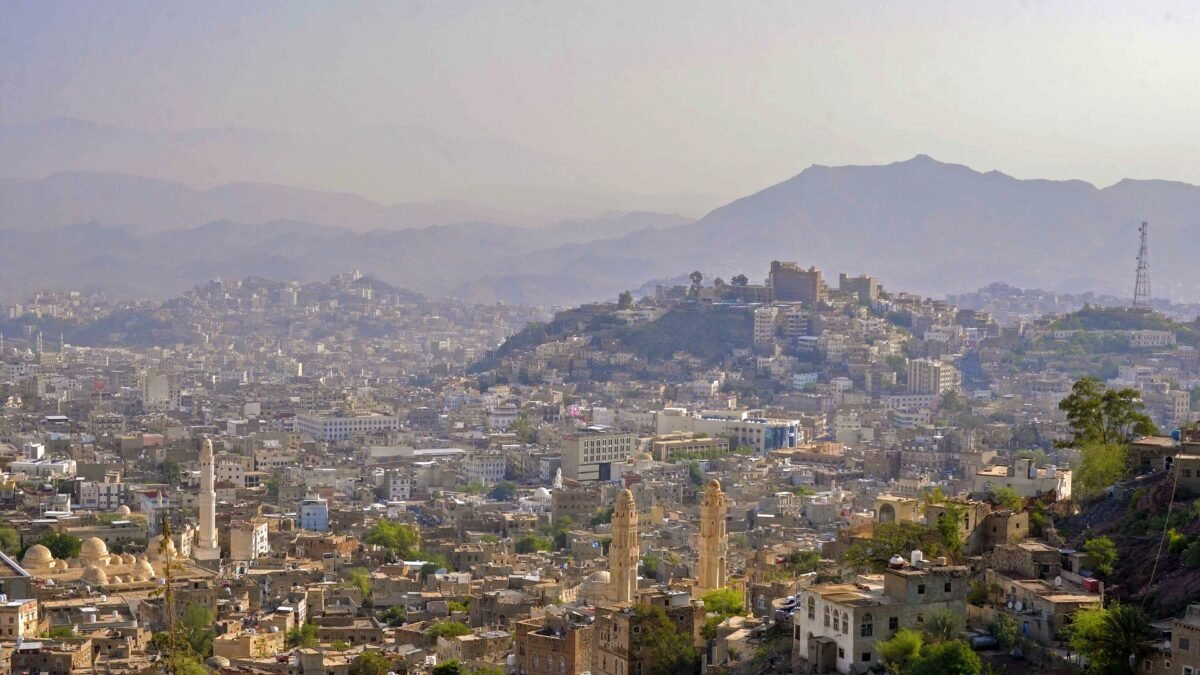
While the fighting in al-Jawf has drawn the attention of military analysts, the gravest humanitarian emergency is in Taiz, Yemen’s third-largest city, where around a million people are trapped by a siege that has now lasted a month.
The siege began with the seizure of al-Turbah, a town in the far south-west of Taiz governorate, cutting the city’s main road to Aden and the outside world. The Houthis had ringed Taiz from the north, east and south since 2015, but taking the western countryside has now closed the circle, leaving the city cut off from food, water, fuel and medicine.
Taiz Governor Nabil Shamsan issued an urgent appeal over the health situation in the city, saying 120 health centres had stopped operating and another 66 were close to shutting down. Hospitals are working at only 20 percent capacity, he said, and the besieged city is hosting 39,000 displaced families. “We urge the international community to secure at least one safe route between Taiz and Aden to enable citizen movement and the smooth entry of services, essential materials and goods,” Shamsan appealed to Al Jazeera.
The UN emergency relief chief, Tom Fletcher, warned that all roads into Taiz were closed and essential supplies were running out, saying: “We have food and medicines ready to move, but the roads must be opened by the parties and those supplies must be let in as soon as possible.” The UN spokesman, Stephane Dujarric, went further, calling the encirclement a medieval siege and saying humanitarians cannot shoot their way through a blockade cutting off about one million people from food, water and medicine, according to Arab News.
Human Rights Watch, which spoke to residents, doctors and civil society workers in October, says the Houthis have deprived Taiz civilians of food, medicine and other essentials since fully encircling the city, and that residents and UN officials place responsibility for the shortages on the Houthis. The Houthi side disputes that account: its leader has said the way remains open for food, medicine and aid, and a Houthi spokesperson told Human Rights Watch that government forces, not the Houthis, were blocking roads into the city.
The acting head of the governorate’s siege affairs department called it the worst catastrophic siege imposed on a Yemeni city since the war began in 2014. The UN Population Fund said more than 13,000 pregnant women in Taiz have been left without essential care, with daily births in the city down from around 10 to around five, and women surviving on little more than tea, bread or rice, according to Reuters. The World Food Programme says more than 800,000 people in Taiz and nearby areas have been cut off from food aid since early October.
The Red Cross delivery of four truckloads of surgical kits to help hospitals treat patients wounded in the renewed fighting was described by the organisation as a vital step in providing support to health facilities under extreme pressure since fresh hostilities began in September. It was the first such delivery to reach the city after weeks in which renewed fighting had cut off access.
Yemen’s Ministry of Education earlier announced that more than 2.5 million children are out of school because of the conflict, a figure that captures the war’s long shadow over a generation that has now spent much of its childhood under bombardment, displacement or blockade.
The human cost
More than 300,000 people have fled their homes in western Yemen due to the escalating fighting, most of them in the last two months, according to the International Organization for Migration. More than 43,000 people have fled the district of Al Madaribah Wah al-Aarah in Lahj since the start of October, the highest number in any district in Yemen, the organisation said on Sunday.
The UN Population Fund said nearly 6,100 pregnant women were among those recently displaced, including 600 expected to give birth within two weeks of its briefing on Friday. The Office of the UN High Commissioner for Refugees warned that more than 65,000 refugees and asylum seekers in Yemen face worsening conditions as services are disrupted and food and fuel prices rise.
The figures tell a story of a war that has again become a war of movement. For years after the 2022 truce, the front lines in Yemen were largely frozen, and the country’s suffering was measured in hunger, collapsed services and a shattered economy. Since the truce collapsed in July, and especially since the Houthis launched their offensive down the Red Sea coast in September and the government answered with Operation Dawn of Yemen in October, hundreds of thousands of people have been forced to move, often more than once.
Nour al-Din al-Mansouri, a member of the committee facilitating the work of the Taiz Siege Affairs Office, told Al Jazeera that at least 23 trucks were damaged or overturned in the past two weeks while seeking alternative routes to Taiz, a measure of how dangerous the roads around the city have become. Intense clashes have also taken place in the strategic highlands of Jabal Han in western Taiz, which overlook areas connecting the province to the government’s Aden base, and heavy fighting was reported in the Dhubab and al-Masrakh districts. A source in the government’s military told Al Jazeera that its air raids had struck Houthi gatherings and infrastructure in the Maafar directorate, south of Taiz.
Yemen’s government later threatened to expand attacks to target rallies staged by the Houthis, claiming the group uses those events to recruit children into combat. In a statement on Thursday, the ministry of defence warned civilians in Houthi-held areas to avoid any Houthi rallies or “cultural courses”, saying the gatherings would be viewed as legitimate military targets. The warning drew attention to the way the war is fought not only on front lines but over the loyalties of a population that has lived under rival authorities for more than a decade.
The regional dimension
The war in Yemen has never been a purely Yemeni affair, and the latest escalation has again spilled across the border into Saudi Arabia, which leads the coalition backing the internationally recognised government.
The Saudi-led coalition said it carried out a “targeted military operation to neutralise critical assets used by the Houthis” in support of its war effort. Coalition spokesperson Major General Turki al-Maliki said in a statement that the operation took place on Sunday morning following continued Houthi attacks against civilians and civilian infrastructure in Yemen and Saudi Arabia.
Saudi defences “intercepted and destroyed a ballistic missile” targeting the kingdom’s southern region, al-Maliki said in a statement on Monday. On Tuesday, the coalition said it had intercepted and destroyed a drone over Mecca. Houthi military spokesman Yahya Saree denied launching any attack on Saudi territory.
Saudi civil defence authorities twice activated early-warning sirens in the southern Najran region on Wednesday morning, after a similar alert overnight in the Riyadh region. On Monday, the Saudi Civil Defence authority issued and then lifted alerts warning of “potential danger” in the city of Abha, as well as the provinces of Khamis Mushait, Taif and Najran, and warned residents against “filming, publishing or sharing information” related to missile and drone attacks.
Saudi Arabia’s Authority of Civil Aviation said on Thursday that the death toll has risen to two following a Houthi strike on the King Fahd airport in Dammam on Wednesday evening. The strike was the latest in a campaign of Houthi attacks on Saudi airports that analysts say is designed as a pressure campaign to force a political resolution. Houthi forces say the strikes are in retaliation for Saudi Arabia’s longstanding restrictions on Houthi-controlled airports and seaports, including Sanaa airport.
The United States State Department said on Wednesday that it had ordered non-essential staff and family members at its embassy in Riyadh to leave the country, raising fears of further escalation. The embassy was already badly damaged at the onset of the US-Israel war on Iran and had been operating on a lean rota of staff, although some had recently returned. In a new travel alert, the State Department warned Americans that “the hostilities have the potential to escalate rapidly beyond that immediate area”. US government staff now require special permission to use any airport in Saudi Arabia.
Yemen’s government accused the Houthis of striking the Aden and al-Rayyan airports on Wednesday. The head of the governing Presidential Leadership Council, Rashad al-Alimi, condemned the strikes and called on the international community to proscribe the group as a “terrorist” organisation.
Yemen’s Interior Minister Ibrahim Ali Haidan said 21 foreign experts were directing Houthi operations: 14 from Iran’s Islamic Revolutionary Guard Corps and seven from Lebanon’s Hezbollah. Hezbollah rejected the accusation as “baseless”. The claim, if it were substantiated, would underline the regional character of a war in which the Houthis are aligned with Iran and the government is backed by Saudi Arabia and its coalition partners.
The escalation comes against the backdrop of a wider regional war. The United States and Israel have been at war with Iran since late February, the Strait of Hormuz has been closed, and the Houthis have repeatedly tied their campaign to the Gaza war, which has been under a ceasefire since October 2025. The Houthis announced a blockade on Saudi ports in the Bab el-Mandeb strait in July, and their lightning offensives swiftly seized strategic areas along Yemen’s Red Sea coast, including Mokha, Hays, Al Khawkhah, Dhubab and the Hanish Islands. At least 129 people were killed in the opening clashes on 3 September, according to a chronology of the 2026 Yemen offensives.
Only days before the latest escalation, Houthi forces advanced to within 80 kilometres of Aden, the closest threat to Yemen’s seat of government since 2015, after seizing the whole of al-Maqatirah district in Lahj. And on 10 October, a Houthi missile strike on Riyadh’s King Khalid International Airport killed at least 12 people and wounded 309, according to Saudi Arabia’s civil aviation authority, the deadliest attack in Saudi Arabia in more than a decade. The Asian Football Confederation has since postponed the 2027 Asian Cup in Saudi Arabia by almost a year, citing the security situation.
Analysis: Why It Matters
The fighting in al-Jawf and the siege of Taiz are two faces of the same war, but they point in opposite directions. In the north, the government is on the offensive for the first time in years, taking ground and talking openly about marching on Sanaa. In the south-west, a city of a million people is being slowly strangled, and the United Nations is counting the displaced in the hundreds of thousands. The contrast captures the central truth of Yemen’s renewed war: it is a conflict in which both sides can claim momentum, and in which civilians pay for every claim.
1. Al-Jawf is about Marib, and Marib is about everything
The heights east of al-Hazm matter less for their own sake than for what they protect. Al-Jawf is the shield of Marib, the oil-rich governorate that is the government’s most valuable remaining stronghold and the last major obstacle between the Houthis and Yemen’s eastern oil and gas fields. Whoever holds the high ground in al-Jawf can watch, and interdict, the supply lines that feed Marib’s defence. The government’s claim to have taken the Huwaishan and al-Dahida ranges, if it holds, would give it the observation and fire control it needs to secure Marib’s northern flank and, just as importantly, the confidence to talk about al-Hazm itself.
But the history of al-Jawf counsels caution. Control over al-Hazm has shifted several times in 12 years of war, and the Houthis have repeatedly shown that they can absorb losses in the desert and return. The researchers quoted by Al Jazeera are right to stress that the advances are significant, and equally right to stress that they are a beginning rather than a conclusion. The appointment of al-Akimi, a commander with tribal roots in the governorate, suggests the government understands that holding al-Jawf will depend as much on tribal politics as on firepower. The test will not be this week’s claims but whether government forces are still holding the heights in a month, and whether they can turn a tactical gain into a sustained advance on al-Hazm without overextending the supply lines that the Houthis will be trying to cut.
2. Taiz is the war’s moral centre
Taiz has been under siege in one form or another since 2015, but the full encirclement of the past month is different in kind. When the city’s main road to Aden was cut, Taiz lost its last lifeline, and the numbers now tell the story with brutal clarity: 120 health centres closed, hospitals at a fifth of their capacity, more than 800,000 people cut off from food aid, and a Red Cross convoy of four truckloads of surgical kits celebrated as a breakthrough because it was the first to get through in weeks.
The dispute over who is responsible for the siege — Human Rights Watch and the UN place it on the Houthis, who dispute the account and blame government forces — matters for accountability, but it does not change the condition of the people inside the city. A siege is a siege regardless of who dug the trenches, and the international law governing it is clear: civilians must be allowed access to food, water and medicine. The UN’s language has hardened accordingly, from warnings to the spokesman’s description of a “medieval siege”. What has not hardened is the international response. Tom Fletcher’s statement that food and medicines are ready to move, if only the roads are opened, is an indictment of a war in which the supplies exist and the suffering is a choice made by armed men.
3. The displacement crisis is the war’s second front
Nearly 260,000 people displaced since August, and about 300,000 by the latest fighting on the UN’s broader count, is a figure that deserves to be read slowly. Yemen was already home to one of the world’s largest displacement crises before this year’s escalation, with millions uprooted by a decade of war. The new wave is different because it is fast: most of the 300,000 fled in the last two months, and more than 43,000 fled a single district in Lahj in a single month. That pace overwhelms the humanitarian system’s ability to respond, which is why OCHA’s figure that partners have reached only six in ten displaced households is as important as the displacement figure itself.
The detail that nearly 6,100 pregnant women are among the recently displaced, with 600 expected to give birth within two weeks, is a reminder that displacement in Yemen is not an abstraction. It is women giving birth on roadsides and in overcrowded shelters, children out of school — 2.5 million of them, by the education ministry’s count — and families whose most pressing need, in OCHA’s words, is shelter, followed by food and cash. The war’s human cost is increasingly measured not in battlefield casualties, which neither side reports honestly, but in these quiet, cumulative figures of uprooting.
4. The Saudi front shows how regional this war has become
The sirens in Najran, the alert over Riyadh, the intercepted drone over Mecca and the strike on Dammam airport are not side incidents. They are the Houthis’ deliberate strategy of carrying the war into Saudi Arabia, and they are the reason the United States has ordered its embassy staff out of Riyadh and warned that hostilities “have the potential to escalate rapidly beyond that immediate area”.
The logic of the strategy is clear enough. The Houthis cannot match the Saudi-led coalition in the air, but they can impose costs on the kingdom — on its airports, its cities and its sense of security — and they can do so at a moment when Saudi Arabia is hosting, or preparing to host, events that depend on the perception of safety, from the Asian Cup to the wider programme of investment and tourism that is central to the kingdom’s economic transformation. The postponement of the Asian Cup was the first visible price. The Dammam airport strike, which killed two people, was a reminder that the price can be paid in lives as well.
For Riyadh, the dilemma is acute. The coalition’s air campaign can hit Houthi positions, but it has not stopped the missiles, and every strike that the Houthis say kills civilians hands them a propaganda victory. The claim by Yemen’s interior minister that 21 Iranian and Hezbollah experts are directing Houthi operations, whether or not it is substantiated, reflects the government’s effort to frame the war as a regional confrontation rather than a civil conflict — a framing that, if accepted, would justify a harder line from the international community. Hezbollah’s rejection of the claim as “baseless” shows how contested that framing remains.
5. A war that was frozen is now moving — and nobody has a plan for where it stops
The most important fact about Yemen in 2026 is that a war that had been frozen for four years is moving again, and it is moving on several fronts at once: the Houthis down the Red Sea coast and towards Aden, the government in al-Jawf and Taiz, the missiles over Saudi Arabia, and the diplomacy, such as it is, nowhere. The 2022 truce collapsed in July, and nothing has replaced it. The United States is at war with Iran, the Houthis’ patron, and the Strait of Hormuz is closed. The Gaza ceasefire has held since October, but the regional war that grew out of it has not ended; it has migrated.
In that context, Operation Dawn of Yemen is both an opportunity and a gamble. If the government can turn its gains in al-Jawf into a sustained advance, it could change the balance of a war that has been stalemated for a decade. If it overreaches, as the Houthis did when they advanced towards Aden, it could find its supply lines cut and its gains reversed. And while the armies manoeuvre, Taiz starves. The history of Yemen’s war suggests that the fighting will continue until one side is exhausted or the outside world imposes a settlement. Neither condition is in sight, which is why the UN’s displacement figures, rather than any battlefield claim, are the most reliable guide to where this war is heading: towards more people on the move, and more cities under siege.
What to Watch Next
- Whether the al-Jawf gains hold: The government’s claim to the Huwaishan and al-Dahida heights needs independent confirmation, and the real test is whether the heights are still in government hands in the coming weeks. Watch for any Houthi counterattack on the al-Alam front road and for the next phase of the advance towards al-Hazm.
- Taiz’s roads: The UN says food and medicines are ready to move. Watch for whether any corridor opens between Taiz and Aden, whether the Red Cross or other agencies manage a second delivery, and whether the Security Council or regional mediators put public pressure on the parties to open the roads.
- The Saudi front: After the Dammam airport strike and the sirens over Najran and Riyadh, watch for further Houthi missile or drone attacks on Saudi cities and airports, and for whether the coalition’s air campaign intensifies in response. Any attack on a major hub would raise the stakes sharply.
- The displacement count: OCHA’s figure of almost 260,000 displaced since August is already weeks old. Watch for updated IOM and OCHA figures, and for whether humanitarian agencies can raise their reach beyond six in ten displaced households as winter approaches.
- The diplomatic vacuum: With the 2022 truce dead, the US at war with Iran and no peace process under way, watch for any sign of mediation — from the UN envoy, from Oman or from regional powers — and for whether the new US Congress, after the Democrats’ midterm sweep, changes Washington’s approach to a war it is now fighting on two fronts.
Sources
- Al Jazeera – “Al-Jawf becomes new hotspot in Yemen war between government forces, Houthis”
- Al Jazeera – “Yemeni government forces claim control of strategic al-Jawf mountain range”
- Al Jazeera – “Fighting rages in Yemen’s Taiz as UN warns nearly 260,000 displaced”
- Reuters – “Red Cross delivers essential medical supplies to Yemen’s besieged Taiz city”
- Al Jazeera – “Yemeni government forces seize strategic positions in al-Jawf”

About the Author — Abdul Mannan
Related Articles

Trump Says US Will End $4 Billion in Annual Military Aid to Israel by Year’s End in Deal With Netanyahu
President Donald Trump says the United States will end nearly $4 billion in annual military aid to Israel…

Trump Says US Has ‘No Immediate Plan’ to Strike Iran as Tehran Hails Midterm Vote as a Rejection of War
President Donald Trump has said the United States has no immediate plan to strike Iran, telling the Financial…
Iran Warns of ‘New Battlefield’ and Threatens US Bases in Europe as Washington Prepares Possible Post-Midterm Strikes
Tehran says any renewed American attack will be met with a response 'without geographical limits' — and names…