
Amateur Radio Operator Tells a Satellite to Play Doom — and It Listens in a Space First

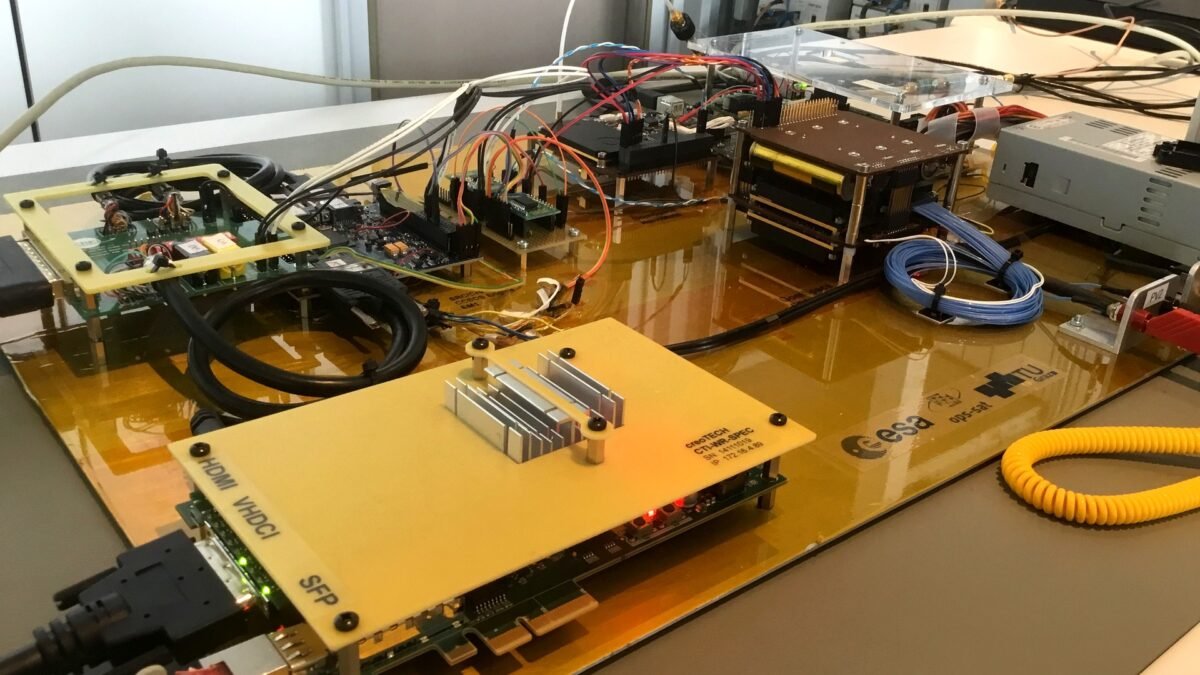
An amateur radio operator standing on a rooftop in Oslo spoke three words into a microphone — and a satellite 568 kilometres overhead heard them, understood them and acted on them. The command was “PRETTY PLAY DOOM”. The satellite, the European Space Agency’s OPS-SAT PRETTY, launched the 1993 video game Doom and sent back a picture to prove it. According to the team behind the experiment, it was the first time a satellite in orbit has recognised and carried out a spoken command on its own, with no human in the loop between the words leaving the ground and the game starting in space.
The experiment took place on 27 July 2026, but the results were only made public this week, when the research team published a full account of the test and the space press picked it up. SpaceNews reported the story on 4 November, and Gizmodo followed on 5 November, describing the test as “what appears to be the first time a spoken instruction has been successfully sent to and executed by a satellite”. The account published by Tanagra Space, the company whose software made the test possible, is more emphatic still: “It had never been done before.”
For more than six decades, talking to a satellite has meant something very different from talking to a person. Operators build commands as structured digital packets, encode them, and beam them up through a ground station during a scheduled pass. The spacecraft receives the packet, decodes it and obeys. The Oslo experiment skipped every step of that ritual. A human being simply spoke, and the machine in orbit did the rest.
That is the headline. The more interesting story is what had to be true for it to work at all: a small satellite with a software-defined radio, a speech-recognition model small enough to run on a spacecraft’s limited computer, and a group of volunteer radio amateurs willing to treat a passing CubeSat as a conversation partner. The result was a stunt with a punchline — a demon-shooting game from 1993 running in orbit — and a demonstration with consequences that reach well beyond gaming.
How the command travelled from a rooftop to orbit
The chain began on the ground in Oslo, where the Oslo Group of the Norwegian Radio Relay League, Norway’s amateur radio association, transmitted from a rooftop under the club call sign LA4O. The operator spoke into a microphone: “LIMA ALFA FOUR OSCAR, PRETTY PLAY DOOM DOOM DOOM, PRETTY PLAY DOOM DOOM DOOM.” The call sign came first, as amateur radio rules require for legal identification, then the command, spoken twice, with the word “DOOM” repeated three times in each round.
The transmission went out on the 23-centimetre amateur radio band, an ordinary slice of radio spectrum that amateurs share with other users, and travelled upward to a spacecraft moving at roughly 7.6 kilometres per second. OPS-SAT PRETTY’s software-defined radio recorded the signal as the satellite flew over the ground station. Then the onboard software went to work in a sequence that Tanagra Space, whose founder Georges Labrèche led the experiment as principal investigator, describes in six steps: listen, narrow in, transcribe, recognise, play, celebrate.
First, the software radio captured the incoming signal. Then it found the voice buried in the radio noise and tuned in to just that sliver of the spectrum. An onboard speech-to-text artificial intelligence model turned the recovered audio into words. A matcher checked those words against the command, tolerating the mangling that a noisy radio link produces. On a match, the satellite launched Doom, rendered a “postcard” — a gameplay frame stamped with the onboard transcription and signal diagnostics — and downlinked it to Earth as proof.
The transcription itself was rough. The speech model is small enough to fit the satellite’s limited onboard computer, and the radio link was noisy, so the words the satellite heard were garbled. But the repeated trigger word got through, and that was enough. The satellite did not need to understand the sentence. It needed to recognise the command, and it did.
The whole sequence ran on open-source tools, according to Tanagra Space: GNU Radio for the signal processing and Sherpa-ONNX for the speech recognition, both of which also run on ordinary home computers. That detail matters, because it means the experiment was not the product of a billion-dollar ground station or a classified payload. It was assembled from tools anyone can download, flown on a satellite built to be experimented with, and operated by volunteers.
Two passes, one proof
The team tested the system twice on the same day, and the two runs were deliberately different. During a morning pass over Oslo, the team transmitted a synthesised voice message on a continuous loop from a keyer. The satellite detected the command and launched Doom. That evening, the team went further: an operator spoke the command live into a microphone, with no keyer and no recording. The satellite detected that too — the first detection of a live human voice from orbit, according to Tanagra Space.
The distinction between the two runs is important. A synthesised voice played on a loop is a controlled, repeatable signal. A live human voice, spoken once, through a handheld microphone, into a radio, up through the atmosphere, into a receiver moving at orbital speed, is a messy, one-shot event. That the second run worked as well as the first is what turns the experiment from a laboratory curiosity into a proof that the idea survives contact with reality.
The experiment did not begin in July. Radio amateurs in Legnica, Poland, ran the earlier link tests from April to June 2026 under the call signs SQ6RDP and SQ6QV, establishing that the satellite could hear the ground at all. The passes themselves were scheduled and operated by the OPS-SAT mission operations team, and the experiment flew with the support of the Graz University of Technology. The full flight record, source code and per-pass analysis have been published openly, so anyone can inspect exactly what the satellite heard and what it did.
That openness is part of the point. The project is not a secret military test or a proprietary product launch. It is a public demonstration, documented in the open, with the raw audio the satellite recovered from the noise floor published alongside the account. You can listen to the command as the satellite heard it: a human voice, drowned in static, and still recognisable.
The satellite that listened
OPS-SAT PRETTY is a 3U CubeSat — a box roughly 30 centimetres long, 10 centimetres wide and 10 centimetres tall, about the size of a shoebox — operated by the European Space Agency. Its full name spells out its job: Passive REflecTometry and dosimeTrY. Its primary payload is a passive reflectometer that listens for navigation signals from Galileo and GPS satellites after they have bounced off the Earth’s surface, and uses those reflections to measure sea state, sea ice and ocean currents. Its secondary payload is a radiation monitor. It was launched on 9 October 2023 aboard a Vega rocket, flight VV-23, from French Guiana, and it circles the Earth in a sun-synchronous orbit at an altitude of about 568 kilometres.
PRETTY was built by Beyond Gravity Austria, the Graz University of Technology and Seibersdorf Laboratories, and its science is coordinated by a consortium led by the Norwegian University of Science and Technology, with the German Research Centre for Geosciences, the German Aerospace Center and researchers at the Institute of Space Sciences in Barcelona. The mission’s original purpose was to demonstrate that a cheap, small satellite could measure the height of the sea and the ice to an accuracy of at least 50 centimetres from 550 kilometres up, using nothing more than reflected navigation signals. It was, in other words, already an experiment in doing more with less.
In November 2025, maintenance of the satellite was transferred to the OPS-SAT Space Lab and the Graz University of Technology, and the spacecraft was renamed from PRETTY to OPS-SAT PRETTY. The rename matters because it placed the satellite under the umbrella of ESA’s OPS-SAT programme, which exists precisely to let experimenters try new software in orbit. PRETTY’s new role is not to do one job well, but to be a platform on which other people’s ideas can be tested. The voice-command experiment is the clearest example yet of what that means.
The satellite’s own history makes the result slightly less surprising than it first appears. According to Wikipedia’s account of the mission, the July experiment was “a continuation of similar code for Doom that had been deployed to the OPS-SAT-1 CubeSat”. The game had already been running on ESA’s experimental satellite family. What was new on 27 July was not the game, but the way it was started: by a voice, from the ground, with nobody typing anything.
A flying laboratory with a long history
OPS-SAT itself, the programme that now operates PRETTY, was ESA’s first CubeSat, launched on 18 December 2019 aboard a Soyuz rocket from Kourou in French Guiana, alongside the CHEOPS exoplanet telescope. The Graz University of Technology described it at the time as “the world’s first flying laboratory”: a satellite designed explicitly for experimentation, carrying a computer ten times more powerful than any other on an ESA spacecraft, a high-resolution camera, radio equipment and a programmable receiver, and built so that entire software programs could be uploaded and modified during flight.
That was a deliberate break with how space agencies had always worked. Traditionally, as ESA itself put it in 2017, “it has been very difficult to perform live, in-flight testing of newly developed software for satellites. No one wants to take any risk with an existing, valuable satellite, so there are only limited opportunities to test new procedures, techniques or systems in orbit.” OPS-SAT was the answer: a small, low-cost and extremely robust platform on which industry, research laboratories, academia and even individual developers could test their software in orbit, at low risk, because the satellite existed for that purpose.
More than 130 experiments from 12 countries were planned for the original OPS-SAT, ranging from onboard image recognition using neural networks to detect forest fires, to controlling rovers remotely, to testing a completely automated space mission using artificial intelligence, to measuring interference in communications with other spacecraft. The voice-command test belongs squarely in that tradition: it is the kind of experiment that would never be risked on a billion-euro operational satellite, and exactly the kind a flying laboratory exists to host.
The programme’s philosophy also explains why the experiment involved radio amateurs at all. When OPS-SAT launched in December 2019, ESA publicly challenged amateurs to be the first to catch a signal from the brand-new satellite, inviting the worldwide amateur community to listen for it as it passed overhead. The relationship between space agencies and radio amateurs is older than the space age itself: amateurs have tracked satellites, relayed signals and built ground stations since the first Sputnik beeps in 1957. The Oslo experiment is the latest chapter in that partnership, and the most literal one — the amateurs did not just listen to the satellite. They spoke to it, and it answered.
Why Doom?
The choice of Doom was not an accident, and it was not really about the game. Doom, released by id Software on 10 December 1993 for MS-DOS, is one of the most consequential video games ever made. Designed by John Romero, Tom Hall and Sandy Petersen, and programmed by John Carmack, John Romero and Dave Taylor, it put the player in the boots of a space marine fighting demons through a Martian base, and it defined the first-person shooter genre, pioneered networked multiplayer deathmatch, and built a modding community that is still active more than three decades later.
But Doom‘s second life is the relevant one here. In 1997, id Software released the game’s source code, and in 1999 it was freely released under the GNU General Public Licence. The code was small, clean and portable, and the community took it everywhere. Doom has since been ported, officially and unofficially, to almost every device with a screen — and to many without one. It has run on calculators, digital cameras, pianos, smart thermostats, printers, pregnancy tests and the Nintendo Alarmo clock. The joke became a meme, and the meme became a benchmark: “Can it run Doom?” is now the internet’s shorthand for asking whether a piece of hardware can run anything at all.
That is why Doom was the right payload for this experiment. Running it proves nothing about gaming. It proves that a general-purpose program, with graphics, sound and real-time input handling, can execute on the satellite’s computer under the control of a voice command. It is a visible, verifiable, unmistakable result: the postcard the satellite sent back shows the game running. A silent computation would have proved the same thing to an engineer, but a screenshot of Doom proves it to everyone.
There is also a neat symmetry in the choice. Doom is a game about a lone marine on Mars, fighting alone in a hostile environment, with only the tools he carries. A satellite is a lone machine in a hostile environment, with only the tools it carries. The marine’s story is fiction. The satellite’s is not, and on 27 July the satellite did something the marine never could: it listened.
Analysis: Why It Matters
1. The command chain is the real breakthrough, not the game
It is easy to treat this story as a joke — a satellite playing a video game — and to miss what actually happened. Nobody typed a command. Nobody clicked a button. Nobody uploaded a packet. A human voice crossed 568 kilometres of space, was pulled out of radio noise by a software-defined radio, was converted into text by a model small enough to run on a CubeSat’s computer, was matched against a trigger phrase, and produced an action. Every link in that chain worked, in orbit, on the first attempt that mattered, and then again on the second. The game is the proof. The chain is the product.
That chain is significant because it collapses the distance between a human intention and a spacecraft’s behaviour. Today, commanding a satellite is a specialist skill, mediated by software, schedules and ground stations. The Oslo experiment suggests a future in which it is closer to speaking: slower, noisier and less precise than a digital command, but far more direct, and available to anyone with a radio. That is not a replacement for telecommanding, and the researchers do not claim it is. It is a new option, and new options have a way of finding uses nobody planned.
2. Onboard intelligence is quietly becoming the story of this decade in space
The voice-command test arrives in a year when satellites have started thinking for themselves in public. Just last week, Google announced that its Project Suncatcher prototype satellite had sent back its first AI response from orbit — a haiku about being in space, written by an onboard model and downlinked as the satellite passed over Svalbard in Norway. The two stories are cousins: both put machine-learning models on small spacecraft, both produced a whimsical first output, and both are really about the same underlying shift.
For most of the space age, satellites were remote sensors and dumb pipes: they collected data and sent it home, and the thinking happened on the ground. That model is breaking down, because the data is growing faster than the downlinks. A modern Earth-observation satellite can generate more imagery in a day than it can transmit in a week. The only way forward is to decide in orbit what matters, and to send down the answer rather than the raw material. A satellite that can recognise a voice is a satellite that can recognise anything — a distress call, a wildfire, a solar flare, a gamma-ray burst — and act on it before the ground ever knows it happened.
3. The distress-call idea is the one to take seriously
Georges Labrèche, the principal investigator, told SpaceNews that the most promising application is also the most human one. “Maybe there is an application there in terms of capturing [distress calls] on a global scale and acting on them immediately, instead of waiting until a Coast Guard or another ship,” he said. His vision, as he put it to SpaceNews, is a service in which “you can point to the air, call out for mayday and then a network of satellites is able to relay that immediately.”
That matters because the places where people most often need rescue are the places where the existing infrastructure is thinnest: the open ocean, the polar regions, the deserts, the mountains. A ship in distress today depends on radios, beacons and satellite phones — all of which require the person in trouble to have the right equipment, working, and to know how to use it. A satellite that can simply listen for a voice changes the threshold. It does not replace the rescue chain, but it could shorten it, and in rescue work, minutes are the currency that matters.
It is worth being clear about how far away this is. The demonstration used a constrained vocabulary — the satellite was listening for one phrase, not holding a conversation — and the researchers themselves stress that authentication, replay-attack prevention and false-command filtering would each need rigorous validation before any real deployment. A satellite that obeys voices is also a satellite that could be tricked by a recording, or confused by a similar-sounding phrase. The team has proved the idea can work. Turning it into a service is a different, longer job.
4. The same technology points at the sky, not just the ground
Labrèche offered a second application, and it is the more elegant one. “When you do astronomical observations, like observing gamma-ray bursts or black holes colliding, you’re looking for signals with very specific patterns,” he told SpaceNews. “So maybe there is a near future where instead of training a model to recognize a human voice, we train a model to recognize these astronomical events directly on board the satellite, so we can detect them more immediately.”
The logic is the same as for the voice: the pattern is known, the signal is noisy, and speed matters. A gamma-ray burst fades in seconds. A satellite that waits for the ground to tell it what to look at will miss the beginning. A satellite that recognises the event itself can swing its instruments around, record the data and alert other observatories while the burst is still happening. The voice experiment is a demonstration that a small model, running on a small computer, in a harsh environment, can pick a known pattern out of noise and act on it. The pattern does not have to be a word. It could be anything.
5. The amateur radio community is doing real space work, and it should be recognised as such
The most quietly remarkable part of this story is who did it. The ground segment was not a space agency. It was two volunteer radio amateur teams — the Oslo Group of the Norwegian Radio Relay League, transmitting from a rooftop, and amateurs in Legnica, Poland, who ran the link tests — working with open-source software and ordinary radio equipment. The experiment’s principal investigator is the founder of a small company, not a government programme manager. The satellite is a CubeSat built by a university consortium.
That is a genuine shift in who gets to do space. For the first half-century of the space age, orbit belonged to governments and, later, to billionaires. The CubeSat revolution changed the hardware; the open-source revolution is now changing the software; and experiments like this one change the question of who is allowed to try. A rooftop in Oslo is now a ground station. A microphone is now a command interface. The barrier to entry for doing something genuinely new in space has never been lower, and the people walking through it are not the people anyone expected.
What to Watch Next
- Whether the “first” claim holds up to scrutiny. Tanagra Space describes the test as the first time a satellite has been commanded by voice and acted autonomously in orbit. GadgetReview, in its careful account of the experiment, notes that establishing a clean historical record across all satellite experiments is difficult, and that the claim should be understood as Tanagra Space’s assessment rather than an independently verified universal record. Watch for other researchers, historians or agencies to confirm — or challenge — the claim in the coming weeks.
- What the team tries next on OPS-SAT PRETTY. The full flight record, source code and per-pass analysis are public, and the experiment was designed as a beginning rather than an end. The obvious next steps are a larger vocabulary, a second command, or a test of the distress-call concept itself. The OPS-SAT Space Lab and the Graz University of Technology now operate the satellite, and its experimental mandate invites exactly that kind of follow-up.
- Whether anyone builds the mayday service. Labrèche’s distress-call vision needs more than a demonstration: it needs a satellite network, a validated authentication scheme, and a partnership with the maritime and rescue authorities who would act on the alerts. Watch for ESA, or a commercial operator, to pick up the idea — or for it to remain, like many good space ideas, a demonstration waiting for a customer.
- The onboard-AI race in orbit. The voice-command test and Google’s Suncatcher haiku arrived within days of each other, and both point in the same direction: intelligence moving from the ground into orbit. Watch for announcements from satellite operators and space agencies about onboard processing in the coming months, and for the first operational mission — rather than a demonstration — to carry a machine-learning model as a core part of its payload.
- Security and the rules of the road. A satellite that listens is a satellite that can be spoken to by anyone with a transmitter. The researchers are candid that authentication, replay protection and false-command filtering are unsolved for this approach. Watch for the amateur radio community, ESA and regulators to start writing the rules: who is allowed to talk to a satellite, how a satellite knows who is speaking, and what happens when the wrong voice gives the right command.
Sources
- Tanagra Space — “PRETTY DOOMed: The First Voice Command of a Satellite” (primary account of the experiment, with full flight record)
- Gizmodo — “An Amateur Radio Operator Told a Satellite to Play ‘Doom.’ And It Listened” (5 November 2026)
- SpaceNews — “Satellite on orbit responded to voice command in experimental first” (4 November 2026)
- GadgetReview — “Someone Told a Satellite to Play Doom. It Obeyed.” (5 November 2026)
- Wikipedia — “PRETTY (satellite)”: mission facts, launch and orbital parameters
- European Space Agency — OPS-SAT programme and PRETTY mission background

About the Author — Abdul Mannan
Related Articles
NASA Unveils X-70 Fractal, a Crewed Test Jet Built to Fly Manoeuvres No Pilot Has Flown Before
NASA has unveiled the crewed X-70 Fractal experimental aircraft, a rapidly reconfigurable flight-research platform due to fly under…

Yonsei University Brings IBM’s Nighthawk Quantum Processor Online in a World First Outside IBM
Yonsei University has switched on IBM's Nighthawk quantum processor — the first deployment of the chip outside IBM…
Google Dismantles Botnet Hidden in 1.3 Million Android TV Boxes After Maker Accused of Baking In the Backdoor
Google says Shenzhen-based Videostrong built a backdoor into the firmware of more than 1.3 million Android TV boxes…