
NASA Unveils X-70 Fractal, a Crewed Test Jet Built to Fly Manoeuvres No Pilot Has Flown Before

NASA has unveiled a new crewed experimental aircraft, the X-70 Fractal, a high-performance research jet designed to test flight-control ideas that, according to the agency, have never before been demonstrated in crewed flight. The announcement was made on Wednesday at the UP.Summit at NASA’s Kennedy Space Center in Florida, and NASA said it expects the aircraft’s first flight under its own banner within the next two years.
The X-70 is not a passenger aircraft, a fighter or a record-breaking speed machine, at least not as NASA has described it so far. It is a flying laboratory: a relatively small, adaptable platform whose main job is to let engineers try out new ways of controlling an aircraft in the air, swap experiments in and out quickly, and learn from real flight rather than from computer models and wind tunnels alone. In NASA’s own framing, that speed of learning is the point. The agency said the aircraft’s modular design and its ability to rapidly swap internal and external payloads will keep its teams flying, learning and moving quickly from one experiment to the next.
According to NASA, the crewed X-70 features advanced, rapidly reconfigurable flight-control technology that will allow it to explore aircraft manoeuvrability in ways never before demonstrated in crewed flight. It can also carry up to 2,000 pounds of experimental payloads in internal and external locations, opening up a wide range of research and flight-testing opportunities. NASA Administrator Jared Isaacman said the X-70 gives NASA a crewed, high-performance platform to test advanced flight-control, manoeuvrability and other cutting-edge technologies in real flight, and described the aircraft as just one part of what he called a new beginning for aeronautics.
The headline numbers released with the announcement are modest by the standards of headline-grabbing aviation records, and that modesty is itself informative. According to NASA, the X-70 Fractal has a takeoff weight of 10,000 pounds and is designed to cruise at Mach 0.75, reach altitudes of up to 45,000 feet, and provide an operational range exceeding about 1,726 miles, or 1,500 nautical miles. Those figures place it firmly in the world of practical, repeatable flight research: fast enough and high enough to test demanding ideas across a broad range of operating conditions, but not built around chasing a single extreme of speed or altitude. Its value, on NASA’s account, lies in how quickly and how often it can fly, and in how easily its flight controls and payloads can be changed between sorties.
What NASA announced, and what it did not
NASA’s announcement was short, and its brevity matters. The agency confirmed the aircraft’s name, its crewed status, its reconfigurable flight controls, its payload capacity and its broad performance envelope, and it set a two-year window for a first flight under the NASA banner. It did not name the manufacturer, publish a detailed design, give a cost, or say where the aircraft will be based for testing. The War Zone, the specialist defence and aviation outlet that first covered the unveiling in detail, noted that it is unclear who is building or has built Fractal, and raised two possibilities: that NASA will take delivery from a manufacturer, or that an existing asset is being moved into NASA’s hands from elsewhere. Neither possibility has been confirmed by NASA, and this article does not treat either as established fact.
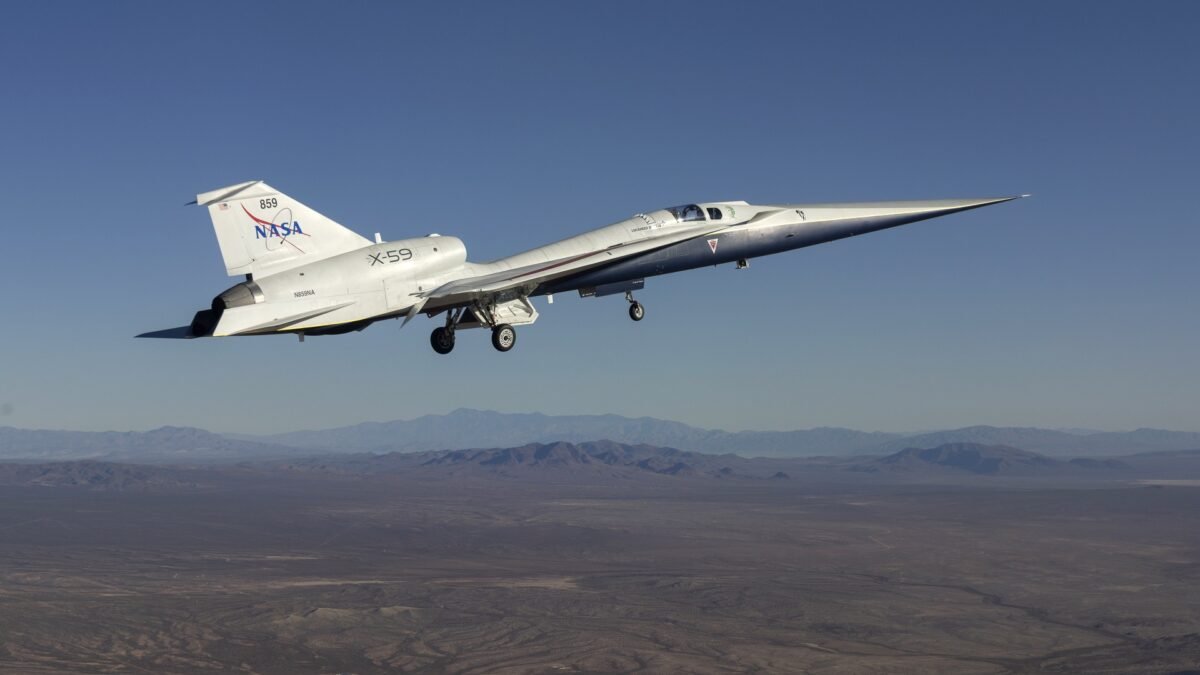
One other detail deserves plain handling, because it affects how readers should view any picture of the aircraft circulating online. The image NASA supplied with the announcement was described by The War Zone as generated content: a concept impression, much of it cloaked in cloud, showing an aircraft with splayed tails, a bubble canopy and fighter-like wings. It is not a photograph of the X-70 in flight, and it should not be presented as one. That is why the featured photograph with this article is something else entirely, and is labelled as such: NASA’s X-59 quiet supersonic research aircraft lifting off on its first flight on 28 October 2025. The X-59 is the closest real aircraft in the same programme lineage, and the photograph shows what a modern NASA X-plane actually looks like in the air, rather than an illustration of one that has not yet flown under NASA’s banner.
Laurie Grindle, director of the Aeronautics Division within NASA’s Research and Technology Mission Directorate, said that for decades NASA Aeronautics has used X-planes to develop technologies that advance aviation, and that it is exciting to bring on another X-plane to accelerate and drive aeronautics research. That sentence captures the institutional logic of the programme: X-planes are not ends in themselves. They are tools for answering questions that cannot be answered on the ground, and their successes are usually measured years later, in the safer, quieter, more efficient aircraft that ordinary passengers eventually fly in.
Why flight controls are the frontier here
To a casual reader, flight controls may sound like a narrow, technical corner of aviation. In practice, they are the interface between everything an aircraft is supposed to do and everything it actually does. A flight-control system translates a pilot’s intentions, or an autopilot’s commands, into movements of control surfaces, engine thrust and, increasingly, software-driven adjustments that happen faster than any human could manage. When that system can be reconfigured rapidly, engineers can test a new idea on Monday, fly it on Tuesday, change it on Wednesday and fly the revised version on Thursday, rather than waiting months for a new airframe or a major modification.
That is the capability NASA is emphasising with the X-70. A rapidly reconfigurable system means the aircraft is not locked to one handling character. It can be made to behave, within safe limits, like different kinds of aircraft, or to test control laws that would be too risky or too expensive to try first on a production jet. The War Zone noted that such a platform could help move forward bleeding-edge concepts, including morphing wings and air-bursted flight controls that would allow aircraft to manoeuvre without traditional moving surfaces, as well as lift-fan and thrust-vectoring capabilities. Those examples are possibilities raised by specialist coverage, not promises in NASA’s announcement, and they should be read as a sketch of the territory the X-70 could explore, not as a list of systems it is confirmed to carry.
The distinction matters because flight-control research has a habit of looking unspectacular while changing aviation profoundly. Fly-by-wire, which replaced direct mechanical links between pilot and control surfaces with electronic signals, once sounded like an abstraction. It is now the basis of almost every modern airliner and fighter. Relaxed static stability, which lets a computer keep an otherwise unstable aircraft flying in exchange for greater agility and efficiency, was once a research curiosity. It is now routine. If the X-70’s contribution turns out to be a control approach that makes future aircraft safer in turbulence, more efficient in cruise, or more forgiving when something goes wrong, it will have done its job even if it never sets a record or appears on a poster.
The payload capacity reinforces the same point. Two thousand pounds of internal and external payload space is not enormous, but it is flexible space: sensors, experimental avionics, new materials samples, or test equipment can be carried, removed and replaced without rebuilding the aircraft. For a research programme, that flexibility is often worth more than raw size. It means the X-70 can serve many different research teams over its life, rather than being tied to the single experiment it was built to carry, and it means a failed experiment does not strand an expensive airframe.
A lineage stretching back to the sound barrier
NASA placed the X-70 explicitly in a lineage that begins with the Bell X-1, the rocket-powered aircraft that first broke the sound barrier in level flight in 1947 with Chuck Yeager at the controls, and runs through the X-15 hypersonic research aircraft to today’s X-59 quiet supersonic demonstrator. That lineage is not decoration. It is a claim about method. The X-1 established the idea of an aircraft built solely for experimental purposes. The X-15, operated jointly by NASA, the United States Air Force and the United States Navy, pushed research far beyond the speed of sound, reaching Mach 6.7 in 1967 and an altitude of 354,200 feet in 1963, according to NASA’s historical records. The X-59, the current flagship of the programme, is built to answer a different question: whether a shaped airframe can reduce the sonic boom of supersonic flight to a quiet thump, potentially reopening the door to supersonic travel over land, which is currently banned in the United States because of the noise.
The X-59’s own recent history shows how slow and how consequential this kind of research can be. Developed by Lockheed Martin under NASA’s Quesst mission, the X-59 began flight testing in late October 2025, after years of design, integration and ground testing and after repeated delays from its original schedule. It achieved its first supersonic flight in June 2026 and subsequently reached its design condition of Mach 1.4 at approximately 55,000 feet, according to specialist aviation reporting. The aircraft is now due to be displayed at the MAX POWER aerospace exposition at Kennedy Space Center this weekend, alongside the wider showcase of NASA’s aeronautics work. The X-70, by contrast, is at the beginning of that long road: announced, described in broad terms, and still up to two years from its first flight under NASA’s banner.
Between those two bookends sit other, less famous members of the family that help explain what the X-70 is for. The F-16 VISTA, now designated the X-62A, is a modified two-seat F-16D that serves as an active testbed for flight-control and autonomy research. The X-57 Maxwell, NASA’s first piloted X-plane in two decades when it was developed, explored the very different challenges of electric propulsion. The unmanned X-43A demonstrated air-breathing scramjet propulsion at approximately Mach 9.6 in 2004. Each of these aircraft answered a specific question. None of them was designed to do everything. The X-70’s question, as NASA has framed it, is about control itself: how much can be changed, how quickly, and how safely, in a crewed aircraft flying real missions.
Isaacman, MAX POWER and the SR-71 that is not the story
The unveiling did not happen in a vacuum. It arrived in the middle of a deliberate push by NASA Administrator Jared Isaacman to rebuild the agency’s experimental flight portfolio, a pledge he has made repeatedly, including during a town hall with NASA staff on just his second day in the job in December 2025, according to The War Zone. Isaacman, a billionaire entrepreneur, pilot and commercial astronaut who was confirmed as NASA’s 15th administrator in December 2025, has described building more X-planes among his priorities, and NASA’s budget proposals and its previously announced Aeronautics Flight Accelerator initiative have reflected that push. The agency has told specialist outlets that it wants to see more X-planes flying in the years ahead, developing technologies that will allow the United States to fly higher, farther and faster than it has in decades.
The timing of the announcement, at the UP.Summit at Kennedy Space Center and days before the MAX POWER aerospace exposition at the same site on 7 and 8 November, is part of that campaign. According to Florida Today, the two-day MAX POWER festival will showcase events at the Kennedy Space Center Visitor Complex, the UP.Summit technology showcase at Space Florida’s Launch and Landing Facility, and an air show at the northern end of the former shuttle strip, headlined by the United States Air Force Thunderbirds. Attractions are due to include a SpaceX Falcon 9 rocket, the upper stage of a Blue Origin New Glenn rocket, and NASA’s X-59. Isaacman himself is due to fly his privately owned MiG-29 in the show, alongside NASA’s F-15D Eagle, a Navy F/A-18 Super Hornet demonstration team, a C-17 Globemaster III and other aircraft.
Isaacman had teased the new aircraft in advance, telling NASASpaceflight’s The Flame Trench podcast that NASA would announce a new X-plane at MAX POWER, and adding, pointedly, that it is not the one you are thinking of. The remark was aimed at weeks of speculation surrounding an SR-71 Blackbird, tail number 844, that had been removed from public display at NASA’s Armstrong Flight Research Center. Asked directly whether the Blackbird might fly again, Isaacman joked that crews were merely cleaning it, saying it was dusty out there in the desert and felt like it needed a cleaning. Flying Magazine reported the same exchange, noting that Isaacman confirmed the new project is not the previously speculated SR-71-inspired aircraft. The clarification matters because it closes off the most romantic reading of the announcement — a secret return of a legendary spy plane — and replaces it with something less cinematic but more significant: a new, purpose-built research aircraft for a programme that had narrowed, for a time, to a single flagship.
There is a longer history behind the SR-71 speculation that is worth noting briefly. NASA flew two SR-71s in the 1990s from its Dryden Flight Research Center, now Armstrong, as testbeds for high-speed and high-altitude research, and earlier flew two YF-12A interceptors and an SR-71 operating as the YF-12C between 1969 and 1979 to investigate sustained flight above Mach 3. That history is why the idea of a Blackbird returning to flight captured imaginations. But NASA has given no indication that the X-70 is connected to that aircraft, and Isaacman’s own words point the other way. The X-70 is a new design for a new research question, not a resurrection.
What to watch in the next two years
The most important unanswered questions about the X-70 are also the most ordinary, and they will be answered in the unglamorous language of programme management rather than in unveiling ceremonies. Who is building the aircraft, and under what contract? Where will it be tested, and by which pilots? What is the first flight-control experiment it will actually fly, and what does success look like for that experiment? How much will the programme cost, and how many flight hours a year will NASA fund? None of those answers were in the announcement, and none should be invented to fill the gap. The two-year first-flight window is itself a test: experimental aircraft programmes have a long history of slipping, as the X-59’s own path from planned flight testing in 2021 to actual first flight in late 2025 demonstrates, and a window is not a date.
There is also a question about how the X-70 will fit alongside the X-59 rather than simply beside it. The X-59 is a single-purpose demonstrator with a long, pointed nose designed to shape a sonic boom. The X-70 is a general-purpose testbed designed to change its behaviour. If both fly in the same period, NASA will have, for the first time in years, a small fleet rather than a single flagship: one aircraft proving a specific aerodynamic idea, and another proving the control systems that future aircraft of many kinds might use. That combination, more than either aircraft alone, is what a revived X-plane portfolio would actually mean.
Finally, there is the question of who benefits. NASA’s aeronautics research has historically flowed, sometimes slowly and sometimes invisibly, into commercial aviation: quieter engines, more efficient wings, safer handling in bad weather, better air-traffic procedures. The X-70’s research, if it succeeds, will most likely follow the same path, appearing not as a new aircraft that passengers board, but as a control law, a handling quality or a safety margin inside aircraft they already fly. That is a harder story to tell than a speed record, and it is the reason X-planes are easy to overlook and hard to replace once they are gone.
Analysis: Why It Matters
1. NASA is rebuilding a capability, not just unveiling a jet
The most significant sentence in NASA’s announcement may not be about the X-70 at all. It is the implication that the X-70 is, in Isaacman’s words, just one part of a new beginning for aeronautics. For years, NASA’s piloted experimental flight programme effectively narrowed to the X-59, a superb aircraft with a single mission. A programme with one aircraft can prove one idea. A programme with several can sustain a research culture: test pilots, flight-test engineers, safety reviewers and data analysts who learn from one programme and carry that judgement into the next. The X-70 matters because it suggests NASA is trying to rebuild that culture, not merely to add a tail number. If the agency follows through with further X-planes, as Isaacman has promised, the X-70 will be remembered less for its own flights than for being the second aircraft in a portfolio that had almost become a collection of one.
2. Flight controls are where safety and efficiency now live
Aviation’s great leaps in speed and altitude largely happened in the twentieth century. Its great leaps in the twenty-first are happening in software, sensors and control. An aircraft that can be reconfigured rapidly lets engineers test ideas that would otherwise stay in simulation, where they are cheap but unproven, or wait for a production programme, where they are proven but ruinously expensive to change. That middle ground — real flight, real risk, manageable cost — is where most aviation progress now sits. It is also where the hardest safety questions live, because a control system that can change its own behaviour must be proven not to change it in the wrong way at the wrong moment. The X-70’s crewed status is part of that argument: a pilot on board is both a safety monitor and a judge of handling qualities that no sensor can fully capture. The programme’s success will be measured not in how exotic its control laws are, but in how convincingly it proves they are safe.
3. The honest limits of the announcement are a strength, not a weakness
It would have been easy for NASA to dress up the X-70 announcement with a dramatic photograph, a named manufacturer and a list of futuristic capabilities. It did almost the opposite: a short release, a generated concept image, a two-year window, and no builder named. That restraint is worth noting, because it leaves the programme room to be judged on what it actually does. The contrast with the speculation that preceded the announcement is instructive. Weeks of SR-71 rumour produced excitement but no aircraft. A short, factual announcement produced an aircraft programme, even if many details remain unknown. Readers should hold NASA to the same standard in reverse: celebrate the announcement, but treat the missing details — builder, cost, first experiment, test base — as open questions to be answered with evidence, not filled with guesswork.
4. The X-59 comparison shows what patience buys
The X-59 is the cautionary tale and the encouragement in one airframe. It took years longer than planned to reach first flight, and its full payoff — community overflight data that could persuade regulators to allow quiet supersonic flight over land — is still years away. Yet it is now flying, it has passed Mach 1.4 at its design altitude, and it is the centrepiece of a mission that could change the rules of commercial aviation. The X-70 will face the same long arc. Its first flight, if it comes within two years, will be a beginning, not a verdict. Its verdict will come in the experiments it flies, the papers its data supports, and the control ideas that migrate, years later, into aircraft that carry passengers. Judging it now as a success or a disappointment would be premature in both directions.
5. This is also a statement about American aviation leadership
NASA framed the X-70 as part of a legacy that helped establish American leadership in aviation, from the X-1 onwards. That framing is not merely patriotic decoration. Experimental flight has always been a form of industrial policy by other means: the country that can afford to fly risky ideas, learn from them in public, and publish the results shapes the standards and the supply chains that others follow. China and Europe are investing heavily in their own flight-test and aeronautics programmes, and the gap between announcing an aircraft and flying one is where leadership is actually won or lost. The X-70 announcement, on its own, does not close any gap. But a sustained programme of X-planes, flown regularly and reported openly, would be a credible way of competing — not through a single spectacular aircraft, but through the steady accumulation of flight-proven knowledge that no competitor can copy from a press release.
What to Watch Next
- NASA’s MAX POWER exposition at Kennedy Space Center on 7 and 8 November, where the X-59 will be on display and where further details of the X-70 programme may emerge.
- Any NASA announcement naming the X-70’s manufacturer, test base and first flight-test campaign, which will turn a two-year window into a verifiable programme.
- The first description of the X-70’s opening experiment: which flight-control idea it will test first, and what NASA will count as success.
- Progress on the X-59’s Quesst mission, whose community overflight data will show whether NASA’s current flagship can deliver the regulatory case for quiet supersonic flight.
- Whether Isaacman’s promised expansion of the X-plane portfolio produces further announcements in the coming months, or whether the X-70 remains, for now, a portfolio of two.
Sources
- NASA — NASA Announces X-70 Experimental Aircraft to Advance Flight Research
- The War Zone — NASA Announces X-70 “Fractal” Experimental Aircraft
- Flying Magazine — NASA Plans New X-Plane, But It’s ‘Not the One You’re Thinking of’
- Florida Today — NASA’s Max Power expo to feature tech companies, Air Force Thunderbirds
- Air Data News — NASA wants to revive X-plane program for faster, higher experimental flights

About the Author — Abdul Mannan
Related Articles

Yonsei University Brings IBM’s Nighthawk Quantum Processor Online in a World First Outside IBM
Yonsei University has switched on IBM's Nighthawk quantum processor — the first deployment of the chip outside IBM…

Google Dismantles Botnet Hidden in 1.3 Million Android TV Boxes After Maker Accused of Baking In the Backdoor
Google says Shenzhen-based Videostrong built a backdoor into the firmware of more than 1.3 million Android TV boxes…
China Lays Out Four-Mission Plan to Land Astronauts on the Moon Before 2030 as New Space Race With US Takes Shape
China has published its most detailed schedule yet for landing astronauts on the Moon, with uncrewed test flights…