
KOSPI Crashes 8% and Trading Is Halted as AI Sell-Off Sweeps Asia, Dragging Nikkei Into a Bear Market

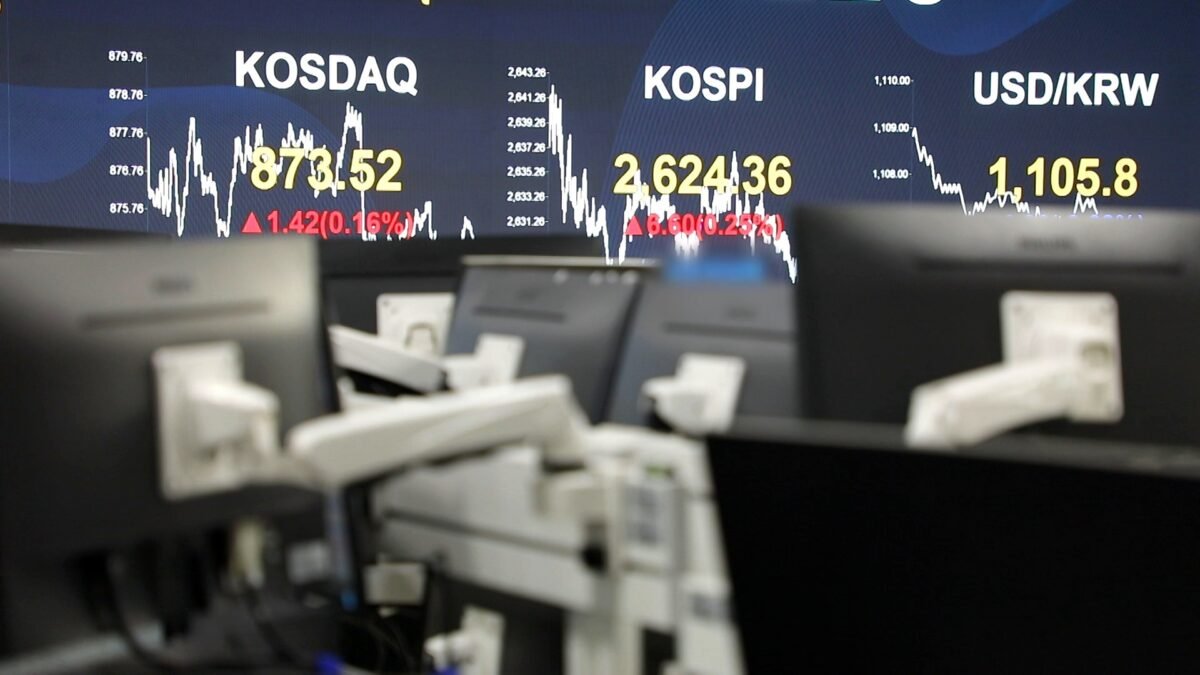
South Korea halted trading on its stock market on Friday after the KOSPI crashed more than 8 per cent in the opening minutes, as the sell-off in artificial intelligence stocks that tore through Wall Street spread across Asia and dragged Japan’s Nikkei into a bear market.
The Korea Exchange triggered a Level 1 circuit breaker at 9:03 a.m. local time, suspending all trading for 20 minutes after the benchmark index plunged 8.52 per cent from the previous session’s close, according to the exchange. The KOSPI fell as low as 4,911.28, down 8.78 per cent, and dropped below the 5,000 level for the first time in about nine months. It later recovered some of the losses but still closed 6.02 per cent lower at 5,059.65, taking its losses for the week to 12 per cent, according to Dow Jones Newswires.
Japan’s Nikkei 225 fell as low as 56,745.81 in early trading, a drop of more than 7 per cent, before closing at 57,434.77, down 3,643.13 points or 5.96 per cent, in its worst day since April 2025. The decline pushed the index more than 20 per cent below its June peak, placing it officially in bear-market territory, according to market reports. The broader TOPIX index fell nearly 6 per cent, and the Nikkei’s volatility index jumped 32.21 per cent to 44.37.
In Taiwan, the TAIEX suffered the largest intraday point drop in its history, plunging 3,737.67 points to a low of 37,837.05 shortly after trading began. The index recovered part of the loss but still closed 1,873.08 points, or 4.51 per cent, lower at 39,701.64, its biggest daily percentage loss since July, according to Taiwan’s Central News Agency. Taiwan Semiconductor Manufacturing Company, the world’s biggest contract chipmaker, hit its daily down-limit of NT$2,020 shortly after the open, down NT$220, wiping about NT$5.7 trillion from the company’s market value. TSMC accounts for more than 40 per cent of the Taiwan market’s total value.
The rout followed the steepest wipeout on Wall Street since the tariff-triggered “Liberation Day” sell-off in April 2025. On Thursday, the Nasdaq Composite sank 5.52 per cent to 24,315, the S&P 500 fell 4.36 per cent to 7,354, and the Dow Jones Industrial Average lost 1,833.06 points, or 3.44 per cent, to 51,523.06. The Philadelphia Semiconductor Index plunged 12.25 per cent. Reuters reported that the Nasdaq alone lost $2.5 trillion in market value in a single session, and the index is now more than 10 per cent below its record close of 27,599.89 on 6 October, confirming a correction.
One tally put the paper losses across Asian markets above $1 trillion in a single day, with Japan’s Nikkei alone accounting for roughly $450 billion of the destruction, according to a market report published on Friday.
Seoul pulls the emergency brake
The speed of the fall in Seoul forced the authorities into action within minutes of the opening bell. The Korea Exchange activates a Level 1 circuit breaker when the index falls more than 8 per cent from the previous day’s close and stays at that level for one minute. Trading in stocks and derivatives was suspended for 20 minutes, and a five-minute halt was also imposed on the smaller, technology-heavy Kosdaq market.
When the halt and a five-minute curb on programme selling failed to stop the slide, Seoul reached for an emergency measure. At a meeting chaired by Deputy Prime Minister and Finance Minister Lee Hyoung-il, with the heads of the Financial Services Commission, the Financial Supervisory Service and the Bank of Korea, the government agreed to exempt brokerages for three months from the rule that forces them to sell shares bought with borrowed money when prices fall. The measure takes effect on Monday.
The KOSPI recovered about a third of its losses after the late-morning announcement, with domestic institutions doing most of the buying while foreign investors kept heading for the exit, according to Aju Press. Outstanding margin loans in South Korea have already fallen 25.9 per cent from their peak of 38.63 trillion won on 24 June to 28.64 trillion won as of 4 November, according to the Korea Financial Investment Association, a sign that forced selling had already been eating into the market before Friday’s crash.
The selling was concentrated in the two memory-chip giants that dominate the Korean market. Samsung Electronics fell as much as 11 per cent in early trading, and SK Hynix plunged as much as 14 per cent, before both recovered part of their losses. The two companies together account for nearly half of the KOSPI’s total market capitalisation, and both are the world’s largest memory-chip makers and the main suppliers of high-bandwidth memory to Nvidia, the company at the centre of the AI boom. SK Hynix still ended the day more than 10 per cent lower, according to Dow Jones Newswires.
The authorities also moved to relax margin rules to ease forced selling, and the finance ministry’s intervention was the clearest sign yet that Seoul regards the sell-off as a threat to financial stability rather than a routine market correction.
Tokyo enters a bear market
Japan bore the second-heaviest blow. The Nikkei’s 5.96 per cent fall was its worst single day since April 2025, and it took the index below the psychologically important 60,000 level. The benchmark has now fallen more than 20 per cent from its June record high, the formal definition of a bear market.
Technology shares led the losses. SoftBank Group, the Japanese conglomerate that has become one of the world’s biggest investors in AI, shed more than 10 per cent on Friday, extending a fall of 6.8 per cent on Thursday. The cost of insuring SoftBank’s debt against default leapt to a four-year high during the Asian session, according to Reuters, and credits across the US technology sector are now in focus for signs of pressure or of markets cutting off access to debt funding.
Semiconductor equipment makers were among the biggest decliners. Advantest, Kioxia Holdings and Lasertec all fell sharply, with Kioxia plunging 14 per cent. The selling followed heavy losses in the same names on Thursday, when Advantest fell 15 per cent and Lasertec dropped 14 per cent.
European shares were set to open lower on Friday as well, with futures tied to the EURO STOXX 50 down 1 per cent and contracts tracking benchmarks in Germany and the United Kingdom down 0.8 per cent and 0.9 per cent respectively, according to Reuters. The STOXX 600 index was relatively less affected, given its smaller exposure to AI stocks, and was still up more than 1.3 per cent for the week, buoyed by healthcare and banking shares and better-than-feared earnings.
Taipei: TSMC hits its limit down
Taiwan’s session was the most violent of all in point terms. The TAIEX fell below 40,000 points and below its 240-day moving average of about 38,827 points within minutes of the 9 a.m. open, recording the largest intraday point drop in the market’s history, according to Taiwan’s Central News Agency.
TSMC, which makes the most advanced chips used in AI data centres, fell to its daily limit of NT$2,020 shortly after trading began. The stock recovered some ground later in the session but still ended the day 4.7 per cent lower, according to Dow Jones Newswires. Foxconn, formally Hon Hai Precision Industry, fell 9.4 per cent, and Foxconn Technology declined 9.1 per cent.
Reuters reported that Taiwan’s market was heading for its largest weekly loss since 1999. Analysts cited by Taiwan’s Central News Agency warned that the index could face a further wave of selling linked to margin calls in the coming sessions.
The damage spread beyond the three big markets. In China, the STAR Market and the ChiNext Artificial Intelligence Index each lost more than 4 per cent. In India, benchmark indices opened lower after a six-session winning run, although foreign institutional investors had bought stocks worth about 150 billion rupees, or $1.6 billion, on Thursday, their biggest single-day net purchase in nearly six years, according to Reuters. In Australia, the S&P/ASX 200 was down 0.85 per cent at midday.
How Wall Street’s rout became a global one
The trigger for the sell-off, according to Reuters, was concern that the Democrats’ sweep of both chambers of Congress in the midterm elections on Tuesday could put the brakes on data-centre development, though confidence in the sector had already been shaken by mounting concerns over whether the massive AI investments would generate sufficient returns.
Thursday’s session on Wall Street was the breaking point. The Nasdaq’s 5.52 per cent fall was its biggest drop in more than a year, and the Nasdaq 100 lost about 6.4 per cent. Chipmakers bore the brunt: SanDisk crashed more than 22 per cent, Micron Technology and Western Digital both fell more than 17 per cent, AMD dropped 12 to 15 per cent, Nvidia fell 7 per cent, erasing its gains for the year, and Qualcomm fell 9 to 11.5 per cent in its worst day since March 2020. Tesla shed 9.5 to 11 per cent, and CoreWeave fell 11 per cent. The CBOE Volatility Index, Wall Street’s fear gauge, jumped 50 per cent to its highest level in seven months.
Investors had already been questioning the economics of the AI build-out for weeks. Hyperscalers are expected to spend about $800 billion on AI infrastructure in 2026 and about $1.2 trillion in 2027, according to Goldman Sachs estimates cited in earlier reporting, much of it funded with debt. The fear is that the returns on that spending are arriving too slowly, while the costs — in energy, water and capital — keep rising.
The politics changed the calculation. Voters backed restrictions on data-centre projects, or rejected them outright, in 40 of the 41 local measures decided on Tuesday, according to Ballotpedia, and governors-elect in Ohio and Texas called for conditional freezes on new projects. The governor-elect of Texas campaigned on a temporary moratorium and an end to tax incentives for data centres. Meta’s president, Dina Powell McCormick, warned at a conference on Wednesday that the midterm results would make building data centres “harder” and that the industry had “not done as good a job as we needed to explain the benefits”.
Reuters also reported on Thursday that potential investors in Anthropic’s highly anticipated initial public offering were raising doubts about whether the AI start-up could proceed with its planned roadshow next week in time for a November listing, citing people familiar with the discussions.
The selling has also exposed the leverage built up behind the rally. Margin calls rippled across Asia on Friday, according to Reuters, as investors who had borrowed to buy shares were forced to sell into a falling market. Bond markets surged at the short end as investors headed for safety and reassessed whether central banks would really be in the mood to raise interest rates if the construction, spending and hiring around AI infrastructure were to slow down.
Safe havens and the jobs report
Gold eased on Friday as a rebound in oil prices fanned inflation worries, but bullion remained on track for a weekly gain of about 4 per cent. Spot gold fell 0.6 per cent to $4,063.39 per ounce, according to Reuters, while US gold futures for December delivery dropped 1 per cent to $4,072.90.
Oil prices rose more than 1 per cent on Friday but were set for a sharp weekly drop on expectations of a de-escalation in the Iran conflict after the US election result. Brent crude traded near $98 a barrel after jumping almost 4 per cent on Thursday, when tanker attacks in the Strait of Hormuz revived fears about shipping through the world’s most important oil chokepoint.
Bitcoin fell about 6 per cent to near $75,800 after the Nasdaq 100 sank 6.4 per cent on Thursday, and held just above $75,000 on Friday.
Attention now turns to the US labour market. The Bureau of Labor Statistics is due to publish the October jobs report at 8:30 a.m. Eastern time on Friday, with economists expecting employers to have added about 59,000 to 65,000 jobs and the unemployment rate to hold at 4.2 per cent, after just 29,000 jobs were added in September. Private payrolls provider ADP reported on Wednesday that private employers added 86,000 jobs in October.
Traders currently see about a 68 per cent chance that the Federal Reserve will raise interest rates in December, according to CME’s FedWatch tool cited by Reuters. The central bank raised rates in September and held them at 3.75 per cent to 4.00 per cent in late October, with two officials favouring a further increase. A strong jobs report would keep a December rise firmly in play; a weak one could force traders to reconsider whether the Fed will really tighten into a market sell-off.
US stock futures were mixed on Friday morning. Futures tied to the Dow Jones Industrial Average were about 1 per cent lower, S&P 500 futures were little changed, and Nasdaq 100 futures rose about 0.7 per cent, clawing back a fraction of Thursday’s heavy losses, according to market reports.
Analysis: Why It Matters
Friday’s trading halt in Seoul is the moment this stopped being an American stock-market story and became a global financial event. Circuit breakers are designed to be rare. When one of the world’s ten largest stock markets has to stop trading 20 minutes after the open, and when the government then reaches for emergency measures to suspend forced selling, the message is that the authorities believe the market itself is malfunctioning, not merely falling. That is a different kind of event from a bad day on Wall Street, and it is why this story matters far beyond the traders who lost money.
The AI trade was built on borrowed money
The most important fact in Friday’s story is not the size of the falls but the mechanism behind them. Margin calls rippled across Asia, according to Reuters, and Seoul’s emergency response was aimed squarely at forced selling: brokerages will be exempt for three months from the rule that makes them dump shares bought on credit when prices fall. Margin loans in South Korea had already shrunk by more than a quarter from their June peak, which means the deleveraging was under way before Friday. The AI rally of 2026 was not only a bet on future profits; it was a leveraged bet, funded by borrowed money in Seoul, Taipei and Tokyo as well as in New York. Leveraged rallies fall faster than unleveraged ones, because every drop forces more selling, which causes another drop. That feedback loop is what a circuit breaker is meant to interrupt, and it is why the Korean authorities acted within hours rather than days.
The politics of AI has changed the economics of AI
The trigger for this sell-off was political, and that is what makes it different from the ordinary corrections that punctuate every bull market. Voters in 40 of 41 local ballots on Tuesday backed restrictions on data centres or rejected the projects outright, and the governors-elect of two of the biggest data-centre states, Ohio and Texas, have called for freezes. The industry’s own leaders now concede the point: Meta’s president said this week that building data centres will get “harder” and that the industry had failed to explain its benefits. For three years, the AI trade rested on a simple assumption — that the spending would continue without serious opposition. That assumption is now broken. Every new data centre will face longer reviews, higher costs and a real risk of local rejection, and investors are repricing the entire build-out on that basis. The $800 billion of hyperscaler spending planned for this year was always a bet; it is now a bet with a political risk premium attached.
Asia is where the AI supply chain lives
The geography of Friday’s losses is the story in miniature. The United States designs the AI chips and builds the data centres, but Asia makes the hardware: TSMC fabricates the chips, Samsung and SK Hynix supply the memory, Foxconn assembles the servers, and Japanese companies make the equipment that makes the chips. When American investors doubt the AI build-out, the pain lands hardest on the suppliers, because their revenues are the most directly tied to the volume of hardware orders. TSMC hitting its daily limit down is the clearest possible signal: the world’s most important chipmaker, a company with an order book that stretches years into the future, fell as far as the rules allow in a single session. That tells us the market is no longer debating whether the AI boom is real; it is debating whether the boom is profitable, and whether the supply chain has built too much capacity for the demand that actually exists.
The bond market is telling a different story from the stock market
While equities crashed, bonds surged at the short end, and traders began to question whether central banks will really raise rates in December if the AI build-out slows. That is a remarkable shift in a single week: on Wednesday, the post-midterm rally was built on hopes that a Democratic Congress would end the Iran war and bring oil prices down; by Friday, the market was wondering whether the Fed could tighten into a rout. The Federal Reserve raised rates in September and held them in October, and the market still prices a December rise as the likelier outcome. But if the sell-off deepens, the Fed will face the same dilemma central banks always face in a leveraged sell-off: raising rates into falling markets risks turning a correction into a credit event. The SoftBank credit-default swap at a four-year high is the early warning light. It says that at least some investors are now worried not about share prices but about whether the debt behind the AI boom will be repaid.
This is a test of the new political order
Friday’s crash is also the first market test of the political order created by Tuesday’s midterm elections. The Democrats won both chambers of Congress on a platform that included scepticism about the AI build-out, and the market has now delivered its verdict on what that means for the sector that drove the rally. The test runs in both directions. If the sell-off continues, the new Congress will face pressure to reassure markets and protect the jobs and investment tied to data centres; if it does not, the AI companies will have to slow their spending, which would deepen the slowdown they fear. Either way, the relationship between Washington and Silicon Valley has changed. The era in which the technology sector could count on uncritical political support is over, and the market is repricing that change in real time.
What to Watch Next
- The October jobs report (Friday, 8:30 a.m. ET): Economists expect 59,000 to 65,000 jobs added and unemployment steady at 4.2 per cent. A number well above 100,000 would lock in a December rate rise and could restart the selling in technology shares; a number well below expectations would raise the opposite fear — that the economy is weakening just as the market is falling.
- The US market open (Friday, 9:30 a.m. ET): Nasdaq 100 futures were modestly higher in early trading, but the bounce was described as “sketchy” by Reuters. Whether Wall Street follows Asia down or stages a recovery will decide whether this becomes a two-day correction or a genuine bear market in technology.
- Seoul’s emergency measures (from Monday): The three-month exemption from forced margin sales takes effect on Monday. Watch whether foreign investors return to the KOSPI or keep selling, and whether the finance ministry has to extend the measures or add new ones.
- The Anthropic roadshow (next week): Reuters reported that investors are doubting whether the AI start-up can proceed with its planned roadshow in time for a November listing. If the year’s most anticipated AI offering is delayed, it will confirm that the funding window for AI companies is closing.
- Tuesday’s US inflation data: The consumer price index for October is due on Tuesday and is expected to show a monthly rise of 0.3 per cent, according to a Reuters poll. Hot inflation alongside a falling market would leave the Federal Reserve with no good options at its 8–9 December meeting.
Sources
- Reuters — “AI’s reality check” (global markets view, 6 November 2026)
- Reuters — “Analysts and investors react to AI market rout” (6 November 2026)
- Reuters — “European shares set to fall as global AI rout gathers pace” (6 November 2026)
- Dow Jones Newswires via Morningstar — “Asian Equities Tumble as AI Selloff Deepens” (6 November 2026)
- Aju Press — “Seoul buys time to halt KOSPI’s downward spiral” (6 November 2026)
- Taiwan’s Central News Agency (via EL7) — “Taiwan TAIEX Plunges 3,737.67 Points in Biggest Intraday Drop” (6 November 2026)

About the Author — Abdul Mannan
Related Articles
Remember, Remember the Fifth of November: The Day the AI Bubble Burst
On 5 November 2026 the Nasdaq fell 5.5% in a single day and $2.5 trillion vanished, as the…

Toyota Shares Jump 17% in Biggest One-Day Gain in Almost 40 Years as Carmaker Raises Outlook and Unveils $89 Billion Returns Plan
Toyota raised its full-year operating profit forecast to ¥3.9 trillion and unveiled an $89 billion shareholder returns plan,…
Nasdaq Plunges Into Correction as Chip Rout Wipes Out Post-Midterm Rally and Dow Drops More Than 1,000 Points
Wall Street's post-midterm rally lasted barely a day as the Nasdaq plunged into correction territory on Thursday, with…