
Remember, Remember the Fifth of November: The Day the AI Bubble Burst

What happens when the future stops believing in itself?
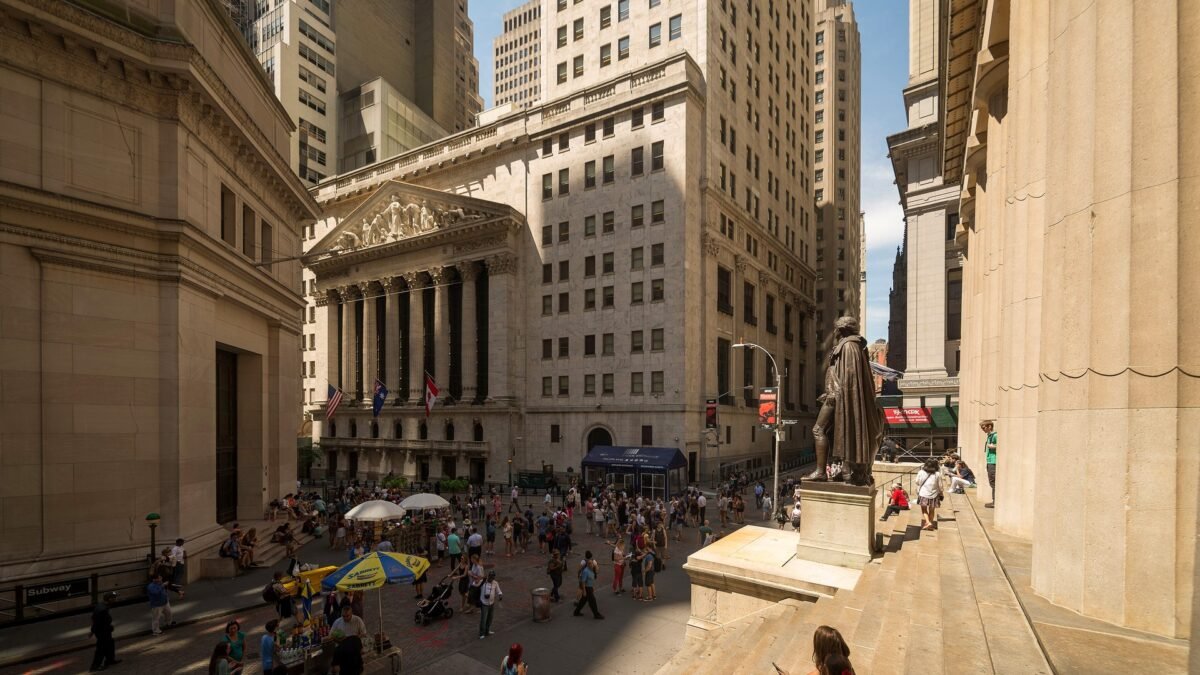
That is the question Wall Street was forced to ask on Thursday, the fifth of November 2026 — a date the English have long remembered for gunpowder and treason, and which the markets will now remember for something else entirely: the day the artificial intelligence bubble burst in full view of the world. The Nasdaq Composite, the temple of the technology age, fell 5.52 per cent in a single session to 24,315.00 — its worst day since April 2025 — and closed in what traders call a correction, nearly 12 per cent below the record it had set only a month earlier, on 6 October. Some two and a half trillion dollars of value vanished from the Nasdaq in one day. The companies of the S&P 500 shed around $2.9 trillion, the largest single-day destruction of wealth ever recorded on that measure. The Magnificent Seven alone — the seven giants upon whose shoulders the entire rally had rested — lost about $1.04 trillion between them before the closing bell.
I have watched markets long enough to know that numbers, by themselves, tell you nothing. It is the story behind the numbers that matters. And the story of the fifth of November is not a story about a bad earnings report or a disappointing forecast. It is a story about a promise that finally came due.
A Thursday Written in Red
Let me set down the facts plainly, because they deserve to be remembered exactly. The Philadelphia Semiconductor Index — the heartbeat of the chip industry — collapsed 12.25 per cent, its worst day in roughly six and a half years and the second-biggest fall on record. Nvidia, the company whose chips power the entire artificial intelligence revolution, fell 9.26 per cent to $181.60 and gave back every gain it had made all year. AMD fell 17.26 per cent. Micron, the memory-chip maker, fell 17.46 per cent. SanDisk plunged 22 per cent. Broadcom fell more than 10 per cent. Qualcomm fell 9.5 per cent on a weak forecast. Tesla fell 11 per cent. Even Meta, which had seemed untouchable, fell 3.4 per cent. The S&P 500 fell 4.4 per cent. The Dow Jones Industrial Average fell 1,833 points, or 3.44 per cent, to 51,523.06 — wiping out the entire post-election rally of the day before.
Only the day before, the markets had celebrated the election result — the Nasdaq up 1.4 per cent, the Dow up 3 per cent, London’s FTSE 100 enjoying its best day since May. It looked, for a few hours, like the beginning of a new chapter. Then Thursday came, and the chapter turned out to be an ending.
The Pick-and-Shovel Men
History does not repeat itself, the old saying goes — but it does rhyme. And on the fifth of November, history rhymed with a story I have always carried with me: the California Gold Rush of 1849.
When gold was discovered at Sutter’s Mill, thousands of men rushed west with picks and pans, dreaming of fortune. Almost none of them found gold. The men who grew rich were the ones who sold the picks and the shovels, the jeans and the tents — the suppliers of the rush, not the rushers themselves. Levi Strauss never dug a single mine. He sold trousers to the men who did.
The artificial intelligence boom was our generation’s gold rush, and the chipmakers were its pick-and-shovel men. For three years they could name their price, because everyone believed the gold was limitless. And then, on Thursday, the market looked at the shovel-sellers and asked a question nobody had dared to ask: what if the gold is not there?
Consider what had already happened before the fifth of November. Since its peak, Nvidia had lost a quarter of its value. Micron had lost 55 per cent. Intel, the former giant of the semiconductor world, had seen its share price fall by a factor of 2.6. The semiconductor index as a whole had lost a third of its value since its June peak. CoreWeave, the heavily indebted company that rents out AI computing power, had seen its market value shrink by more than two-thirds. Oracle, the empire of Larry Ellison, had been cut in half. Fermi, which had boasted of building the world’s largest data-centre park at Amarillo in Texas, was now valued at barely $1 billion, some eighteen times less than its peak.
This was not a sudden storm. It was a tide going out, and Thursday was simply the day everyone noticed the beach.
The Revolt of the Neighbours
But what, you will ask, lit the fuse? The answer lies not in a spreadsheet but in a ballot box — and in the anger of ordinary people who live next door to the future.
On Tuesday, 3 November, the American people voted in the midterm elections, and the Democrats swept both houses of Congress. That alone would have been enough to shake a market built on the assumption of unlimited, unquestioned support for the AI build-out. But something deeper happened in those elections. In Texas, in Ohio, in Georgia, in Michigan, the data centre itself became a campaign issue. These vast, humming warehouses of machines — devouring electricity, drinking water, humming through the night — had become the neighbours nobody wanted. Local referendums organised to slow the development of these infrastructures succeeded almost everywhere they were held, failing only in the frozen plains of North Dakota.
Read that again, and feel its weight. The people who live beside the machines voted against the machines.
Pat Grady, a partner at Sequoia Capital, told the Wall Street Journal that the election would “probably elongate the timelines for the data-center build-outs”. In other words: the door was closing, and those already inside were safe.
And then came the earnings. Intel, the fallen giant, reported results that signalled a slowdown in demand — proof that investors had begun to believe this highly cyclical business had somehow become immune to cycles, simply because the letters “AI” were attached to it. Qualcomm’s weak forecast deepened the fear, and the previous month’s results from Alphabet and Meta had failed to reassure anyone that the hundreds of billions being poured into data centres would ever come back as profit.
Borrowed Billions, Borrowed Time
Here, dear reader, is the heart of the matter — the question at the centre of every bubble in history, from the South Sea of 1720 to the dot-com mania of 2000. Who pays, and when?
The AI build-out was financed not by profits but by borrowing — staggering sums raised by companies that promised the future would pay for it. Data centres were built on debt. Valuations were justified not by what these companies earned, but by what they might earn someday. Anthropic, one of the leading AI laboratories, was preparing to go public at a valuation of $2 trillion before the number was quietly revised down to $1.5 trillion. Even that now looks like a fantasy: on the Kalshi prediction market, bettors now estimate a 60 per cent chance that Anthropic will not be able to go public in November at all.
And on election day itself, Sam Altman, the chief executive of OpenAI, warned on X against the notion that people should be relegated to doing things that “AI systems think make sense to reward in humans.” The man who built the machine was warning us about the machine — on the very day the voters were warning us too.
I think of the dot-com crash of 2000, when the Nasdaq lost nearly four-fifths of its value over two years, and of the railway mania of the 1840s. In every case the technology was real. But a real technology can still be wrapped in a false price. The bubble is never the invention. The bubble is the belief that the invention abolishes arithmetic — that costs do not matter, that debts do not come due, that trees grow to the sky.
What It Means for the Rest of Us
You may be reading this far from the trading floors of New York, and you may ask: what has this to do with me? Everything, I tell you. Everything.
When $2.5 trillion vanishes from one market in one day, it does not vanish from the accounts of billionaires alone. It vanishes from pension funds, from retirement savings, from the mutual funds that hold the savings of teachers and nurses and shopkeepers across the world. The same week, the Bank of England raised interest rates for the first time since the start of the Iran war, lifting its key rate to 4 per cent, and gold rallied to $4,061 an ounce, as it always does when the world grows afraid.
And yet — and this is the part the headlines miss — the same week produced a different story too. Toyota’s shares soared by almost 17 per cent on Thursday, their biggest jump in nearly four decades, after the world’s largest carmaker raised its annual profit outlook on strong American demand for hybrid vehicles. A company that makes things people actually buy, at prices people can actually pay, rewarded its shareholders on the very day the dream-merchants were punished. There is a lesson in that contrast, and it is not a subtle one.
The Verdict
So I ask you again: what happens when the future stops believing in itself?
It does not end. That is the first thing to understand. Bubbles burst, but the world goes on — and, more often than not, it goes on better. The dot-com crash cleared the field for the companies that actually had businesses: Amazon, which lost 90 per cent of its value and survived, went on to become one of the great companies of the age. The railway mania left behind a railway network that transformed Britain. The gold rush left behind California.
The fifth of November was not the death of artificial intelligence. It was the death of a particular fantasy about it — that a handful of companies could borrow without limit, build without permission, and charge without question, and that the rest of us would simply pay the bill and applaud. The voters of Texas and Ohio and Georgia and Michigan have given their answer to that fantasy. The markets have given theirs. And the two answers, for once, agree.
Every bubble, I have come to believe, is a moral event before it is a financial one. It begins the day we stop asking what a thing is worth and start asking only what the next fool will pay for it. It ends the day someone — a voter, a neighbour, a trader staring at a red screen — remembers to ask the first question again.
Remember, remember the fifth of November. Remember what it cost. And remember, above all, what it taught: that no machine, however powerful, can repeal the oldest law of the marketplace — that value must finally be earned, not merely imagined.
Sources & References
Reuters, “Trading Day: A November 5 market bonfire”, 5 November 2026
Le Monde, “On Wall Street, Democrats’ midterm victory bursts the AI bubble”, 6 November 2026
The Times, “Stock markets rally and oil falls after US midterm elections”, 5 November 2026
CNN, “Nasdaq has worst day since April 2025 as chip stocks plunge after midterms”, 5 November 2026 (closing figures as reported)
Associated Press, market reporting on the 5 November 2026 sell-off (as reported)
The Hindu BusinessLine, “Top Business & Market Headlines Today — BL Morning Report, November 6, 2026”
Peter Lewis, “Peter’s Asian Business & Finance Briefing — Friday 06 November 2026”

About the Author — Abdul Mannan
Related Articles
Toyota Shares Jump 17% in Biggest One-Day Gain in Almost 40 Years as Carmaker Raises Outlook and Unveils $89 Billion Returns Plan
Toyota raised its full-year operating profit forecast to ¥3.9 trillion and unveiled an $89 billion shareholder returns plan,…
Nasdaq Plunges Into Correction as Chip Rout Wipes Out Post-Midterm Rally and Dow Drops More Than 1,000 Points
Wall Street's post-midterm rally lasted barely a day as the Nasdaq plunged into correction territory on Thursday, with…
China Blocks SoftBank’s $5.4 Billion Takeover of ABB’s Robotics Unit in Blow to Son’s Physical AI Ambitions
China has told SoftBank it will not allow its $5.4 billion purchase of ABB's robotics division, ABB confirmed…