
CERN Finds Evidence of a One-in-Ten-Billion Particle Decay After a 42-Year Search, Opening a Door to the ‘Zeptoverse’

Physicists at CERN have found the first evidence from a single experiment of one of the rarest particle decays nature allows — a transformation so unlikely that the Standard Model of particle physics predicts it should happen only once in every ten billion cases. The result, announced by the LHCb Collaboration at a seminar at CERN on Tuesday, 3 November 2026, ends a search that began more than four decades ago and opens a new window onto the smallest scales of reality ever probed, a realm researchers have begun calling the “zeptoverse”.
The decay in question involves a particle known as a Bd meson, a short-lived particle made of a beauty quark and a down antiquark, transforming into a pair of muons — heavier cousins of the electron. According to CERN, the signal reached a statistical significance of 3.2 standard deviations, comfortably beyond the three-sigma threshold physicists use to claim evidence of a phenomenon, though short of the five-sigma standard required to declare a discovery. The findings have been posted as a preprint on arXiv and submitted to the journal Physical Review X, but have not yet completed peer review.
“Physicists have been chasing this decay for more than forty years,” said Marco Santimaria, a researcher at the Frascati National Laboratory of Italy’s National Institute for Nuclear Physics (INFN), who co-led the 19-person international analysis team, in a CERN press release. “Extreme precision is required to pick the muons out of the overwhelming background.”
The result matters not because it overturns physics, but because it confirms it at a level of precision never achieved before. As the researchers summarise in their paper, all results are consistent with Standard Model expectations, and they constrain possible new physics at energy scales beyond those accessible through direct particle production at the Large Hadron Collider. In other words, the most precise test of its kind yet has found the Standard Model still standing — and has narrowed the hiding places where undiscovered particles could lurk.
What the LHCb team actually saw
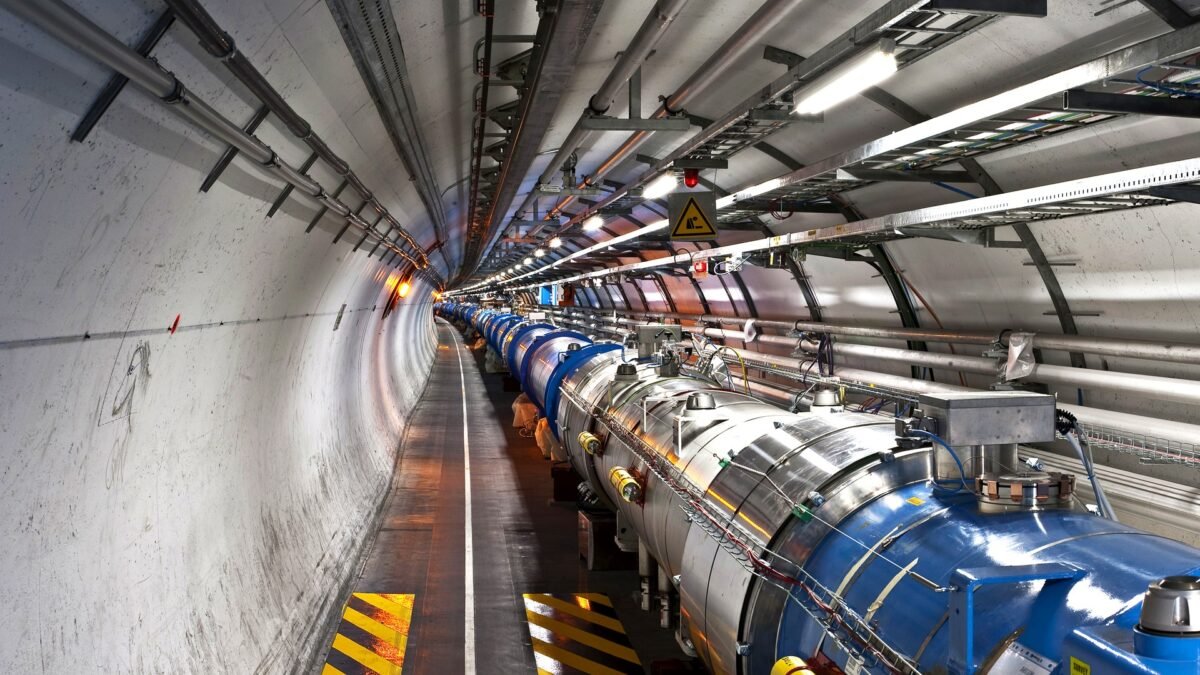
The experiment was conducted at the Large Hadron Collider Beauty experiment, known as LHCb, one of the four large detectors ranged around the 27-kilometre Large Hadron Collider ring beneath the French–Swiss border near Geneva. LHCb is purpose-built to study particles containing beauty quarks, heavier relatives of the quarks that make up most of the visible matter in the universe.
Beauty quarks were common in the soupy aftermath of the Big Bang, perhaps when the cosmos was just a hundredth of a billionth of a second old, but they are naturally absent from the universe today. To study them, physicists have to make them from scratch. At the LHC, protons are smashed together at close to the speed of light, producing an ephemeral spray of particles that includes many beauty quarks and down antiquarks. Because quarks cannot exist alone, these combine almost instantaneously, through the strong nuclear force, into B mesons.
The mesons themselves are extraordinarily fleeting. A Bd meson lives for only about one and a half trillionths of a second before decaying. In the overwhelming majority of cases it decays through common, well-understood routes. But the Standard Model predicts that, on average, just one Bd meson in ten billion will instead transform into a muon and an antimuon — a negatively charged muon and its positively charged antiparticle. The muons themselves survive for only around two millionths of a second before decaying into electrons and positrons.
Spotting that one event among ten billion is the challenge. The LHCb experiment records hundreds of millions of proton collisions every second, corresponding to a data flow of four terabytes per second, according to INFN. Within that torrent, the signal is a whisper: two muons emerging from the same point with precisely the right combined energy. Everything else — the countless ordinary decays, the debris of billions of other collisions — is background noise that must be stripped away.
Two developments made the observation possible. The first was a major upgrade of the LHCb experiment in 2024, which allowed data to be collected at five times the rate achieved between 2010 and 2018, and improved the detector’s ability to distinguish between different types of particle. The second was the application of machine-learning techniques, which allowed the team to suppress the vast background of processes that would otherwise have swamped the signal. The experiment’s eagle-eye Vertex Locator, known as VELO, sits less than a finger’s width from the particle beam and pinpoints where decays happen with extraordinary precision.
Data taken by LHCb in 2024 and 2025 revealed evidence of the Bd → μ+μ– decay at a level of 3.0 standard deviations on their own. By combining this fresh data with measurements collected between 2011 and 2018, the significance rose to 3.2 standard deviations — roughly a one-in-1,500 chance that the signal is a fluctuation of the background rather than a real effect, according to INFN. In the same analysis, the team also made the most precise ever measurements of the previously observed sibling decay, Bs → μ+μ–.
Why one in ten billion matters
To a non-physicist, a decay that happens once in ten billion tries may sound like a curiosity. To particle physicists, it is a precision instrument. The Bd → μ+μ– decay belongs to a subset of processes so rare that they have long been regarded as “golden channels” in the search for new physics, according to CERN.
The reason lies in quantum physics. Particle decays are influenced by other particles, including particles too heavy to be produced directly in a collider. In these rare decays, a beauty quark and an oppositely charged antiquark annihilate, releasing energy that becomes a muon and its antiparticle. Because the process is so unlikely in the first place, even a tiny influence from an undiscovered particle would shift the measured rate noticeably. As CERN explains, in general, the more unlikely a decay, the more sensitive it is to the influence of new particles.
That makes rare decays a kind of indirect telescope. The LHC can only create particles up to the energy of its collisions — currently 13.6 teraelectronvolts in the centre-of-mass frame. But a precise measurement of a rare decay can be sensitive to particles far heavier than that, particles whose fleeting quantum presence nudges the decay rate one way or another. If the measured rate had differed from the Standard Model prediction, it would have been a signpost pointing to new physics. That it agrees instead places strict limits on what those undiscovered particles can be.
The sibling decay illustrates the scale. The Bs → μ+μ– process occurs only around three times in every billion beauty-particle decays — already extraordinarily rare. The Bd version is about thirty times rarer still, with a predicted rate roughly thirty times lower. If confirmed, the Bd decay would be the rarest decay of a beauty particle ever observed.
Evidence, not yet discovery
Particle physics guards its language carefully, and the distinction between “evidence” and “discovery” is not pedantry — it is the discipline’s immune system against false alarms. To claim evidence of a new phenomenon, a result needs a significance level of three standard deviations, corresponding to just a 0.3 per cent chance that the signal occurred randomly. A full discovery conventionally requires five standard deviations, a chance of roughly one in 3.5 million that the result is a fluke.
The new result, at 3.2 sigma, clears the evidence threshold comfortably but sits well short of discovery. That is why CERN, INFN and the universities involved describe the finding as evidence, and why the paper has been submitted for publication rather than presented as a closed case. More data, expected from future running of the LHCb experiment, should sharpen the measurement further.
The caution is earned. In 2015, a joint analysis by the LHCb and CMS Collaborations resulted in the first observation of Bs → μ+μ– and a claim for the first evidence of Bd → μ+μ–. However, in subsequent updates using data collected up until 2018, the evidence for the Bd decay was not confirmed. The signal faded as more data arrived. The new measurement, built on a much larger and cleaner dataset from the upgraded detector, is the first time a single experiment has reported evidence for the decay on its own — but the community will want to see the significance climb toward five sigma before treating the case as closed.
It is also important to be clear about what has not happened. The result does not mean a new particle has been discovered, and it does not point to behaviour beyond the Standard Model. The measured decay rate agrees with the Standard Model prediction within the margin of error. As the researchers put it, the results are consistent with Standard Model expectations and constrain new physics contributions at energy scales beyond those accessible through direct production at the LHC.
A 42-year hunt
The search for this decay began in the early 1980s with the CLEO experiment at Cornell University in the United States, and the latest result ends a hunt that has run for 42 years. Generations of physicists have worked on the problem; the analysis team behind the new result numbers just 19 people, but it stands on the work of thousands who built the detectors, ran the experiments and refined the theory over four decades.
Harry Cliff, a particle physicist at the University of Cambridge’s Cavendish Laboratory and LHCb’s Rare Decays Convener, who co-led the analysis, described the moment to the BBC and in Cambridge’s announcement. “Seeing clear evidence for this rarest decay for the first time was thrilling,” he said. “We’re knocking on the door of the zeptoverse now. I can’t wait to see what we find as we explore deeper.”
Niladri Sahoo, a particle physicist at the University of Birmingham and convenor of the LHCb Very Rare Decays working group, said the result provides “a powerful new test of the Standard Model and a window into potential new physics”. The University of Birmingham plays a leading role in the LHCb collaboration, and British scientists were prominent in the analysis.
The long hunt is itself a story about how science advances. The decay was predicted by theory decades before any machine could hope to see it. Each generation of experiment — CLEO, then the B-factories, then the LHC — pushed the sensitivity a little further, ruling out larger and larger deviations from theory, without ever quite reaching the predicted rate. The 2024 upgrade of LHCb finally tipped the balance: five times the data rate, sharper particle identification, and machine learning to sift signal from background.
The machine behind the measurement
The Large Hadron Collider is the largest machine ever built, a 27-kilometre ring of superconducting magnets buried beneath the countryside near Geneva, straddling the French–Swiss border. Protons circulate inside it at close to the speed of light, guided by magnets cooled to temperatures colder than deep space, before being steered into head-on collisions at four interaction points. At each point sits a detector the size of a building — ATLAS, CMS, ALICE and LHCb — recording the debris.
LHCb is the specialist of the four. Where ATLAS and CMS are general-purpose detectors built to catch anything new, LHCb is designed to study the subtle differences between matter and antimatter in the decays of beauty particles. It is, in effect, a microscope tuned to a single family of particles, and that specialisation is what makes measurements like this one possible.
The experiment’s sensitivity comes from precision rather than brute force. Its Vertex Locator tracks particles to within a fraction of a millimetre of the collision point, allowing physicists to reconstruct decays that happen a trillionth of a second after the collision. Its ring-imaging Cherenkov detectors identify particles by the faint light they emit as they pass through gas. And its trigger system, rebuilt in the 2024 upgrade, decides in real time which of the hundreds of millions of collisions per second are worth keeping.
The collider is also the machine that found the Higgs boson in 2012, completing the Standard Model’s roster of predicted particles. Since then, the central question in particle physics has shifted: the Standard Model works, almost too well, yet it is known to be incomplete. It does not explain dark matter, which outweighs ordinary matter roughly five to one in the universe. It does not explain the slight asymmetry between matter and antimatter that prevented the entire cosmos from annihilating itself in a puff of energy after the Big Bang. And it does not include gravity. Something beyond it must exist — the question is where it is hiding.
The zeptoverse: a new address in nature
The word that has captured the public imagination is “zeptoverse”, the name physicists have given to the scale of reality this measurement begins to probe. A zeptometre is one billion-trillionth of a metre — 10−21 metres, or a sextillionth of a metre. It is a scale roughly a hundred billion times smaller than an atom, and thousands of trillions of times thinner than a human hair. It is, as far as anyone knows, the smallest scale of the physical world ever explored.
The zeptoverse is not a place in the ordinary sense. It is a regime of distance and time so small that the familiar rules of the everyday world dissolve entirely, and even the rules of particle physics are stretched to their limits. Quantum actions at these scales unfold across time spans that are unimaginably small. What makes the new result remarkable is that it offers experimental access to that regime at all — not by building a microscope that can see a zeptometre, which is impossible, but by reading the fingerprints that zeptometre-scale physics leaves on the decays of particles we can observe.
For now, those fingerprints match the Standard Model’s predictions. But the measurement establishes a method: as LHCb collects more data, the precision of this and similar rare-decay measurements will improve, and the fingerprints will become sharper. If a deviation ever appears, it will be in measurements like this one that it shows up first.
Analysis: Why It Matters
The Standard Model survives its hardest test yet
The most striking thing about this result is what it did not find. The Standard Model has now been tested at a precision that would have exposed many proposed extensions of physics — new particles, new forces, new symmetries — and it has passed again. That is a triumph for a theory assembled over half a century, but it is also a frustration. Physicists know the theory is incomplete, yet every experiment designed to break it has instead confirmed it. The Bd decay measurement tightens the screws further: whatever lies beyond the Standard Model must now be either heavier, weaker, or more cleverly hidden than many theorists had hoped. The value of a null result at this precision is that it tells theorists where not to look, which is often as useful as telling them where to look.
The zeptoverse is now a real address, not a metaphor
Until this week, the zeptoverse was a theorist’s word for scales too small to reach. This measurement changes its status. By observing a process sensitive to physics at zeptometre scales, the LHCb collaboration has effectively fastened a knocker on the door of that realm, in the words of the researchers’ own framing. The door is not yet open — the result is evidence, not discovery, and the measurement agrees with existing theory — but there is now a proven experimental route into territory that was previously accessible only in equations. That route will matter enormously in the coming decade, as the High-Luminosity LHC and the upgraded LHCb multiply the available data.
Indirect discovery is how particle physics actually advances
The public image of particle physics is the dramatic one: a giant machine smashing particles together and a new particle emerging from the wreckage, as the Higgs boson did in 2012. But much of the field’s real progress has been indirect. The charm quark and the top quark — the latter about as massive as an entire gold atom — were both inferred from the patterns of rare decays before they were ever produced directly. This result belongs to that tradition. It shows that discovery need not mean a bump on a graph or a new particle appearing in a detector; it can mean a decay rate measured so precisely that only one explanation fits. For a public that often asks what the LHC has done since the Higgs, the answer is that it has become an instrument of exquisite precision, and precision is itself a form of discovery.
A 42-year payoff for patience — and for upgrades
Few human endeavours sustain a single goal for 42 years. The search for this decay outlasted careers, survived the construction and rebuilding of the world’s largest machine, and persisted through a 2015 claim that later faded. Its success is an argument for a kind of science that is hard to fund and harder to explain: long, incremental, and dependent on unglamorous engineering. The decisive factor was not a new idea but a better detector — a 2024 upgrade that quintupled the data rate, plus machine-learning methods that made the data usable. The lesson for science policy is plain: the breakthroughs of the 2030s will depend on the upgrades funded in the 2020s, and the High-Luminosity LHC, due to start up in 2030, with a further LHCb upgrade in the middle of the next decade, could increase the data collection rate by another order of magnitude.
What it does not mean
Honesty requires stating the limits plainly. No new particle has been found. No law of physics has been broken. The result has not been peer-reviewed yet, and its 3.2-sigma significance, while past the evidence threshold, leaves room — roughly one chance in 1,500 — that the signal is a statistical fluctuation. The 2015 experience, when an earlier hint of this same decay faded with more data, is a reminder that in rare-decay physics, patience is not optional. The story here is not a revolution; it is the opening of a new front in a long campaign, and the next data will decide whether the knock on the zeptoverse’s door is answered.
What to Watch Next
- Peer review and the published paper: The preprint has been submitted to Physical Review X. Referees will scrutinise the analysis, the background estimates and the machine-learning methods before the result enters the formal literature. Watch for the published version and any changes to the quoted significance.
- The climb to five sigma: Further research will seek to confirm the Bd → μ+μ– decay by reaching five standard deviations, which would make it the rarest beauty-particle decay ever observed. That will require substantially more data from continued LHC running.
- The sibling measurement: The same analysis produced the most precise ever measurement of the Bs → μ+μ– decay. Theorists will mine both numbers together, since new physics would typically shift the two rates in related ways.
- The High-Luminosity LHC: The start-up of the High-Luminosity LHC in 2030 and the planned LHCb upgrade in the middle of the next decade could increase the data collection rate by another order of magnitude, turning today’s evidence into tomorrow’s precision measurement — and opening sensitivity to still rarer decays.
- Other golden channels: LHCb and its sister experiments are pursuing a family of similarly rare decays. A deviation in any one of them, corroborated by the others, would be the first crack in the Standard Model. Watch for results on related beauty- and strange-particle decays in the coming year.
Sources
- CERN — LHCb finds evidence of one-in-ten-billion particle decay
- ScienceAlert — After 42 Years of Searching, Physicists Find Evidence of a One-in-10-Billion Particle Decay
- INFN — LHCb finds evidence of one-in-ten-billion particle decay
- JournalArta — CERN LHCb Finds Evidence of an Ultra-Rare Particle Decay
- TechieMag — Particle Physicists Are Getting a First Glimpse Into the ‘Zeptoverse’
- 247 News Bulletins — CERN scientists manage to peer into the ‘zeptoverse’, the smallest world ever detected

About the Author — Abdul Mannan
Related Articles

Britain Gets a New Pair of Eyes in Space as Military Satellite Titania Reaches Orbit
The Ministry of Defence says Titania, built in Hampshire by Dstl and BAE Systems, is now in orbit…

OpenAI Launches GPT-6 Cyber, a ‘Critical’-Rated AI That Finds and Builds Exploits — and Only Vetted Defenders May Use It
OpenAI's new GPT-6 Cyber model found 81 previously unknown high-severity flaws in Firefox and built working exploits for…
Amateur Radio Operator Tells a Satellite to Play Doom — and It Listens in a Space First
An amateur radio operator in Oslo spoke three words to a satellite 568 kilometres overhead — and the…