
Britain Gets a New Pair of Eyes in Space as Military Satellite Titania Reaches Orbit

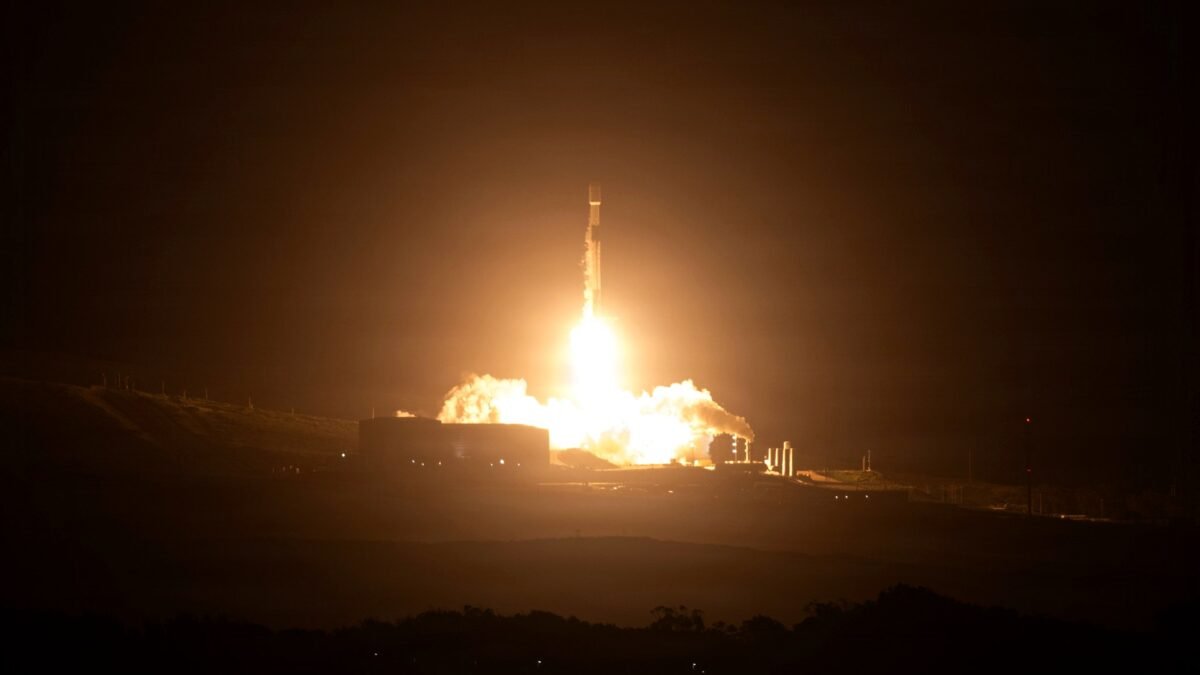
Britain has a new pair of eyes in space. The Ministry of Defence announced on Friday 7 November 2026 that Titania, a British-built military observation satellite, has successfully launched and is now in orbit, giving the Armed Forces a second spacecraft with which to watch military activity on Earth from above.
According to the Ministry of Defence, Titania was launched last month on a reusable SpaceX Falcon 9 rocket from California and is now being operated by UK Space Command as part of the ISTARI programme, the military’s project to build a sovereign constellation of surveillance satellites and the ground systems that support them.
“Britain has a new pair of eyes in space, with the successful launch of British-built military satellite Titania,” the ministry said in its announcement, adding that the launch “will further help the Armed Forces coordinate their efforts on and above Earth, by improving their ability to observe military activity on Earth from space.”
Titania is the second satellite in the United Kingdom’s growing military constellation, following Tyche, which was launched in August 2024. Like Tyche, Titania weighs around 100 kilograms — about the size of a washing machine — and circles the Earth every ninety minutes, travelling at 27,000 kilometres per hour, according to the Ministry of Defence.
The announcement, published at 00:01 on 7 November, also revealed a second, quieter strand of Britain’s space defence effort: Project Inaros, a new trial of advanced ground-based sensors designed to watch for threats to the satellites themselves. Together, Titania and Inaros sit inside more than £3 billion of defence investment in space capabilities over the next four years, part of a much larger rearmament programme that the government says is a response to a world in which orbit has become a front line.
What Titania will do
Titania was designed and built in Hampshire by a partnership between the Defence Science and Technology Laboratory (Dstl) and BAE Systems, under a £9.5 million contract, according to the Ministry of Defence. It will be operated by UK Space Command, the joint command headquartered at RAF High Wycombe that is responsible for Britain’s military space operations.
The ministry has not published detailed specifications of Titania’s sensor, and military observation satellites are rarely described in full. What is public is the role: Titania joins Tyche in providing imagery of the Earth’s surface to support defence intelligence and military operations, and to help British forces coordinate their activity. Tyche, the first of the pair, carries a high-resolution optical payload that delivers sub-one-metre imagery of ground areas about five kilometres wide, including video, and the two satellites together give Britain its first wholly owned imaging capability.
Before Tyche, the United Kingdom was the only G8 nation without its own sovereign satellite imaging capability, relying instead on imagery bought from allies and commercial providers. That dependence was the gap ISTARI was created to close.
The orbital catalogue Satcat records Titania as a United Kingdom payload launched on 1 October 2026 on a Falcon 9 from California, placing it in a sun-synchronous orbit, according to a report by the Transatlantic Standard. The Ministry of Defence itself has said only that the launch was completed last month. Sun-synchronous orbits are the standard choice for imaging satellites because they pass over any given place at the same local solar time on each visit, giving consistent lighting for the pictures they take.
Defence Secretary Wes Streeting MP said the satellite’s arrival marked a turning point. “The new space age is here,” he said, according to the Ministry of Defence. “Space underpins everything from weather forecasts and financial transactions to sat-navs and mobile phone connections, and it is critical for our national security and military operations.”
“Having Titania now in orbit and Project Inaros stepping up how we watch over our satellites means we can see threats sooner, making the UK safer,” Streeting added. “Titania and Inaros are British-built and British-designed, backed by more than £3 billion of investment in space capabilities. That means highly skilled jobs across the UK, a stronger industrial base, and a more secure United Kingdom.”
Air Chief Marshal Sir Harv Smyth, the Chief of the Air Staff, said the ability to observe the Earth from space was “critical to both national resilience and military advantage”, adding: “This will be demonstrated by Tyche and Titania, alongside Juno and Oberon in the years ahead.”
Andrea Thompson, managing director of BAE Systems Digital Intelligence and Land, said the programme “highlights the strength of the UK’s sovereign space capability and the critical role it plays in protecting the nation”, while Dstl chief executive Dr Paul Hollinshead said his laboratory had been “at the heart of Titania, from the original concept, through Science and Technology investment, technical development, programme delivery, and successful launch”.
Project Inaros: watching the watchers
The second half of Friday’s announcement may prove the more consequential. Project Inaros will trial three ground-based neuromorphic sensors, developed by the British-Australian company Optera in partnership with the National Security Strategic Investment Fund, to monitor movements in space from sites in the United Kingdom, Australia and British facilities on the island of Cyprus.
Neuromorphic sensors mimic biological processes by detecting changes in light rather than recording full images, which makes them fast and sensitive to movement. According to the Ministry of Defence, the technology “could be developed to be an early warning system to spot unusual or threatening activity near UK satellites”.
Information gathered by Inaros will feed UK Space Command units including No. 1 Space Operations Squadron, No. 2 Space Warning Squadron and the new No. 3 Space Effects Squadron, which the ministry says exist to safeguard the satellites that guide British ships, connect mobile phones and warn of missile attacks.
The logic is straightforward: a satellite that watches the Earth is useless if it is blinded, jammed or destroyed, and the sensors that protect it are as much a part of the capability as the satellite itself. Inaros is a trial, not yet an operational system — the ministry has disclosed no contract value or trial duration for it — but its three sites are deliberately spread across the globe so that activity near British satellites can be tracked around the clock.
The money behind the programme
Titania and Inaros are part of the more than £3 billion committed by the Defence Investment Plan for space-based capabilities, according to the Ministry of Defence, money intended to protect British assets in space and strengthen deterrence on Earth. The Defence Investment Plan, published on 30 June 2026, committed £298 billion of defence spending over the next four years in total.
The sums attached to the satellites themselves are modest by defence standards. Titania cost £9.5 million to design and build; Tyche was built under a £22 million contract. The wider ISTARI programme — Intelligence, Surveillance, Target Acquisition and Reconnaissance Information — was originally costed at around £970 million over ten years under the 2022 Space Defence Strategy, with the aim of delivering a sovereign operational surveillance constellation by 2031.
Two more satellites are already named as the next steps. Juno, built with Surrey Satellite Technology Ltd, and Oberon, built with Airbus Defence and Space, will follow Titania into orbit. The four names — Tyche, Titania, Juno and Oberon — are all drawn from classical mythology and Shakespeare, a deliberate naming pattern for the constellation.
The investment is also an industrial bet. Titania was built in Hampshire, Tyche in Guildford, and the programme’s supporters in government and industry present it as a way of anchoring high-skilled space jobs in Britain rather than buying imagery from abroad. Streeting’s statement made the point explicitly, linking the satellites to “highly skilled jobs across the UK, a stronger industrial base, and a more secure United Kingdom”.
From Tyche to a full constellation
Tyche’s launch on 16 August 2024 was itself a milestone. The satellite lifted off from Vandenberg Space Force Base in California aboard a SpaceX Falcon 9 rocket on the Transporter-11 rideshare mission, one of 116 payloads on the flight, and was deployed about an hour and nineteen minutes after lift-off. It was the first satellite operated by UK Space Command, the first satellite fully owned by the Ministry of Defence, and the first dedicated Earth-imaging satellite Britain had ever flown.
Tyche is a Surrey Satellite Technology Carbonite-class microsatellite of about 160 kilograms, operating at an altitude of roughly 500 kilometres in low Earth orbit, with a planned mission life of five years. It provides daytime imagery — its sensor works at optical wavelengths, in the same light the human eye senses — and its pictures are used to support military operations, disaster monitoring, mapping and tracking the effects of climate change.
Titania, at around 100 kilograms, is lighter than Tyche, but the two are complementary rather than identical, and the constellation they form is the point. A single imaging satellite revisits any given place only when its orbit carries it overhead; two satellites halve the wait, and four — once Juno and Oberon join — will shorten it further still. For a military that wants to track the movement of troops, vehicles, ships and aircraft, revisit time is the currency that matters.
The programme’s roots go back to the 2021 Space Command Paper and the 2022 Space Defence Strategy, under which the previous government committed to the ISTARI investment. The current government’s Strategic Defence Review, published in June 2025, elevated space further, treating it as a fully fledged operational domain alongside land, sea, air and cyber, and the Defence Investment Plan of June 2026 put the money behind that judgement.
Why Britain is rushing into orbit
The urgency is driven by what British commanders say is happening above their heads. The head of UK Space Command, Major General Paul Tedman, told the BBC that Russia is stalking British satellites and that these assets face jamming attempts on a weekly basis, according to a report by Airforce Technology. At the DSEI defence exhibition in September 2025, Tedman counted 20 “counterspace systems” in geostationary orbit and more than 200 in low Earth orbit, warning: “This is not an emerging threat. It is here, now, and active.”
The Strategic Defence Review itself described Russia as “an immediate and pressing threat” and China as a “sophisticated and persistent challenge”, and it warned that the precision weapons of both countries, guided by space-based navigation systems, hold British strategic capabilities at risk. It recommended that the United Kingdom prioritise investment in counter-space systems — the ability to protect its own satellites and to understand what adversaries can do to them.
The record gives the warning substance. Russia destroyed one of its own satellites in a direct-ascent anti-satellite missile test in 2021, creating a cloud of debris that endangered the International Space Station, and it disrupted satellite services in the opening days of its full-scale invasion of Ukraine in 2022, an attack that has continued in various forms since. China destroyed a satellite in its own anti-satellite test in 2007, and the latest United States Annual Threat Assessment judged that China has now surpassed Russia as a space leader, fielding ground-based counter-space capabilities and conducting close-proximity inspections of other satellites with dual-use inspector spacecraft.
There have also been persistent reports, never officially confirmed, that Russia has been developing a nuclear weapon designed to destroy satellites indiscriminately. The Royal United Services Institute has estimated that disruption to the Global Positioning System alone would cost the British economy around £1 billion a day, a figure that explains why the protection of space infrastructure is treated in Whitehall as an economic question as much as a military one.
Britain is not alone in responding. The United States Space Force publishes a regular threat fact sheet on counterspace weapons, and in September 2026 the Royal Air Force announced the creation of its first space squadron, tasked with protecting British satellites. Experts quoted by The Telegraph in October 2026 warned that armed conflict in space could begin within five years, as near-Earth orbit turns into a potential theatre of military operations — a warning that should be read as an assessment of risk, not a prediction of war, but one that British planners plainly take seriously.
The Strategic Defence Review also allocated £1 billion towards the “Digital Targeting Web”, a system intended to link sensors and weapons across the armed forces and bring it into service in 2027. Space-based imagery from satellites like Titania is the kind of sensor data the web is designed to consume: pictures taken from orbit, fused with other intelligence, and turned into targeting decisions faster than an adversary can move.
Analysis: Why It Matters
Sovereignty, not just surveillance
The most important word in the Titania announcement is not “military” but “British-built”. Until 2024, Britain had no satellite imaging capability of its own at all, which meant that whenever its armed forces needed a picture from orbit, they had to ask an ally or buy one from a commercial provider — on the provider’s timetable, at the provider’s price, and with no guarantee the picture would be available in a crisis. Two satellites do not end that dependence, but they end the position of having nothing at all. Sovereignty in space is, at its root, the ability to look when you choose rather than when someone else allows it, and Titania is the second step in acquiring it.
A small satellite with an outsized message
Titania weighs about as much as a washing machine and cost £9.5 million, a rounding error in a defence budget of hundreds of billions. That is the point. The ISTARI model is built on small, relatively cheap satellites launched as rideshares on other people’s rockets, rather than on a handful of enormous, exquisite spacecraft that take a decade to build and cannot be replaced if they fail. If one is lost, another can be built and launched. That resilience — the ability to absorb losses and keep watching — is exactly what the threat environment demands, and it is a deliberate contrast with the older model of space power.
Inaros shows where the real race is
The most revealing part of Friday’s announcement is not the satellite but the sensor network that will watch over it. Project Inaros acknowledges, in public, what commanders have been saying in private: that Britain’s satellites are already being stalked and jammed, and that the next fight may be over the satellites themselves rather than anything on the ground. A constellation that cannot defend itself is a liability, not an asset. Inaros is only a trial, but it signals that London has understood that protecting the watcher matters as much as the watching.
The £3 billion question is delivery
Announcements are cheap; constellations are not. The history of British defence procurement is littered with programmes that were announced with fanfare and delivered late, over budget or not at all, and ISTARI’s own history includes the long gap between the 2022 strategy and the first launch in 2024. The test of Friday’s announcement is not whether Titania is in orbit — the orbital catalogue says it is — but whether Juno and Oberon follow on schedule, whether Inaros graduates from trial to operational system, and whether the £3 billion is spent on hardware rather than absorbed by administration. The Defence Investment Plan gives the programme money; only delivery will give it credibility.
Space is now part of daily life, not just war
Streeting’s list — weather forecasts, financial transactions, sat-nav, mobile phone connections — is a reminder that the stakes of the space race are not confined to generals. The same satellites that guide a warship also time the transactions in a bank and route the ambulance to a crash. That is why the argument for spending billions on orbit is made in terms of national resilience rather than military glory, and why the disruption of a satellite is treated as an attack on the economy as well as on the armed forces. Titania is a military satellite, but the infrastructure it belongs to is civilian life itself.
What to Watch Next
- The first pictures. The Ministry of Defence has not said when Titania’s first imagery will be released or whether any of it will be made public. The first published image from the satellite will be the first real test of its capability — and of how much the government is willing to show.
- Juno and Oberon. The next two satellites in the constellation, built with Surrey Satellite Technology and Airbus Defence and Space, will determine whether ISTARI becomes a genuine four-satellite network or stalls at two. Watch for launch dates and contract announcements.
- Inaros results. The three-site neuromorphic sensor trial in the United Kingdom, Australia and Cyprus is the programme’s most novel element. Any statement on what the sensors have detected — or whether the trial is extended into an operational system — will show whether Britain can actually see threats to its satellites coming.
- The Defence Investment Plan in practice. More than £3 billion is committed to space over four years. The first spending decisions under that plan, and any sign of slippage in the wider £298 billion programme, will show whether the money announced on Friday is real.
- The threat picture. Major General Tedman’s warnings about Russian stalking and weekly jamming were unusually blunt for a serving commander. Any further public statements from UK Space Command, or any incident involving a British satellite, will indicate whether the threat is intensifying — and whether Inaros was stood up just in time.
Sources
- UK Ministry of Defence — “UK military satellite Titania launches into orbit following £3bn space investment into defence of space” (GOV.UK, 7 November 2026)
- Sky News via Q Radio — “UK has ‘new pair of eyes’ in space after military satellite Titania enters orbit” (7 November 2026)
- ITV News via Europe Says — “Britain launches new military observation satellite into space” (7 November 2026)
- Transatlantic Standard — “UK confirms second military observation satellite is in orbit” (7 November 2026)
- Securities.io — “UK Titania Military Satellite Reaches Orbit Under £9.5 Million Contract” (7 November 2026)
- Aerospace Global News — “First dedicated Earth-imaging satellite for UK Space Command” (Tyche background, 18 August 2024)

About the Author — Abdul Mannan
Related Articles

OpenAI Launches GPT-6 Cyber, a ‘Critical’-Rated AI That Finds and Builds Exploits — and Only Vetted Defenders May Use It
OpenAI's new GPT-6 Cyber model found 81 previously unknown high-severity flaws in Firefox and built working exploits for…
Amateur Radio Operator Tells a Satellite to Play Doom — and It Listens in a Space First
An amateur radio operator in Oslo spoke three words to a satellite 568 kilometres overhead — and the…
NASA Unveils X-70 Fractal, a Crewed Test Jet Built to Fly Manoeuvres No Pilot Has Flown Before
NASA has unveiled the crewed X-70 Fractal experimental aircraft, a rapidly reconfigurable flight-research platform due to fly under…