
Armed Man Arrested Near White House After Telling Secret Service He Came to Kill Trump

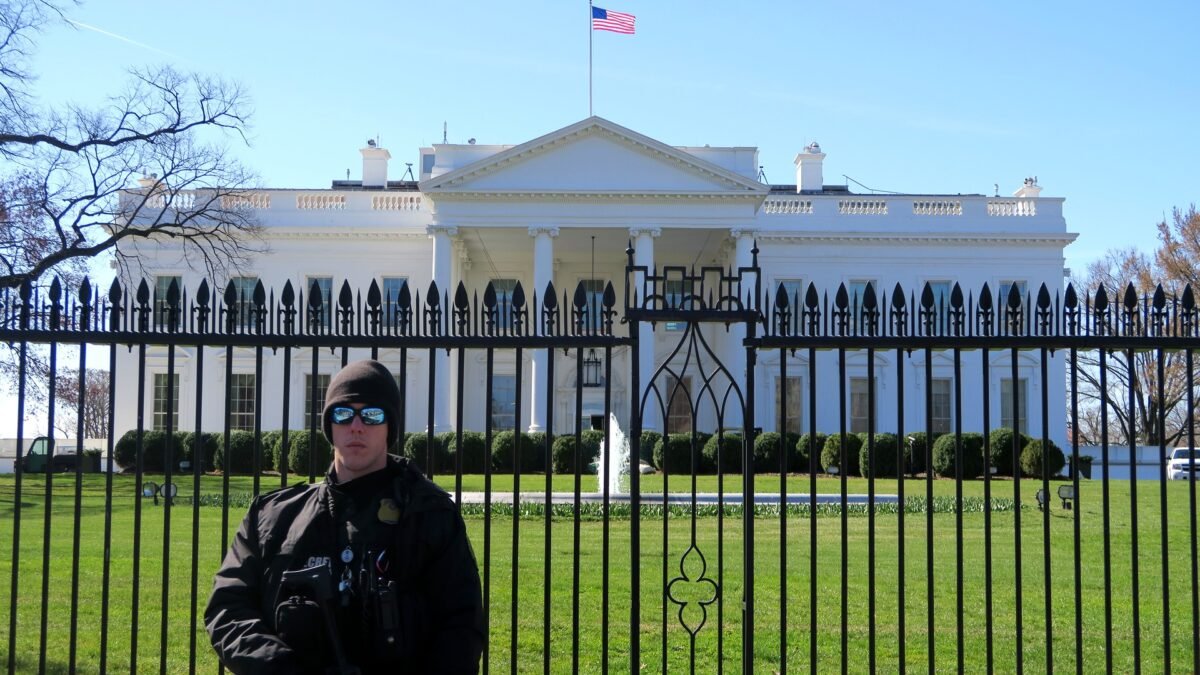
The United States Secret Service arrested an armed man near the White House on Thursday evening after he told officers that voices in his head had ordered him to travel to Washington and kill President Donald Trump, according to the Department of Homeland Security. Officers found three firearms and dozens of rounds of ammunition inside a stolen car parked a short distance from the presidential residence, in the latest in a series of threats against the president since he returned to office.
The suspect was identified by the Department of Homeland Security as Ronny Yordrix Guanipa Chrinos, a 30-year-old Venezuelan national. According to the department, Secret Service officers noticed him acting suspiciously in a vehicle parked on Constitution Avenue NW, in the 1600 block near the Ellipse, and approached the car. What followed, the department said, was a calm but chilling exchange.
“When they confronted the suspect, he said that he heard voices in his head telling him to come to Washington, D.C. and kill President Trump,” the Department of Homeland Security said in a news release issued on Friday. “The officers then discovered that the vehicle had been reported stolen, and the suspect admitted to having weapons in his vehicle.”
A search of the car turned up three firearms — an AR-15-style rifle, a Mac-10 handgun and a Glock pistol — along with dozens of rounds of ammunition, according to the Department of Homeland Security. No shots were fired and no one was injured during the stop, officials said.
Chrinos was arrested on a series of firearms and vehicle charges, including carrying a rifle outside a home or business, carrying a pistol without a licence, three counts of unlawful transportation of a firearm, three counts of possessing an unregistered firearm, three counts of possessing unregistered ammunition, possession of certain dangerous weapons, unauthorised use of a motor vehicle, theft and receiving stolen property. He is in the custody of the US Marshals Service, and Immigration and Customs Enforcement has lodged a detainer against him.
Notably, the charges announced so far do not include attempted murder or any federal charge of threatening or attempting to assassinate the president. The allegations against Chrinos have not yet been adjudicated in court.
The Department of Homeland Security said Chrinos entered the United States illegally through Texas in March 2024, was arrested at the time by the US Border Patrol, and was later released into the country. The department’s statement described him as a Venezuelan national in the United States illegally.
Homeland Security Secretary Markwayne Mullin credited the officers who made the arrest. “Thanks to our brave Secret Service officers, this illegal alien with three firearms in his vehicle was arrested near the White House before he could harm anyone,” Mullin said in the department’s statement.
Secret Service Director Sean Curran praised the officers’ handling of the encounter and pointed to the pressure his agency is under. “This is the latest example of Secret Service personnel relying on extensive training and experience to deescalate a volatile situation that posed an imminent threat to our protectees and other Americans,” Curran said. “This incident reflects the heightened threat environment in which we operate, as well as the continued number of armed individuals who are drawn to the White House complex.”
The White House itself did not comment on the arrest, referring questions to the Department of Homeland Security and the Secret Service.
A Pattern the Secret Service Has Been Warning About
According to the Associated Press, the arrest is the latest in a series of arrests that the Secret Service and other law enforcement agencies have made against people who have threatened the lives of Trump or members of his family since he returned to office last year. The agency has also reported a significant increase in incidents involving people with mental health problems around the White House, according to CNN, with officials saying the White House and the presidency can act as a symbolic focal point for people experiencing such difficulties.
The most serious recent episode came in May, when Secret Service officers shot and killed a 21-year-old man, Nasire Best, after he opened fire near a security checkpoint at 17th Street and Pennsylvania Avenue. According to CNN, Best had a history of mental health problems. A bystander was also wounded in that exchange of gunfire, and Trump, who was inside the White House at the time, was not harmed.
Best was already known to the Secret Service. Court records show he had been arrested in July 2025 after trying to enter a White House checkpoint without authorisation, claiming he was Jesus Christ and saying he wanted to be arrested, and a judge had ordered him to stay away from the White House grounds. A bench warrant was issued in August 2025 after he failed to appear for a hearing.
Days earlier in the same month, on 4 May, Secret Service agents exchanged gunfire with another armed man, Michael Marx, 45, near the National Mall after he drew a handgun when officers approached him. Marx was wounded and taken to hospital, and a bystander was grazed by a bullet. No officers were injured.
In two separate incidents, in March 2026 and October 2025, drivers rammed vehicles into security barricades near the White House and were detained and questioned. The incidents, taken together, describe a perimeter that is tested again and again — sometimes by people with a plan, sometimes by people in crisis, and sometimes by people whose motives are never fully clear.
The Shadow of 2024
The threat environment around Trump changed permanently in 2024, when he survived two assassination attempts during his campaign for a second term. In July of that year, a gunman opened fire at a campaign rally in Butler, Pennsylvania, wounding Trump in the ear and killing a spectator. Two months later, in September, a man armed with a rifle was arrested after being spotted hiding in bushes near Trump’s golf course in West Palm Beach, Florida.
Those attacks prompted a sweeping review of Secret Service protection, and the agency has operated since then under intense scrutiny. Every incident at the White House perimeter now lands in a context in which the public, Congress and the agency itself are acutely aware of what a failure would look like. Thursday’s arrest, in which no one was hurt, will be presented by the agency as evidence that its training and its posture are working. It will also be read, inevitably, as evidence of how often the system is tested.
The circumstances of the latest case also place it at the centre of one of the most politically charged debates in American public life. The Department of Homeland Security moved quickly to identify Chrinos as a Venezuelan national who entered the country illegally in March 2024 and was released after being detained by the Border Patrol. That framing — an armed foreign national, released into the country under the previous administration, arriving at the White House with three guns — was the first thing the department chose to emphasise, and it was echoed in the secretary’s statement.
Immigration enforcement has been a defining project of Trump’s second term, and the administration has repeatedly argued that the releases of migrants who crossed the border illegally under President Joe Biden created security risks. The case of Chrinos will now be cited by the administration as an example of that argument. Critics, for their part, are likely to note that the system that identified, stopped and arrested him was the same system the administration credits, and that a single case — whatever its facts — does not by itself establish a pattern.
What is not yet in the public record is as important as what is. Officials have not said how long Chrinos had been in Washington, where the car was stolen, how he obtained the weapons, or whether he had any connection to organised groups. Nor have they said whether he will face additional federal charges, including any charge relating to a threat against the president. The firearms and vehicle charges announced so far are serious — each unlawful-transportation and unregistered-firearm count carries its own penalty under District of Columbia law — but they are not the charges that would be expected if prosecutors were treating the case primarily as an attempted assassination.
The statement attributed to Chrinos himself — that voices in his head told him to come to Washington and kill the president — raises a further set of questions that will almost certainly shape the case. If the account given by the Department of Homeland Security is accurate, the question of his mental state will be central to any prosecution, to any assessment of his competence to stand trial, and to the public understanding of what happened. The Secret Service’s own observation that the White House draws people experiencing mental health crises is, in that sense, both an explanation and a warning: the perimeter is not only a security problem, but a place where untreated illness arrives with a weapon.
Analysis: Why It Matters
1. A system that worked — but only just
The most important fact about Thursday night is the simplest one: nobody was hurt. Officers noticed a man behaving suspiciously, approached him, listened to what he said, discovered a stolen car, and found three guns before any of them could be used. That is the outcome the Secret Service trains for, and in a year in which its officers have had to open fire twice at the White House perimeter, a bloodless arrest is a success worth recording plainly.
But the success also underlines the narrowness of the margin. The car was parked on Constitution Avenue, a public road that runs along the National Mall within a short walk of the White House. The man inside it was, according to the Department of Homeland Security, carrying a rifle, two handguns and dozens of rounds. The encounter was resolved by the judgement of the officers on the spot and by the suspect’s willingness, in that moment, to talk rather than to fight. A different mood, a different second, and the same facts could have produced a very different headline. The agency’s director said as much himself when he spoke of a “heightened threat environment” and “the continued number of armed individuals who are drawn to the White House complex”. That is not the language of an agency that believes the problem is solved.
2. The mental-health pattern the Secret Service keeps flagging
The detail that officials chose to highlight — that the White House has seen a significant increase in incidents involving people with mental health problems — deserves more attention than it has received. The presidency is, as officials put it, a symbolic focal point. For a person in crisis, the White House is not merely a building; it is the place where the most powerful person in the country lives and works, and therefore the place where a delusion finds its address.
The history of the last two years bears that out. Nasire Best, the man killed in May, had told officers he believed he was Jesus Christ and had been ordered by a judge to stay away from the grounds. Chrinos, according to the department, told officers he heard voices instructing him to kill the president. These are not the profiles of conspirators. They are the profiles of people whose illness has fastened onto the most visible symbol in American public life.
That presents a problem that no amount of fencing or firepower can fully solve. A perimeter can be hardened against a vehicle or a rifle, but it cannot be hardened against a person who arrives in a state of delusion and is, in the moment, willing to speak. The response, then, depends on training, on de-escalation, and on the ability of officers to distinguish a person in crisis from a person with a plan — often in the space of a few seconds, and sometimes with a gun already in view. The fact that Thursday’s arrest ended without a shot being fired is a credit to that training. The fact that such encounters keep happening is a reminder that training alone is not a cure.
3. The immigration fault line
It is impossible to discuss this case honestly without acknowledging the political argument that will be built around it. The Department of Homeland Security identified Chrinos as an illegal immigrant within hours of the arrest, and its secretary’s statement used language — “this illegal alien” — that left no doubt about the message the administration wanted to send. The administration’s case is straightforward: a man who crossed the border illegally in 2024, was detained and released, was later found outside the White House with three guns and a stated intention to kill the president.
That argument will be powerful, and it will be repeated. But it is worth being precise about what it does and does not prove. The arrest proves that a man who entered the country illegally was later found armed near the White House. It does not, by itself, prove that the release policy of the previous administration caused this, or that the case is representative of the millions of people who crossed the border in the same period. Nor does it answer the question the administration itself will have to answer: what, concretely, would have prevented it? Chrinos was detained on entry in 2024 and released — a practice that, under the law and the capacity constraints of the time, applied to vast numbers of people. The harder question is not whether the release was a mistake in hindsight, but what system, applied at the border in March 2024, could have identified a man who would, two and a half years later, drive to Washington with three guns in a stolen car.
That is a genuine question, and it has no easy answer. It is also the question that will be lost if the case is reduced to a slogan. The public deserves a fuller account: how the weapons were obtained, whether Chrinos had been in contact with the authorities before, and what, if anything, was known about him before Thursday night.
4. A presidency under permanent threat
Step back from the details of one arrest, and the picture is striking. In the space of a little more than two years, a president has survived two assassination attempts, watched his protective agency open fire twice at the White House perimeter, and seen a succession of arrests of people who threatened him or his family. The Associated Press described Thursday’s arrest as the latest in a series of such cases since Trump returned to office. The Secret Service director spoke of armed individuals being “drawn” to the complex, as if the building exerted a pull of its own.
There is a cost to this, and it is not only measured in the budgets of protective agencies. A presidency that must be defended at this level of intensity is a presidency that is, in some measure, sealed off from the public it serves. The White House has long been a fortress, but the fortress keeps growing — more fencing, more checkpoints, more officers, more distance between the president and the street. Each incident justifies the next layer of protection, and each layer makes the next incident more likely to be treated as a test of the perimeter rather than as a human event.
That is not an argument against protection. The alternative — a president exposed to the kind of violence that has already been attempted twice — is unthinkable. But it is worth noticing what is being lost, slowly and without any single decision, when the seat of American government becomes a place that armed and disturbed people are drawn to, and where the first question after every incident is whether the fence held. The fence held on Thursday night. The deeper question — why so many people arrive at it with a weapon and a grievance — is not a question a fence can answer.
5. What the charges do — and do not — say
The list of charges against Chrinos is long, and it is worth reading carefully, because it tells its own story about how the case is being handled. There are firearms charges and vehicle charges — unlawful transportation, unregistered weapons, unregistered ammunition, theft, receiving stolen property, unauthorised use of a motor vehicle. There is no charge of attempted murder, and no federal charge of threatening the president.
That may change. Federal prosecutors may bring further charges as the investigation develops, and the statement attributed to Chrinos, if proved, would support a charge of threatening the president. But the initial charges suggest that, for now, the case is being treated as a firearms and property case in the District of Columbia, not as a federal assassination case. That distinction matters, because it determines where the case is tried, what penalties apply, and how the public understands its gravity.
It also matters because of the mental-health question. If Chrinos did tell officers that voices in his head ordered him to kill the president, his lawyers will almost certainly seek a psychiatric evaluation, and the question of his competence to stand trial will be raised early. The outcome of that evaluation will shape everything that follows — whether he is tried, where he is held, and what sentence, if any, he ultimately faces. The public conversation about this case, which has so far been dominated by the immigration argument, may yet turn out to be, in the courtroom, a conversation about illness, treatment and the limits of criminal responsibility.
None of this diminishes the seriousness of what happened. A man with three guns in a stolen car, parked near the White House, telling officers he had come to kill the president, is a serious event by any measure. But seriousness is not the same as simplicity, and this case is not simple. It is, at once, a security success, a mental-health crisis, an immigration controversy and a test of the legal system — and it will be judged, in the end, not by the headlines of the first weekend but by what the investigation reveals in the weeks to come.
What to Watch Next
- First court appearance: Chrinos is expected to appear before a judge in the District of Columbia, where prosecutors will set out the charges and a judge will decide on detention. Whether federal charges follow will be the first signal of how seriously the Justice Department views the threat itself, as opposed to the firearms and vehicle offences already filed.
- Mental-health evaluation: Given the statement attributed to him about hearing voices, a psychiatric evaluation is likely. Its findings will shape questions of competence to stand trial and any defence the case may raise, and they will determine whether the public conversation shifts from immigration to illness.
- Immigration proceedings: With an Immigration and Customs Enforcement detainer lodged, Chrinos faces removal proceedings alongside the criminal case. How the two tracks interact — and whether the administration uses the case to press its wider argument about releases at the border — will be closely watched.
- The investigation into the guns and the car: Officials have not said where the vehicle was stolen, how the weapons were obtained, or how long Chrinos had been in Washington. Those details will establish whether this was a sudden act or a planned journey, and whether anyone else was involved.
- The Secret Service review: Every incident at the perimeter prompts a review of posture, patrols and the handling of suspicious vehicles. Watch for any change to the security footprint around Constitution Avenue and the Ellipse, and for any statement from the agency about how it identifies and approaches people behaving suspiciously near the complex.
Sources
- CNN — Secret Service arrests armed man near White House allegedly threatening to kill Trump
- The Associated Press, via The Washington Sun — Secret Service Arrests Man Who Said He Heard Voices Telling Him to Kill Trump
- New York Post — Illegal immigrant heard voices to assassinate Trump — arrested with firearm-filled stolen vehicle
- PEOPLE — Armed Man, Who Allegedly Told Secret Service He ‘Heard Voices Telling Him to Kill’ Donald Trump, Arrested Near White House
- NBC Palm Springs — Armed Man Arrested Near White House After Allegedly Threatening to Kill Trump
- Astig — He parked a stolen car with 3 guns near the White House and told agents he came to kill Trump

About the Author — Abdul Mannan
Related Articles
US Treasury Cuts Crypto Exchange MEXC Off From the American Financial System Over $16 Billion in Alleged Illicit Flows
FinCEN has ordered American banks to stop moving money for MEXC Global, accusing the exchange of channelling at…
Judge Blocks Trump’s 250-Foot Triumphal Arch Within an Hour of Final Approval as President Declares Oval Office a National Monument
A federal judge halted construction of President Trump's 250-foot triumphal arch within an hour of its final approval,…
Trump Names Stephen Miller White House Chief of Staff as Susie Wiles Departs After Midterm Rout
President Donald Trump has named Stephen Miller as his new White House chief of staff, replacing Susie Wiles…