
Trump Names Stephen Miller White House Chief of Staff as Susie Wiles Departs After Midterm Rout

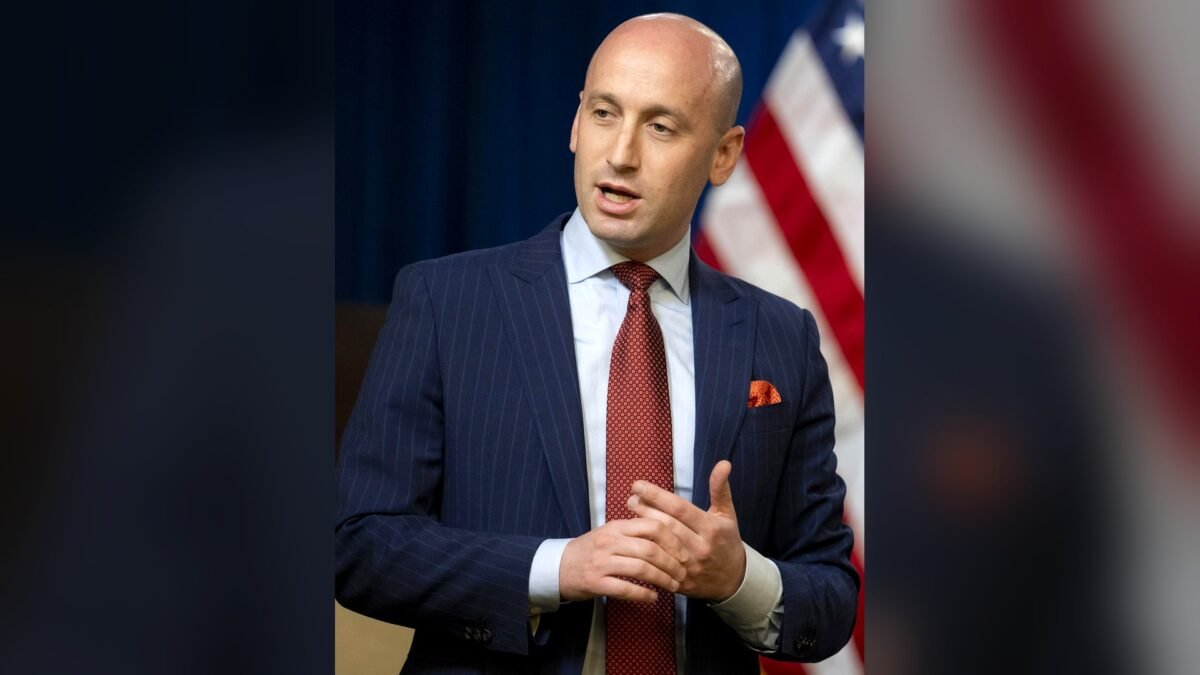
President Donald Trump has named Stephen Miller as his new White House chief of staff, replacing Susie Wiles in the first major personnel shake-up of his second term, just three days after Republicans suffered sweeping defeats in the midterm elections.
Mr Trump announced the change on Friday in a post on his Truth Social platform, according to USA Today, saying that Mr Miller, currently a deputy chief of staff, would take over the most powerful job in the West Wing on Monday, 9 November 2026. Ms Wiles, who has served as chief of staff since the start of Mr Trump’s second term, will move to what the president called the “Trump Political Operation”.
“I am pleased to announce that Mr. Stephen Miller, the current Deputy Chief of Staff of the Trump Administration, and one of my most trusted advisors, will become the Chief of Staff starting Monday, November 9, 2026,” Mr Trump wrote, according to USA Today. “Susie Wiles, who has done an outstanding job, will be moving over to the Trump Political Operation. I want to thank her for her service as Chief of Staff — She has done a great job!”
Ms Wiles confirmed on Friday that her time in the role was ending. “Today is my last day as White House Chief of Staff,” she wrote in a statement on X, according to CNN, adding that serving Mr Trump had been “the honor of a lifetime” and that she was “proud to have been a part of what we’ve accomplished together”. “While my role may be changing, my commitment to the President and the mission never will,” she added.
The move comes three days after Democrats won control of both the House of Representatives and the Senate in Tuesday’s midterm elections, a result widely interpreted as a repudiation of the second Trump presidency. CNN reported that the change takes effect on Monday, while The Times reported that Mr Trump had come under increasing pressure to remove Ms Wiles after losing both chambers of Congress.
The announcement
The announcement arrived on Friday afternoon, Washington time, as Mr Trump prepared to travel to Florida for his first trip outside the capital since the midterm defeat, according to USA Today. The president had kept a lower-than-usual profile in the days since the election, while senior Republicans publicly debated what had gone wrong.
According to CNN, Mr Trump said Ms Wiles would move to his political operation, adding that she “has done an outstanding job”. The Wall Street Journal reported that Mr Trump called Mr Miller one of his most trusted advisers and said he would start in the new role on Monday. The Journal also noted that Ms Wiles was the first woman to serve as White House chief of staff.
Mr Miller, 41, currently serves as deputy chief of staff for policy and as homeland security adviser, and he is widely regarded as the architect of the administration’s hardline immigration agenda. In elevating him, Mr Trump is promoting one of the most polarising figures in his administration — and one of its longest-serving — to the job that controls access to the president, manages the flow of decisions through the White House, and enforces discipline across the executive branch.
The chief of staff does not require Senate confirmation, so Mr Miller will assume the role on Monday without a hearing or a vote. That matters, because the new Democratic-controlled Senate would have had the power to block or slow any nominee requiring confirmation. By choosing a promotion from within his own staff, Mr Trump avoided that fight entirely.
News of the change was reported within minutes by CNN, USA Today, The Wall Street Journal, The Times, the New York Post and the Associated Press, all confirming the same core facts: Mr Miller in, Ms Wiles out, effective Monday, with Ms Wiles moving to the president’s political operation. The speed and consistency of the reporting left no doubt about the announcement itself, though the precise duties Ms Wiles will hold in her new role were not specified in Mr Trump’s post.
A chief of staff who made history
Susie Wiles, 69, was the first woman ever to serve as White House chief of staff, and she became the longest-serving chief of staff of either Trump presidency, according to NBC Connecticut. She had served in the role for 21 months, from the first day of the second term, after Mr Trump selected her shortly after his 2024 election victory.
Before taking the West Wing’s top job, Ms Wiles was Mr Trump’s campaign manager in the 2024 election, the campaign that returned him to the White House. She was, in the words of CNN, a longtime Republican operative in Florida and an architect of the president’s political strategy. She had also worked on Mr Trump’s 2016 and 2020 campaigns, and she ran his Florida operation in 2016, when the state was still a battleground he needed to win.
Inside the White House, Ms Wiles was known as a disciplined, behind-the-scenes operator. Colleagues nicknamed her “the Ice Maiden” for her cool, controlled manner, and she rarely spoke directly to the public, preferring to work out of sight. That discretion was part of her appeal to Mr Trump, who had cycled through four chiefs of staff in his first term — Reince Priebus, John Kelly, Mick Mulvaney and Mark Meadows — and who prized, above all, a chief of staff who could impose order without becoming a story herself.
Her tenure was also marked by a serious personal challenge. In March 2026 she announced that she had been diagnosed with early-stage breast cancer, and she underwent months of treatment while remaining in the job. In September she announced that she was cancer-free, writing in a USA Today opinion article that “with grit, determination, faith and the support of extraordinary people, it is possible to fight this disease while continuing to embrace the work, relationships and sense of purpose that make you who you are”. She thanked Mr Trump for, in her words, “the kindness and compassion while I was undergoing treatment”.
Only last month, Ms Wiles stepped into a new public role alongside the first lady, becoming co-chair of Melania Trump’s task force on women’s health. The New York Post reported at the time that the first lady had reached out to Ms Wiles during her cancer treatment, and that the two had built a cordial relationship. “As the first female Chief of Staff who battled cancer, I am honored to be asked to be a part of this incredibly important work,” Ms Wiles said then.
Yet her position had been under pressure for weeks before the election. In October, Politico reported that Mr Trump had been asking political allies whether it was time to replace her, and that Mr Miller, former House Speaker Kevin McCarthy, Middle East envoy Steve Witkoff and Federal Housing Finance Agency Director Bill Pulte were among the possible successors discussed. Mr Trump publicly dismissed that report, telling NBC Palm Springs on 16 October that there was “zero chance” he was considering replacing Ms Wiles, calling her “incredible” and describing her as smart and tough. In a statement to Politico he said she was his loyal and longest-serving chief of staff and had his “COMPLETE confidence”. Three weeks later, she was gone.
The man taking over
Stephen Miller, born on 23 August 1985 in Santa Monica, California, has worked for Mr Trump since his first presidential campaign, which began in 2015. He joined the campaign in January 2016 as a senior policy adviser and speechwriter, and he has been at the president’s side, in one role or another, for a decade. According to CNN, he is one of a handful of advisers to have served in both Trump administrations, and he is among the president’s closest and longest-serving aides.
Before joining Mr Trump, Mr Miller worked on the staff of Alabama Senator Jeff Sessions, where he focused on immigration policy and helped defeat the Border Security, Economic Opportunity, and Immigration Modernization Act of 2013, the last major bipartisan immigration reform bill to reach the Senate floor. At Duke University, where he studied political science, he wrote a polarising opinion column for the student newspaper called “Miller Time”.
In the first Trump administration, from 2017 to 2021, Mr Miller served as senior adviser to the president and director of speechwriting. He was a central figure in the administration’s immigration policy, including the family separation policy under which children were taken from parents who had crossed the southern border illegally, and Executive Order 13769, the travel ban that restricted entry from several Muslim-majority countries. After Mr Trump left office, Mr Miller founded America First Legal, a conservative legal advocacy organisation, in 2021.
When Mr Trump returned to power, he announced on 13 November 2024 that Mr Miller would serve as deputy chief of staff for policy and as homeland security adviser. Mr Miller assumed both posts on 20 January 2025, and neither required Senate confirmation. In that role he oversaw the team writing the administration’s initial executive orders, and he was the architect of its second-term immigration policies, including the use of the Alien Enemies Act, a wartime law from 1798, to carry out deportations quickly and without time-consuming hearings, and the push to reinstate Title 42 expulsions.
According to CNN, Mr Miller has widened his portfolio over the past year to include wide swaths of domestic policy, and he has advocated for an expansive view of executive power. He has demanded that immigration enforcement officers arrest a minimum of 3,000 people a day, triple the level of the first Trump presidency, and he has written or edited every executive order Mr Trump has put in place, according to accounts of his role in the second term. He also met daily with Mr Trump and Ms Wiles to go through the president’s diary and review the executive orders to be signed — a routine that gave him, in practice, a central role in running the White House even before his promotion.
Mr Miller’s influence extends beyond immigration. He has been a leading voice in the administration’s confrontations with universities, its deployment of immigration agents in American cities, and its arguments that the president holds sweeping, even plenary, authority over the executive branch. His critics describe his politics as far-right and anti-immigration; his supporters describe him as the most effective executor of the president’s agenda. Either way, there is little dispute that he has been, for the past two years, the most powerful policy mind inside the White House.
The midterm shadow
The timing of the change is impossible to separate from Tuesday’s election. Democrats won control of both chambers of Congress, and votes were still being counted on Friday in the Alaska and Mississippi Senate races and in dozens of House races, according to USA Today. The defeat was described by USA Today as a crushing one for Republicans, and by The Times as a disastrous set of midterm results.
The result has already set off a public reckoning inside the Republican Party. Vice President JD Vance blamed the midterm defeat on the war in Iran, according to USA Today, while other Republicans have pointed to the economy, the cost of living and the administration’s handling of domestic policy. The day after the election, the Nasdaq fell into correction territory as technology stocks sold off, wiping trillions of dollars from American markets — a sell-off this site reported on Thursday — and the president himself said voters had themselves to blame for the market’s historic drop, according to Just Security.
The midterms also changed the practical arithmetic of governing. With Democrats in control of the House, the administration faces the prospect of investigations, subpoenas and a hostile legislative agenda for the final two years of Mr Trump’s presidency. The House is expected to return from the midterms next week, and an impeachment vote against Pentagon chief Pete Hegseth is already anticipated, according to USA Today. In that environment, the chief of staff’s job — managing the president’s agenda, controlling the flow of information, and holding together a fractious administration — becomes harder, not easier.
Mr Trump had already been warned by some of his own allies that the White House needed a shake-up. The Times reported that he came under increasing pressure to fire Ms Wiles after losing both chambers, and the Politico report in October suggested that the idea of replacing her had been circulating among his advisers for some time. The president’s public denials — “zero chance”, “COMPLETE confidence”, “TOTAL FAKE NEWS” — now read, in retrospect, as the kind of emphatic defence that often precedes a departure in Mr Trump’s orbit.
It is also worth noting what did not happen. Mr Trump did not blame Ms Wiles publicly, and his announcement praised her work in warm terms. She was not fired in a social media post full of insults, as some of his former aides have been; she was thanked, and she was given a new role in his political operation. That suggests the move was, at least in its presentation, a reshuffle rather than a rupture — a change of personnel at the top of the White House, with the outgoing chief of staff kept inside the president’s political world rather than cast out of it.
Analysis: Why It Matters
A shift from management to ideology
The most important thing about this appointment is what it says about how Mr Trump intends to govern for the final two years of his presidency. Ms Wiles was, above all, a manager and a political operative. Her job was to impose discipline, control access, and keep the White House functioning. Mr Miller is, above all, an ideologue and a policy architect. His job, until now, has been to design and drive the administration’s agenda — most visibly on immigration, but increasingly across domestic policy as a whole.
Promoting the ideologue to the manager’s chair is a choice with real consequences. A chief of staff who is also the administration’s leading policy mind does not simply run the building; he shapes what the building does. Mr Miller will now control both the policy agenda and the machinery that turns it into action — the diary, the meetings, the flow of papers to the president’s desk. That concentration of power in one aide is unusual, and it means that the hardline direction of the administration’s second term is likely to intensify rather than moderate in the face of the midterm defeat.
The message to the base — and to the opposition
There is also a political message in the choice. After a defeat, a president can respond in two ways: by moving towards the centre, or by doubling down on the voters and the agenda that brought him to power. Mr Trump has chosen the second. Mr Miller is the figure most associated with the administration’s hardest-edged policies, and his promotion tells the president’s supporters that the midterm result will not soften the approach on immigration, on executive power, or on the culture-war fights that have defined the second term.
At the same time, the appointment hands the new Democratic majorities in Congress a clear target. Democrats have spent two years attacking Mr Miller’s immigration policies, his use of executive authority, and his role in the deployment of federal agents in American cities. Now the man they have attacked is the man who runs the White House. That will sharpen the coming confrontations, and it will make Mr Miller — who has never faced a Senate confirmation hearing, and never will — a central figure in the oversight battles that lie ahead.
Divided government, executive power and the courts
With Congress now in Democratic hands, Mr Trump’s ability to pass legislation is effectively over. That makes executive action — the tool Mr Miller has wielded most skilfully — the administration’s main instrument for the next two years. Mr Miller’s record suggests he will push that instrument to its limits: using old statutes in new ways, as he did with the Alien Enemies Act; testing the boundaries of executive authority; and daring the courts to stop him. The courts have already pushed back on some of these moves, including ordering a halt to deportation flights to El Salvador that Mr Miller insisted should continue.
The risk for the administration is that an aggressive executive strategy, run by a chief of staff who is himself the policy’s author, leaves little room for the kind of internal challenge that a more independent chief of staff might provide. Ms Wiles’s role, in part, was to be the person who could tell the president when a course of action was politically dangerous. Mr Miller has never been that person; he has been the person urging the president forward. The White House is about to find out what happens when the accelerator and the brake are the same man.
The end of the “Ice Maiden” era
Ms Wiles’s departure also closes a distinctive chapter in the Trump White House. She was the first woman to hold the job, and the longest-serving of Mr Trump’s chiefs of staff — a remarkable fact, given that he went through four in his first term. Her achievement was stability: she kept the second-term White House more disciplined than the first, and she did it while undergoing cancer treatment. Her survival in the role for 21 months was, in its own way, an achievement of management.
But stability was not enough to save her after the midterms. The pattern is familiar from Mr Trump’s first term, when chiefs of staff were discarded after political setbacks, and it raises a question about the value of loyalty in this White House. Ms Wiles was loyal, she was effective, and she was, by the president’s own repeated account, trusted completely. She was also, in the end, expendable. That is a lesson every remaining member of the administration will have absorbed by Monday morning.
What it means for the world
For the rest of the world, the appointment matters because the chief of staff shapes the president’s day — and therefore the decisions that reach him. Mr Miller has been involved not only in immigration but in the administration’s broader view of American power, including its ambitions over Greenland, which he has publicly defended with the argument that might is right. His elevation does not change American foreign policy by itself, but it puts a figure with a maximalist view of executive power at the centre of the room where decisions are made.
Allies and adversaries alike will be watching how the new arrangement works in practice. A White House run by its most hardline policy mind, facing a hostile Congress, a sceptical judiciary and a war in Iran that the vice president himself blames for the midterm defeat, is a White House that will be tested from every direction. The next two years will show whether Mr Miller’s promotion was a masterstroke — the right man, in the right job, at the right moment — or whether it was the act of a president who, having lost Congress, chose to fight the next battle with the people who helped him lose the last one.
What to Watch Next
- Monday’s first day: Mr Miller takes over on 9 November. Watch who he keeps, who he moves, and whether the White House’s daily rhythm changes — the first week of a new chief of staff is when the new order of power becomes visible.
- Ms Wiles’s new role: What exactly is the “Trump Political Operation”, and what will she do there? Her new brief will show whether this was a genuine reshuffle or a polite exile — and whether she retains influence over the president’s political decisions.
- The first confrontation with Congress: The House returns next week, and an impeachment vote against the Pentagon chief is already expected. How the Miller-run White House handles its first Democratic-led oversight fight will set the tone for two years of divided government.
- Immigration and the courts: With Mr Miller now running the White House as well as designing its immigration policy, watch for new executive actions on deportations, detention and border enforcement — and for the court challenges that will almost certainly follow.
- The 2028 succession: Mr Miller is 41 and has been at Mr Trump’s side for a decade. His promotion puts him at the centre of the administration’s final two years, and it will shape his own standing in the movement long after this presidency ends.
Sources
- CNN — “Stephen Miller replacing Susie Wiles as chief of staff, Trump announces”
- USA Today — “Trump names Stephen Miller new chief of staff, replacing Susie Wiles”
- The Wall Street Journal — “Trump Names Stephen Miller His New Chief of Staff”
- The Times — “Stephen Miller replaces Susie Wiles as Trump’s chief of staff”
- Associated Press via KCAU — “Susie Wiles out, Stephen Miller in, as Trump’s chief of staff”
- Encyclopaedia Britannica — “Stephen Miller”

About the Author — Abdul Mannan
Related Articles

US Jobs Report Crushes Forecasts as Employers Add 165,000 Jobs in October and Unemployment Falls to 4.1%
American employers added 165,000 jobs in October — more than double what economists expected — as unemployment edged…

Newsom Empties California’s Death Row in Largest Mass Commutation in US History as 548 Sentences Become Life Without Parole
Governor Gavin Newsom has commuted all 548 death sentences in California to life in prison without parole, the…
Harmeet Dhillon Resigns as Justice Department Civil Rights Chief in First Senior Exit After Democrats’ Midterm Sweep
Harmeet Dhillon has resigned as head of the Justice Department's Civil Rights Division, becoming the first senior Trump…