
Gunman Kills Six in Random Shooting in Krakow’s Main Market Square as Police Officer Fights for Life

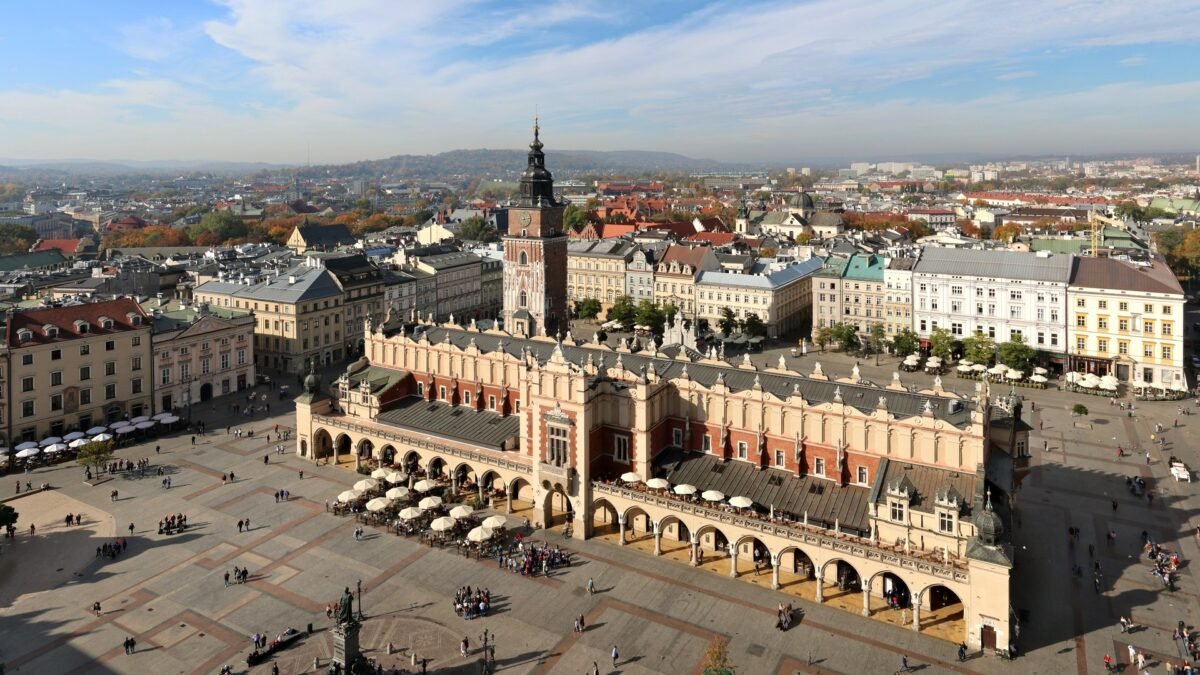
Six people were killed and 15 more were injured on Saturday afternoon after a gunman drove into the Main Market Square in Krakow and opened fire at random on the crowds in one of Europe’s most famous public squares, according to Polish police.
The attack, in the historic heart of Poland’s second-largest city, unfolded at about 3pm local time, when a man drove his car onto the Rynek Gówny — the vast medieval square lined with cafes, bars and market stalls — and began shooting at passers-by from inside the vehicle, police said.
Four women and two men were among those killed, according to the police. Two police officers were wounded by gunfire as officers confronted the gunman; one of them was in a serious condition and undergoing surgery, Poland’s interior ministry said.
The suspected gunman, a 24-year-old Polish citizen, was shot by police and detained before being taken to hospital, according to the police. Officers said he had acted alone and denied reports that they were searching for a second attacker.
Police said the man was wearing military-style clothing, including fatigues and a bulletproof vest, and was carrying a military-type long gun. Officers recovered many other weapons and a large quantity of ammunition from his car, according to the police.
“A man who had driven onto the square began firing at random people from his car,” the regional police force said in a statement. “The perpetrator was shot by police officers.”
The shooting took place in a square that is normally thronged with tourists and local families on a Saturday afternoon. Krakow draws more than 15 million visitors a year, according to the city’s tourism figures, and most of them pass through the Main Market Square, one of the largest medieval squares in Europe.
Video footage from the scene showed heavily armed police wearing helmets and tactical gear moving through the square as sirens sounded and pedestrians hurried away, according to Reuters. Police privacy screens were later installed around a cordoned-off area of the square, and emergency services continued working at the scene into the evening.
Polish Prime Minister Donald Tusk said in a post on social media that police were investigating the “tragic shooting” and that he was being updated by the interior ministry. President Karol Nawrocki said the head of Poland’s National Security Bureau, Bartosz Grodecki, was travelling to Krakow, adding: “My thoughts are with the victims, those injured and their families.”
The city’s mayor, Łukasz Gibala, declared an official period of mourning in Krakow until 11 November, according to local reports.
What happened in the square
According to the police account, the gunman arrived by car at the Main Market Square shortly after 3pm and began shooting without distinguishing between his targets. Katarzyna Cisło, a spokesperson for the Krakow police, told the broadcaster TVN24 that the attacker went on what she described as a “wild ride” around the square, which was why people were wounded at several different locations rather than in a single spot.
Police said the gunman fired indiscriminately at passers-by from a moving vehicle. The square, ringed by the Renaissance Cloth Hall, St Mary’s Basilica and the Town Hall Tower, is one of the busiest pedestrian spaces in Central Europe, and at 3pm on a Saturday it would have been full of shoppers, cafe customers and sightseeing groups.
Officers responding to the attack confronted the gunman a short distance from the initial shooting. According to a police spokesperson, officers used their weapons during the arrest, the man returned fire, and two police officers were among the injured. One officer suffered three gunshot wounds and was in a very serious condition, according to the interior ministry, while the other officer’s injuries were less severe.
The gunman was shot and wounded during the confrontation before being detained and taken to hospital, the police said. Footage circulating on social media appeared to show a police officer standing over a man in tactical gear lying on the ground.
Police confirmed on social media that the only known perpetrator had been arrested and was in custody, and that he was a Polish citizen. “The person responsible for the incident at Krakow’s Main Market Square is a citizen of the Republic of Poland,” the police said in a statement, adding that he had been wearing military camouflage clothing and carrying a military rifle, which had been seized along with a large amount of ammunition and other weapons found in his vehicle.
According to the broadcaster RMF FM, the attacker was driving a black Subaru and used an AR-15-type rifle. That detail had not been confirmed by the police in their public statements, and the precise make of the weapon remained unverified on Saturday evening.
The authorities have not established a motive for the attack. There was no confirmed evidence linking the gunman to a terrorist organisation, a foreign intelligence service or any extremist group, according to reports from the scene, and the police have not described the shooting as terrorism.
A city in mourning
The dead were four women and two men, the police said. The injured numbered at least 15, including the two police officers. Hospitals in Krakow received the wounded through the afternoon, and the police said emergency services were still working at the scene hours after the shooting.
Krakow is Poland’s second-largest city and lies about 250 kilometres south-west of the capital, Warsaw. Its Old Town, built around the Main Market Square, is a UNESCO World Heritage site and one of the most visited places in the country. The square itself measures roughly 200 metres by 200 metres and is dominated by the Cloth Hall, a Renaissance trading hall that still houses market stalls, and by the twin towers of St Mary’s Basilica, from which a trumpeter sounds the hourly Hejnał call.
On an ordinary Saturday the square is a working market, a meeting place and a tourist attraction at once: flower sellers and souvenir stalls under the Cloth Hall arcades, horse-drawn carriages waiting by the basilica, cafes spilling onto the cobbles. The attack struck at the heart of that daily life, in a space that belongs to everyone in the city and to nobody in particular.
The mayor’s declaration of mourning until 11 November covers the days in which Krakow would normally be preparing for Poland’s Independence Day on 11 November, one of the most important dates in the national calendar. Flags in the city were expected to fly at half-mast, and public events were being reviewed.
President Nawrocki’s decision to send the head of the National Security Bureau to the scene underlined how seriously the Polish state was treating the attack, even though the police had already established that the gunman acted alone. The Bureau, a government agency responsible for national security and defence, advises the president on security threats, and its chief’s presence in Krakow signalled that the investigation would be followed at the highest level.
Prime Minister Tusk, who was being updated by the interior ministry, described the shooting as tragic and said the police were investigating. His government, which took office promising to restore the rule of law and strengthen state institutions, now faces the first mass-casualty attack of its tenure in a major Polish city.
Poland’s strict gun laws
Poland, like most European Union countries, has strict rules about who may own a gun, and very few people are allowed to own firearms or to carry them in public, according to CNN. Firearm ownership in Poland is treated as a privilege granted through a permit system, not as a constitutional right, and every applicant must prove a specific, justified reason for wanting a gun, pass medical and psychological evaluations, and clear a background check before the police will issue a permit.
Around 411,000 people hold gun permits in Poland, a country of about 37 million people, and interest in gun ownership has been rising, according to the Associated Press. The total number of registered civilian firearms recently passed one million, more than double the roughly 380,000 registered guns recorded in 2015, according to Polish police figures cited in recent reporting. Even so, Poland has one of the lowest rates of civilian gun ownership in the European Union: as recently as 2017 it had roughly 2.5 civilian firearms per 100 residents, the lowest rate in the EU at the time, and fewer than one in a hundred citizens holds a valid permit.
The main permit categories are sport shooting, hunting, collecting and personal protection. Sport shooting is the most common route and requires membership of a shooting association and documented participation in competitions. Personal protection is the hardest permit to obtain: an applicant must prove a constant, real and above-average threat to life, health or property, supported by objective evidence. The governing law is the Act on Arms and Ammunition of 21 May 1999, which starts from a default position of prohibition: acquiring, possessing or selling firearms and ammunition is illegal unless the holder has the right permit.
It was not immediately clear on Saturday evening whether the firearm used in the attack, or the other guns found in the perpetrator’s car, were legally held, according to the Associated Press. The Sun newspaper reported that the suspect held a firearms permit, but the police had not confirmed that detail in their public statements, and the question of how the gunman obtained his weapons is likely to become one of the central lines of the investigation.
The contrast between the number of weapons recovered from the car and the strictness of the permit system is one of the most troubling features of the attack. If the weapons were legally held, investigators will want to know what checks the gunman passed and whether any warning signs were missed. If they were not, the question becomes how a man was able to assemble an arsenal of military-style weapons and ammunition without detection.
How rare are attacks like this in Poland?
Mass public shootings are exceptionally rare in Poland, and in the European Union more broadly. Poland’s homicide rate is among the lowest in Europe, and gun crime is a small fraction of overall violent crime. The country has no recent history of the kind of random mass shooting that has become grimly familiar in the United States, and Saturday’s attack in Krakow will be remembered as one of the worst acts of gun violence in modern Polish history.
That rarity is part of why the attack has shocked the country so deeply. Krakow is not a city associated with political violence or organised crime on this scale. It is a university city and a cultural capital, the former seat of Polish kings, and its Main Market Square is a symbol of Polish civic life that has survived centuries of war, occupation and political upheaval.
The attack also comes at a moment of heightened security anxiety across Europe. Poland, which shares a border with Ukraine and has been a central hub for Western military and humanitarian support since Russia’s full-scale invasion in 2022, has lived for nearly five years with war on its doorstep. Polish officials have repeatedly warned about sabotage, disinformation and hybrid threats, and the country’s security services have been on alert for Russian-linked activity. Nothing in the public evidence so far connects Saturday’s shooting to any of those threats, and the police have given no indication that the gunman had any foreign backing — but the context means that investigators will examine the possibility carefully before ruling it out.
Europe has seen a series of lone-actor attacks in public spaces in recent years, from vehicle rammings to knife attacks, and each has forced the same painful public conversation about how a state can protect open, crowded places without closing them off. Krakow’s Main Market Square, like the Christmas markets, railway stations and promenades that have been targeted elsewhere in Europe, is by design an open space: no barriers, no ticket gates, no security checks. That openness is what makes it beloved, and it is also what makes it vulnerable.
Analysis: Why It Matters
1. A rare horror in one of Europe’s safest countries
The first thing to understand about Saturday’s shooting is how unusual it is. Poland is one of the safest countries in Europe by almost every measure that matters: a low homicide rate, very little gun crime, and a civilian population in which fewer than one person in a hundred holds a firearms permit. Mass shootings of this kind are not part of the country’s recent history, and there is no domestic template for what happened in Krakow. That is precisely why the shock has been so profound. When a random attack strikes a crowded square in a country where such things are not supposed to happen, the sense of violation runs deeper than the casualty figures alone can explain, because it breaks a settled assumption about safety. The Polish public has long accepted strict gun laws as the price of that safety, and the fact that a man in military fatigues was able to drive into the country’s most famous square with a military-style rifle and a car full of weapons will inevitably reopen the question of whether the system worked as intended. For now, that question has no answer, because it is not yet known whether the weapons were legally held. But the question itself is the story of the coming days: a society that prides itself on low gun violence must now explain how its controls were circumvented or, worse, complied with.
2. The square itself is the story
The choice of target, if it can be called a choice, matters as much as the weapon. The Rynek Gówny is not a government building, a military installation or a symbolic institution of the state. It is a market square: the place where a city eats, trades, meets and celebrates. Attacks on such places carry a particular cruelty, because they strike at the most ordinary and defenceless form of public life. A parliament can be guarded; a square cannot, or at least not without ceasing to be a square. The attack in Krakow belongs to a grim European pattern in which the targets have been Christmas markets, promenades, concert halls and cafes — places chosen precisely because they are open, crowded and unguarded. What makes Krakow’s square different is its history. This is a space that has been the centre of Polish civic life for more than seven centuries, a UNESCO-listed Old Town that survived the Second World War largely intact and became, after 1989, the showcase of a free Poland. An attack there is an attack on a piece of national heritage as well as on the people who happened to be standing in it. That is why the mourning declared by the mayor, and the presence of the National Security Bureau chief, carry weight beyond protocol: the state is signalling that this was not only a crime but an assault on a place that belongs to the whole country.
3. What the police response tells us
The speed with which the attack ended is one of the few reassuring facts of the day. Within minutes of the first shots, armed officers were on the scene, confronted the gunman and shot him, at the cost of two officers wounded. That the gunman was stopped before he could do more damage is a credit to the police response, and the officer now fighting for his life after suffering three gunshot wounds is the human price of that intervention. But the police account also raises questions that will need answers. The gunman was able to drive onto a pedestrian square and begin what the police spokeswoman called a “wild ride”, wounding people at several locations before he was stopped. In a city centre that has been progressively pedestrianised, the question of vehicle access to the square — which vehicles may enter, through which streets, and with what checks — will now be examined closely. Krakow, like many European cities, has wrestled with the balance between keeping its historic centre open to delivery vehicles, residents and emergency services and protecting it from exactly this kind of attack. Bollards, barriers and vehicle restrictions are already common in European city centres, and the fact that a car could enter the square and move around it freely will be a central part of the official review. The police were quick, but the square was open, and the gap between those two facts is where the next debate will happen.
4. The questions investigators must now answer
Four questions will dominate the investigation, and each of them carries consequences beyond this one case. First, the motive: the police have said nothing about why a 24-year-old Polish citizen would open fire at random on strangers, and until they do, speculation will fill the vacuum. Investigators will be examining his background, his online activity, his associations and his mental health history, and the public will be watching for any sign of ideology, grievance or delusion. Second, the weapons: how many guns he had, where they came from, and whether they were legally held. The answer will determine whether this becomes a story about enforcement failure or about a permit system that granted a dangerous man the means to kill. Third, the permit system itself: if the gunman held a permit, what medical and psychological checks did he pass, when were they carried out, and were there warning signs that should have triggered a review? Poland’s system is designed to catch exactly this kind of risk, and if it did not, the system will need reform. And fourth, the security of public space: whether the square’s vehicle access arrangements were adequate, and whether other Polish cities need to reassess their own defences. None of these questions has an answer yet, and it would be wrong to prejudge them. But they are the questions on which the public debate will turn, and the credibility of the official response will depend on how openly they are answered.
5. A test for Poland’s institutions — and for its politics
Finally, the shooting is a test of Poland’s institutions at a sensitive moment. The Tusk government has spent its time in office arguing that the Polish state can be both strong and lawful, and the response to a mass-casualty attack is one of the moments when that claim is judged in public. The early signs — a rapid police response, clear public communication from the police, a presidential visit to the scene through the National Security Bureau, and a mayor’s declaration of mourning — suggest a state that knows how to behave in a crisis. The harder test comes next: whether the investigation is transparent, whether the findings are published honestly even if they are uncomfortable, and whether any reforms that follow are real rather than symbolic. Poland’s politics are polarised, and there is a risk that the attack becomes a weapon in the country’s political arguments — about gun laws, about security, about the state of the nation. That would be a disservice to the victims. The six people killed in the square were not political symbols; they were shoppers, tourists, families and passers-by, and the measure of the country’s response will be whether it honours them with facts, accountability and quiet competence rather than with rhetoric.
What to Watch Next
- The casualty toll and the condition of the wounded: Hospitals in Krakow were still treating the injured on Saturday evening, and the condition of the police officer who suffered three gunshot wounds will be the most closely watched update. Any change in the death toll would reshape the scale of the tragedy.
- The gunman’s condition and the charges he will face: The suspect was taken to hospital after being shot by police. Once he is fit to be questioned, prosecutors will decide on charges, and the first court appearance will reveal what the investigation has established about his background and his weapons.
- The motive and the question of terrorism: The police have not established a motive and have not described the attack as terrorism. Investigators’ findings on the gunman’s background, online activity and associations will determine whether that assessment holds.
- Whether the weapons were legally held: The legality of the firearms found in the gunman’s car is the single most important unanswered factual question. If he held a permit, the scrutiny will fall on the medical, psychological and background checks behind it; if he did not, it will fall on enforcement and the black market.
- Security changes in Krakow and beyond: Expect a review of vehicle access to the Main Market Square and possibly to other pedestrianised centres in Poland, alongside a renewed national debate about gun permits, which have already been rising sharply in recent years.
Sources
- CNN — At least 6 dead in shooting in the main market square of Krakow, Poland, police say
- The Times — Krakow shooting: six killed and 15 injured near main square
- Associated Press via Gazette & Herald — Six killed and at least 15 injured in Krakow shooting
- EuropeSays — Kraków attack caught on camera: Six dead as police confront gunman
- Wikipedia — Gun laws in Poland (background on permits and ownership)
- LegalClarity — Are Guns Legal in Poland? Permits and Ownership Rules

About the Author — Abdul Mannan
Related Articles
New Zealand Election Ends in Deadlock as Luxon’s Coalition Clings to a One-Seat Lead and Weeks of Talks Loom
New Zealand's general election ended in a knife-edge deadlock, with Christopher Luxon's governing coalition clinging to a one-seat…
Europe Rejects Trump’s ‘Big, Beautiful’ Security Deal With Russia as Zelensky Warns Against a ‘Yalta 2.0’
Europe has rejected President Trump's proposal for a sweeping security deal with Russia, with the EU's Kaja Kallas…
At Least 30 Killed in Attack on Market in Yemen’s Taiz as Houthis and Government Trade Blame
At least 30 people were killed when strikes hit a crowded market in Yemen's Taiz province on Friday,…