
New Zealand Election Ends in Deadlock as Luxon’s Coalition Clings to a One-Seat Lead and Weeks of Talks Loom

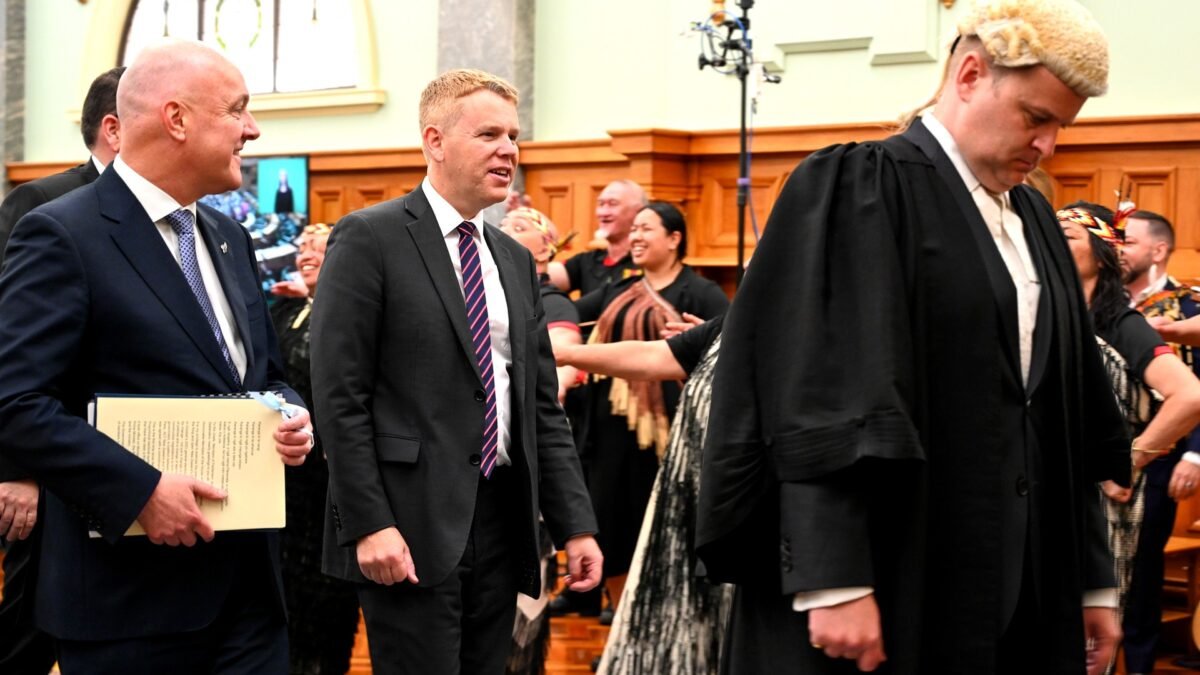
New Zealand’s general election ended in deadlock on Saturday, 7 November, with neither of the country’s two great political blocs able to claim a clear mandate and the shape of the next government still unresolved hours after the polls closed. With more than 95 per cent of the votes counted, Prime Minister Christopher Luxon’s governing coalition was clinging to the slimmest of leads — a projected majority of just one or two seats — while the opposition insisted that hundreds of thousands of yet-uncounted special votes could still change everything.
According to the Associated Press, the incumbent conservative government “hovered on the brink of a wafer-thin majority that could allow it to eke out a precarious return to power” after a night in which the two major parties finished within a few thousand votes of each other, each polling just under 30 per cent of the party vote. Neither leader claimed victory. Luxon told supporters in Auckland that his party had “a pathway to forming the next government” but admitted the race remained “too close to call”. Labour leader Chris Hipkins, addressing supporters in Upper Hutt, did not concede, telling the crowd that “every vote matters. And every vote must be counted.”
The Electoral Commission is not due to declare the official result until Friday, 27 November, once special votes — ballots cast overseas, by voters outside their home electorates and by people who enrolled late — have been counted. Until then, New Zealand faces weeks of political limbo, with coalition negotiations likely to drag on even after the final numbers are known.
A Night Without a Winner
Voting in the general election closed at 7 p.m. local time on Saturday, 7 November, after advance voting that began on 26 October. Nearly 1.67 million people had already voted before election day, according to New Zealand media, out of about 3.8 million eligible voters in a country of 5.6 million people, the Associated Press reported. The Electoral Commission aimed to report results from 50 per cent of voting places by 10 p.m. and 95 per cent by 11.30 p.m. local time.
As the count progressed through the night, the two major parties swapped the lead repeatedly. At about 40 per cent counted, Labour was ahead on the party vote with 29.88 per cent against National’s 29.35 per cent, a gap of about 8,000 votes, according to the Electoral Commission feed reported by New Zealand media. By the end of the night, with roughly 2.38 million votes counted, the positions had effectively reversed: National stood on about 29.3 per cent and Labour on about 29.2 per cent, separated by only some 2,500 votes. CNN reported that Labour had received the highest share of the popular vote “by a tiny margin”, a reminder of how fluid the numbers remained as the count advanced.
What was not in doubt was the scale of the rejection of both major parties. Neither National nor Labour cleared 30 per cent of the vote, a result the Associated Press described as underscoring opinion polls before election day “that showed little public enthusiasm for either party”. It was, by several measures, the weakest combined showing for the two parties that have dominated New Zealand politics for nearly a century.
Luxon addressed supporters at National’s headquarters in Auckland after midnight. “National is once again the largest party in Parliament and we have a pathway to forming the next government,” he said, according to the Associated Press. “But I have to tell you right now it is too close to call.” He said the country would need to wait until the Electoral Commission delivered the final official results on 27 November for certainty.
Hipkins, speaking at Labour’s headquarters in Upper Hutt, outside Wellington, was smiling as he addressed his supporters. “Tonight, New Zealand has spoken,” he said. “It may take us a little bit longer to figure out exactly what it is that you’ve said.” Hipkins, who served briefly as prime minister in 2023, did not concede defeat. He was seeking a second chance at power after what the Associated Press called a “resounding defeat three years ago”, but he had not benefited much from Luxon’s slumping popularity in pre-election opinion polling. The final pre-election poll, published on Friday, had put Labour on 30.7 per cent and National on 26.4 per cent.
The Numbers That Will Not Sit Still
Under New Zealand’s mixed-member proportional system, known as MMP, voters cast two votes: one for their preferred party and one for a local representative. A party must win either an electorate seat or 5 per cent of the party vote to enter Parliament, and the total number of seats is determined by official calculations on election night based on the quirks of the system. New Zealand switched to MMP in 1996.
On the Electoral Commission’s preliminary seat projection, the three governing parties — National, the libertarian ACT party and the populist New Zealand First — held 67 seats between them: 42 for National, 13 for ACT and 12 for New Zealand First, according to the Associated Press. The opposition grouping of Labour, the Greens and the Indigenous rights party Te Pāti Māori held a combined 56 seats, with Labour on 35, the Greens on 16 and Te Pāti Māori on five. CNN put the left bloc at 57 seats. A seventh party, the centrist Opportunity Party, won seven seats on about 6 per cent of the vote.
Even the size of the next Parliament was unsettled. Because National won more electorate seats than its share of the party vote would normally earn it — it was leading in 42 of the country’s 71 electorates — the Parliament is expected to swell beyond its usual 120 members through so-called overhang seats. The Associated Press reported a possible 130-seat Parliament, with 66 seats needed for a majority. CNN reported 131 seats, with the governing grouping holding a two-seat majority. Other projections put the figure at 129 or 130. On any of those counts, the governing parties’ lead amounts to one or two seats — the slimmest possible return, as the Associated Press put it.
The Greens were celebrating their best-ever result, with an apparent 16 seats in Parliament, according to the Associated Press, and a record share of the party vote of about 13.7 per cent. ACT also recorded its strongest result, with about 11 per cent of the vote, and New Zealand First took about 10 per cent. Both of Luxon’s coalition partners increased their vote share and their seat counts, putting them in a stronger position to dictate terms in the coalition talks ahead.
For National, the night was a sharp comedown. The party took 38 per cent of the vote when it won power in 2023; on the preliminary count it had fallen to about 29.3 per cent, according to CNN. Its coalition partners’ gains offset its losses in the seat count, but not the political damage: Luxon now leads a diminished party inside a coalition in which his partners hold more of the cards than they did three years ago.
The night also suggested a startling exit from Parliament for some of National’s most senior figures, according to the Associated Press, including Finance Minister Nicola Willis, Speaker of the House Gerry Brownlee, Defence and Justice Minister Paul Goldsmith, and Attorney-General and Transport Minister Chris Bishop. Bishop was reported to be trailing Labour’s Ginny Andersen by about 900 votes in the Hutt South electorate. If those results stand, Luxon would have a complex job filling key cabinet posts in a second term.
The Newcomer in the Middle
The defining surprise of the night was the performance of the Opportunity Party, a centrist party that had never before won seats in Parliament. Led by 38-year-old Qiulae Wong, it cleared the 5 per cent threshold with about 6 per cent of the vote, winning seven seats and thrusting itself into a potential kingmaker position.
Wong is a political newcomer in the fullest sense. According to CNN, she applied for the party’s leadership by responding to a job advertisement a year ago. On election night she told supporters they had voted “to change New Zealand politics for good”. The party, which describes itself as both business-friendly and climate-friendly, positions itself as socially liberal, technocratic and pro-environment, and has pledged a non-partisan and pragmatic agenda.
It was too soon on Saturday night to know whether Wong’s support would be required for any leader seeking to form a governing majority. The Associated Press reported that Wong had said that if she held the tiebreaker power, she was open to negotiating with either a conservative or a left-wing government, and would deal first with whichever major party won the most votes. Luxon had previously ruled out working with the party, and the Associated Press noted that the right-wing bloc might not need her. Analysts quoted by the agency said, however, that both major party leaders would likely “answer the phone” if Wong held the only path to power.
CNN reported that Opportunity becomes the first total outsider party — one not involving established political figures — to enter Parliament since the country moved to the mixed-member proportional voting system in the mid-1990s. The Associated Press put it differently, calling Opportunity the first new entrant party in more than a decade. Either way, its arrival marks a break in a system in which new parties have rarely survived the 5 per cent threshold.
A Wounded National Party
The incumbent coalition that took power in 2023 was, as CNN noted, the country’s most right-wing in a generation, capitalising on an electorate looking for change in the wake of the Covid-19 pandemic. Three years on, its struggle to secure an emphatic victory signified the level of public discontent over living costs, stubbornly high unemployment rates and concerns over healthcare, CNN reported.
Analysts had suggested before the election that economic woes — including inflation, living costs and unemployment — and apathy about the premierships of either Luxon or Hipkins would see minor parties grow in popularity, granting them greater bargaining power in forming a governing coalition and forcing the major parties to enact more of their agendas. That is broadly what happened.
The stronger-than-expected result for New Zealand First and ACT, and National’s weakened position, raises the prospect of the coalition moving further to the right in a second term and further embracing culture-war policies, CNN reported. On the campaign trail, ACT vowed to end affirmative action schemes at the country’s medical schools, while New Zealand First promised sweeping immigration changes and voiced support for a review of the ban on gay conversion therapy.
Luxon’s difficulties will not end with the arithmetic. His detractors criticised his political inexperience during his tenure in a power-sharing deal with two veteran and canny politicians, David Seymour of ACT and Winston Peters of New Zealand First, the Associated Press reported. Both will want greater influence in any coalition formed on Saturday’s results, and both have shown, over the past three years, that they are willing to use their leverage in public.
Hipkins, for his part, faces his own reckoning. He led Labour into the election hoping to reverse the party’s catastrophic collapse of 2023, when it lost power after six years in government. Labour’s vote share on Saturday night was only marginally better than its 2023 result, and its seat count of 35 was far short of the 42 National won despite the two parties polling almost identically. That disparity stems from how seat allocations are calculated under MMP: National’s strength in individual electorates delivered it more seats than its share of the party vote would suggest, while Labour’s support was spread more thinly across the country.
What the Campaign Was About
The campaign was dominated by the economy. Voters told pollsters and journalists that their concerns were the cost of living, jobs and the health system, and the governing parties struggled to convince them that the country was on the right track. Unemployment has remained stubbornly high, and the cost of everyday goods has continued to squeeze household budgets, even as inflation has eased from its peak.
The result was a campaign in which neither leader inspired much enthusiasm. Opinion polls before election day showed little public appetite for either Luxon or Hipkins as prime minister, and the final tallies bore that out: voters turned instead to minor parties on the ideological flanks and to Opportunity in the centre. The Greens’ record result and ACT’s best-ever showing were two sides of the same coin — an electorate that wanted sharper, more distinctive choices than the two big parties offered.
New Zealanders do not elect prime ministers directly. They cast two votes, one for their preferred party and one to select a local representative, and the prime minister emerges from the coalition negotiations that follow. That is why Saturday night ended without a winner: under MMP, the election is only the first act, and the government is assembled in the weeks that follow.
Analysis: Why It Matters
A verdict on both big parties, not just one
The most important fact of this election is not who finished first but how little either of the two big parties won. National and Labour have dominated Wellington politics for nearly a century, taking turns in government while smaller parties orbited around them. On Saturday, between them, they took less than 60 per cent of the vote. That is not a normal election result in New Zealand; it is a structural warning. Voters did not merely punish the government, as they often do after a difficult term. They also declined to reward the opposition. Hipkins could not convert Luxon’s unpopularity into a Labour victory, and Luxon could not convert incumbency into a renewed mandate. The two-party system did not collapse on Saturday night, but it bent further than it has in a generation, and the bend may not straighten.
The arithmetic now belongs to the minor parties
Whatever government emerges, it will be built on terms set by parties that won a tenth of the vote each. ACT and New Zealand First both increased their vote shares while National shrank, which means their price for a second term will be higher than it was for the first. In 2023, Luxon needed them; in 2026, he needs them more, and they know it. The same logic applies on the left: the Greens’ best-ever result gives them a louder voice in any Labour-led arrangement, and Te Pāti Māori’s five seats matter in a Parliament where every seat counts. The paradox of this election is that the parties with the least votes now hold the most power over the outcome. That is how MMP is designed to work, but it is rarely this visible.
Opportunity’s kingmaker problem
Qiulae Wong’s party has won the hardest prize in New Zealand politics — a place in Parliament as a genuine outsider — and now faces the hardest problem: what to do with it. If the right bloc holds its one-seat lead after the special votes are counted, Opportunity’s seven seats will not be needed, and Wong will sit on the crossbenches as a new voice with no leverage. If the bloc falls short, she becomes the most courted person in the country, with both sides offering her whatever she wants. Her promise to deal first with whichever major party won the most votes is a sensible way to stay neutral, but neutrality will be hard to maintain once the offers begin. The party’s claim to be non-partisan and pragmatic will be tested by the first decision it has to make, and that decision may define it for a decade. New parties that enter Parliament on a wave of goodwill often discover that the wave breaks quickly once they take a side.
Special votes: the left’s quiet hope
The one card the left still holds is the special vote. Hundreds of thousands of special votes remain to be counted, and they have historically favoured parties on the left. In the past four elections, National lost one or two seats when the special votes were counted, while left-wing parties won between one and three additional seats, according to the Associated Press. If that pattern repeats, the right bloc’s 67 seats could fall to 65 or 66 — below a majority — and the entire shape of the negotiation would change. That is why Hipkins’s line, “every vote must be counted”, was more than a platitude. It was a statement of strategy. But the left should not overstate its hope: special votes have narrowed National’s lead before, but they have never overturned an election-night result on this scale, and the 2026 pattern may not follow the old one. The official count on 27 November will settle it.
A government that may govern to the right of its mandate
If Luxon does secure a second term, he will do so at the head of a coalition that is further to the right than the one he led into the election, and further to the right than the electorate that voted for it. National lost votes; ACT and New Zealand First gained them. The price of their support will be policies that National itself did not campaign on — the end of affirmative action in medical schools, sweeping changes to immigration, a review of the conversion therapy ban. Luxon will have to decide how much of that agenda he is willing to own, knowing that it was not his party’s vote that delivered it. A government that governs to the right of its mandate can survive, but it invites the same backlash that produced this result. The 2026 election may turn out to be less a verdict on the last three years than a preview of the next three.
What to Watch Next
- The special votes. More than 172,000 special votes had already been recorded by election night, and the final total is expected to run into the hundreds of thousands. Their count will determine whether the right bloc’s one-seat lead survives. The Electoral Commission will declare the official results on Friday, 27 November.
- Whether the right bloc holds 67 seats. The seat projection fluctuated through the night as the count progressed, and the final size of Parliament — 129, 130 or 131 seats — is itself still unsettled. A single seat lost to the special votes could erase the governing parties’ majority entirely.
- Coalition talks. Even if the right bloc holds its lead, Luxon must renegotiate with ACT and New Zealand First, both of which emerged stronger. Their demands — and how much of them Luxon accepts — will shape the next government’s programme. After the 2023 election, coalition negotiations took weeks even when the majority was clear.
- Opportunity’s decision. If neither bloc commands a majority after the official count, Qiulae Wong’s seven MPs become decisive. Her promise to deal first with the largest party will be tested, and Luxon’s earlier refusal to work with her party may have to be revisited.
- The parliamentary deadline. Constitutionally, the next Parliament must meet no later than six weeks after the return of the writs, which means MPs must gather in Wellington by 14 January at the latest. Before then, New Zealand needs a government — or at least a caretaker arrangement that can hold the country together while the talks continue.
Sources
- Associated Press — Conservative bloc takes a slim lead in New Zealand election that’s still too close to call
- CNN — New Zealand in political limbo after knife-edge election
- New Zealand Electoral Commission — 2026 General Election preliminary results
- The Sun Report (Richard Shaw, Massey University) — A knife-edge result, 3 possible outcomes: what comes next after NZ’s election?
- Newswire — Labour narrowly leads New Zealand election party vote, but National, ACT and NZ First hold a bare majority with 40 per cent counted
- AsiaToday — New Zealand election results: coalition’s one-seat lead

About the Author — Abdul Mannan
Related Articles

Europe Rejects Trump’s ‘Big, Beautiful’ Security Deal With Russia as Zelensky Warns Against a ‘Yalta 2.0’
Europe has rejected President Trump's proposal for a sweeping security deal with Russia, with the EU's Kaja Kallas…

At Least 30 Killed in Attack on Market in Yemen’s Taiz as Houthis and Government Trade Blame
At least 30 people were killed when strikes hit a crowded market in Yemen's Taiz province on Friday,…

Hormuz on a Knife’s Edge: Trump’s Looming Iran Decision and the Strait the World Cannot Lose
President Trump says a decision on further military action against Iran is coming soon. Qatar says a deal…