
The Pope Who Came Home: Leo XIV, Argentina, and a Wounded Nation’s Long Wait

A Long Silence, Broken at Last
What does a nation do when the man it has waited for finally comes — and he is not the man it expected? Today, Sunday 8 November 2026, Pope Leo XIV lands in Buenos Aires at half past four in the afternoon, and Argentina will have to answer that question in the streets. He is the first pope to set foot on Argentine soil in nearly forty years. He arrives only weeks after surgeons removed a cancerous nodule from his lung. And he arrives in the homeland of the pope who never came home.
Think about that for a moment. Jorge Mario Bergoglio was Archbishop of Buenos Aires. He was elected pope in 2013 and took the name Francis, and for twelve years the Argentine people waited for him to return. He travelled to Brazil, to Cuba, to Mexico, to Colombia, to Chile and Peru — he circled his own country like a man avoiding his own front door. He died in 2025 having never once visited Argentina as pope. The Argentines loved him, and they never quite forgave him for staying away.
Now another man comes in his place. And here is the first irony history offers us: Leo XIV is not Argentine. He is an American, born in Chicago, a son of the Augustinian order who spent the best decades of his life as a missionary and then a bishop in Peru. He is, in the deepest sense, a man of the Americas who learned his faith not in the seminaries of Rome but in the dust and the heat of Chiclayo. He comes to Argentina not as a native son returning, but as a neighbour who has walked the same roads. Sometimes, I have come to believe, the stranger understands a house better than the son who left it.
The Pope Who Never Came Home
History, if you read it honestly, is a mirror — and Argentina has been staring into one for a long time. The last pope to visit was John Paul II, in 1982 and again in 1987. The 1982 visit came in the shadow of the Falklands War, when a Polish pope stood before a military junta and a grieving nation and spoke of reconciliation. It was an act of moral courage. But nearly four decades have passed since a Successor of Peter last walked these streets, and in those decades Argentina has lived through hyperinflation, default, populism, and a political fracture so deep that Argentines have given it a name of its own: la grieta — the rift.
When Archbishop Jorge García Cuerva of Buenos Aires spoke recently of “a wounded Argentina, a divided Argentina,” he was not using the language of diplomacy. He was describing a country where families no longer discuss politics at the dinner table, where poverty has become a permanent condition for millions, and where hope itself has started to feel like a luxury. Into this Argentina walks Leo XIV — a pope who, as the Archbishop’s words suggest, does not yet belong to either side of the divide. That is precisely his power. A man who belongs to no faction can speak to all of them. And no honest account of this visit can pretend the comparison with Francis does not exist: every pope inherits the unfinished business of his predecessor, and Leo inherits the most human of all — a homecoming that never happened.
A Wounded and Divided Argentina
Look at the itinerary and you will see a man who understands the country he is entering. He does not begin with ceremony alone. After the welcome at the Casa Rosada and his meeting with President Javier Milei, after the visit to the memorial of General José de San Martín — the liberator, the father of Argentine independence, the one figure every Argentine still agrees on — Leo goes to the margins. On Monday 9 November he will visit the Pequeño Cottolengo in Claypole, a home for people with disabilities run by the Sons of Divine Providence. He will celebrate Mass in Palermo before a crowd organisers expect to surpass 1.5 million people. He will meet representatives of the world of work, and leaders of other Christian churches and other faiths.
Read that list again, slowly. The disabled. The workers. The believers of other faiths. The bishops. This is not the schedule of a tourist. It is the schedule of a pastor who has read the country before arriving in it — the woman in Claypole who has cared for a disabled child for thirty years on a pension that no longer buys bread, the worker whose wages evaporate before the month ends, the young people who have grown up hearing that their country was once one of the richest on earth and wondering what happened to the promise.
On his final day, before flying to Peru, Leo will do two things that tell you everything about the man. He will visit the federal prison of Devoto. And he will celebrate what organisers are calling the Mass of Charity at the Basilica of Our Lady of Luján, the shrine of Argentina’s national patroness. A prison and a shrine. The forgotten and the beloved. If you want to know a leader, do not watch where he is applauded. Watch where he chooses to go when no applause is guaranteed.
The Man Who Walked Back from the Surgeon’s Table
There is another story here, and it may be the most important one of all. On 13 October, less than a month ago, surgeons removed a nodule from this pope’s lung. The diagnosis was adenocarcinoma — lung cancer. The Vatican announced on 21 October that his physicians had declared him fit, and on 26 October that the journey would proceed as planned. At the Vatican briefing on 3 November, the Holy See Press Office director Matteo Bruni told journalists plainly: there is no special medical equipment travelling with the pope, no therapy is required, and he is clinically fit to undertake the trip.
Pause on that. A man of seventy-one, weeks out of cancer surgery, boarding a flight of more than fourteen hours to cross an ocean, and then travelling for twelve days across three countries, celebrating nine public Masses and delivering some thirty-six speeches. The Vatican says he is “personally enthusiastic” about the trip. I believe it. But I also see something else in it — a deliberate act of witness. In a world where leaders hide their frailty behind walls of protocol, Leo has chosen the opposite: to walk, visibly, with a body that has just been cut open and stitched shut, and to let the world see that a wounded man can still carry hope to a wounded nation.
Four days before he left Rome, Bob Dylan came knocking on his door. The American singer, in Italy between concert dates, met the American pope at the Vatican. Leo gave him a rosary; Dylan gave him a copy of his autobiography. But the detail that stays with me is this: Leo had quoted, in an earlier address, from an unpublished protest song Dylan wrote in 1963 — a lyric addressed to a hypothetical atomic bomb, warning against the race to rearm and the recourse to nuclear weapons. A pope quoting a protest singer to warn the powerful against the bomb. If you want to understand Leo XIV, start there.
What This Journey Is Really About
Uruguay, where the journey began on 6 November, is the most secularised country in Latin America — a nation that separated church and state with a determination few others have matched. Leo went there first, deliberately, to the Virgin of the Thirty-Three, the small Marian image that Uruguay’s secularisation could never entirely separate from the national identity. In Montevideo he celebrated forty years of uninterrupted democracy. The message was unmistakable: faith and democracy are not enemies. A secular state and a living church can share the same street.
That message matters for Argentina, and it matters for Peru, where the journey ends on 17 November — Lima, Chiclayo, Cusco, Pucallpa — the land where Leo spent his missionary life. But the heart of this journey, the place where its meaning will be decided, is Argentina. Because Argentina is where the questions are sharpest. Can a divided nation be healed by a visit? Can a pope who is not Argentine succeed where an Argentine pope did not even try? Can 1.5 million people in a park in Palermo become something more than a crowd — can they become a country again? I will not pretend to know the answers. But I will tell you what to watch: whether Leo speaks about la grieta by name, whether he meets the poor before he meets the powerful, and how long he stays with each. The measure of this visit will not be the size of the crowds. Crowds are easy. The measure will be whether, a year from now, any Argentine can point to a single thing that changed because the pope came.
The Verdict History Will Write
History has a habit of remembering journeys like this one for reasons the travellers never intended. When John Paul II came to Argentina in 1982, he came to a nation at war. When he returned in 1987, he came to a nation learning democracy again. When Leo XIV comes today, he comes to a nation that has forgotten how to hope together. The parallel is not exact — history never repeats itself cleanly — but the pattern is there for anyone willing to see it: a pope arrives when a country is at a crossroads, and the country must decide whether his visit was a festival or a turning point.
Leo XIV will fly to Peru on 11 November, and Argentina will be left with itself again — with its rift, its poverty, its memories, and its pride. The question this visit poses is not whether the pope loves Argentina. The question is whether Argentina still loves itself enough to become one country again. The crowds in Palermo will answer with their voices. The years will answer with the truth.
A nation is not healed by a visit. It is healed by what the visit awakens. Let us pray — whatever our faith, or even if we have none — that something in Argentina has been awakened today, and that it does not go back to sleep.
Sources & References
Holy See Press Office — Apostolic Journey of Pope Leo XIV to Uruguay, Argentina and Peru (6–17 November 2026), Welcome Ceremony in Uruguay, 6 November 2026.
The Catholic Sun (OSV News) — “Vatican: Pope Leo ‘enthusiastic’ and ‘clinically fit’ for whirlwind Latin America homecoming”, 3 November 2026.
OSV News, via BishopAccountability.org — “Pope Leo heads to a divided Argentina still reckoning with Francis’ legacy”, 4 November 2026.
Wikipedia — “Visit by Pope Leo XIV to Uruguay, Argentina, and Peru” (itinerary and medical timeline, accessed 8 November 2026).
The Associated Press, via KNKX — “Bob Dylan comes knockin’ on pope’s door as Leo welcomes legend to Vatican”, 4 November 2026.
Particle News — “Pope Leo XIV Begins Four-Day Argentina Visit as Security and Holiday Measures Take Effect”, 7 November 2026.
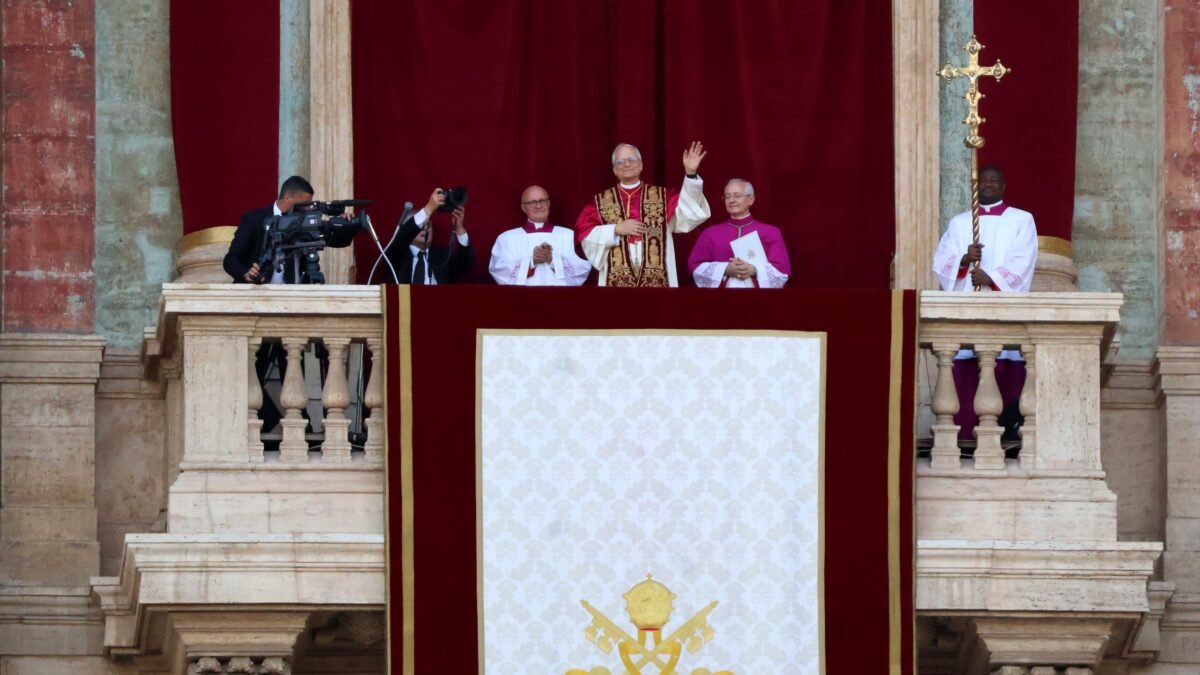
Photo: Pope Leo XIV on the loggia of St Peter’s Basilica, 8 May 2025. Photo: Edgar Beltrán / The Pillar, via Wikimedia Commons (CC BY-SA 4.0).

About the Author — Abdul Mannan
Related Articles
Persecuted and Forgotten? 220 Million Christians and the Silence the World Must Answer
Aid to the Church in Need's new report finds Christian persecution worsened in 55% of the 18 countries…
When the Pontiff Became the Patient: Pope Leo XIV, Cancer, and the Great Equalizer
Five days after surgeons removed the lower lobe of his right lung, Pope Leo XIV stood at his…
Assisi 2026: Forty Years After John Paul II, the World’s Religions Pray Together Again
On 27 October 2026, Pope Leo XIV returns to Assisi exactly forty years after St John Paul II…