
Three Tankers Ablaze in the Strait of Hormuz as Missiles Target Riyadh in Sharp Escalation of the Iran War

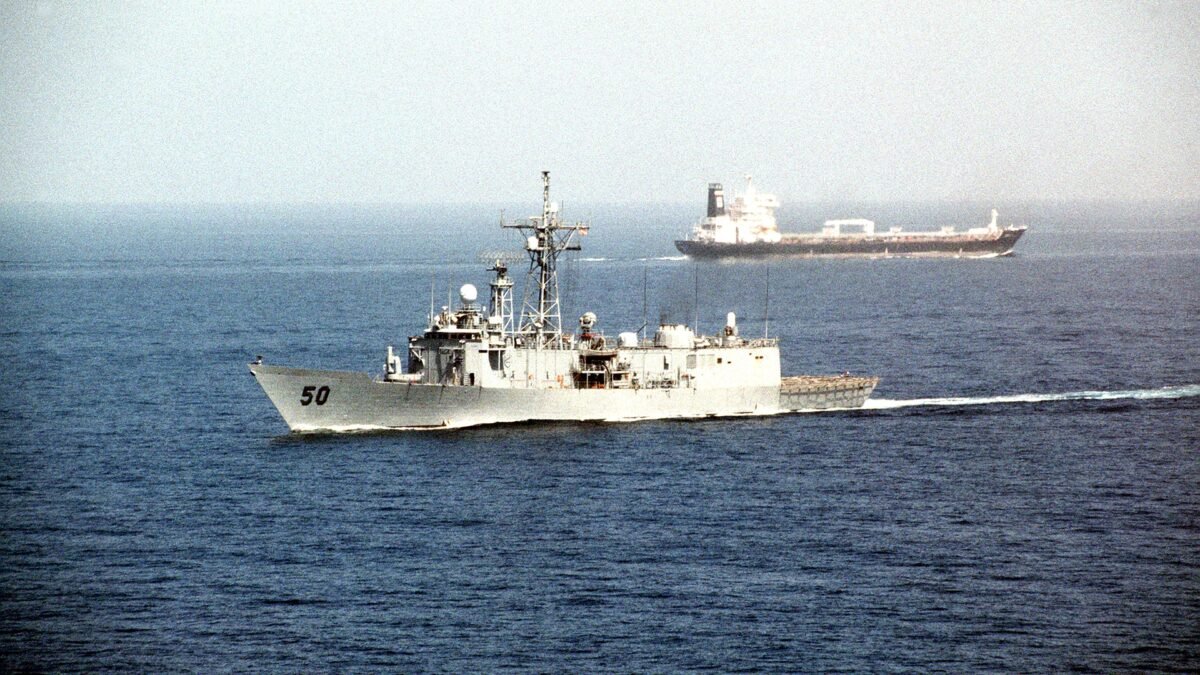
Three oil tankers exploded and caught fire in the Strait of Hormuz in the early hours of Sunday, according to Iran’s Islamic Revolutionary Guard Corps, in the most serious single day of attacks on commercial shipping in the waterway since the war between the United States and Iran began in late February. Hours later, missiles aimed at the Saudi capital, Riyadh, were intercepted overhead, and falling debris damaged a tower belonging to the state oil giant Aramco — a second front opening on the same morning.
The Revolutionary Guard’s navy said in a statement carried by Iranian state media that the three tankers were travelling along what it called an unauthorised route through the strait when they were hit by explosions and severe fires. Thick smoke was blanketing the sky over the critical trade waterway, the statement said, and it warned that any vessel defying Iran’s rules for passing through the strait would meet the same fate.
“These tankers are burning because they turned off their navigation and identification systems and because of the aggression of the American invading military,” the statement said, according to Al Jazeera’s live coverage of the war. “The Iranian regulations for the Strait of Hormuz have been repeatedly announced to all vessels, and defiance of these regulations … will have no other fate.”
No names, flags, owners or casualty figures for the three tankers have been disclosed by any source, and no independent authority has confirmed that three vessels were hit. That gap between the claim and what can be independently established is now a familiar feature of this war at sea — and it is the first thing any reader of Sunday’s events should understand. What follows is what is known, what is claimed, and what remains unverified.
What Is Confirmed — and What Is Only Claimed
The core fact of the morning — that Iran’s Revolutionary Guard says three tankers were hit — is confirmed as a statement, not as an event. Al Jazeera, the French news agency AFP, the news channel WION and the Israeli outlet All Israel News all reported the Guard’s announcement on Sunday, and Iran’s English-language Press TV published the statement in full. That is two or more independent, reputable outlets confirming that the statement was made and what it said. It is not the same as confirming that three tankers burned.
What independent reporting does confirm is that at least one tanker was on fire in the strait on Saturday. The United Kingdom Maritime Trade Operations centre, the Royal Navy-linked reporting centre that acts as the merchant fleet’s point of contact in the region, said a tanker caught fire about eight nautical miles north-west of Khasab, on Oman’s Musandam Peninsula, on Saturday, and that military authorities had evacuated the vessel and its crew to a safe location. UKMTO also reported that another tanker was damaged after being struck by an unidentified missile on Saturday, according to AFP. AFP said it could not independently establish whether the separate incidents were connected.
The cause of the fires is disputed, and the dispute matters. The Revolutionary Guard has attributed the explosions to naval mines and to American military action, saying the tankers were punished for using a route Tehran does not authorise. The United States Central Command, by contrast, has maintained throughout the conflict that all internationally recognised transit routes through the strait have been cleared of sea mines by American forces and remain clear. Neither side has produced evidence that would settle the question in public, and no wreckage, satellite imagery or ship-tracking data identifying the vessels has been released.
The Guard did not take direct responsibility for the explosions, despite having previously fired on vessels attempting to transit outside its approved route and despite having deployed sea mines in the strait, according to All Israel News. Instead it presented the fires as the consequence of the tankers’ own choices — switching off their transponders and sailing an unauthorised channel — and of American aggression. That framing is itself part of the story: Tehran is asserting a right to police the strait, to dictate which route ships may use, and to punish those that do not comply.
Saturday’s Two Tankers Set the Pattern
Sunday’s announcement came less than a day after the Guard said two oil tankers had struck naval mines and caught fire on Saturday, according to Press TV. In a statement late on Saturday, the Guard said the two vessels — one located east of the strategic waterway and the other within the strait itself — had deactivated their navigation and positioning systems in an attempt to slip through an unauthorised southern corridor. Iranian state media reported the same account through the Islamic Republic News Agency, which said the two tankers caught fire after hitting mines.
Taken together, the two days’ claims amount to five tankers hit in a single weekend, according to the Guard. But the independent record is thinner. UKMTO’s Saturday advisory confirms one vessel on fire and one damaged by an unidentified missile; it does not confirm the Guard’s count, the mine explanation, or the claim that the vessels were deliberately running dark. The French agency AFP, reporting the Sunday statement, was careful to note that it could not independently verify the account.
This is not the first time the Guard has made a claim of this shape. On 29 October it said three tankers had exploded and caught fire after striking mines on the same southern route, according to Arab News and the Saudi Gazette. On that occasion, too, UKMTO confirmed only one vessel on fire — about nine nautical miles north of Khasab, sighted by the master of a passing ship — and said it did not know the crew’s status or the cause of the fire. No ship names, flags, operators or casualty figures were disclosed then either, and no Western maritime authority independently confirmed the mine claim, according to the Times of Israel. The repetition of the pattern, ten days apart, is itself worth noting: the same number of ships, the same route, the same absence of identifying detail.
That does not mean the claims are false. It means they are unverified, and that the fog is thick enough that shipowners, insurers and governments are being forced to make decisions on the basis of partial information. The United Kingdom Maritime Trade Operations centre has advised vessels in the area to transit with caution and to report suspicious activity. Tanker owners have been cancelling charters, and spot availability in the upper Gulf has fallen sharply as shipowners refuse fixture orders without naval escorts, according to maritime reporting.
Missiles Over Riyadh
While the strait was burning, the war reached into the Saudi capital. Saudi Arabia intercepted incoming missiles targeting Riyadh and other regions on Sunday morning, with falling debris damaging a building belonging to Aramco in the capital’s King Abdullah Financial District, according to The Hindu BusinessLine and Reuters.
Witnesses in Riyadh told AFP they heard a loud explosion on Sunday morning and described damage across multiple floors of an Aramco tower, with shattered glass and part of the facade torn away. Video circulating on social media, verified by CNN, showed windows blown out across several floors of the building. A Reuters witness saw the same damage. Saudi Arabia’s Energy Ministry said in a statement that an administrative building belonging to Aramco had been subjected to an attempted attack and that falling shrapnel had caused minor damage, with no injuries or fatalities.
The Saudi-led coalition fighting Yemen’s Houthis said its air defences had intercepted and destroyed two ballistic missiles launched towards Riyadh, and that it had also intercepted two cruise missiles and a drone over Riyadh and the southern regions, as well as another ballistic missile aimed at the oil-rich Eastern Province. The coalition’s spokesman, Major-General Turki al-Malki, announced the interceptions in a social media post on Sunday morning and blamed the Houthi militia for the ballistic launches.
The Houthis have not claimed responsibility for the attack. That matters, because attribution in this conflict is routinely contested. The coalition’s account is precise about what was intercepted; it is an allegation, not a proven fact, that the Houthis fired the missiles. What is established is that missiles were fired towards Riyadh, that Saudi defences intercepted them, that debris damaged the Aramco tower, and that nobody was killed or injured, according to the Saudi authorities.
The Houthis’ military spokesman, Yahya Saree, responded with a counter-claim: that the coalition had carried out 105 air strikes in 24 hours, and that the Houthis had run six operations against Aramco facilities, Riyadh airport and Saudi military positions. That claim, like the coalition’s, has not been independently verified.
The Riyadh attack came a day after the Houthi-run health ministry said at least 33 people had been killed and 39 wounded in what the Houthi-run Saba news agency described as Saudi air strikes on a village near the Yemeni capital, Sanaa, on Saturday. Reuters, reporting that claim, said it could not independently verify the account, and the casualty figures remain contested — the same reason previous reports of that strike were not treated as established fact. The cycle is now visible in a single weekend: a strike attributed to Saudi jets near Sanaa, then missiles over Riyadh, each side blaming the other, and the civilian toll asserted by one side and unverifiable by anyone else.
A War That Keeps Widening
Sunday’s events did not arrive out of nowhere. They are the latest turn in a war that began on 28 February 2026, when the United States launched Operation Epic Fury and Israel launched Operation Roaring Lion, killing Iran’s supreme leader and opening a conflict that has since closed the Strait of Hormuz to normal traffic, imposed an American naval blockade on Iranian ports, and drawn in actors from Yemen to the Levant.
Only on Friday evening, President Donald Trump confirmed that American forces had carried out fresh strikes on Iran’s Qeshm Island, knocking out a newly built Iranian anti-aircraft device. “We do minor strikes… we knocked it out in about 15 minutes, maybe five,” he said, according to the Associated Press. It was the second American strike on Qeshm in five days, and the first since the midterm elections on 3 November in which Democrats won both chambers of Congress.
On Saturday, the United States Central Command announced the creation of Task Force Iron Gate, a team of about 20 civilian and military personnel based in Tampa, Florida, to disrupt Iran’s use of land routes for moving advanced weapons, dual-use technologies, sanctioned materials and illegal revenue across its land borders and the Caspian Sea. The same day, American military aircraft fired precision munitions at the stern of the St Kitts-flagged cargo ship M/V Huda in the Gulf of Oman, disabling it after its crew ignored repeated warnings and tried to break the naval blockade several times. CENTCOM said the blockade had prevented more than $25 billion in Iranian crude exports in recent months — the command’s own figure, which has not been independently verified.
Iran, for its part, lifted its self-imposed limit of about 2,000 kilometres on the range of its ballistic missiles on Saturday, according to the Revolutionary Guard’s spokesman, Brigadier-General Hossein Mohebbi. “This restriction has been lifted for us,” he said at a press conference in Tehran, adding that Iran must demonstrate its capabilities in practice, not merely in statements, and that another underground “missile city” would soon be unveiled. He also said that if Iran decided to alter its nuclear doctrine and build a bomb, preparations would be made. The 2,000-kilometre limit dated to 2017 and covered Israel and American bases in the region, but not Europe.
Diplomacy has not stopped. Qatar is mediating, and its foreign ministry spokesman, Majed al-Ansari, dismissed reports on Saturday that the talks had failed, saying that “promoting such false claims serves only those seeking to prolong the war and destabilise the region”. The Associated Press reported that Iran was reviewing Qatari proposals on its nuclear programme, with what it called a “glint of openness”. Iran’s foreign minister, Abbas Araghchi, said he had spoken to 12 foreign ministers in 48 hours, and Tehran has set out seven demands for reopening the strait. President Trump has told Prime Minister Benjamin Netanyahu that nuclear talks with Iran must continue, according to reporting over the weekend.
In a separate development on Sunday, Iran executed three men after they were convicted of carrying out operations for Israel and the United States and taking part in armed unrest during anti-government protests in January, according to Iranian state media cited by Reuters. The executions are a reminder that the war abroad is running alongside a crackdown at home, and that Tehran’s leadership is signalling resolve on both fronts at once.
The Oil Market’s Strange Calm
For a waterway that carries about a fifth of the world’s seaborne oil and liquefied natural gas, the Strait of Hormuz has produced a strikingly muted market reaction. Brent crude ended Friday near $98 a barrel, after falling by more than $20 a barrel over the previous week, according to market reporting — a decline driven by hopes of diplomatic progress rather than by any improvement in the physical security of shipping.
The physical picture is far worse than the price suggests. Transit through the strait has collapsed to a fraction of its pre-war level. A weekly report from United Kingdom Maritime Trade Operations covering the week ending 6 November recorded at least 11 ships attacked in and around the strait, three of them sunk, with about 170 outbound and 155 inbound transits — roughly 65 per cent below the level before the conflict. The International Maritime Organization had recorded 129 incidents as of 6 November, with 25 seafarer fatalities since the conflict began.
The gap between the price and the physical reality is one of the most interesting features of this war. Markets appear to be pricing the possibility of a deal — the Qatari mediation, the “glint of openness” reported by the Associated Press, the fact that both sides keep talking even as they keep shooting — rather than the daily toll of burning tankers. That is a bet, not a fact, and it is a bet that can reverse in a single morning if a named, flagged, insured tanker is shown burning on camera, or if a crew is killed, or if the strait is closed outright rather than merely contested.
The human cost is already real even where the price is calm. Twenty-five seafarers have died since the conflict began, according to the International Maritime Organization, and crews are now sailing into a waterway where the rules are set by a belligerent that claims the right to dictate routes and punish those who disobey, where mines may or may not be present, and where the only independent reporting centre can confirm a fire but not its cause. The shipping industry’s response — cancelled charters, demands for naval escorts, soaring insurance — is the market’s own verdict on the risk, even if the oil price has not yet caught up.
Analysis: Why It Matters
The “unauthorised route” doctrine is a blockade by another name
The most important sentence in the Revolutionary Guard’s Sunday statement may not be the one about the three burning tankers. It is the warning: vessels that defy Iran’s regulations for the strait “will have no other fate”. Read plainly, Tehran is claiming the authority to license passage through an international waterway, to divide it into authorised and unauthorised channels, and to destroy ships that choose the wrong one. That is not a safety regulation. It is a blockade, imposed unilaterally, enforced by fire, and justified after the fact as punishment for non-compliance.
The distinction matters legally and practically. The United States has imposed its own blockade on Iranian ports since July, and it does not pretend otherwise: it announces interdictions, names the ships it disables, and states its figures. Iran’s approach is the mirror image — a blockade that denies it is a blockade, enforced through claims that cannot be checked because the ships are never named and the evidence is never shown. The effect on shipping is the same either way: the strait is no longer a free waterway but a gauntlet in which two armed camps each claim the right to decide who may pass. For the rest of the world, which depends on that waterway for a fifth of its oil and gas, the question of who is legally right is rapidly becoming less important than the fact that neither side’s writ runs reliably, and that commercial crews are caught between them.
Two fronts are becoming one war
Sunday joined two conflicts that have been treated as separate stories. The war in the Gulf — American strikes, Iranian mines, burning tankers — and the war over Yemen — Saudi air strikes, Houthi missiles — landed on the same morning, in the same news cycle, with the same logic. The Houthis are Iran’s allies; Saudi Arabia is America’s partner; the missiles over Riyadh and the fires in the strait are different weapons in the same confrontation.
The timing is unlikely to be a coincidence, even if no coordination has been proven. The Houthi missile attack followed the reported Saudi strike near Sanaa by a day; the tanker fires followed the American strike on Qeshm and the announcement of Task Force Iron Gate by a day. Each side is answering the other’s latest move, and the answers are getting closer together in time. That compression is dangerous, because it shortens the space in which a misread signal can be corrected. A missile intercepted over a financial district and a tanker burning in a chokepoint are both events that can be read, by a jumpy adversary, as the opening of something larger than a reprisal.
The merger of the fronts also widens the circle of countries with a direct stake. Saudi Arabia is no longer a bystander to the Iran war; its capital has now been targeted and its national oil company damaged, however lightly. The United Arab Emirates, Oman and Qatar all sit on the same waterway and the same fault line. The war is ceasing to be a bilateral American-Iranian affair and becoming a regional one, which is precisely the outcome the diplomacy of the past eight months has been trying to prevent.
The verification fog is now part of the weaponry
Sunday’s reporting exposed, once again, how little can be independently established about events in the strait. The Guard’s claim rests on its own word. UKMTO can confirm a fire but not a cause. AFP cannot establish whether separate incidents are connected. No vessel has been named in any of the three “three tanker” claims made since late October. No flag state has protested, no owner has come forward, no insurer has filed a claim in public, and no crew has been interviewed.
That absence of detail is not necessarily evidence of fabrication — ships running dark, by definition, leave little trace, and owners of sanctioned cargo have reasons to stay quiet. But it is a structural problem for everyone trying to understand the war. When claims cannot be checked, they cannot be falsified either, and that gives every side an incentive to make them: a burning tanker that nobody can identify is a useful story for Tehran, and a denied minefield is a useful story for Washington. The fog is not an accident of war reporting. It is a condition the belligerents exploit, and the public pays for it in confusion.
The lesson for readers is to hold two ideas at once: the strait is genuinely dangerous, with ships genuinely burning, and the specific claims made about any given day’s fires should be treated as claims until independent evidence arrives. Sunday’s story is reported here on exactly that basis — the statement is real, the UKMTO confirmation of a fire is real, the rest is attributed and caveated.
The market is pricing diplomacy, not the shooting
Brent crude falling by more than $20 a barrel in a week in which tankers burned, missiles flew over Riyadh and a new American task force was stood up is, on its face, absurd. It is also explicable. Markets are forward-looking, and what they are looking at is the negotiating table: the Qatari mediation, the reported “glint of openness” in Tehran’s position, the fact that President Trump keeps saying a deal is possible even as he orders strikes, and the knowledge that both sides have reasons to settle before the new American Congress sits in January with investigations and impeachment on its agenda.
But the market’s calm rests on an assumption — that the shooting is leverage, not prelude. If that assumption is wrong, the repricing will be violent. The strait still carries a fifth of the world’s oil and gas, and there is no alternative route of comparable capacity. A single confirmed sinking of a large crude carrier, a single mass-casualty event among crews, or a formal closure of the waterway would force the price to reflect the physical reality that the transit statistics already describe. The $98 barrel is a vote of confidence in diplomacy. Sunday’s fires are a reminder of what happens if that confidence is misplaced.
Escalation as leverage — and its limits
Both sides are escalating and talking at the same time, and that is not a contradiction. It is the strategy. Iran demonstrates that it can set the strait alight and reach Riyadh through its allies; the United States demonstrates that it can strike Qeshm at will, disable blockade-runners in the open sea, and now choke Iran’s land routes as well. Each escalation is a message to the other side’s negotiators: settle on our terms, because the alternative is worse.
The danger is that leverage has a half-life. Every round of escalation raises the domestic political cost of compromise — in Tehran, where the leadership has staked its survival on defiance; in Washington, where a president who promised strength cannot be seen to settle cheaply; in Riyadh, where a damaged Aramco tower demands a response; and in Jerusalem, where a government in transition is watching the American commitment. The missile-range limit has been lifted, the underground missile cities are being unveiled, the task forces are being stood up. Each of these is easy to announce and hard to walk back. The window in which escalation is still a bargaining tactic, rather than the war itself, narrows with every burning tanker.
What to Watch Next
- The Abu Dhabi talks. Russia is sending senior diplomats and military officials to United States-mediated peace talks with Ukraine in Abu Dhabi on 10–11 November, according to the Kremlin, and the Iran file is expected to shadow those discussions. Any signal from that table about the Gulf will matter more than the daily claims from the strait.
- Names and flags. The single most informative development would be the identification of any of the five tankers the Guard says were hit this weekend — a name, a flag, an owner, a cargo. Until that appears, the claims remain in the category of assertion, and the count of five should be treated with caution.
- UKMTO’s next advisory. The maritime reporting centre is the only independent source confirming fires in the strait. Its next warning, and whether it confirms additional vessels, will be the best available check on the Guard’s account.
- Monday’s oil open. Brent ended the week near $98 a barrel. Whether traders treat Sunday’s fires and the Riyadh attack as a reason to buy will show whether the market’s faith in diplomacy survives contact with a weekend of escalation.
- A Houthi claim — or its absence. If the Houthis claim the Riyadh attack, it will confirm the merger of the two fronts. If they stay silent, the question of who fired on the Saudi capital will remain open, and the coalition’s attribution will remain an allegation rather than a fact.
Sources
- Al Jazeera — Iran war live: 3 tankers on fire in Hormuz Strait as attacks intensify
- Press TV — IRGC Navy: Three oil tankers engulfed in flames in Strait of Hormuz after maritime violations
- The Hindu BusinessLine — Saudi Arabia intercepts incoming missiles targeting kingdom’s capital and other regions on Sunday
- All Israel News — Following reported explosions on 3 ships in Strait of Hormuz, IRGC threatens vessels operating outside Iranian route
- NationWire (citing AFP and UKMTO) — Three Oil Tankers Catch Fire in Strait of Hormuz Amid Rising Regional Tensions
- Reuters World News Summary (via Devdiscourse) — Russian diplomats to join talks; Houthi strike casualty claims unverified; Iran executions

About the Author — Abdul Mannan
Related Articles
At Least 21 Dead as Migrant Boat Capsizes off Senegal’s Coast on the Atlantic Route to Europe
At least 21 people have died after a pirogue carrying migrants capsized off Kébémer in north-western Senegal, with…
Four Killed and 88 Injured as Two Passenger Trains Collide South of Cairo in Egypt’s Al-Ayyat District
Two passenger trains collided near Al-Ayyat in Giza province on Sunday, killing at least four people and injuring…
COP31 Opens in Antalya on Monday as Climate Plans Fall Far Short of the 1.5°C Goal
Nearly 200 nations gather in Antalya on Monday for COP31, the first climate summit held after the world…