
Four Killed and 88 Injured as Two Passenger Trains Collide South of Cairo in Egypt’s Al-Ayyat District

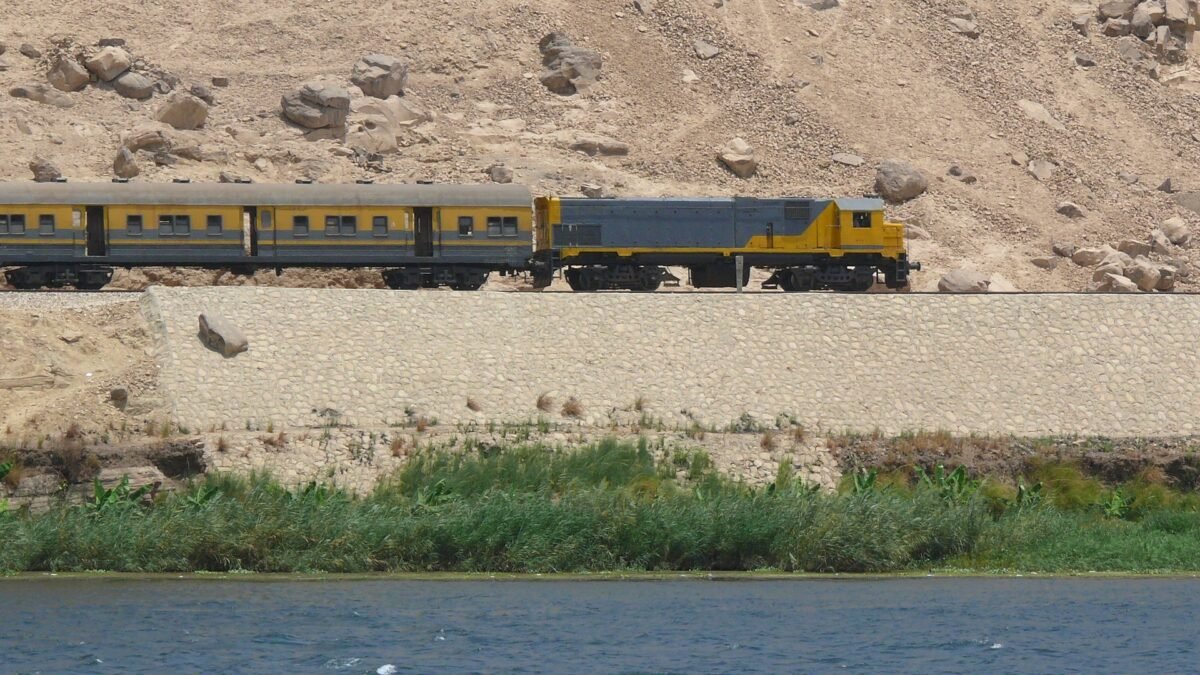
At least four people were killed and 88 injured on Sunday when two passenger trains collided south of Cairo, in the latest deadly accident on a railway network whose history of crashes stretches back decades and whose promises of reform have repeatedly failed to prevent the next one.
According to Egypt’s health ministry, the collision happened in the Al-Ayyat district of Giza province, where a train travelling from Giza to Fayoum crashed into the rear of another service heading south from Cairo to Aswan. Several carriages derailed in the impact, and images from the scene showed some of them had fallen down an embankment.
The railway authority said emergency teams and cranes had been sent to the scene, and crews were clearing the wreckage to restore services on the Cairo to Upper Egypt line, although it gave no indication of how long that would take, according to Reuters. Trains between Giza and the Upper Egypt region were suspended, BBC Arabic reported.
President Abdel Fattah al-Sisi said he was following the incident with “great concern” and extended his “deepest condolences to the families of those who lost their lives”. In a post on X, quoted by the BBC, he wrote: “I have directed state agencies to provide the necessary medical care, promptly investigate the circumstances of the accident, and hold accountable anyone found to have been negligent.” Reuters reported separately that the president had ordered a swift investigation and said anyone found negligent should be held accountable.
The health ministry said at least 72 ambulances were sent to the scene, according to the BBC, and the government said hospitals in the area had been put “on heightened alert” as they coped with a large influx of patients. The Associated Press reported that at least 54 of the injured were taken to Al Wasta Hospital in Beni Suef and 10 to Al Ayyat Hospital in Giza. Local media reported that a train driver was among the dead, according to the BBC, and witnesses told the Associated Press that local residents rushed to the scene to help passengers trapped in the overturned carriages escape.
The toll given by the health ministry — four dead and 88 injured — was described as an initial count, and it may yet change. State-owned media had earlier reported that 120 people were wounded, without clarifying the severity of their injuries, according to Reuters. That gap between the first reports and the official count is a familiar feature of Egyptian rail disasters, and it is one reason the first hours after a crash are the hardest in which to be certain about anything beyond the bare fact that a crash happened.
What happened at Al-Ayyat
The collision occurred in the area between Kafr Ammar and Al-Raqqa stations in Al-Ayyat, according to the BBC. The Associated Press put the site at about 52 kilometres (32 miles) south of Cairo; Reuters reported it as about 76 kilometres (47 miles) south of the capital. The difference reflects the different points from which the distance was measured, but both accounts place the crash on the same stretch of the line that carries trains from Cairo down through Giza province towards Upper Egypt.
What the two trains were doing there is not in dispute. Egypt’s railway authority said a train travelling from Giza to Fayoum, a city in the south-western desert depression of the same name, hit the back of another service heading from Cairo to Aswan, the city at the southern end of the line near Egypt’s border with Sudan. The Associated Press, citing the Transport Ministry, reported the same sequence of events. Neither outlet, nor the railway authority, has yet said why the second train ran into the first, and no official cause has been established. The investigation ordered by the president is still at its earliest stage, and the authorities have not said whether signalling failure, human error, a mechanical fault or something else was responsible.
What is clear is the scale of the emergency response. Dozens of ambulances converged on a rural stretch of track, hospitals in Giza and neighbouring Beni Suef took in the injured, and the railway authority moved cranes to the site to lift derailed carriages. The suspension of trains between Giza and Upper Egypt cut one of the country’s main transport arteries, stranding passengers who depend on the line to travel between Cairo and the south.
For the families of the four people killed, the numbers are not statistics. They are the beginning of a wait for names, for bodies to be identified, for an explanation of how a routine Sunday journey ended in a collision on a straight stretch of track in daylight. None of the victims had been publicly identified by the time the first reports were published, and the health ministry’s count of the injured gave no breakdown of how serious their injuries were.
A place with a terrible record
Al-Ayyat is not an anonymous dot on the railway map. It is the site of Egypt’s worst-ever rail disaster, and the name carries a weight that every Egyptian reader of Sunday’s news will have recognised at once.
On 20 February 2002, shortly after 2 a.m., a fire broke out on train No. 832, an eleven-carriage service travelling from Cairo towards Luxor and Aswan. The fire destroyed seven third-class carriages. The official death toll was 383, all of them Egyptians, but the figure has always been disputed: the carriages were packed to at least double their maximum carrying capacity of 150 passengers each, and with no full passenger list, accounting for the missing was almost impossible. Some Egyptians have argued that the official number was a gross underestimate, put forward to limit the damage to the government’s reputation. The cause was first given as an exploding cooking gas cylinder; it was later stated that an electrical fault was responsible.
Seven years later, Al-Ayyat was the scene of another rear-end collision of the same kind as Sunday’s. On 24 October 2009, a passenger train stopped in the El Ayyat area after striking a water buffalo. Another passenger train, travelling in the same direction, later ran into the back of the stationary train, killing at least 18 people. The parallel with Sunday’s crash — a train running into the back of another on the same stretch of line — is exact, and it is the detail that makes this latest accident harder to dismiss as a freak occurrence.
The wider record is long. On 27 February 2019, a train smashed into a barrier inside Ramses Station in central Cairo, causing a major explosion and a fire that killed more than 25 people and injured at least 50. On 26 March 2021, two trains collided near Sohag in Upper Egypt, killing 18 people and injuring around 200. Less than a month later, on 18 April 2021, four carriages of a passenger train travelling from Cairo to Mansoura derailed at Toukh, killing 23 people and injuring 139. And as recently as 30 August 2025, a passenger train travelling from Matrouh to Cairo derailed in the west of the country, killing three people and injuring at least 94.
Between 2008 and 2017, the government recorded nearly 11,000 accidents on Egypt’s rail lines, including a high of 1,793 in a single year, 2017, according to figures cited in the background to the Sohag collision. The numbers describe a system in which accidents are not rare exceptions but a regular feature of daily life — and in which the deadliest ones tend to happen on the same busy, ageing lines, to the same kind of ordinary passenger, travelling in the same crowded third-class carriages.
The investigation, and what it has to answer
The first question the investigation must answer is the simplest one: why did the Giza to Fayoum train run into the back of the Cairo to Aswan train? A rear-end collision on a railway is, in principle, one of the most preventable kinds of accident. Modern signalling systems are designed precisely to stop it happening: they divide the track into sections, allow only one train in each section at a time, and automatically apply the brakes if a driver passes a signal at danger. When two trains collide in this way, the failure is usually found in one of three places — the signalling, the braking, or the people operating them — and often in the interaction between all three.
The second question is whether the safety systems that are supposed to prevent such collisions were working on this stretch of track on Sunday. That question matters because of what the last major investigation found. After the Sohag collision in 2021, the Public Prosecution’s inquiry found that negligence and drug abuse on the part of railway employees were factors in the crash, and six employees of the National Railway Authority were arrested. But the inquiry also exposed a decision taken far above the level of individual drivers: the transport minister at the time, Kamel al-Wazir, publicly admitted that he had ordered the partial suspension of a crucial safety mechanism, automatic train control, in certain areas of the national rail network in order to keep trains running on time, and that the automatic train control system was in fact switched off by the drivers of the two trains that collided at Sohag. The system, which slows trains to 80 kilometres per hour, would have added about 25 per cent to journey times if fully implemented across the network.
The minister said afterwards that he would not allow trains to operate without automatic train control from now on, and that delaying trains was the only way to escape accidents. Whether that commitment was kept — and whether the system was active on the Al-Ayyat stretch on Sunday — is a question the new investigation cannot avoid. If the answer is that the system was off, or absent, or overridden, then the collision will look less like an accident and more like a known risk that was accepted.
The third question is about the condition of the trains and the track. Egypt’s railway is one of the oldest in the world, and much of its infrastructure dates from decades ago. In 2018, President al-Sisi said the government lacked the 250 billion Egyptian pounds — about 14 billion US dollars at the time — required to address all the problems within the rail system. After Sohag, the transport ministry said it had allocated around 225 billion pounds to develop the railway system and asked citizens to “have patience” until the process was complete. Five years later, the Matrouh derailment and now the Al-Ayyat collision suggest that whatever that money bought, it has not yet bought a railway on which a passenger train can be relied upon not to run into the one in front of it.
Analysis: Why It Matters
Al-Ayyat, again — the same place, the same kind of crash
The most damning fact about Sunday’s collision is not the death toll, terrible as it is, but the postcode. Al-Ayyat has now seen three major railway disasters in a quarter of a century: the fire of 2002, the rear-end collision of 2009, and the rear-end collision of 2026. The 2009 crash and Sunday’s crash are not merely similar; they are the same accident, repeated. In both cases a train ran into the back of another train on the same stretch of line, in the same district, with the same result.
When a disaster repeats itself in the same place in the same way, it stops being a story about bad luck and becomes a story about a system that did not learn. The railway authority, the transport ministry and the government have had seventeen years since the 2009 collision to make sure that a train cannot run into the back of another train at Al-Ayyat. They have had five years since Sohag, when the same failure killed eighteen people further south on the same line. The question that will dominate the coming days is not whether someone made a mistake on Sunday — someone almost certainly did — but why the system was still arranged in a way that allowed that mistake to kill people.
The accountability ritual — and where it stopped last time
President al-Sisi’s response followed a script that Egyptians will recognise. Condolences, an order for a swift investigation, and a promise to hold anyone found negligent accountable. It is the right script, and it is also, by now, a familiar one. The test is not in the words but in where the accountability lands.
After Sohag, accountability landed on six railway employees who were arrested, and on the drivers whose drug use and negligence the prosecution highlighted. It did not land on the ministerial decision to switch off automatic train control in the name of punctuality — a decision the minister himself admitted to, in public, without apparent consequence. That is the pattern that matters: blame travels downwards, to the people in the cab and the signal box, and stops before it reaches the people who set the budgets, the timetables and the safety rules.
If Sunday’s investigation follows the same pattern, a driver or a signaller will be charged, the public will be told that justice has been done, and the underlying conditions — ageing signalling, pressure to keep trains on time, safety systems that can be switched off — will remain exactly as they were. The real measure of this investigation will be whether it asks who decided what was safe enough, and on what evidence, rather than merely who was holding the controls when the trains met.
Billions promised, collisions continuing
Egypt has not been short of money for its railways, at least on paper. The 225 billion pounds allocated after Sohag, the 250 billion pounds the president said in 2018 would be needed to fix the system’s problems, the repeated announcements of modernisation programmes — the sums are large, and they are real. What is missing is the evidence that they have changed the experience of an ordinary passenger on an ordinary Sunday.
The Matrouh derailment of August 2025, which killed three people and injured at least 94, was a warning that the system was still producing serious accidents. Sunday’s collision is the confirmation. Money spent on new trains and refurbished stations does not by itself make a railway safe; safety lives in signalling, in maintenance, in training, in the unglamorous work of keeping automatic systems switched on and in making sure that a driver who passes a signal at danger is stopped by the machine before he reaches the train ahead. Until the investigation shows what failed at Al-Ayyat, the suspicion will remain that the money went to the visible parts of the railway while the invisible parts — the parts that stop trains colliding — were left to cope.
The fog of the first hours — and why the numbers move
Within hours of Sunday’s crash, two different injury figures were in circulation: 120, from state-owned media, and 88, from the health ministry. The death toll, given as four, was described as an initial count. Readers who have followed Egyptian rail disasters before will know to expect the numbers to move, and usually to move in a particular direction.
After Sohag, the first death toll given was 32. It was later revised down to 19, and then to 18, as the count was corrected. That is not necessarily evidence of deception; in the chaos of a crash, with casualties spread across several hospitals and the dead and injured counted by different agencies, early figures are often wrong in both directions. But the pattern has a cost. Every revision, in either direction, feeds the suspicion that the official count is being managed rather than measured — a suspicion that runs deep in Egypt, where the 2002 death toll of 383 has been doubted for more than two decades by people who believe the real figure was far higher.
The honest response to that suspicion is transparency: named hospitals, published lists, regular updates, and an explanation when a figure changes. The health ministry’s figure of 88 injured, with 54 taken to one hospital and 10 to another, is a start. Whether the final toll stays at four dead will be the first test of whether the official account of Sunday’s crash can be trusted.
What a rear-end collision says about the system
There are many ways for a railway to fail. A derailment can be caused by a broken rail or a faulty wheel. A level-crossing crash can be caused by a driver who ignores the barriers. A fire can start in a carriage for reasons nobody foresaw. A rear-end collision is different. It is the failure of the railway’s most basic function: keeping two trains apart.
That is why this kind of crash carries a particular weight, and why it tends to produce a particular kind of public anger. Passengers can accept, however reluctantly, that a railway is old and that accidents happen. What they cannot accept is a railway that cannot do the one thing it exists to do — move trains along a line without them running into each other. The fact that this has now happened at Al-Ayyat twice, and on the Cairo to Aswan line at Sohag as well, suggests a systemic weakness in the way trains are separated, rather than a single error by a single person on a single day.
If the investigation finds that the signalling was working and a driver simply ignored it, that will be one kind of failure, and a serious one. If it finds that the signalling was not working, or that automatic train control was off, that will be another kind of failure, and a more serious one, because it will mean the system had already given up on protecting passengers before the trains ever left their stations.
What to Watch Next
- The final casualty toll. The health ministry’s count of four dead and 88 injured is an initial figure. Watch for hospital updates, a published list of the injured, and any revision to the death toll in the coming days.
- The cause. The investigation ordered by President al-Sisi has not yet established why the Giza to Fayoum train ran into the back of the Cairo to Aswan service. Watch for the first official statement on whether signalling, automatic train control, human error or a mechanical fault was involved.
- Who is held accountable — and at what level. Watch whether arrests or charges stop at drivers and signallers, as they did after Sohag, or whether the inquiry examines the decisions that set the safety rules for this stretch of line.
- The restoration of the line. Trains between Giza and Upper Egypt were suspended after the crash. Watch for when the Cairo to Aswan line reopens, and what that means for the thousands of passengers who use it every day.
- Any new safety measures. After Sohag, the transport minister promised that no train would run without automatic train control. Watch for whether the government announces a fresh programme — and, more importantly, whether it publishes evidence that the system is actually switched on.
Sources
- Reuters — Train collision in Egypt’s Giza province kills 4 and injures 88, health ministry says
- Associated Press — Collision between 2 trains in Egypt kills 4 and injures 88
- LaPresse / Associated Press — Egypt: Train collision in Giza leaves at least 4 dead and 88 injured
- Wikipedia — List of rail accidents in Egypt
- Wikipedia — Sohag train collision (26 March 2021)
- Mada Masr — Investigation into fatal Sohag crash shifts blame from Transport Ministry

About the Author — Abdul Mannan
Related Articles

At Least 21 Dead as Migrant Boat Capsizes off Senegal’s Coast on the Atlantic Route to Europe
At least 21 people have died after a pirogue carrying migrants capsized off Kébémer in north-western Senegal, with…

Three Tankers Ablaze in the Strait of Hormuz as Missiles Target Riyadh in Sharp Escalation of the Iran War
Iran's Revolutionary Guard says three oil tankers exploded and caught fire in the Strait of Hormuz early on…

COP31 Opens in Antalya on Monday as Climate Plans Fall Far Short of the 1.5°C Goal
Nearly 200 nations gather in Antalya on Monday for COP31, the first climate summit held after the world…