
Bangladesh Measles Death Toll Reaches 1,284 as Outbreak Becomes the Country’s Deadliest in Decades

Two more children have died in Bangladesh’s measles outbreak, taking the death toll to 1,284 and making the epidemic the deadliest the country has faced in decades, according to the latest official figures.
The Directorate General of Health Services (DGHS), the government body tracking the outbreak, reported the two latest deaths in its daily update on Monday, 9 November. Both children died with symptoms consistent with measles in the 24 hours to 8am, the update said, according to The Business Standard.
Of the 1,284 deaths recorded so far, 1,179 were classified as suspected measles-related deaths, while 105 were confirmed through laboratory testing, the DGHS said. The same update recorded 1,359 new suspected cases in a single day, taking the cumulative number of suspected cases nationwide to 240,199. A further 81 laboratory-confirmed cases were reported, bringing the total number of confirmed infections to 24,523.
Since 15 March, when the DGHS began counting hospital admissions in the current wave, a total of 214,251 patients with suspected measles have been admitted to hospitals across the country. Of those, 205,383 have recovered, according to the health directorate.
The daily figures have climbed with grim regularity. The combined death toll stood at 1,276 on 6 November, rose to 1,280 on 7 November, and reached 1,282 on 8 November, according to successive DGHS updates reported by The Business Standard and the United News of Bangladesh. Monday’s update adds two more deaths to that count, and more than a thousand new suspected cases are still being recorded every day.
The outbreak, which began in late February and gathered pace through March, is now the largest measles epidemic Bangladesh has ever recorded, and the country has reported the highest number of measles cases of any nation in the world in 2026, with India recording the second-highest total, according to figures compiled by the World Health Organization (WHO) and summarised in an independent assessment of the outbreak.
A disease that strikes the youngest first
Measles is one of the most contagious viruses known to medicine, and in Bangladesh it is overwhelmingly a disease of small children. According to the country’s health minister, Sardar Shakhawat Hossain Bokul, 82 per cent of those infected have been children under the age of five, and 91 per cent of cases have occurred among children aged between one and 14.
That age profile explains why the daily death reports read the way they do. Almost every new fatality announced by the DGHS in recent weeks has been a child. The virus spreads through the air when an infected person coughs or sneezes, and it can linger in the air for up to two hours after the infected person has left a room. In crowded urban neighbourhoods and large households, where children share sleeping space and play areas, it finds its victims quickly.
Most children who catch measles recover, but the disease can cause severe complications, including pneumonia, brain swelling and severe diarrhoea, and it weakens the immune system for months afterwards, leaving children vulnerable to other infections. Malnourished children and those with weakened immune systems face the highest risk of death. Two doses of the measles vaccine are about 97 per cent effective at preventing infection, according to the United States Centers for Disease Control and Prevention (CDC), which is why the scale of the Bangladeshi outbreak has stunned public health specialists: it is, in the strictest sense, a preventable catastrophe.
The geography of the outbreak tells its own story. Dhaka, the capital, accounts for about 36 per cent of all cases, with the port city of Chattogram and the northern city of Rajshahi among the other worst-hit areas. A WHO assessment in April found transmission in 58 of Bangladesh’s 64 districts, spanning all eight of the country’s divisions, and the agency assessed the risk at the national level as high.
By early September, Dhaka division alone had recorded 70,786 suspected cases and 401 deaths, with 12,000 confirmed infections, according to DGHS figures compiled at the time. The national totals then stood at 164,148 suspected cases, 894 deaths and 19,696 confirmed infections. In the two months since, the suspected caseload has grown by roughly 76,000 and the death toll by almost 400.
Compared with last year, the scale of the resurgence is extraordinary. The outbreak represents at least a 75-fold increase in measles cases from 2025, according to the independent assessment, which drew on WHO data. For a country that once prided itself on driving measles to the margins, the reversal has been total.
How a success story unravelled
Bangladesh’s measles tragedy is not a story about a virus that could not be stopped. It is a story about a vaccination programme that was allowed to fall apart.
In 2014 and 2015, the country ran nationwide measles-rubella campaigns that vaccinated more than 50 million children. By the mid-2010s, more than 92 per cent of children were receiving their first dose of measles vaccine, and second-dose coverage had passed 80 per cent. Deaths among children under five from measles fell rapidly over three decades, and the disease had become a rarity in a country of more than 170 million people.
Over the years that followed, however, the programme grew weak, irregular and delayed. The COVID-19 pandemic pulled attention and resources towards coronavirus vaccination, and routine immunisation suffered. In April 2020, the WHO warned that many countries had begun suspending their measles vaccination programmes because of the pandemic, and projected that 117 million children worldwide would be at risk of infection.
In Bangladesh, the damage continued after the pandemic. Investigations by Bangladeshi newspapers, including the Dhaka Tribune and the Daily Star, have blamed governance failures for the return of measles, reporting that the interim government led by Muhammad Yunus neglected the immunisation programme and halted funding for vaccine procurement. Political instability and administrative disruption during the period compounded the weakening of the programme, according to the same reporting.
An independent assessment carried out by the WHO, UNICEF, Gavi and the country’s Expanded Programme on Immunization highlighted failures in childhood measles vaccination, and pointed to a shortage of measles-rubella vaccine in the national supply during 2024 and 2025, and to a scheduled mass vaccination campaign in 2025 that never took place. Bangladesh reinstated vaccine procurement through UNICEF in April 2026, as the outbreak was already spreading.
The result is visible in the daily DGHS bulletins: a cohort of children, many of them born during or after the pandemic disruption, who never received the protection that should have been routine, and who are now catching a disease their parents’ generation had largely stopped fearing.
The emergency response
The government declared an emergency response in April. On 5 April, an emergency mass vaccination campaign was launched, initially covering the Dhaka North and South city corporations and the districts of Mymensingh and Barisal, with the health ministry identifying 30 hotspots across 20 districts. Nationwide mass vaccination began on 3 May, with all children aged between six and 59 months offered the measles vaccine regardless of whether they had received earlier doses.
Prime Minister Tarique Rahman was photographed observing a vaccination drive in Bogura on 20 April, and the health minister toured vaccination centres in Dhaka and Narayanganj the same month. The home affairs minister, Salahuddin Ahmed, vowed to bring measles under control within 2026, and leave for medical staff was cancelled as hospitals filled with cases.
The campaign has reached millions of children, but the virus has kept moving. One reason is timing: immunity takes weeks to build after vaccination, and public health specialists have warned that the wave could continue for at least another month after the emergency campaign, because children vaccinated today are not protected tomorrow. Another reason is scale: with more than a thousand new suspected cases a day still being reported, and transmission established in nearly every district, the campaign must reach almost every unprotected child in the country before the outbreak can be broken.
There is also a telling detail in the daily figures. The number of laboratory-confirmed deaths has held at 105 for days, even as the suspected death toll has climbed past 1,170. That gap does not mean the outbreak is slowing. It reflects the limits of laboratory confirmation in a health system handling a quarter of a million suspected cases: most deaths are recorded on clinical symptoms alone, because testing every case is impossible. The true toll, specialists say, is likely to be higher than the confirmed count, and the suspected count is the figure that tracks the real scale of the disaster.
The hospitals have borne the weight. More than 214,000 people have been admitted with suspected measles since mid-March, and although more than 205,000 have recovered, the daily flow of new admissions has kept wards under pressure for eight months. In Dhaka, where more than a third of all cases have been recorded, hospitals in the capital have treated tens of thousands of patients.
Analysis: Why It Matters
A preventable catastrophe, in the fullest sense
There is no mystery about how to stop measles. The vaccine is cheap, safe and extraordinarily effective, and it has been in use for more than six decades. Bangladesh proved that it knew how to use it: the campaigns of 2014 and 2015 reached more than 50 million children and drove the disease to the edge of elimination. What happened in 2026 is therefore not a failure of science but a failure of administration, and that distinction matters, because administrative failures can be fixed in a way that scientific ones cannot.
The chain of events is now documented in unusual detail. A vaccine shortage in 2024 and 2025. A mass campaign scheduled for 2025 that never happened. Funding halted. A programme that grew irregular and delayed. Each step on its own might have been recoverable; together, they left a generation of small children unprotected against one of the most infectious viruses in existence. When the virus arrived, it found them.
The lesson extends beyond Bangladesh. Measles is the canary in the coal mine of immunisation systems: because it is so contagious, it is the first disease to return when vaccination coverage slips, and the first to expose the gaps. A country that loses control of measles has usually lost control of much more, and the same children who missed their measles jabs are likely to have missed others as well.
Children are paying the price of adult decisions
The most striking figure in this outbreak is not the total number of cases but who is catching the disease. More than four in five of those infected are under five years old, and nine in ten are under 15. These are children who had no say in the decisions that left them unprotected: not in the funding of the vaccine programme, not in the scheduling of campaigns, not in the political upheavals that disrupted the health system.
That is worth stating plainly, because it shapes what accountability should look like. The debate in Dhaka about who neglected the programme and why is a political argument, and it will run for a long time. But the children dying in hospital wards are not participants in that argument. They are its consequences. Any reckoning that does not start from that fact will miss the point.
It also shapes what the response must prioritise. The emergency campaign targets children aged six to 59 months, precisely the group at greatest risk, and it offers the vaccine regardless of earlier doses, removing the paperwork and record-checking that can slow a campaign down. That is the right design. The question is whether it can reach every child in time, including those in the most remote districts and the most crowded urban settlements, where the virus spreads fastest.
The vaccination race against the virus
There is a cruel arithmetic to an outbreak like this one. Every day, the DGHS reports more than a thousand new suspected cases, and every day the vaccination campaign reaches more children. The question is which line moves faster, and for how long.
Vaccination is not instant protection. A child vaccinated today needs weeks to build immunity, and during those weeks the virus can still reach them. That is why specialists have warned that the wave may continue for weeks after the campaign reaches full coverage, and why the daily death toll may keep rising even as the campaign succeeds. The public, and politicians, need to understand that lag, or they may conclude too early that the campaign has failed, when in fact it is still working through the pipeline.
The other race is against complacency. Measles outbreaks burn through the unprotected population and then, eventually, run out of victims. The danger is that a falling case count is mistaken for a solved problem, and the routine programme is allowed to weaken again. Bangladesh has been here before: the success of the mid-2010s bred the neglect of the 2020s. Breaking that cycle will require the routine programme to be rebuilt, not just the emergency campaign to be completed.
A warning far beyond Bangladesh
Bangladesh is the worst-affected country in the world this year, but it is not alone. Measles is resurging globally, and the pattern is the same almost everywhere: vaccination coverage slipped during and after the pandemic, and the virus is exploiting the gaps.
In the United States, the CDC reported 5,182 confirmed measles cases in 2026 as of 5 November, the highest total in decades, and three Americans died of measles in a single week, including an infant in New York State, the state’s first measles death in 30 years. In Britain, the WHO said earlier this year that the country could no longer be considered to have eliminated measles, after cases rose and an adult died following an outbreak in England. The same story, in different keys, is playing out across continents.
That global context matters for two reasons. First, it means Bangladesh cannot count on the world to solve its problem for it: the agencies that would normally surge support, including the WHO and UNICEF, are dealing with measles resurgences in many countries at once. Second, it means the Bangladeshi experience is a preview of what awaits any country that lets its immunisation programme slip. Measles does not respect borders, and it does not wait for political stability.
What the numbers cannot show
Behind the daily bulletins are families. A mother who took her child to a hospital in Dhaka or Rajshahi and watched the rash spread, the fever climb, and the breathing falter. A health worker who has spent eight months admitting children with a disease that a single injection could have prevented. A district hospital that has treated thousands of cases with limited staff and limited beds.
The DGHS bulletins count cases and deaths, but they do not count the children who survived measles and will carry its effects for years: the weakened immune systems, the damaged lungs, the lost schooling, the families pushed deeper into poverty by hospital bills and lost work. Measles is often described as a childhood illness, as if that made it mild. In a country where it is killing more than a thousand children, that description is a lie.
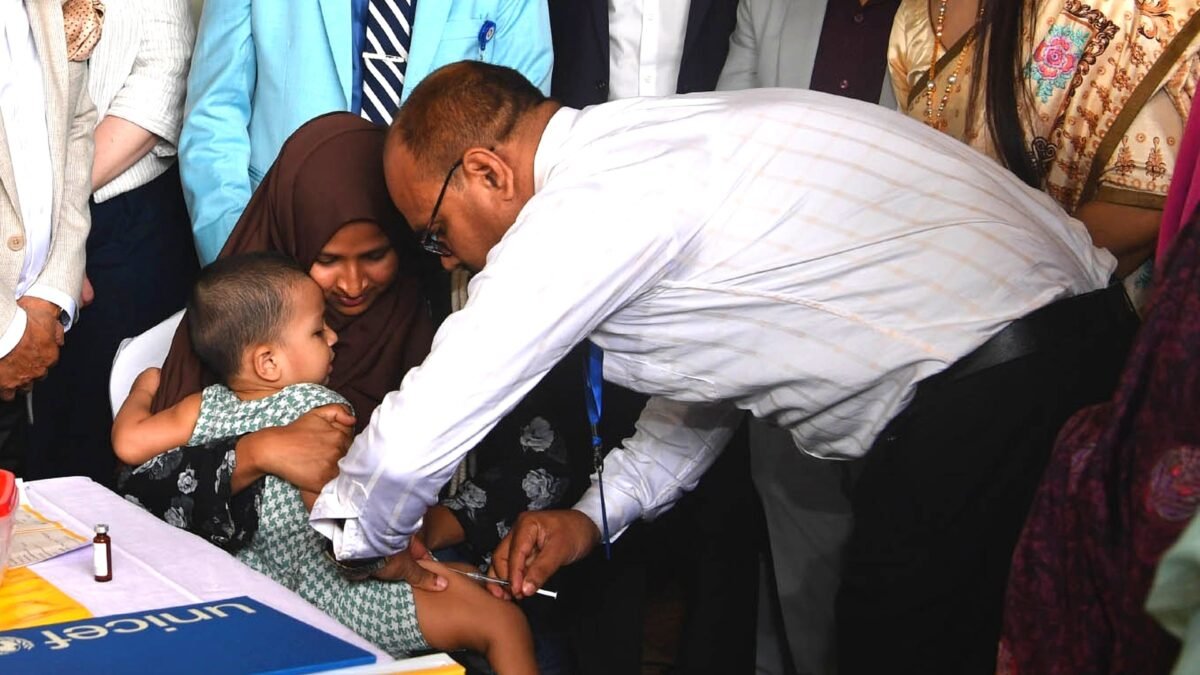
The photograph that accompanies this report shows the other side of the story: a health worker vaccinating a small child in Bangladesh during the emergency campaign, the child’s mother holding them close. That image, taken in April, is what the response looks like at its best. The tragedy of this outbreak is that it was needed at all.
What to Watch Next
- The daily DGHS bulletins: whether the number of new suspected cases each day begins to fall, and whether the death toll’s daily increase slows. A sustained fall in new cases would be the first sign that the emergency campaign is breaking transmission.
- The confirmed-death count: whether laboratory confirmation catches up with the suspected toll. If confirmed deaths begin to rise from 105, it will confirm that the suspected figures reflect real measles mortality, not over-counting.
- Vaccination coverage figures: how many children aged six to 59 months the emergency campaign has reached, and whether it is reaching the hardest-hit districts, including Dhaka, Chattogram and Rajshahi, where the virus is most entrenched.
- Hospital pressure: whether admissions begin to fall from the current level of more than a thousand suspected cases a day, and whether hospitals in Dhaka can return to normal services after eight months of outbreak response.
- The global picture: whether measles continues to spread in other countries, including the United States and Britain, and whether the WHO updates its risk assessment for Bangladesh and the wider region as the outbreak enters its ninth month.
Sources
Asia Daily — “Bangladesh Measles Death Toll Reaches 1,204” (WHO figures, 20 October 2026)

About the Author — Abdul Mannan
Related Articles

Johnson & Johnson’s Once-Daily Pill Eases Psoriatic Arthritis in Late-Stage Trial, Offering Hope of an Injection-Free Option
Johnson & Johnson says its once-daily pill ICOTYDE met its main goal in a 552-patient Phase 3 trial,…
US Measles Cases Pass 5,000 for First Time Since 1991 as Infant Death in Wisconsin Brings Toll to Eight
Measles cases in the United States have passed 5,000 in a single year for the first time since…
Wisconsin Infant Dies of Measles in State’s First Death From the Disease in 36 Years as US Cases Hit 35-Year High
An infant in southwestern Wisconsin has died of measles — the state's first measles death since 1990 —…