
Wisconsin Infant Dies of Measles in State’s First Death From the Disease in 36 Years as US Cases Hit 35-Year High

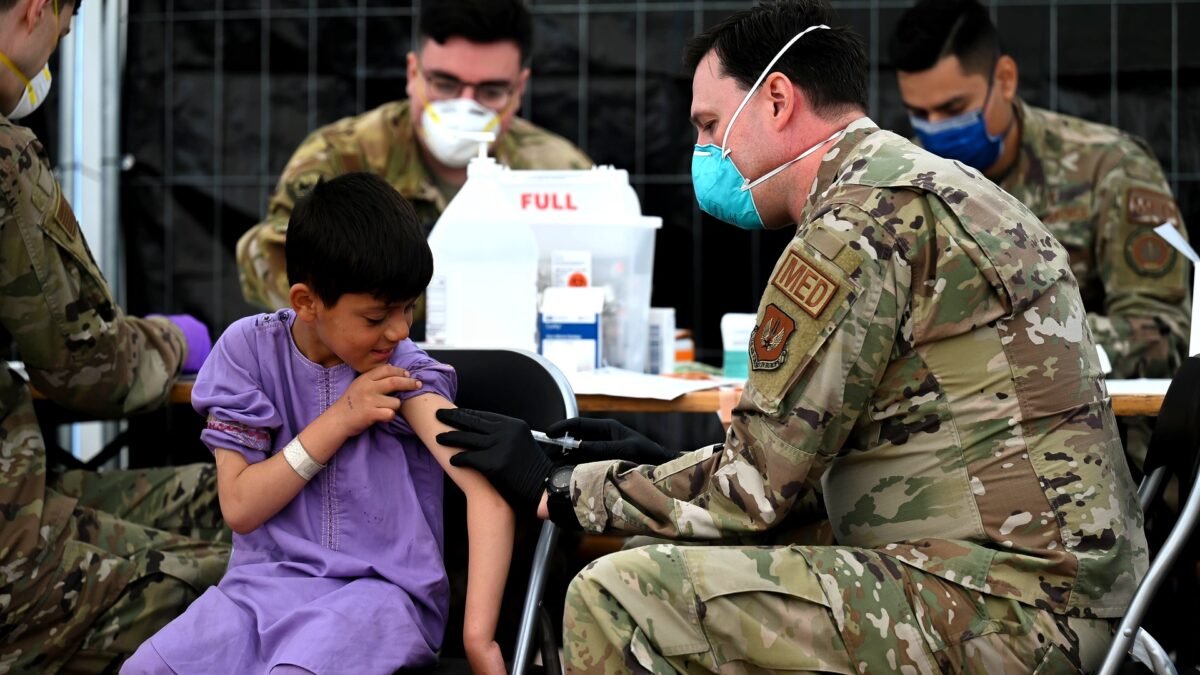
An infant in southwestern Wisconsin has died of measles, the first measles death in the state in 36 years, the Wisconsin Department of Health Services announced on Thursday, in the latest grim milestone of the worst measles year the United States has seen in more than three decades.
The coroner listed measles as the immediate cause of death, according to the department, which said it would release no further information about the child — including the age, the county of residence or the vaccination status — in order to protect the privacy of the family. The death was the third measles fatality reported by a state health department in the United States in a single week, and it came as the national case count stood at 4,852 confirmed infections, more than double last year’s total.
“It is with a heavy heart we are reporting the first death of an infant connected with a measles outbreak in Wisconsin in many years. My heart is broken for the family,” the department’s secretary, Kirsten Johnson, said in a statement. “Any death of a child is a tragedy and even more so when it is related to a vaccine-preventable disease.”
The infant died in the middle of an outbreak that has now reached 431 confirmed cases across 13 counties in Wisconsin, the highest number the state has recorded in more than 35 years, according to the department. Nine people have been hospitalised with severe symptoms. All but three of the 431 cases were in people who had not been vaccinated.
Wisconsin’s death is the first from measles in the state since 1990, a span of 36 years in which the disease had been reduced to a historical memory for most residents. Its arrival in the same week as two other deaths — an infant in New York and a young mother in Pennsylvania — has turned a state outbreak into a national warning about a disease the United States declared eliminated a quarter of a century ago.
The outbreak in Wisconsin
The outbreak is concentrated in the rural south-west of the state. According to the department, Lafayette County has recorded 155 confirmed cases, Grant County 142 and Iowa County 97 — together more than 90 per cent of Wisconsin’s total. A separate cluster in Chippewa County has produced 44 confirmed cases, and smaller numbers have been reported in Rock, Richland, Marathon, Jackson, Marquette, Buffalo and Vernon counties. On the same day the death was announced, Green Lake County recorded its first confirmed cases, making it the first county in the north-east of the state to be affected this year.
The outbreak is still growing. The 431 cases recorded as of 3 November were up from 335 only two weeks earlier, and the state’s epidemiologist, Ryan Westergaard, warned that the true scale is larger than the official count. “This is the largest number of measles cases we’ve seen in Wisconsin in more than 35 years,” Westergaard said, according to Reuters. “The 431 cases we’ve identified are almost certainly an underestimate. Not everyone who becomes infected gets tested or comes to the attention of public health.”
State health officials said they have been working with local and tribal health departments to respond through case tracking, testing and vaccination drives. Since 1 August, the department has delivered 2,000 doses of the measles, mumps and rubella (MMR) vaccine to local health departments in communities with confirmed cases. On 3 November, the department recommended that babies aged six months and older who are likely to be exposed to measles receive an early dose of the vaccine — a departure from the routine schedule, under which the first dose is normally given at 12 to 15 months of age.
That recommendation points to the central cruelty of this death. An infant too young for the routine vaccination schedule depends entirely on the immunity of the people around them. The MMR vaccine is normally given first at 12 to 15 months, with a second dose at four to six years, and children as young as six months can receive an early dose only when exposure is likely. A baby who has not yet reached their first birthday has no vaccine of their own to rely on; the protection that is supposed to surround them is the vaccination of everyone else.
A deadly week across America
The Wisconsin infant was the third measles-related death reported by a state health department in the United States within a week, according to the Center for Infectious Disease Research and Policy at the University of Minnesota. On Monday, the New York State Department of Health reported its first measles-associated death in more than 30 years — a child in Lewis County, in the north of the state. On Wednesday, Pennsylvania health officials confirmed the state’s sixth measles-associated death of the year. The Washington Post identified that victim as a young mother who had just given birth.
Taken together with the earlier deaths, the state-reported toll for the United States in 2026 now stands at eight: six in Pennsylvania, one in New York and one in Wisconsin, according to state health department reports compiled by several outlets. At least four of the eight involved children or infants.
The federal count tells a different, smaller story. The Centers for Disease Control and Prevention has confirmed four measles-associated deaths this year, adding one to its official toll only on Wednesday, according to the infectious disease research centre. The gap between the two counts is the result of a policy change under Health Secretary Robert F. Kennedy Jr., under which the CDC now draws its mortality figures from the National Center for Health Statistics rather than automatically adding deaths confirmed by state health departments. The CDC has said it is working with state disease experts to create a standard way of counting measles deaths, and that its count may change.
The discrepancy has become a political flashpoint in its own right. In August, Kennedy accused the Pennsylvania governor, Josh Shapiro, of “fabricating” the deaths reported in his state, while Shapiro said Kennedy was “downplaying the severity of measles”. The CDC said on 13 October that it would deploy more support to Pennsylvania to investigate the outbreak. The argument over the numbers has unfolded while the outbreak itself has kept growing.
For all the dispute over counting, the direction of the figures is not in doubt. The country has not seen more than four measles deaths in a year since 1991, according to USA Today. Three people died of measles in the United States in 2025 — two children and one adult in the Texas outbreak — the first paediatric measles deaths in the country in a decade. Before last year, the most recent measles death in the United States was in 2015.
The national picture: worst year since 1991
As of 29 October, the CDC had confirmed 4,852 measles cases across 45 states and Washington, DC, according to the agency’s figures reported by USA Today and the infectious disease research centre. That is more than double the 2,289 cases recorded in the whole of 2025, and the highest yearly total since 1991. The CDC recorded 264 new cases in the week before 30 October alone — roughly the number the country once recorded in an entire year — and it was the 12th consecutive week of triple-digit weekly increases.
Of the confirmed cases, 511 people — about 11 per cent — have been hospitalised, compared with 244 hospitalisations in all of 2025. About 41 per cent of cases were in children and teenagers aged five to 19, and an unusually large share — also 41 per cent — were in adults aged 20 and older, up from 29 per cent last year. About 96 per cent of the cases were in people who were unvaccinated or whose vaccination status was unknown, according to the CDC’s figures.
Pennsylvania remains the epicentre of the national outbreak, with more than 1,400 confirmed cases — by far the largest state outbreak since the early 1990s — and 265 hospitalisations, according to state health data. The state passed 1,000 cases in early October, a dramatic increase from the 106 cases reported statewide last year. Two other states, Utah and South Carolina, are each contending with outbreaks of 500 or more cases. New York declared a state of emergency on 5 October after the state passed 100 cases. Minnesota has reached its highest measles total in 36 years.
The CDC has logged 43 measles outbreaks across the country so far this year, compared with 48 for the whole of last year. Measles is one of the most contagious infectious diseases known: about 90 per cent of unvaccinated people who are exposed to it become infected, according to the CDC, and about one in five of those infected ends up in hospital. Out of every 1,000 unvaccinated children who contract measles, between one and three die from respiratory and neurological complications, according to the infectious disease research centre. Beyond death, the disease can cause immune suppression, injury to the lungs, permanent brain damage and loss of eyesight and hearing.
Measles was declared eliminated in the United States in 2000 — a designation the CDC once called a historic public health achievement — meaning that sustained domestic transmission had been interrupted. That status is now in doubt. The World Health Organization is expected to review the United States’ elimination status on 10 November, following the 2025 Texas outbreak that killed three people. Canada already lost its measles-free status in November 2025. Elimination is defined as the interruption of endemic transmission for at least 12 consecutive months, together with high population immunity, a functioning surveillance system and a robust response capacity.
Analysis: Why It Matters
The youngest pay the price
The Wisconsin death is not only a statistic; it is a demonstration of how measles finds the people who cannot defend themselves. An infant under 12 months old cannot routinely be vaccinated, because the first MMR dose is scheduled for 12 to 15 months. The child’s only shield is the immunity of the community around them — parents, siblings, neighbours, the staff of a nursery, the other families at a clinic waiting room. When that shield holds, the virus cannot reach the baby. When it does not, the baby is defenceless, and the consequences can be fatal within days.
That is what makes this death different from a death among adults who chose not to be vaccinated. The infant had no choice to make and no vaccine to receive. The question the death poses is not about one family’s decisions but about the vaccination level of an entire community — and in the counties at the centre of the Wisconsin outbreak, that level had fallen far below the threshold at which measles stops spreading. The department’s decision to recommend an early dose for babies as young as six months is an emergency measure, an admission that the normal schedule no longer protects the youngest children in the affected counties.
Nor is Wisconsin an isolated case. The New York death was also a child. The Pennsylvania death reported this week was a young mother who had just given birth. At least four of the eight people who have died of measles in the United States this year were children or infants. A disease that was once described as a childhood illness is once again killing children, and the pattern of the victims tells its own story about who bears the cost when vaccination coverage falls.
A 95 per cent shield with holes in it
Measles is so contagious that stopping it requires about 95 per cent of a community to be immune. That figure is not an aspiration; it is a mathematical consequence of the virus’s ability to spread, and it is the reason measles was the first disease to return when vaccination rates slipped. Two doses of the MMR vaccine are about 97 per cent effective at preventing infection, according to the CDC, which makes the vaccine one of the most effective in medicine. The problem is not the vaccine. The problem is how many people receive it.
Nationally, MMR coverage among kindergarten pupils stood at 92.4 per cent in the 2025–26 school year, down from 95 per cent in 2017–18, according to CDC data. That national average conceals much deeper gaps in particular communities, where coverage can fall far below the threshold. In Wisconsin’s outbreak, all but three of the 431 confirmed cases were in unvaccinated people — a figure that shows, with unusual clarity, that the virus is moving almost exclusively through the unvaccinated population. The outbreak is not a failure of the vaccine; it is a map of where the vaccine has not reached.
The decline has been gradual and is the product of many forces: missed appointments, exemptions, distrust of public health institutions, and the normalisation of a disease that most parents have never seen. Measles was eliminated in 2000, which means that an entire generation of parents has grown up without ever seeing a child with the disease. The danger of a disease nobody remembers is that it stops feeling dangerous, and the vaccine that prevents it starts to feel optional. Wisconsin’s 431 cases, and the death of an infant, are the price of that forgetting.
When the count itself becomes a controversy
One of the more troubling features of the 2026 outbreak is that the country cannot agree on how many people it has killed. State health departments report eight deaths. The CDC reports four. The difference is not a matter of arithmetic but of method: the CDC no longer automatically adds deaths confirmed by state officials, and now relies on mortality data from the National Center for Health Statistics while it develops a standardised definition of a measles death.
The practical effect is that the official federal count understates the toll at the very moment the outbreak is at its worst, and the gap has become entangled in a political argument between the health secretary and a state governor. That argument matters, because the death count is not an abstraction. It is the figure that tells the public how serious the outbreak is, and it is the figure that underpins decisions about emergency declarations, school exclusions and vaccination campaigns. When the count is disputed, the public message is blurred, and a blurred message is the last thing a measles outbreak needs.
There is also a longer-term cost. The CDC’s surveillance system has historically been the gold standard for tracking infectious disease in the United States, and its credibility depends on its numbers being complete and trusted. If state health departments and the federal agency publish different death tolls for the same outbreak, the public is left to choose which one to believe — and in a country where trust in public health institutions is already strained, that choice is likely to follow political lines rather than evidence. The Wisconsin death, confirmed by a coroner and announced by the state, is not in dispute. But the national picture it belongs to is.
Elimination status on the line
On 10 November, the World Health Organization is expected to decide whether the United States keeps its measles elimination status. The review was already scheduled after the 2025 Texas outbreak, and the 2026 figures — 4,852 cases, 43 outbreaks, deaths in three states in a single week — will make the case for retaining the status very difficult to sustain. Canada has already lost its measles-free status, and the United States is likely to follow.
Losing elimination status would be more than a symbolic embarrassment. It would be an official declaration that measles is once again spreading continuously within the United States, reversing a public health achievement that took decades to build and that was once held up as a model for the world. It would also place the United States in a category it has not occupied since the 1990s, alongside countries where measles remains endemic. The review will be read around the world as a verdict on the state of American public health.
The irony is that the tools to prevent this outcome are cheap, safe and available. The MMR vaccine costs a few dollars a dose, has been used for more than half a century, and is about 97 per cent effective after two doses. The outbreak is not the result of a new virus or a failed vaccine; it is the result of a decision, repeated in thousands of individual cases, not to use a tool that works. The WHO review will not judge the vaccine. It will judge the country that stopped using it enough.
The politics around the vaccine
The outbreak is unfolding under an administration that has made childhood vaccination a subject of open political debate. On 10 August, President Trump signed an executive order calling for a review and restructuring of the childhood vaccination schedule, including spacing out the administration of childhood shots. Health Secretary Robert F. Kennedy Jr. has long promoted scepticism about vaccines, and the CDC’s change in how it counts measles deaths took place under his leadership.
It would be wrong to attribute the outbreak to any single policy. Vaccination rates had been falling for years before this administration took office, and the outbreaks in Pennsylvania, Wisconsin and New York have local roots in particular communities with low coverage. But the tone set at the top matters in public health, and the tone in 2026 has been one of doubt rather than encouragement. When the health secretary publicly disputes a state’s death count, and when the childhood schedule itself is under review, the message received by a hesitant parent is not reassurance. It is permission to wait.
The counterweight to that message is the evidence in Wisconsin itself. Two thousand doses of MMR vaccine have been delivered to local health departments in the affected communities since August. Babies as young as six months are being offered an early dose. The public health response, at state level at least, is vigorous and practical. The question is whether it can move faster than the virus, and whether the national conversation about vaccines catches up with the reality on the ground: a baby dead in southwestern Wisconsin, the first in the state in 36 years, from a disease that a vaccine prevents.
What to Watch Next
- The WHO review on 10 November: the World Health Organization’s decision on whether the United States retains its measles elimination status will be the formal verdict on the outbreak. A loss of status would be the first since the designation was awarded in 2000.
- Wisconsin’s case count: the outbreak grew from 335 to 431 cases in two weeks, and the state epidemiologist has said the official figure is almost certainly an underestimate. Watch whether Green Lake County’s first cases signal a spread into the north-east of the state, and whether the early-dose recommendation for babies slows transmission.
- The CDC death count: the gap between the federal tally of four deaths and the state-reported total of eight will only close when the CDC finalises its standardised definition of a measles death. Watch whether the agency updates its dashboard after the Wisconsin death.
- Pennsylvania, the epicentre: with more than 1,400 cases and six deaths, Pennsylvania remains the largest outbreak in the country. Watch whether its case count stabilises, and whether the CDC’s additional support deployed in October changes the trajectory.
- Kindergarten vaccination rates: the 2025–26 national MMR coverage figure of 92.4 per cent is below the 95 per cent threshold. Watch the next round of state-level school vaccination data for whether coverage is still falling — and in which communities the gaps are widest.
Sources
- Reuters — “Wisconsin reports infant death linked to measles outbreak”
- CIDRAP — “A baby in Wisconsin has died from measles, the 3rd such US death this week”
- USA Today — “New measles deaths reported as US outbreak keeps growing”
- Associated Press via Medical Xpress — “Child dies of measles in Wisconsin’s first such death since 1990”
- Milwaukee Journal Sentinel — “Infant’s death from measles is first in Wisconsin since 1990”
- Becker’s Hospital Review — “Wisconsin reports 1st measles death in 36 years”

About the Author — Abdul Mannan
Related Articles
WHO Backs Trials for Two New Ebola Vaccines as Bundibugyo Outbreak Passes 10,000 Cases in DR Congo
The WHO has backed trials for two vaccines designed specifically for the Bundibugyo strain, as the DR Congo…
NHS Launches World-First Trial of Multi-Cancer Blood Tests at 200 GP Surgeries
More than 20,000 patients at 200 GP surgeries in England will be offered a blood test that can…

Early Valve Replacement Cuts Death and Heart Failure in ‘Moderate’ Aortic Stenosis, Landmark Trial Finds
Replacing the aortic valve before the disease turns severe cut deaths and heart-failure events by a third in…