
Russell Brand Jailed for Ten and a Half Years for Rape and Sexual Assaults as Judge Calls Him a ‘Sexual Predator’

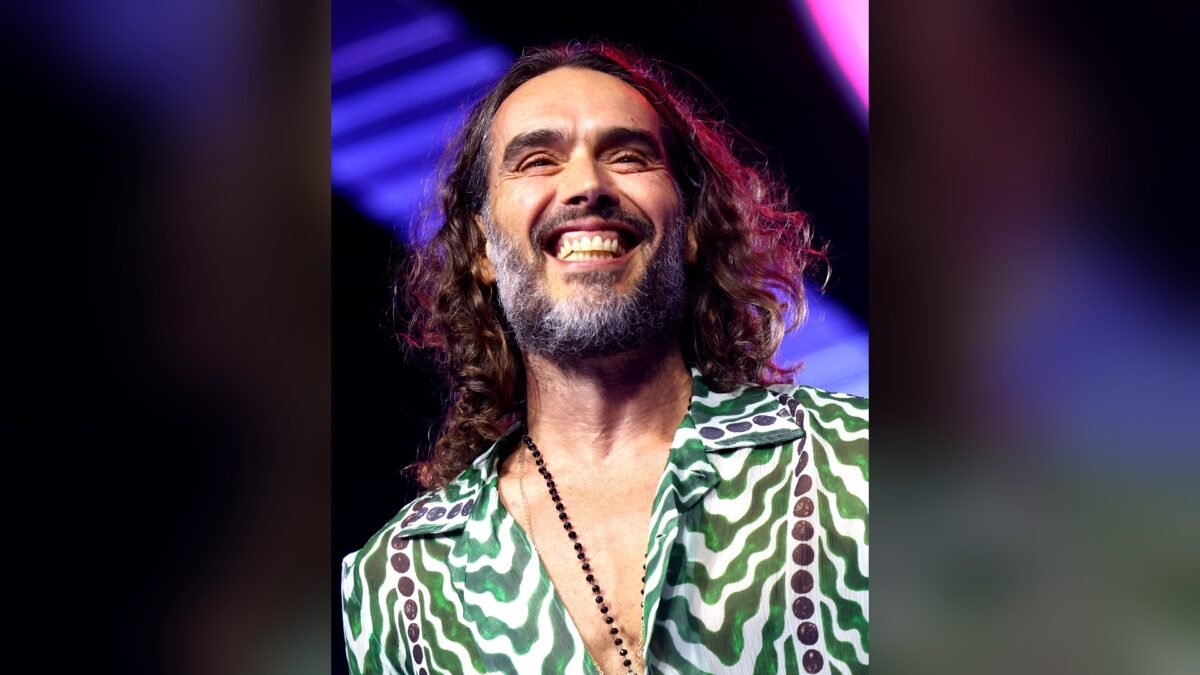
Russell Brand has been jailed for ten years and six months after a judge at Southwark Crown Court described the former comedian and broadcaster as a sexual predator who used his rising fame to assault women, and then relied on that same fame to escape accountability for almost two decades. Mr Justice Bennathan passed the sentence on Monday, four days after a jury convicted Brand of raping one woman and sexually assaulting three others in offences committed between 2004 and 2009.
The 51-year-old showed no emotion as the sentence was delivered, according to Britain’s Press Association news agency. He held a crucifix in his hands and appeared to be praying as he listened to the victim impact statements earlier in the day. As he was led away from the dock, he told his wife, Laura Gallacher, “we’ll be OK”, and the couple exchanged a brief farewell before he was taken to begin his sentence.
Brand will serve two-thirds of his sentence before he can be released on licence, meaning he faces at least seven years in prison, according to The Times. His name will also remain on the sex offenders’ register for life, CNN reported.
The sentence brings to an end, for now, one of the most high-profile criminal trials of a British celebrity in recent years — a case that began with a joint media investigation in 2023, passed through a three-week trial at Southwark Crown Court, and ended with a jury’s split verdict on 5 November. Brand was convicted on four counts and acquitted on three.
The sentence, count by count
Mr Justice Bennathan set out the sentence in full in remarks delivered in court on Monday, explaining how each term was reached under the Sentencing Council guidelines and how they combined into a single total.
The longest term, nine years, was imposed for the rape of a 21-year-old woman in the spring of 2009. Brand was 33 at the time. The woman had met him after one of his stand-up shows at the Hammersmith Apollo in west London and had gone to his home in Hampstead, north London, a few days later. The judge said Brand had been happy to exploit the fact that she was a huge fan of his. After consensual sexual activity, the judge said, Brand removed a condom without her agreement and raped her while she asked him to stop, twice. He then told her to clear up the bed, the judge said, and left for work. The woman was later driven to a nearby Underground station by Brand’s driver, weeping, according to the sentencing remarks.
The three sexual assault sentences will run concurrently with each other but consecutively to the rape term. For the July 2004 assault on a professional woman at a party in a Soho bar, where Brand grabbed her breasts moments after being introduced to her, the judge imposed nine months. For the 2005 assault on a newsreader at a London radio station, where Brand pinned her against a wall and kissed and groped her in front of his entourage, he imposed 18 months, reduced from two years to reflect the principle of totality. For the late 2009 assault on a woman working for a major television company, who was told she must give Brand a massage before he would continue filming an advertisement, he imposed eight months.
Together, the assault terms add eighteen months to the nine-year rape sentence, producing the total of ten years and six months.
The judge explained that he had reduced the rape sentence by a year from the ten years he would otherwise have imposed, in recognition of the mitigation in Brand’s favour. That mitigation, he said, included the fact that Brand had no significant previous convictions, that seventeen years had passed since the last of the offences, and that he had since done good work, particularly in helping people struggling with addiction, often by funding their treatment. The judge singled out a statement in Brand’s support from Dean Osgood, who wrote of Brand giving him his time, not just his money, as “particularly impressive”.
But the judge was clear about the limits of that mitigation. The sentencing guidelines for rape, he noted, state that previous good character and exemplary conduct “should not normally be given any significant weight”. He added that treating Brand as a man of good character by the time of the rape was “at least tempered” by the fact that he had already committed two sexual assaults by then.
“You had also become a sexual predator”
The judge’s remarks were unsparing in their assessment of Brand’s conduct and of the role his celebrity played in it. “About 20 years ago, Russell Brand, you were becoming famous. You were clever and, in many people’s eyes, funny and charismatic. You had also become a sexual predator,” Mr Justice Bennathan said, according to CNN and The Times.
“Your status protected you until 2023 when journalists collected and published the allegations that were broadcast as a Channel 4 documentary and in articles in the Times newspapers,” the judge said. “Those public declarations that you were a sex offender empowered a number of women to come forward and tell their stories of your activities many years before.”
He returned repeatedly to the theme of arrogance. The 2004 Soho bar assault, he said, “displayed your casual, arrogant disregard of any woman’s right to say ‘no’ to you”. Of the late 2009 incident, he said: “The whole episode reeks of casual disrespect and your belief that fame meant you could act how you liked, when you liked, unhindered by the rules by which decent people live.”
He was equally direct about the entourage that surrounded Brand at the time. In the 2005 radio station assault, the judge noted, Brand’s companions — a woman and two or three men — stood and watched while he pinned the victim against a wall. “No doubt your companions thought it was outrageous laddish behaviour that only you could get away with,” he said. “It was outrageous and possibly laddish, but also a criminal sexual offence, and as it turns out you haven’t got away with it.”
He also addressed Brand’s evidence at trial, in which the comedian said he had never touched a woman sexually without her consent. “In the light of the jury’s verdicts, that was one of a series of lies you told,” the judge said.
One of the most quoted passages of the remarks came when the judge dealt with the prosecution’s suggestion that two of the victims had been “particularly vulnerable” because they had been drinking or because they admired Brand. He rejected the suggestion, but in terms that carried a wider message. “Whatever women wear, wherever they go, indeed whatever they drink, they retain the right to say no and to demand justice from the criminal courts when sexual predators like you, Russell Brand, act without their consent,” he said.
What the victims told the court
Before sentence was passed, the court heard victim impact statements from all four women. The statements, which the judge described as evidence of harm that was “significant and long lasting”, gave the hearing its most powerful moments.
The woman assaulted in the Soho bar in 2004 read her statement to the court in person, shielded by a protective curtain. She spoke of being “extremely upset and traumatised”, of feeling vulnerable every time she went out for the evening, and of feeling sick on the many occasions she saw Brand in newspapers or on television. She said she had been left in “complete shock and turmoil” for years. She ended with a line that was widely reported: “A leopard may change its spots, but it’s still a leopard.”
The newsreader assaulted at the radio station in 2005 wrote that she was startled every time she heard Brand’s voice on television, that the incident had damaged her relationship with male colleagues, and that she had suffered stress, at least some of which she attributed to the assault. The judge said her account of the attack was one he accepted “without reservation”.
The woman who was raped in 2009 had her statement read to the court by the prosecutor, Riel Karmy-Jones KC. She wrote of struggling to eat and sleep, of taking two to three months off work, and of abandoning the career she had embarked upon. Although the rape took place seventeen years ago, the judge said, she still finds it affects her ability to form new friendships and to know when she can trust people. She also developed an alcohol problem, partly as a result of the attack, and turned to alcohol “to block out my feelings and memories”, according to CNN.
The woman working for the television company in 2009 wrote that she had been left upset, had lost trust in people, and no longer felt safe in her workplace. In her statement, quoted by CNN, she called Brand “a sexual predator who has no remorse for how his behaviour has impacted my life”, and said she feared the assault would “haunt me every day” and worried “there will be repercussions for telling the truth”. She added: “I just hope he is not allowed to hurt any more women.”
The judge noted that the harm in these cases went well beyond the guideline categories he was required to apply. The 2004 assault, he said, caused a degree of upset “significantly above that which would normally follow” from an offence of its type, and he went above the prescribed sentencing range for it. The rape, he said, involved two serious aggravating factors: the removal of the condom without the victim’s agreement, and the fact that Brand ejaculated inside her, leaving her fearing for months that she might have contracted HIV.
The defence case
Brand’s barrister, Ian Winter KC, argued in mitigation that the offences were historic and that his client had rebuilt his life since. According to The Sun’s reporting of the hearing, Winter described the rape as a “momentary failure” and the bar assault as a “very, very short incident”, and described one of the victims as “not particularly vulnerable”.
The judge accepted some of the mitigation but not the characterisation of the offending. He noted that Brand had told the jury a series of lies, that his fame had been an intrinsic part of each offence, and that he was careful not to punish Brand more heavily simply because he was famous, while also taking account of the added harm his fame caused — above all, the fact that the women could not avoid seeing him celebrated in the media afterwards.
Brand’s father, Ron Brand, spoke to reporters outside the court and insisted his son was the victim, not “the girls who chased and harassed him”. “He’s strong, he’s strong,” he said, according to The Times.
How the case reached this point
The road to Monday’s sentence began in September 2023, when The Times, The Sunday Times and Channel 4 published a joint investigation in which several women accused Brand of sexual abuse. The women in that investigation were different from the six who later gave evidence at his trial, and Brand has denied wrongdoing in relation to those allegations. The judge was explicit on Monday that he disregarded the documentary allegations, and the allegations in the trial on which the jury was not sure, when deciding the sentence.
The investigation prompted a Metropolitan Police inquiry in which detectives interviewed more than 100 witnesses and reviewed thousands of documents, according to The Wall Street Journal. Brand was charged, and the trial opened at Southwark Crown Court on 12 October 2026, with the jury formally sworn in the following day. Six women gave evidence. The prosecution, led by Riel Karmy-Jones KC, told the jury that the women did not know each other and had come forward independently of each other.
The prosecution’s case was that Brand had been “ruthless and calculating” in his pursuit of a personal goal to have sex with 5,000 women, and that he had used his growing fame to target women at work, at parties and after his comedy shows. In her closing submissions, Karmy-Jones told the jury that Brand was “childlike in his expectation that his every desire should be met” and cared only about his “birth right to orgasm”, according to reporting of the trial.
Brand, who acknowledged during the trial that he had been a highly promiscuous man who enjoyed sex, insisted that the encounters had been consensual. The jury began its deliberations on Tuesday 3 November and returned its verdicts on Thursday 5 November, after three days of considering the evidence.
It convicted him of one count of rape and three counts of sexual assault, and acquitted him on three further counts: raping a woman in a hotel room during the Labour Party conference in Bournemouth in 1999; a second, more serious assault alleged to have taken place in a toilet at the Soho bar in 2004; and attempted indecent assault on another woman in 2001, a count that had been reduced during the trial itself when the judge ruled there was insufficient evidence to sustain the original charge.
As the verdicts were read out, Mr Justice Bennathan told Brand he faced a “significant custodial term” and remanded him in custody. Brand spent the four nights before his sentencing at HMP Wandsworth in south-west London, and returned to Southwark Crown Court on Monday in a prison van.
The sentencing hearing itself was delayed. The judge heard arguments from both sides and the victim impact statements in the morning, then rose to consider his decision before returning at about 2pm to deliver the sentence. The BBC, which broadcast the hearing live, had its coverage interrupted several times during the morning.
Outside the court, some people broke into applause as the sentence was delivered, according to CNN. A small group of Brand’s supporters protested nearby. A crowd swarmed a prison van believed to be carrying Brand as it left the court, The Times reported. His wife left the court accompanied by several people and did not answer questions shouted by journalists.
Reaction: “Fame, status and the passage of time”
After the sentencing, David Roberts of the Crown Prosecution Service said: “Today’s result shows that fame, status and the passage of time do not change the fundamental issue of consent.”
Detective Superintendent Andy Furphy of the Metropolitan Police, speaking on the steps of the court, said: “Today’s sentence marks a significant milestone in our investigation and means Russell Brand has been held accountable for his crimes.” He praised the women for their “immense bravery, dignity and resilience”, and said their courage “may also give confidence to others who have suffered sexual violence to seek help and report what happened to them”.
The Metropolitan Police confirmed last week that it is investigating two further allegations of rape against Brand. Its Commissioner, Sir Mark Rowley, said on Friday that it would not surprise him if “many more” alleged victims came forward, because high-profile cases often produce an “upsurge” in reporting as victims gain confidence. “It does make a difference because people see it is possible, and you will be believed,” he said, according to CNN.
It was revealed at pre-trial hearings that one complaint came from a woman who had previously dated Brand when she was 16 years old and he was 30. A Channel 4 director also hailed “the bravery” of the women who gave evidence, both to the criminal justice system and to journalists, The Times reported.
From television star to online preacher
The sentence marks a stark reversal for a man who was once one of Britain’s best-known broadcasters. Brand’s big break in television came in the early 2000s as host of Channel 4’s “Big Brother’s Big Mouth”, a spin-off of the popular reality show. In 2006 he was given his own radio show, “The Russell Brand Show”, on BBC Radio 6 Music, before being moved to a coveted Saturday night slot on BBC Radio 2. He left the BBC two years later after the broadcast of sexist and misogynistic voice messages about the actor Andrew Sachs’s granddaughter — the episode that became known as “Sachsgate”.
He went on to act in Hollywood films, including “Forgetting Sarah Marshall” and “Arthur”, and built a career as a stand-up comedian and author. In the past decade he moved away from mainstream broadcasting and reinvented himself as an online commentator, making podcasts about spirituality, meditation and yoga after becoming a born-again Christian. He has been living in Florida, and since the Covid-19 pandemic has built a large online following, with more than 6.6 million subscribers to his YouTube channel and a show on the conservative-friendly platform Rumble, according to CNN.
That reinvention is part of why the case has attracted such attention. Brand’s later public persona — the spiritual seeker, the critic of mainstream media, the man who presented himself as a truth-teller persecuted by the establishment — stood in sharp contrast to the picture that emerged in court. The judge’s remarks drew that contrast out explicitly, noting that the women who accused Brand had watched him celebrated in the media for years while they lived with the consequences of what he had done to them.
Analysis: Why It Matters
The jailing of Russell Brand is, on its face, a story about one man and four women. Look closer, and it is a story about how power works in Britain’s entertainment industry, about the long road from allegation to conviction in historic sexual offence cases, and about what the justice system can and cannot repair.
Fame as a shield — and as a weapon
The most striking sentence in Mr Justice Bennathan’s remarks was also the simplest: “Your status protected you.” It is a sentence that should haunt every broadcaster, production company and talent agency that employed Brand at the height of his fame.
The offences in this case were not committed in secret. Two of them took place in workplaces — a radio station corridor and a television advertisement shoot — in front of colleagues, friends and associates. In both cases, the judge found, people stood by. In the radio station, three men and a woman watched Brand pin a newsreader against a wall and did nothing; one man laughed. At the television shoot, two associates relayed Brand’s demand for a massage and then laughed at the victim’s humiliation. These were not strangers in a dark alley. They were co-workers, in offices, in the middle of the working day, and the system around Brand treated his behaviour as a joke that only he could get away with.
That is the mechanism by which fame protects a predator. It does not require a conspiracy. It requires only that the people around a star decide, again and again, that the star’s comfort matters more than a colleague’s safety — that an incident is “laddish” rather than criminal, that intervening would be awkward, that the star is too valuable to challenge. The judge’s anger at the entourage was therefore not a footnote. It was the point. A culture that laughs at an assault in the moment will, years later, have to explain why it did nothing.
There is a second, crueller way in which fame operated here. Brand’s celebrity did not merely shield him from consequences; it prolonged his victims’ suffering. As the woman assaulted in 2004 told the court, she felt physically sick every time she saw him celebrated on television. His face was everywhere — on chat shows, in films, on book covers — while she lived with what he had done. Fame turned a private injury into a public, recurring one. The judge took that into account when assessing the harm, and rightly so: it is a distinct cruelty of celebrity offending that the victim cannot escape the offender’s image.
Why it took seventeen years — and why that matters
The gap between the last offence and the sentence — seventeen years — will be quoted by Brand’s supporters as a reason for leniency, and it was indeed treated as mitigation. But the gap is better understood as evidence of a failure, not as a reason to minimise what happened.
The women in this case did not report promptly, and the reasons they gave are the reasons victims of sexual offences so often give: fear, shame, the belief that they would not be believed, and the knowledge that the man they were accusing was famous, powerful and adored. The rape victim told the court that she reported only when she became aware of the police investigation and felt she was finally in a stronger position mentally. That is not a weakness in her evidence. It is a description of how the justice system looks from the outside to a victim standing alone against a celebrity.
What changed was journalism. The judge said so plainly: it was the 2023 investigation by The Times, The Sunday Times and Channel 4 that “empowered a number of women to come forward”. That is a reminder of something the news industry is often reluctant to claim for itself — that reporting can be the difference between impunity and accountability. The women who came forward after 2023 did not do so because the police had suddenly found new evidence. They did so because they saw other women speaking, and believed, for the first time, that they might be believed too.
That dynamic is now playing out again. The Metropolitan Police has confirmed two further rape allegations against Brand, and its Commissioner expects more. The pattern is familiar from other high-profile cases: a conviction gives other victims the confidence to report. Whether those further allegations lead to charges is a matter for the police and the Crown Prosecution Service, and nothing should be assumed. But the direction of travel is clear, and it is a measure of how much the landscape has changed since 2004, when a woman could be assaulted in a crowded radio station and nobody intervened.
A split verdict, and why it strengthens the outcome
It is worth pausing on the fact that the jury acquitted Brand on three counts. In a case as charged as this one, that fact is sometimes treated as a complication. It is better understood as the opposite.
The jury heard six women give evidence over three weeks. It believed four of them and was not sure about the other two, and it said so, count by count. One count was reduced by the judge himself during the trial for lack of evidence, and the jury acquitted on the reduced charge as well. That is a jury doing its job — weighing each allegation on its own evidence rather than delivering a verdict on a man’s character.
The judge’s own conduct reinforced that care. He told the court that he disregarded the allegations in the 2023 documentary and the allegations on which the jury acquitted, and sentenced Brand only for the four offences of which he was convicted. He rejected prosecution submissions he did not accept, including the suggestion that being a celebrity amounted to an abuse of trust, and the suggestion that the victims were “particularly vulnerable”. He gave Brand credit for the mitigation that was genuinely available to him.
None of that makes the sentence lenient. A sentence of ten and a half years for offences committed two decades ago, with no previous convictions and a long period of good conduct since, is a substantial punishment by any measure. But the care with which it was reached matters, because it makes the outcome harder to dismiss. Brand’s supporters have already begun to frame the case as a persecution; his father called him the victim. The careful, count-by-count reasoning of the jury and the judge is the answer to that claim, and it is an answer that will hold up on appeal far better than a verdict reached in haste would have done.
What the sentence actually means
There is a tendency, when a long sentence is announced, to treat the number as the whole story. It is not. Ten years and six months is the headline, but the mechanics matter just as much.
Brand will serve two-thirds of his sentence before release on licence, which means at least seven years behind bars. He will be on the sex offenders’ register for life, which carries reporting obligations and restrictions that will follow him long after release. And the totality principle, which the judge applied by reducing individual terms rather than stacking them end to end, means the sentence reflects the gravity of four offences against four different women, not a single incident.
It is also worth noting what the judge did not do. He did not impose the maximum. Rape carries a maximum sentence of life imprisonment in England and Wales. The nine-year term for the rape, reduced from ten, reflects the sentencing guidelines for an offence of this category, the aggravating factors the judge identified, and the mitigation he accepted. That restraint is part of why the sentence is likely to survive scrutiny: it is firmly grounded in the guidelines, and the judge explained every step of his reasoning in open court.
A reckoning for the industry, not just the man
Finally, this case should be read as an indictment of an industry, not only of an individual. Brand’s offences took place in the workplaces of some of Britain’s biggest broadcasters and production companies. The women he assaulted were, in three of the four cases, at work — a radio newsreader, a television production worker, a woman at a media party. They were junior, or at least less powerful, and he was the star.
The broadcasters involved have questions to answer about what they knew, when they knew it, and what they did. The judge’s remarks about the entourage apply with equal force to the institutions that employed Brand and profited from him: a culture in which a star’s behaviour is indulged is a culture that will, eventually, have to account for the harm it enabled. Channel 4’s decision to investigate Brand in 2023, alongside The Times, is to its credit. But the industry’s record before that date — the years in which complaints were not pursued, in which Brand’s behaviour was treated as an open secret — deserves the same scrutiny the court gave to Brand himself.
That is the wider significance of Monday’s sentence. It is not only that a famous man has been jailed. It is that a court has said, in the plainest possible language, that fame is not a defence, that the passage of time is not an absolution, and that a woman’s right to say no does not depend on what she was wearing, where she was, or what she had been drinking. Those are principles the law has always stated. It took a courtroom in south London, and four women willing to endure years of public scrutiny, to make them real.
What to Watch Next
- An appeal. Brand has the right to seek leave to appeal against his conviction and his sentence. Any appeal would be heard by the Court of Appeal, and the careful, guideline-based reasoning in the judge’s sentencing remarks will be central to it. Watch for whether his legal team lodges an application in the coming weeks.
- The Metropolitan Police’s further investigations. The force has confirmed it is investigating two further allegations of rape against Brand. Its Commissioner has said he would not be surprised if more alleged victims come forward. Any charging decision will be made by the Crown Prosecution Service on the evidence.
- The release timeline. Brand must serve two-thirds of his sentence — at least seven years — before he can be released on licence. His time on remand at HMP Wandsworth will count towards that period. His name will remain on the sex offenders’ register for life.
- Whether the sentence is reviewed. In England and Wales, an unduly lenient sentence can be referred to the Court of Appeal by the Attorney General if the public asks for a review. Watch for whether any such request is made, and whether the Attorney General considers the sentence within the proper range.
- Brand’s online presence. Brand has more than 6.6 million YouTube subscribers and a show on Rumble. How those platforms treat a convicted sex offender’s channels — and what happens to the audience he built — will be closely watched by his supporters and his critics alike.
- The broadcasters’ response. The BBC and Channel 4, whose workplaces feature in the offences, face renewed questions about what was known about Brand’s behaviour during his years on air. Expect further statements, and possibly further internal reviews, in the days ahead.
Sources
- CNN — Russell Brand sentenced to 10 years and six months in prison for rape and sexual assault
- The Times — Russell Brand jailed for ten years for rape and sexual assaults, as it happened
- The Times — Russell Brand jailed for ten years and six months
- The Wall Street Journal — Russell Brand Sentenced to 10½ Years in Jail for Rape and Sexual Assault
- Media Mole — Judge’s sentencing remarks to Russell Brand, read in full (R v Russell Brand, Southwark Crown Court, 9 November 2026)
- Bury Times (Press Association) — Russell Brand sentenced to 10 years for rape and sexual assaults

About the Author — Abdul Mannan
Related Articles
Labour MPs Urge Burnham to Scrap Draft Conversion Practices Bill Over Fears Parents Could Face Jail
At least a dozen Labour MPs have told party whips they are unhappy with the draft Conversion Practices…
Russell Brand Jailed for Ten Years and Six Months for Rape and Sexual Assault
Russell Brand has been jailed for ten years and six months after a judge at Southwark Crown Court…

Starbucks to Hire 7,500 UK Baristas in Five-Year Expansion as It Bets on Growth Beyond London
Starbucks has announced plans to recruit 7,500 new baristas across the UK over the next five years, staffing…