
Nvidia Loses $430 Billion in Two Days as $7.5 Billion China Chip Claim and a Resignation Call Deepen the Huang Crisis

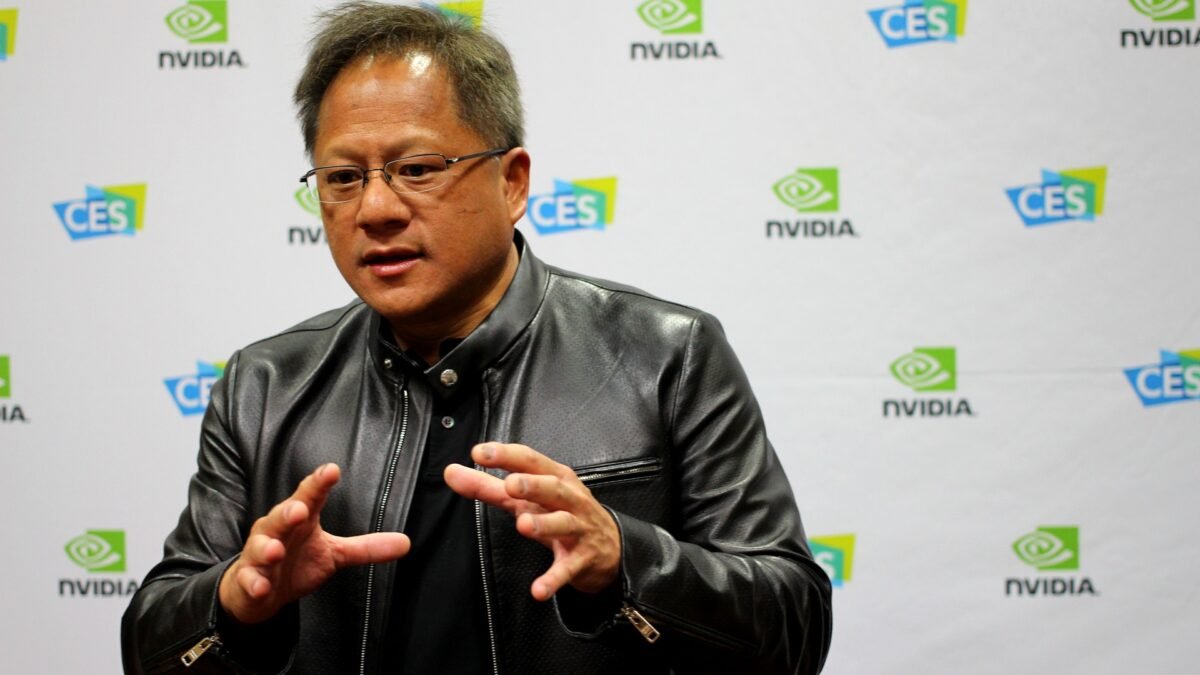
Nvidia has lost about $430 billion in stock market value in two trading sessions, as the crisis around its chief executive, Jensen Huang, deepened on Tuesday with a report alleging that his relationship with a Chinese businesswoman suspected of being a spy helped move at least $7.5 billion worth of the company’s chips to China, and with the first call from a senior Republican senator for Huang to resign.
Shares in the world’s most valuable chipmaker fell 5.5 per cent to $168.89 by the close in New York on Tuesday, according to The Times, after a 4.3 per cent drop on Monday. The two-day slide has left the company valued at about $4.1 trillion, and the stock is down about 9.5 per cent since news of the affair first broke.
The scale of the fall is striking even by the standards of a company whose shares have swung wildly before. About $190 billion was wiped off Nvidia’s value on Monday alone, and Tuesday’s further drop took the combined two-day loss past $430 billion, a sum larger than the entire market value of most companies listed on any stock exchange in the world.
What began ten days ago as a boardroom inquiry into a chief executive’s private life has now become a test of Nvidia’s governance, its compliance with American export controls, its standing with the White House and Congress, and the judgement of the man who has led the company for more than three decades. On Tuesday, each of those fronts moved against the company at once.
A $430 Billion Verdict From the Market
The selling on Tuesday was not a general market retreat. Nvidia fell sharply while the wider market held up far better, a sign that investors were reacting to company-specific news rather than to a broad change in sentiment about technology stocks.
Bank of America analysts, in a note quoted by The Times, framed the question now facing every holder of the stock: “The investment debate is whether this remains company-specific or triggers restrictions and disruption across AI infrastructure.” The bank added a note of caution of its own: “We would not equate allegations with proven business damage.”
That distinction matters, because so far none of the reporting establishes that Nvidia’s business has been damaged in any concrete way. No customer has cancelled an order in public. No regulator has charged the company or its chief executive with any offence. No evidence has been made public showing that Huang knowingly took part in any wrongdoing. What the market is pricing, for now, is uncertainty: uncertainty about who leads the company, uncertainty about whether Washington will tighten the rules under which it sells chips to China, and uncertainty about what the board’s investigation will eventually find.
The timing adds to the pressure. Nvidia is due to report its quarterly earnings on 17 November, six days after the two-day rout, and the results will be examined not only for the numbers but for what Huang says about the investigation, about China, and about his own future. The company had been worth about $4.5 trillion before the affair became public, according to CNN, and its chips sit at the centre of the global race to build artificial intelligence systems, which makes any question about its leadership a question about the industry itself.
Investors had already been jittery about artificial intelligence stocks. Earlier in the month, markets absorbed a sharp sell-off across the sector, and the Federal Reserve’s signals about interest rates have kept technology valuations under scrutiny. Against that background, a scandal touching the chief executive of the industry’s dominant supplier was always likely to be punished swiftly. The speed and size of the punishment, however, surprised even seasoned market watchers: a loss of $430 billion in 48 hours is among the largest two-day destructions of shareholder value ever recorded by a single company.
The $7.5 Billion Claim at the Centre of the Storm
The sharpest escalation on Tuesday came from a report by The Information, a business publication, which said that Huang’s relationship with Alice Huang, the Chinese businesswoman at the centre of the affair, had helped facilitate shipments of at least $7.5 billion worth of Nvidia chips to Chinese firms.
According to the report, cited by Reuters and The Times, about 240,000 processors, including H100, H200 and some A100 models, were moved into China with her help. Some of the chips ultimately served Alibaba and Tencent, two of China’s largest technology companies, as well as smaller Chinese artificial intelligence laboratories, according to Reuters Breakingviews.
The mechanism described in the report is specific. When orders for Nvidia chips subject to American export restrictions stalled, Alice Huang used her ties to Nvidia to secure supplies, helping to move the processors through a network of companies operating in China and Singapore, according to The Information. She was the managing director of Megaspeed, a Singapore-based cloud computing company that describes itself as a business partner of Nvidia in the Asia-Pacific region.
Two cautions are essential, and both were stated plainly by the outlets reporting the claim. Reuters said it could not independently verify the report, and Nvidia did not immediately respond to a Reuters request for comment. The Information’s account rests on two people who know Alice Huang, according to Reuters, and on people familiar with the matter, according to Reuters Breakingviews. The allegation has not been confirmed by any government agency, and no charges have been brought against anyone in connection with it.
Even so, the figure matters because of what it would mean if it were true. The earlier reporting on the chip-diversion question involved far smaller sums. The New York Times reported last month that Megaspeed was under American investigation over helping Chinese customers obtain advanced Nvidia chips, and that nearly $2 billion of chips had moved through a Malaysian unit of the company. A $7.5 billion figure, if accurate, would be almost four times that amount, and would turn a question about one company’s compliance into a question about the effectiveness of the entire American export-control system.
The chips named in the report are among the most powerful processors Nvidia makes. The H100 and its successor, the H200, are the workhorses of modern artificial intelligence training, and the A100 was the previous generation’s flagship. All three have been subject to American export restrictions aimed at preventing China from obtaining the computing power needed to train advanced AI systems. That is why the allegation, even unverified, lands with such force: it suggests that the controls may have been circumvented at industrial scale, through the personal network of the chief executive of the company that makes the chips.
“He’s Got to Go”: The First Resignation Call
On Tuesday evening, the political pressure on Huang crossed a new line. Senator Kevin Cramer, a Republican from North Dakota who sits on the Senate Banking Committee, called on Huang to step down as Nvidia’s chief executive.
“The potential for extortion is so tremendous that something as sensitive as Nvidia chips, I just think he’s got to go,” Cramer told Politico late on Tuesday, according to Reuters. “If the worst thing he did in real life is infidelity with this woman who may or may not be a Chinese spy, but she might be, that’s enough, because whatever else there is, we don’t know. And to me, that’s a security risk.”
Cramer’s intervention is significant for two reasons. First, he is a senior Republican, and his call breaks the pattern in which criticism of Huang has come mainly from Democrats. Second, he sits on the Banking Committee, which has jurisdiction over the financial and sanctions machinery that underpins American export controls. His argument is not that Huang has been proved guilty of anything, but that the mere possibility of compromise, in a job as sensitive as his, is itself disqualifying.
That logic, if it spreads, is the most dangerous threat to Huang’s position. The board has said it has no reason to believe that American national security or company secrets were compromised, and Huang has told employees he was unfaithful to his wife but has provided no details about the relationship. No public evidence establishes that he knowingly participated in any wrongdoing. Cramer’s point is that, for the chief executive of a company whose products sit at the heart of national security, the standard may not be proof of wrongdoing but the absence of doubt.
Huang is one of President Donald Trump’s closest allies in Silicon Valley, according to Reuters, and over the past two years he has repeatedly voiced support for the administration’s agenda and become a regular presence in Washington as Nvidia sought to sell advanced chips to the Chinese market. That closeness has protected him so far. The question now is whether it will continue to do so as members of the president’s own party begin to call for his departure.
Congress Wants Answers, and New Chip Laws
Cramer’s call was not the only congressional development on Tuesday. Senate Democratic Leader Chuck Schumer said Congress must have a full accounting of President Trump’s defence of Huang, and called on lawmakers to quickly approve new restrictions on American chip exports to China.
Schumer cited reports that Trump was briefed on Huang’s affair with a suspected Chinese spy a year ago and did nothing, according to Reuters. The White House and Nvidia did not immediately respond to requests for comment, Reuters reported.
A growing number of lawmakers want restrictions on American exports of chips to China as part of the annual defence bill, according to Reuters. A Senate version of the bill contains provisions giving Congress more authority over AI chips going to China, prodding American allies to restrict sales of semiconductor manufacturing equipment to China, and requiring businesses to track their AI chips abroad to combat smuggling. Lawmakers also want a briefing with Huang himself.
Democratic Senator Ruben Gallego put the question bluntly, according to Reuters: “Nvidia has been asking permission to sell advanced chips to China. We need to know how much the Chinese spy influenced CEO Jensen’s decision.”
The congressional pressure has been building since the story broke. On Monday, the Gang of Eight, the group of senior lawmakers briefed on the most sensitive intelligence matters, received a briefing lasting more than an hour from the Director of National Intelligence, Jay Clayton, and the CIA Director, John Ratcliffe. The session had initially been intended to focus on the war in Iran, but lawmakers left it with more questions than answers about Nvidia, and Democrats have vowed to pursue investigations once they take control of Congress in January.
Separately, three Republican chairmen in the House of Representatives wrote to the administration on 4 November requesting a joint closed-door briefing by 18 November, a deadline that falls one week from today. The letter was released on 6 November, before the affair was publicly acknowledged, and it shows that congressional concern about the matter predates the public scandal by days.
The Briefing Trump Says He Never Heard
The most awkward development of Tuesday for the White House came from a report in The New York Times, which said that Marco Rubio, the secretary of state, briefed Trump aboard Air Force One in May, while the president was en route to China, about American intelligence indicating that Huang was involved with a woman believed to be a Chinese spy.
According to The Times, the message was delivered by Rubio shortly before Huang joined the presidential trip to Beijing at Trump’s invitation. It was, according to one account of the reporting, the second such warning in seven months. Yet when Trump was asked about the report this week, he said: “No, I didn’t hear about it then.”
The contradiction sits at the centre of the political storm. Trump has said repeatedly that he only recently learned about the affair, and that he was not aware of it when he brought Huang to Beijing. On Monday, he told reporters he had spoken to Huang, who told him he had no idea the woman was a spy, and that he believed him. “I really believe him,” Trump said, adding that he was confident Huang would be “in good shape” and describing him as “a very honorable man”.
The record, as reported, is more complicated. A classified memorandum overseen by Rubio circulated among a small group of senior officials before the China trip in May, and the FBI warned lawmakers about a year ago that Huang was the target of a foreign intelligence effort. Two former senior FBI intelligence officials have questioned why no defensive briefing, the standard warning given to Americans targeted by foreign intelligence services, appears to have been delivered to Huang himself.
Trump also awarded Huang the National Medal of Science last month, describing him as “an amazing man” and noting that “the entire world is now running on Nvidia”. He said on Monday that he did not expect to raise the matter with President Xi Jinping of China when the two leaders meet next week at the APEC summit, but added: “I’m sure President Xi will ask me about it.”
Whether Trump was briefed in May and forgot, was briefed and chose not to act, or was never briefed at all, the question now matters far beyond the fate of one executive. Schumer’s demand for “a full accounting” is, in substance, a demand to know what the president knew, when he knew it, and what he did with the information, at a moment when the administration is also deciding how far to open the Chinese market to Nvidia’s most advanced chips.
Inside Nvidia: The Investigation and the Apology
Inside the company, the week has been dominated by the board’s independent investigation, which was announced on Sunday 8 November, and by Huang’s own efforts to hold the trust of the people who work for him.
The board has retained Joon Kim, a partner at the law firm Wachtell Lipton and a former acting United States Attorney for the Southern District of New York, to lead the inquiry, according to reporting by CNBC cited in market coverage. Kim’s practice includes internal investigations and white-collar defence, and his appointment signals that the board is treating the matter as a serious corporate investigation rather than a routine review.
On Monday, Huang apologised to Nvidia’s senior executives at a closed-door meeting before shifting the focus back to business, according to CNBC, and he was back holding meetings at the company’s headquarters on Tuesday. He has told employees he was unfaithful to his wife, but has provided no details about the relationship, and in a message to staff he apologised to his wife and to the company and committed to supporting American national security.
The board has said it has no reason to believe that American national security or Nvidia secrets were compromised, and that it has confidence in Huang and his leadership team. It has also said the inquiry “would examine all available information”, according to Reuters, and that Huang has committed to cooperating with the internal review.
The governance questions, however, run deeper than the investigation itself. Reuters, in an analysis of the board, noted that Nvidia operates unusually among its peers: it has no board chair among its 11 directors, three of its independent directors have served since the 1990s, and only two have joined since 2021. A board that has sat alongside the same chief executive for three decades, the analysis suggested, may struggle to investigate him with the independence the moment demands.
Huang himself has no obvious successor. He co-founded the company, owns about 3.6 per cent of its stock, and has dozens of direct reports, suggesting a tight grip on the organisation he built. That concentration of power is part of what made Nvidia so successful, and part of what makes the current crisis so difficult to resolve: there is no ready-made alternative leader, and no obvious mechanism for a clean break.
Nvidia and Huang also face a proposed class-action lawsuit filed in a federal court in San Jose, California, which accuses the company and its co-founder of misleading investors over failures to disclose potential national security risks linked to the affair. The 19-page complaint, filed by the Rosen Law Firm, cites a New York Times article from October 2025 that questioned Huang’s relationship with Alice Huang and whether Megaspeed was helping China obtain sensitive AI chips, and accuses Nvidia of making false and misleading statements about the pair’s relationship for months before Huang admitted the affair.
How the Story Unfolded
The affair at the centre of the crisis involves Alice Huang, also known as Huang Le, a Chinese businesswoman who is not related to Jensen Huang. She is a former private banker at HSBC in Hong Kong who later worked at CITIC Securities and at Shanghai Hexi Investment Management, where she was deputy general manager and a member of the investment decision committee. In March 2023 she became the controlling shareholder of Megaspeed, according to research by the open-source intelligence group C4ADS, and she served as a director and managing director of the company’s Indonesian subsidiary.
Megaspeed, incorporated in Singapore in 2015 as 7Road International, is an official cloud partner of Nvidia and describes itself as a business partner of the company in the Asia-Pacific region. It has been under American investigation over whether it helped Chinese customers obtain advanced Nvidia chips under export controls, and import records show its Indonesian subsidiary imported Nvidia hardware, including H100 processors, between 2024 and 2026.
The public story began on 29 October, when The New York Times reported that American intelligence agencies had concluded that Alice Huang was a Chinese intelligence asset who had passed information to Beijing while developing a close relationship with Jensen Huang. A second Times report, on 6 November, said she had been recruited by China’s Ministry of State Security to gather intelligence on the chief executive, including pushing for looser American chip export limits. The Times could not establish what information, if any, was passed, or what its value might have been.
On Sunday 8 November, Nvidia’s board announced its independent investigation into whether Huang had been targeted by a foreign intelligence effort, and Huang acknowledged in a message to employees that he had been unfaithful to his wife. On Monday 9 November, Trump confirmed that the FBI was looking into the affair, shares fell 4.3 per cent, and the first investor lawsuit was filed. On Tuesday, The Information’s report and the second day of heavy selling brought the loss to $430 billion, and the first Republican senator called for Huang’s resignation.
China’s foreign ministry has dismissed the spying accusations as “groundless” and “a smear”, and a spokesman, Guo Jiakun, has called the allegations “purely groundless speculation and an attempt to smear and malign China”. Singapore’s Ministry of Home Affairs said on 31 October that there was no investigation into Alice Huang herself, while confirming that a police investigation into Megaspeed was continuing. Alice Huang was questioned by Singaporean authorities in 2025 and released without charge, and her current whereabouts could not be determined by Reuters.
The export controls at the heart of the story were imposed by Washington in 2022, and have been tightened repeatedly since. Last year, the Trump administration allowed Nvidia to resume certain shipments to China under arrangements in which the American government receives a cut of the company’s China chip sales, according to Reuters. That policy, which Huang lobbied for personally and publicly, is now under fresh scrutiny, with lawmakers asking whether the chief executive’s private life influenced decisions about what America sells to its principal strategic rival.
Analysis: Why It Matters
The market is pricing governance, not gossip
The most important thing to understand about the $430 billion loss is what it is not. It is not a judgement that Nvidia’s chips are worse than they were a week ago. It is not a judgement that demand for artificial intelligence has fallen. It is a judgement about governance: about whether the person at the top of the world’s most important chip company can still be trusted, and about whether the company that makes the chips can be trusted to keep them out of the wrong hands.
Markets punish uncertainty more harshly than bad news, because bad news can be measured and uncertainty cannot. A fine can be modelled. A lost contract can be counted. But a chief executive whose judgement is in question, a board whose independence is in doubt, and a set of export controls whose effectiveness is in dispute create a fog that no spreadsheet can clear. That is why the shares fell for a second day even though no new charge was filed and no new fact about the business itself emerged: the fog thickened.
The Bank of America note quoted by The Times captures the calculation precisely. If the crisis “remains company-specific”, the damage is contained to Nvidia. If it “triggers restrictions and disruption across AI infrastructure”, the damage spreads to every company that builds on Nvidia’s chips, and to the valuations of the entire sector. The market, for now, is pricing a meaningful chance of the second outcome.
The $7.5 billion claim changes the legal question
Until Tuesday, the central question about Huang was a personal one: was he the target of a foreign intelligence operation, and did he know? The Information’s report changes the question into a corporate and legal one: did the relationship help move $7.5 billion of restricted chips into China, and if so, who at Nvidia knew?
That distinction matters enormously. An affair is a private failing with public consequences. A diversion of $7.5 billion of controlled technology is a potential violation of American export law, with criminal penalties, and it would put the company itself, not just its chief executive, in legal jeopardy. It is also, crucially, a claim that can be investigated in a way that an affair cannot: chip shipments leave records, customs declarations, invoices, and shipping manifests.
It is equally important to be clear about what has not happened. Reuters could not independently verify the report. Nvidia has not responded to it. No government agency has confirmed it. The figure rests on two sources cited by The Information, and it should be treated as an allegation, not as a fact, until it is corroborated. But the allegation is now part of the record that the board’s investigation, the FBI’s inquiry, and any congressional investigation will have to examine, and the existence of the claim is itself a fact that moves markets and politics.
A resignation call from Trump’s own side
Senator Cramer’s intervention is the most politically significant development of the week, because it breaks the partisan frame in which the story has been told. Until Tuesday, the loudest demands for accountability came from Democrats, which allowed the affair to be dismissed, by some, as a partisan attack on a Trump ally. A senior Republican on the Banking Committee calling for Huang’s resignation removes that defence.
Cramer’s argument is also the hardest for Huang to answer, because it does not depend on proving that he did anything wrong. It depends on the proposition that the chief executive of the company that makes the world’s most sensitive chips cannot carry even the possibility of compromise. That is a standard almost no executive could survive if the underlying suspicion were sustained, and it is a standard that, once stated by a member of the president’s own party, is difficult for the White House to ignore.
The contrast with Trump’s own position is stark. The president has described Huang as “a very honorable man”, said he believed his account, and predicted he would be “in good shape”. The gap between the president’s defence and a Republican senator’s demand for resignation is now the central political tension in the story, and it will be tested in the coming days as more lawmakers are asked to choose between the two positions.
The chip war’s human front
For four years, the contest over advanced semiconductors has been fought with regulations, licences, and export bans: instruments of statecraft that operate at a remove from individual lives. The Huang affair is a reminder that the contest also has a human front, and that it is fought with the oldest tools of espionage.
The reported operation, if the intelligence assessments are correct, followed a classic pattern: identify a person with access to something valuable, build a relationship with them, and use that relationship to obtain information or influence decisions. What makes this case unusual is the scale of the target: not a government official or a defence contractor, but the chief executive of a private company whose products are, in the words of one American official, at the heart of the global race for AI superiority.
Other artificial intelligence companies have already warned their staff about approaches from people offering sex or romance in exchange for information, a sign that the industry has understood for some time that its people are targets. The question the Huang case raises is whether the companies’ defences, which are designed for employees, extend to their founders and chief executives, the people with the most access and the least supervision.
What “no evidence of compromise” does and does not settle
Nvidia’s board has said, twice now, that it has no reason to believe that American national security or company secrets were compromised. That statement is often quoted as though it settles the matter. It does not, and it is worth being precise about why.
First, the board is investigating its own chief executive, through a committee of directors who have sat alongside him for decades, and its statement is a statement about what it has found so far, not a conclusion. Second, the FBI’s inquiry and the board’s inquiry are both continuing, and their findings have not been published. Third, the absence of evidence of compromise is not the same as evidence of absence, particularly in a case involving a foreign intelligence service, where the whole point is to leave no trace.
None of this means the board is wrong. It may well be right, and Huang may turn out to have been, as the board’s framing suggests, the target of an operation he did not understand. But the statement should be read for what it is: an interim assurance from an interested party, not a verdict. The verdict will come from the investigation, from the FBI, and from Congress, and it will take weeks or months, not days.
What to Watch Next
- Nvidia’s earnings on 17 November: the results, and what Huang says on the earnings call about the investigation, China, and his future, will be the next market-moving moment.
- The board’s investigation: whether Joon Kim’s inquiry produces findings, and whether the board publishes them, will determine whether confidence in Huang’s leadership is restored or further damaged.
- The House briefing deadline of 18 November: the three Republican chairmen who requested a closed-door briefing will either receive it or escalate, and their reaction will signal how far congressional patience extends.
- The defence bill: whether the Senate’s proposed restrictions on chip exports to China survive into the final bill, and whether they are tightened further, will show how far Congress is willing to go.
- The Information’s $7.5 billion claim: whether any outlet, agency, or investigation corroborates the figure, and whether Nvidia responds to it in detail, will determine whether it becomes the central fact of the case or fades as an unverified allegation.
- Wednesday’s trading: whether the selling continues into a third session, or buyers return, will show whether investors regard $430 billion as an overreaction or a down payment on further losses.
Sources
- The Times: Nvidia market loss over scandal reaches $430bn
- Reuters: Senior Republican on US Senate banking panel calls on Nvidia CEO Huang to resign
- Reuters: Nvidia CEO’s affair aided $7.5 billion in chip shipments to China, Information reports
- Reuters: Schumer says Congress must have answers on Trump defense of Nvidia CEO
- Reuters: Nvidia’s clubby board faces a sticky ‘honey pot’ test
- Reuters Breakingviews: Nvidia puts Singapore’s chip hub in firing line

About the Author — Abdul Mannan
Related Articles
Hot October Inflation Puts the Fed on Course for a December Rate Hike — and a Half-Point Move Is Now on the Table
US consumer prices rose 0.4% in October and core inflation held at 0.3% for a third straight month,…

Vodafone Lifts Full-Year Guidance as Business Division Hits Record Growth Despite €3.6 Billion Loss on German Writedown
Vodafone raised its full-year profit and cash flow guidance after a strong first half driven by record business…
Qantas to Cut 850 Australian Jobs and Send Back-Office Work to India in Accenture AI Deal
Qantas will cut 850 Australian jobs and move corporate back-office work to Accenture teams mostly based in India,…