
Webb Telescope Detects the ‘Forbidden’ Light of H3+ for the First Time Anywhere — Ending a 40-Year Hunt

For forty years, astronomers knew the light had to be there. Theory said so. The calculations were precise, the wavelengths pinned down to the fraction of a micrometre, and the molecule in question was one of the most important in the Universe. Yet no telescope had ever seen it, and no laboratory on Earth had ever produced it. On Thursday, that wait ended: the James Webb Space Telescope has detected the “forbidden” rotational spectrum of the trihydrogen cation, H3+, for the first time anywhere, according to a paper reported on 12 November 2026.
The detection was made in the glowing, shock-heated gas of Herbig-Haro object HH 168, a violent stellar nursery in the Cepheus A star-forming region roughly 700 parsecs — about 2,300 light-years — from Earth. A team led by David Neufeld of Johns Hopkins University found 26 faint spectral lines matching the forbidden transitions of H3+, the strongest of them measured at 72 times the level of the background noise, a statistical certainty that leaves, in the words of the coverage, virtually no doubt about the detection. The paper has been accepted for publication in The Astrophysical Journal Letters, and the full text is available on the preprint server arXiv, where it was posted on 6 November 2026.
The find matters for two reasons. First, it closes a hunt that began in 1986, when physicists Fu-Shih Pan and Takeshi Oka of the University of Chicago calculated that the triangular molecule should be able to glow, very faintly, as it spins. Second, it hands astronomers a brand-new tool: because H3+ only forms where cosmic rays ionise hydrogen gas, its newly visible light can now be used to measure ionisation inside the shock waves thrown off by newborn stars — regions where stars are born and where the chemistry of the cosmos gets under way.
A signal that should not exist — and the loophole that allows it
To understand why this detection took forty years, it helps to picture the molecule itself. H3+ is the simplest polyatomic ion in nature: three hydrogen nuclei — three bare protons — sharing just two electrons between them, arranged in a perfect equilateral triangle. It is, according to the research paper, the cornerstone of interstellar ion-molecule chemistry, the starting point for almost every gas-phase chemical reaction in the clouds between the stars, including the formation of the complex organic molecules that supply the ingredients of life.
But that perfect triangular shape is also the problem. A molecule can only broadcast the light of its rotation if its electrical charge is unevenly distributed as it spins, creating a shifting electric dipole that radiates. H3+ is so symmetrical that its charge stays evenly spread no matter how fast it turns, so the ordinary rules of molecular physics say it has no allowed pure rotational spectrum at all. Its rotational lines are, in the language of spectroscopy, “forbidden” — not because they break the laws of physics, but because the usual selection rules prohibit them.
Pan and Oka found the loophole in 1986. As the molecule spins, they calculated, centrifugal force distorts its perfect triangle ever so slightly, and that tiny distortion induces a minuscule electric dipole moment. The molecule can then emit radiation as it rotates — but so weakly that the transitions were considered all but undetectable. For four decades, that prediction remained unconfirmed. The signal was simply too faint to catch, even in laboratory experiments designed to look for it, according to ScienceAlert’s report of the discovery.
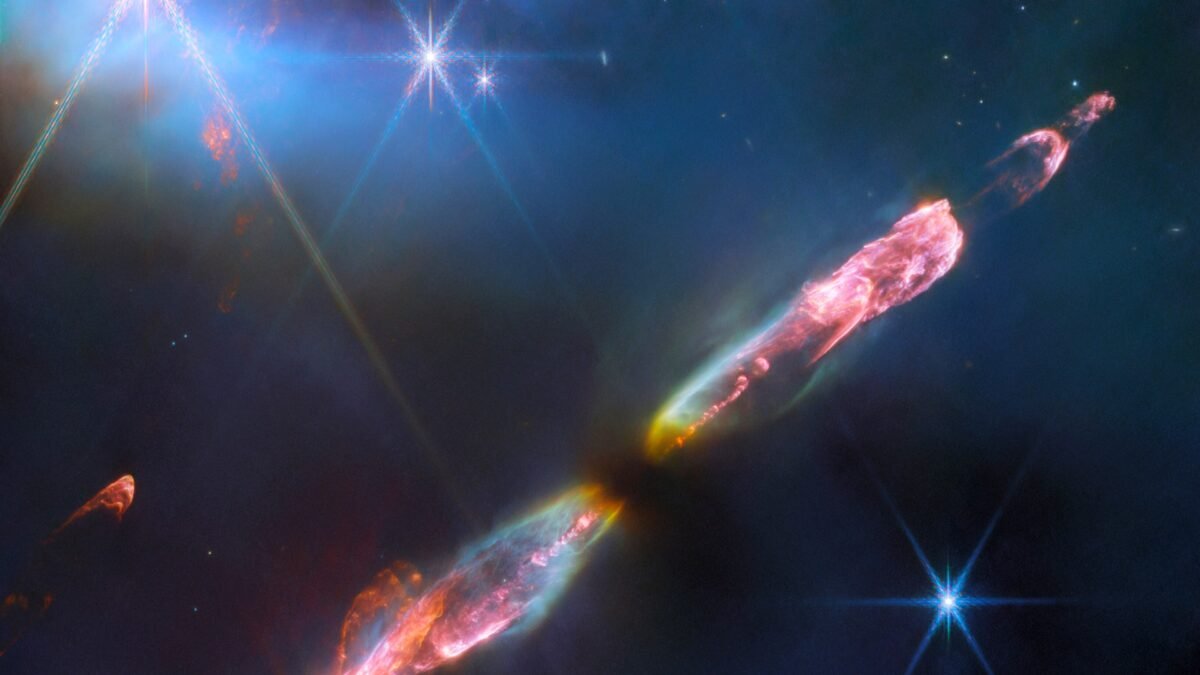
What changed was the combination of the world’s most sensitive infrared telescope and one of the most violent places in the galaxy. Herbig-Haro objects are the luminous wreckage left by newborn stars. As a young star forms, it feeds on the gas swirling around it, but powerful magnetic fields fling some of that material back out into space in tightly focused jets travelling at hundreds of kilometres per second. When those jets slam into the surrounding molecular cloud, they generate immense shock waves that heat the gas to thousands of degrees and make it blaze with light. HH 168 is one of the brightest such objects in Cepheus A West, a high-mass star-forming region, and it was already on Webb’s observing list for an entirely different reason.
What Webb actually saw
Neufeld and his colleagues — Joel D. Green of the Space Telescope Science Institute, Dan M. Watson of the University of Rochester, and Paule Sonnentrucker of the Space Telescope Science Institute and the European Space Agency — were examining observations taken with Webb’s Mid-Infrared Instrument, MIRI, on 1 August 2026. The data came from Webb programme 7084, “Measuring the Thickness of a J-Shock in Cep A West”, led by Green, and covered wavelengths from 4.9 to 27.9 micrometres. Two fields along the shock, labelled C and G, were observed.
Buried among the infrared emissions of the hot, shocked gas were a series of extraordinarily faint spectral lines. Their wavelengths matched the forbidden rotational transitions of H3+ calculated by Pan and Oka forty years earlier. The team measured all 96 such lines between 7.6 and 26.3 micrometres, and 26 of them were detected at more than five times the noise level in at least one of the two fields — 25 in field G and 19 in field C, with 18 appearing in both, according to the paper.
The strongest line, the transition from the (J,K) = (5,0) state to the (4,3) state at 16.325 micrometres, was measured at 72 times the noise level in field G and 49 times in field C, with a flux of 2.1 × 10⁻¹⁶ erg per square centimetre per second in field G. Even so, the signal is astonishingly faint by ordinary standards: the strongest H3+ line carries only between one three-hundredth and one four-hundredth of the flux of the neighbouring hydrogen line known as H2 S(6). Finding it at all is a measure of Webb’s sensitivity — and of how carefully the team had to dig through the spectrum to find lines that earlier telescopes would have missed entirely.
The pattern of the lines told the team as much as their mere presence. The H3+ emission shared the velocity and the spatial distribution of hot molecular hydrogen, H2, rather than of the ionised gas in the region, the paper reports. A rotation diagram drawn from the lines gave a rotational temperature of about 730 kelvin, but the populations of the molecule’s energy levels were not thermal: they are best explained, the authors write, by subthermal excitation in gas hotter than 2,000 kelvin. In other words, the molecule is glowing in gas far hotter than its own rotational temperature would suggest, a clue to the violent, out-of-equilibrium conditions inside the shock.
The second sighting that sealed it
A single detection, however strong, always invites the question of whether it could be a fluke of one unusual object. The team answered that question before the paper was even finished. When they examined archival Webb observations of another Herbig-Haro object, HH 211, they found the same telltale emission there too.
HH 211 is a spectacular bipolar outflow in the constellation Perseus, roughly 1,000 light-years from Earth, driven by a Class 0 protostar — an infant star, an analogue of our Sun when it was no more than a few tens of thousands of years old, with a mass only about 8 per cent of the present-day Sun, according to the European Space Agency’s description of Webb’s 2023 image of the object. That the forbidden lines appear in two separate stellar nurseries, observed at different times with different Webb programmes, makes it far harder to dismiss the HH 168 result as an artefact of one dataset. As ScienceAlert put it, Pan and Oka have been right all this time; what was missing was a tool sensitive enough to confirm it.
The archival check also matters because it hints at how common the signal may be. The paper notes that the forbidden lines should be present wherever hot molecular hydrogen shines brightly, but they are so weak that they will only show up where the spectrum is relatively clean and the observations are deep enough. HH 168 was a favourable target precisely because it sits far from Cepheus A’s embedded protostars, so its spectrum is relatively poor in competing lines and the faint H3+ features suffer little interference. Other Herbig-Haro objects, and other shocked regions, may now be worth a second look with the same question in mind.
A century of chasing the universe’s simplest ion
The new detection is the latest chapter in a hunt that is, in truth, more than a century old. H3+ itself was first discovered in 1911 by J. J. Thomson, but it was not until 1980 that Takeshi Oka measured its first spectrum in the laboratory, using a technique called frequency modulation detection to capture its fundamental vibration-rotation band. That laboratory success set off the search for the ion in space.
The first emission lines beyond the laboratory were reported in 1989 by Drossart and colleagues, found in the ionosphere of Jupiter, where H3+ helps to power the giant planet’s auroral glow. Saturn followed in 1993, and Uranus the same year. But the interstellar medium — the cold clouds between the stars where H3+ was supposed to do its most important chemical work — resisted detection for years. It was finally found there in 1996, when Tom Geballe and Oka reported the ion in two dense molecular clouds, in the sightlines of the young stellar objects W33A and AFGL 2136, in a paper published in Nature. Two years later it turned up unexpectedly in a diffuse cloud, toward the star Cygnus OB2 No. 12, and by 2006 Oka was able to announce that H3+ is ubiquitous in the interstellar medium.
Through all of that history, though, astronomers were always looking at the same kind of light: the molecule’s vibrational transitions, seen in absorption against background stars or in emission from planetary atmospheres. The pure rotational spectrum — the light the molecule gives off simply by spinning — remained unseen. It is the difference between hearing a bell struck and hearing it hum as it turns, and the hum was forty years in coming.
The reason H3+ commands this much attention is its chemical role. It forms when a cosmic ray knocks an electron off a hydrogen molecule, leaving H2+, which then reacts with another hydrogen molecule to make H3+ and a lone hydrogen atom. Once formed, H3+ eagerly donates a proton to almost anything it meets, and that single act kick-starts the ion-molecule chemistry that builds nearly every other molecule found in interstellar clouds. Without it, the clouds that collapse into stars would be chemically barren, and the complex organic molecules that eventually seed planets would have no route into existence. That is why the ion is so often called “the molecule that made the Universe”.
The puzzle: brighter than the models allow
If the detection itself is secure, what it means is not yet settled — and the authors are candid about that. When the researchers tried to reproduce their observations with shock-wave models, neither approach they tried worked perfectly. One model did a good job of reproducing the emission from ordinary molecular hydrogen, but underestimated the H3+ signal by a factor of five or six. Another came much closer to matching the H3+ emission, but only by relying on conditions outside the range for which the model had been validated. Compared with what the models predicted, the signal was unexpectedly bright.
That mismatch is not a weakness of the result; it is, in many ways, the point. A detection that fits the models perfectly tells astronomers only what they already believed. A detection that is five times brighter than expected tells them that something about the shock is not yet understood — that the chemistry, the heating, or the excitation of the gas is doing something the current models do not capture. The paper is explicit about what is missing: to use the H3+ lines as a quantitative probe of ionisation, researchers need state-to-state rate coefficients for collisions between H3+ and H2 at high levels and energies, which do not yet exist, along with better models that mix shock conditions across an extended shock surface. Both are work the authors defer to a later paper.
That honesty is worth noting, because it is how science at this level actually proceeds. The detection is reported with its statistical strength stated plainly — 26 lines, the strongest at 72 sigma — and the interpretation is presented with its limits stated just as plainly. One independent summary of the paper, published on the same day, made the same distinction: the detection itself is secure, while the interpretation of exactly why the emission is so bright is less certain. The two claims are different, and the paper treats them differently.
Analysis: Why It Matters
A forty-year prediction, confirmed by the right instrument at last
Science is full of predictions that wait decades for the instrument that can test them, and this one waited longer than most. Pan and Oka did their calculation in 1986, when the largest infrared telescopes were ground-based, the detectors were comparatively crude, and the idea of a 6.5-metre telescope cooled to a few degrees above absolute zero, parked a million and a half kilometres from Earth, was still a drawing on a whiteboard. The prediction survived four decades of failed searches not because anyone doubted the physics, but because the signal sits at the very edge of what is physically detectable: the strongest line in HH 168 carries only a few hundredths of one per cent of the light of its hydrogen neighbour. That Webb found it in data taken for a different purpose — a programme designed to measure the thickness of a shock front, not to hunt for H3+ — says something important about how discovery works in the Webb era. The telescope is not merely answering the questions it was built to answer; it is sensitive enough that the answers to questions nobody thought to ask are sitting in the archive, waiting for someone to look. The second sighting, in archival data of HH 211, is the proof of that: the signal was already there, recorded years ago, unrecognised until the first detection taught astronomers what to look for.
A new ruler for the most violent places where stars are born
The practical prize here is not the detection itself but what the detection makes possible. Ionisation is the hidden variable of star formation. The fraction of gas that is ionised decides how strongly the gas grips the magnetic field, how fast chemistry runs, and how quickly a collapsing cloud can shed the magnetic support that holds it up. Until now, astronomers had no direct way to measure ionisation inside a shock wave: the usual tracers either come from different gas or require assumptions that break down exactly where the shock is hottest and most turbulent. H3+ changes that, because it is made by cosmic rays and destroyed by the very chemistry it starts, so its abundance tracks the ionisation rate almost directly. The new lines give astronomers a probe that lives inside the shocked gas itself, moving at the same velocity and spread across the same region as the hot hydrogen. If the missing collision data can be supplied and the shock models improved, the same faint lines could become a standard diagnostic — a way of reading the ionisation of any shocked region Webb can see, from the nurseries of our own galaxy to the starburst regions of distant ones. That is a large claim for 26 faint lines, but it is exactly the claim the authors make, and it is the reason the paper’s final sentence frames the lines as a new probe rather than a curiosity.
The models were wrong in the interesting direction
It is tempting to read the five-to-six-fold mismatch between the models and the observations as a problem. It is better read as the discovery’s second result. Models of interstellar shocks are built from laboratory data, and the laboratory data for H3+ colliding with hydrogen at the energies found in a shock simply do not exist yet; the paper says so plainly. What the mismatch shows is that the real shock is doing something the models cannot yet do — exciting H3+ far more efficiently than expected, or channelling energy into its rotation through a route the models omit. Either way, the discrepancy is a work order for two communities at once: laboratory physicists, who now have a reason to measure the missing collision rates, and theorists, who now have a number their next model must reproduce. This is the normal, healthy rhythm of observational science — a clean measurement that breaks the model is worth more than a measurement that confirms it — and it is worth saying so, because the public telling of science too often treats a mismatch as a failure instead of the engine of progress it actually is.
Why a molecule this obscure deserves a headline
There is a fair question lurking behind any story like this one: why should anyone who is not an astrochemist care about 26 faint lines from a molecule with three hydrogen atoms? The answer is that H3+ is the hinge between the simplest substance in the Universe and everything else. Hydrogen is the raw material; almost every molecule that matters — water, carbon monoxide, ammonia, the organic compounds found in comets and in the clouds that form planets — is built through chemical chains that H3+ starts. To understand how the Universe got from hydrogen to chemistry, you have to understand H3+, and to understand H3+ in the places where stars are actually being born, you have to be able to see it where it lives. For forty years, astronomers could only see it in absorption, silhouetted against background stars, or in the thin air of giant planets. Now they can see it in emission, glowing in the shock waves of a stellar nursery, which means they can map it, measure it, and eventually watch it change. That is not a footnote to astronomy; it is a new sense for the field, and the fact that it arrived as a by-product of another programme only underlines how much of Webb’s harvest is still unexamined.
What this says about the telescope — and about patience
Finally, there is a quieter lesson in the dates. The observations were taken on 1 August 2026. The paper was posted on 6 November. The news broke on 12 November. Webb itself was launched on 25 December 2021, after decades of delay, and its first images arrived in the summer of 2022. None of this happened quickly, and none of it was guaranteed: the prediction it confirmed was made in 1986 by two physicists working out what a spinning triangle of hydrogen ought to do, and the confirmation depended on a telescope that did not exist when they did the sums, pointed at a shock wave whose light had to travel 2,300 years to reach it. The gap between prediction and proof is the honest timescale of fundamental science, and it is worth remembering whenever the news cycle demands a breakthrough by breakfast. Some discoveries take forty years, a space telescope, and a newborn star throwing a tantrum — and they are worth the wait.
What to Watch Next
- Publication in The Astrophysical Journal Letters: the paper has been accepted; its formal publication will put the detection through the journal’s final checks and give the wider community a citable result to build on.
- The missing collision data: laboratory groups will be watched for new measurements of state-to-state rate coefficients for H3+ colliding with H2, the numbers the authors say are needed before the lines can be used as a quantitative ionisation probe.
- Improved shock models: theorists will test whether models that mix conditions across an extended shock surface can reproduce the unexpectedly bright emission without stepping outside their validated range.
- A wider hunt in the archive: now that astronomers know what the forbidden lines look like, other Herbig-Haro objects and shocked regions in existing Webb data are obvious targets; HH 211 was only the first archival check.
- New Webb programmes: proposals to observe further shocks with MIRI, deliberately targeting the H3+ lines, will show whether the signal appears wherever hot molecular hydrogen shines, as the paper suggests it should.
- The Cepheus A campaign: further study of HH 168 itself, including the two observed fields C and G, may pin down why the emission is so much brighter than the models predict.
- Application to distant galaxies: if the lines prove to be a reliable ionisation probe, the same diagnostic could eventually be turned on starburst galaxies, where shock-driven chemistry shapes whole systems rather than single stellar nurseries.
Sources
- Neufeld, Green, Watson & Sonnentrucker, “First detection of the forbidden rotational spectrum of H3+: JWST/MIRI observations of the shocked gas in HH 168”, arXiv:2611.10122 (accepted for publication in The Astrophysical Journal Letters)
- ScienceAlert, “JWST Detects a ‘Forbidden’ Signal Never Before Seen in The Universe – Not Even in a Lab”, 12 November 2026
- Full text of the paper (arXiv HTML version)
- Horizon Lab, “Webb Detects the Forbidden Rotational Spectrum of H3+ for the First Time”, 12 November 2026
- Wikimedia Commons, “HH 211 (NIRCam image)” — ESA/Webb, NASA, CSA, T. Ray, CC BY 4.0 (featured image source)
- T. Oka, “The Ubiquitous H3+”, University of Chicago — review of the laboratory and interstellar history of H3+

About the Author — Abdul Mannan
Related Articles
DeepMind Unveils AlphaGenome 2, an AI That Reads DNA Cell by Cell to Pinpoint the Variants Behind Disease
Google DeepMind has unveiled AlphaGenome 2, a DNA model that predicts how a genetic variant behaves in a…
NASA’s Twin ESCAPADE Probes Complete First-Ever Powered Earth Flyby and Set Course for Mars
NASA's twin ESCAPADE spacecraft have completed the first powered Earth flyby ever flown, slingshotting past our planet on…

Google DeepMind’s AI Agents Mathematically Prove Signal’s Encryption Code Is Secure in Four Weeks
Google DeepMind says AI agents have produced a machine-checked mathematical proof that the code behind the Signal protocol…