
Tanker Loses Steering and Capsizes Docked Cruise Ship on the Mississippi in New Orleans; 32 Taken to Hospital

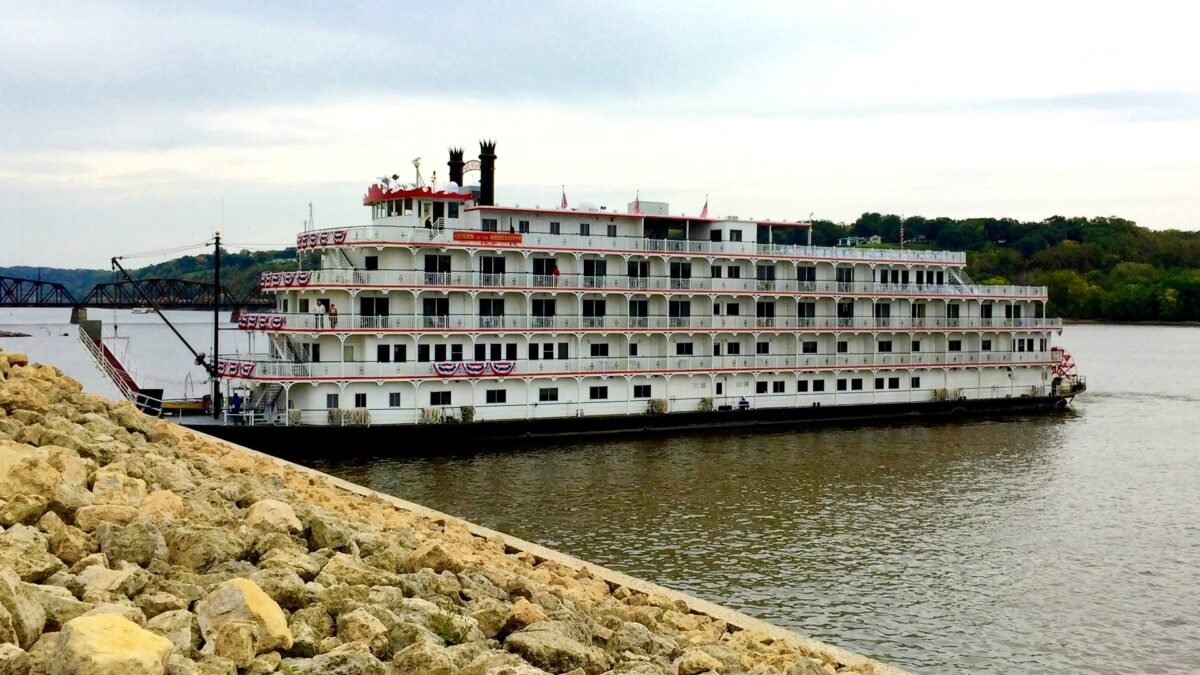
A tanker that lost steering struck a docked river cruise ship on the Mississippi River in New Orleans on Friday, sending the passenger vessel rolling onto its side and throwing people into the water in one of the most serious accidents on the lower river in years. Thirty-two people were taken to hospitals, none of them critically hurt, and every passenger and crew member was accounted for by Friday evening, according to New Orleans Mayor Helena Moreno, who called the outcome “a miracle on the Mississippi.”
The collision happened at about 12:30 p.m. local time on Friday, 13 November 2026, just below the Crescent City Connection bridge, where the American Cruise Lines paddlewheeler American Heritage was tied up at the Port of New Orleans. The vessel that hit it was the Atlantic Asphalt, a Marshall Islands-flagged tanker of about 160 metres that carries asphalt and bitumen. According to the Port of New Orleans, about 129 passengers, as well as crew members, were aboard the riverboat when the tanker struck it.
Video of the incident, widely shared on Friday afternoon, shows the tanker driving into the port side of the docked cruise ship. In the aftermath, the American Heritage took on water, rolled over and capsized alongside the dock, according to the maritime news service gCaptain. Passengers who had been making their way off the vessel found themselves in the river, some of them in life jackets, as rescue boats converged on the scene.
“The passengers began disembarking from the ship after that collision, but while that was happening, the cruise ship began to sink, and then eventually the cruise ship toppled over and flipped,” Moreno said at a news conference on Friday afternoon. “Now, when that occurred, we started to have people in the water.”
By Friday evening, the city’s account was one of relief rather than loss. “At this moment, the information that we have, we have zero people unaccounted for,” Moreno said. “Which truly is a miracle on the Mississippi.” Thirty-two people had been taken to local hospitals, she said, and none was reported to have suffered critical injuries. No deaths were reported.
The United States Coast Guard closed a three-mile stretch of the Mississippi to all vessel traffic, between mile markers 93 and 96, while responders worked at the scene. The National Transportation Safety Board said on Friday evening that it would send a Go Team of investigators to New Orleans, and that the team was expected to arrive on Saturday. The cause of the collision remains under investigation, and the authorities have not yet said whether the tanker suffered a mechanical or propulsion failure before impact.
What happened on the river
The sequence of events, as described by port officials, the mayor and the Coast Guard, is straightforward in outline and still unexplained in its most important detail: why a large tanker moving on one of the world’s busiest commercial waterways ended up against a passenger vessel tied up at a dock.
According to vessel-tracking data from MarineTraffic, the Atlantic Asphalt was involved in a “proximity event” with the American Heritage at 18:29 UTC, or 12:29 p.m. local time, matching the time of the collision given by the Port of New Orleans. The tanker had arrived in New Orleans on 11 November, two days before the collision, after calling at Amuay in Venezuela in mid-October and at Paulsboro, New Jersey, on 24 October, according to shipping data cited by gCaptain.
Moreno said at the news conference that the tanker “lost control” before the crash. That account was confirmed by Coast Guard Captain Melanie Burnham, who said the tanker appeared to have suffered “some type of loss of steering.” The Coast Guard has not yet said more than that, and the precise nature of any steering failure — whether it was a mechanical breakdown, a hydraulic fault, a loss of power or a human error in handling the steering gear — is one of the central questions the investigation will have to answer.
The American Heritage was in no position to get out of the way. It had arrived from Natchez, Mississippi, earlier on Friday and had docked about two hours before the collision to begin letting passengers off at the end of an eight-day cruise, according to the Port of New Orleans. It had also been scheduled to sail again on Friday, beginning an eight-day, seven-night round-trip “Highlights of the Mississippi” cruise from New Orleans, calling at Baton Rouge and St. Francisville in Louisiana and Natchez in Mississippi, according to the cruise line’s published schedule. In other words, the vessel was caught at the most vulnerable moment of its working day: tied up, gangway down, passengers moving between ship and shore, with no way to manoeuvre.
The water temperature in the river was 66 degrees Fahrenheit, or 19 degrees Celsius, according to the Associated Press — cold enough to be dangerous for anyone in the water for long, but not so cold as to make survival a matter of minutes. That, along with the speed of the rescue response, is part of the reason the casualty figures stayed as low as they did.
The rescue
The emergency response was large and fast. The New Orleans Fire Department sent 23 units and 57 personnel to the port, according to the department. They were joined by the Coast Guard, the Port of New Orleans Harbor Police, the New Orleans Police Department and emergency medical services, and the Port of New Orleans said all of those agencies were conducting rescue efforts at the scene.
Passengers were brought inside the Port of New Orleans Administration Building at 1350 Port of New Orleans Place for triage and assistance, officials said. Some were pulled from the water wearing life jackets; others clung to the vessel’s railings as it listed, according to the New York Post, which cited video from the scene. Local television showed the cruise ship lying on its side in the river, and CBS News reported that at least 14 people had been rescued from the water, according to Reuters.
Early in the afternoon, before the all-clear was given, the picture was frightening enough that the federal government intervened publicly. Homeland Security Secretary Markwayne Mullin wrote on social media that “we are throwing every asset we have to helping rescue missing passengers” and that his department was coordinating closely with state officials, according to Reuters. The mayor’s office said on social media that “multiple individuals have been rescued, and search-and-rescue operations remain ongoing.”
Louisiana Governor Jeff Landry said on X that his office was aware of the collision and in close contact with local officials and law enforcement. “I am headed to New Orleans now,” he wrote. He later flew into the city for the evening news conference, where he said the investigation was active and promised that the authorities would “get down to the bottom of exactly what happened here.”
American Cruise Lines confirmed in a statement that its riverboat had been involved in a collision while docked in New Orleans. “We are in close coordination with the US Coast Guard and local authorities,” the company said. “Guests and crew were evacuated, and we are deeply concerned for everyone involved. We will share more information as it becomes available.”
The two vessels
The American Heritage is a familiar sight on the Mississippi. Built in 2015 by Chesapeake Shipbuilding in Salisbury, Maryland, it is a 150-guest, five-deck paddlewheeler with a traditional stern paddlewheel driven by a hydraulic motor powered by diesel engines, according to the cruise line and maritime records. It entered service in the spring of 2015 and sailed for years as the Queen of the Mississippi before taking its current name in 2022, when American Cruise Lines rebranded its paddlewheel fleet. Its home port is New Orleans.
American Cruise Lines, based in Guilford, Connecticut, describes itself as a family-owned company whose ships are built in the United States and sail domestic itineraries. Its fleet includes modern riverboats, traditional paddlewheelers and small coastal ships, with itineraries on the Mississippi, Columbia and Snake rivers, as well as in Alaska, New England and the south-east, according to USA Today. The American Heritage is marketed as a classic paddlewheeler with private-balcony accommodation, three guest lounges and a glass-enclosed dining room, and it sails Mississippi itineraries year-round, including winter cruises between New Orleans and Memphis.
The vessel that struck it could hardly be more different. The Atlantic Asphalt is a working tanker of more than 524 feet — about 160 metres — and just over 77 feet wide, built to carry asphalt and bitumen, the thick black substances used in road construction and roofing, according to shipping data cited by USA Today. It sails under the flag of the Marshall Islands, and its registered owner and commercial manager is Nave Shipping S.A., which is based in Liberia. The tanker is roughly twice the length of the 81-metre riverboat it hit, and many times its weight.
The tanker’s presence in New Orleans was part of an international voyage. It had called at Amuay in Venezuela in mid-October before arriving in Paulsboro, New Jersey, on 24 October, departing two days later and reaching New Orleans on 11 November, according to gCaptain. The voyage coincided with a Trump administration emergency Jones Act waiver allowing certain foreign-flagged vessels to carry domestic cargo between American ports, but gCaptain reported that the tanker did not require the waiver, because it was continuing an international voyage after partly discharging foreign-loaded cargo in Paulsboro rather than loading cargo there for delivery to New Orleans.
What investigators will examine
The National Transportation Safety Board said in a post on X on Friday evening that it would send a Go Team to New Orleans, and that the team was expected to arrive on Saturday, according to USA Today. A Go Team is the board’s rapid-response unit: a group of investigators with specialist expertise, drawn from its headquarters in Washington, who travel to the scene of a major transport accident to gather evidence, inspect the vessels and interview witnesses.
The investigation will have a great deal to work with. There is video of the impact from several angles, vessel-tracking data that fixes the time and position of the collision to the minute, and the two vessels themselves: the capsized riverboat, which will have to be salvaged, and the tanker, which the authorities can inspect and detain. Investigators will examine the tanker’s steering gear, its hydraulic systems, its power supply and its bridge records, including voyage data recorder information, to establish what happened in the minutes before the collision and whether the crew had any warning.
They will also examine the human side of the casualty: who was on the tanker’s bridge, what orders were given, what alarms sounded, and whether the crew attempted an emergency anchoring or any other manoeuvre. The Coast Guard’s Vessel Traffic Service, which monitors traffic on the lower Mississippi, will be able to say what warnings, if any, were broadcast, and how much time other vessels had to react.
The NTSB’s marine investigation process is slow by design. According to the board, a marine accident investigation often requires 12 to 24 months to complete, and the board will not determine the cause of an accident while it is on scene. A preliminary report, giving a synopsis of the factual information gathered during the on-scene phase, is typically available a few weeks after the accident, and the final report, with a probable cause and any safety recommendations, usually follows a year or two later. The board does not assign legal fault; its purpose is to establish what happened and to recommend changes that would prevent a repeat.
There was an unexpected complication for the investigators even before they arrived. On the same Friday, the Federal Aviation Administration ordered a nationwide ground stop for all departing flights in the United States after a communications failure affected its air traffic control centres, and Representative Troy Carter told local station WDSU that the NTSB team was “desperately trying to get here.” The team was still expected to arrive on Saturday morning.
A familiar failure on this river
If the early account of a loss of steering is confirmed, the New Orleans collision will join a long and troubling list of steering failures on the lower Mississippi — a river where a ship that cannot steer is at the mercy of a powerful current and has very little room, or time, to recover.
In August 2014, the bulk carrier Flag Gangos ran into the docked tanker Pamisos at Gretna, Louisiana, just upriver from New Orleans, and then rammed a floating pier, after its steering failed. The National Transportation Safety Board found in a December 2015 report that steering equipment on the vessel had been neglected, and that the probable cause was the operating company’s delay in completing a mandatory upgrade to the steering system and its failure to test the steering system’s hydraulic fluid for debris, as the manufacturer required. No one was injured, but about 1,200 gallons of oil that was being transferred spilled into the river, and the damage was estimated at 16 million dollars to the terminal alone.
In July 2021, the bulk carrier Jalma Topic lost steering on the lower Mississippi near New Orleans, close to the same stretch of river closed on Friday, and struck a permanently moored office barge. The vessel’s rudder had stuck at 10 degrees to port and would not respond to the helm; the pilot ordered the rudder hard to starboard, but the ship kept turning, and its bulbous bow struck the barge at more than six knots, according to the NTSB investigation. The river’s Vessel Traffic Service broadcast a security warning and asked for the barge to be evacuated as the ship bore down on it.
More recently, in May 2025, the towing vessel Rickey Hughes, pushing 22 barges downbound on the lower Mississippi, lost all steering near Vicksburg, Mississippi, after a crew member misaligned the hydraulic valves of the flanking rudder system while responding to a low-pressure alarm. Seven barges broke free, one sank, and the damage to the barges was estimated at about 1.9 million dollars. The NTSB concluded that the probable cause was the loss of all steering, and the vessel’s operator began a fleet-wide campaign to inspect every steering system on its vessels.
None of those accidents involved a passenger vessel. That is what makes Friday’s collision different, and more alarming: the same failure mode, in the same river, this time against a ship full of holidaymakers tied up at a dock.
Analysis: Why It Matters
A docked ship is supposed to be the safe one
The most unsettling fact about Friday’s collision is that the American Heritage was doing nothing at all. It was tied up at its home port, at the end of a voyage, with its passengers walking down the gangway. In maritime safety, a vessel at berth is the baseline case: the place where risk is supposed to be lowest, because the ship is stationary, the crew is in port routine, and the hazards of navigation are, in theory, behind it. A collision that finds a ship in that position breaks the basic assumption on which passengers, and the people who sell them tickets, rely. If a docked cruise ship is not safe from a passing tanker, then the question is not only what failed on the Atlantic Asphalt, but how much protection a berth on a working river actually provides. That is the question the NTSB will have to answer in a way that satisfies not only regulators, but every passenger who boards a river cruise in New Orleans from now on.
Steering is the single point of failure the river cannot afford
The early reports point to a loss of steering, and the history of the lower Mississippi gives that claim a grim credibility. A ship’s steering gear is one of the few systems on board with no real substitute: lose propulsion and a vessel drifts; lose steering and it becomes an unguided mass of steel moving with the current, unable to turn away from anything in its path. The Flag Gangos in 2014, the Jalma Topic in 2021 and the Rickey Hughes in 2025 all lost steering on this river, and in each case the NTSB found that the failure was not a bolt from the blue but something that maintenance, testing or training could have caught. The pattern is the real story of Friday’s accident. It suggests that steering failures on the lower Mississippi are not freak events but a recurring, known hazard, and that the industry’s defences against them — mandatory upgrades, hydraulic fluid testing, crew familiarity with emergency changeovers — have repeatedly proved thinner than they look on paper. If the Atlantic Asphalt lost steering for a preventable reason, the investigation will not be the first to say so, and that will be its own indictment.
A working river and a holiday river share the same water
New Orleans sits at the meeting point of two different rivers. One is the industrial Mississippi: the channel that carries grain, chemicals, oil and asphalt to and from the Gulf, served by ocean-going tankers and bulk carriers, some of them foreign-flagged and crewed by sailors who have never seen the river before. The other is the holiday Mississippi: the paddlewheelers and riverboats that carry American tourists past plantation houses and Civil War battlefields, a trade that has grown steadily as domestic river cruising has become one of the fastest-growing corners of the American travel industry. Both use the same water, the same bends and the same berths, and on Friday they collided — literally. The Port of New Orleans is Louisiana’s only international container port and one of the country’s great cruise embarkation points, and the coexistence of heavy commercial traffic and passenger vessels at the same docks is a fact of life there. The accident will force a hard look at whether that coexistence is managed tightly enough: whether passenger berths are sited far enough from the main channel, whether large commercial vessels are adequately separated from docked passenger ships, and whether the pilots and traffic controllers who manage the river have the tools to intervene when a ship stops answering its helm.
The rescue worked — and that is not luck alone
It is worth saying plainly that Friday could have been far worse, and that the reasons it was not are structural rather than accidental. The river was warm enough for people to survive in it. The collision happened in daylight, in the middle of a city, within minutes of fireboats, harbour police and Coast Guard stations. The American Heritage capsized slowly enough, rather than rolling in an instant, that passengers could get off or be pulled from the water. And the response — 23 fire units, 57 firefighters, harbour police in the water, a triage centre set up inside the port administration building — was the product of a city that has practised for disaster many times over. None of that should be taken as reassurance. A rescue that succeeds because the accident happened in the best possible place at the best possible time of day is not a safety system; it is a fortunate coincidence. The test of Friday’s accident is not whether the rescue worked, but whether the next steering failure happens at night, upriver, against a vessel under way, where none of those advantages apply.
Two transport crises in one day
Friday was an extraordinary day for American transport even before the collision. Hours after the tanker struck the riverboat, the Federal Aviation Administration grounded every departing flight in the United States after a communications failure affected its air traffic control centres, the second nationwide ground stop since the attacks of 11 September 2001. The two events have nothing in common as causes, but they share a lesson: the systems that move Americans — by air and by water — are older, more fragile and more dependent on a small number of critical components than the public is usually told. In both cases the failure was in a system that was supposed to be redundant: communications for the air traffic network, steering for a ship. And in both cases the first official accounts were hedged — no indication of an attack, no confirmed cause — because the institutions involved did not yet know what had happened. The NTSB team’s difficulty in reaching New Orleans, with the country’s flights grounded, was a fitting coda: on a day when America’s transport systems failed twice, the investigators of one failure could not travel because of the other. It was a coincidence, but a revealing one.
What to Watch Next
- The NTSB Go Team’s arrival on Saturday: the investigators’ first public statements and the preliminary findings they release in the coming days will establish whether the loss of steering is confirmed, and what failed.
- The Coast Guard’s river closure: the three-mile closure between mile markers 93 and 96 will show how quickly the river can be reopened, and whether the capsized riverboat or any pollution complicates the salvage.
- The condition of the 32 hospitalised passengers: none was reported critically hurt on Friday, but hospitals’ updates will confirm whether anyone’s condition changes.
- The salvage of the American Heritage: refloating a capsized five-deck paddlewheeler is a major operation, and its cost and duration will determine whether the vessel ever sails again.
- American Cruise Lines’ schedule: the line had departures listed for 19 and 25 November on the same itinerary, and passengers booked on those sailings will need to know whether they are cancelled, moved or rebooked.
- The tanker’s inspection and detention: whether the Coast Guard detains the Atlantic Asphalt, and what its steering gear, maintenance records and bridge recordings show, will shape the investigation’s early direction.
- The NTSB preliminary report: typically published a few weeks after the accident, it will give the first authoritative factual account of what happened on the river on Friday afternoon.
Sources
- USA Today — Tanker collides with riverboat in New Orleans, 32 taken to hospitals
- Reuters — Freighter collides with cruise ship in New Orleans, passengers in the water
- gCaptain — Tanker Strikes Docked Paddlewheeler on Mississippi River, Causing It to Capsize
- Travel Weekly — ‘Miracle on the Mississippi’: No fatalities in American Cruise Lines-tanker collision
- National Transportation Safety Board — Marine Accident Investigation Process
- American Cruise Lines — American Heritage Paddlewheeler

About the Author — Abdul Mannan
Related Articles
FAA Grounds Every Departing Flight in America After Nationwide Air Traffic Control Communications Failure
The FAA halted every departing flight in the United States on Friday after a communications failure hit air…
ICE Deported a Record 483,200 People in a Year as Trump’s Crackdown Reached New Heights — and Still Fell Short of a Million
US Immigration and Customs Enforcement deported a record 483,200 people in fiscal year 2026, the Department of Homeland…

Van Hollen Challenges Schumer for Senate Majority Leader as Democrats’ Midterm Sweep Turns Into a Fight Over the Party’s Future
Senator Chris Van Hollen has launched a challenge to Chuck Schumer for the leadership of the Senate Democrats,…