
Ukraine Launches Its Biggest Drone Attack of the War as 1,336 Drones Strike Russia and Hit the Crimea Bridge

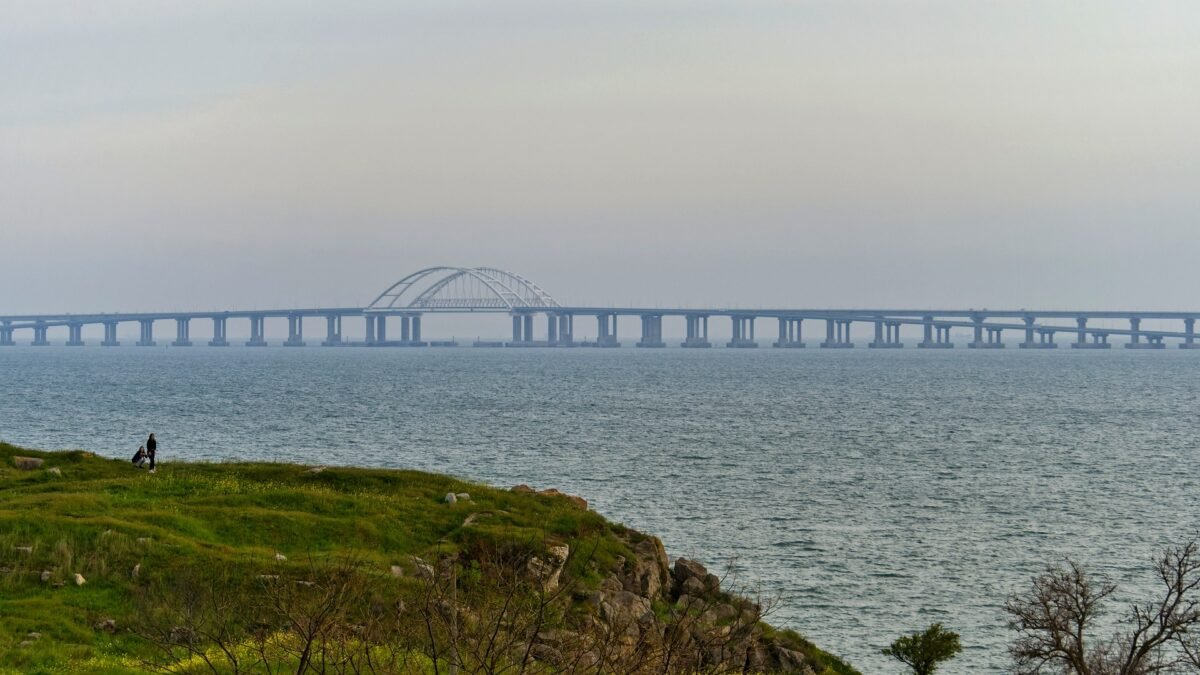
Ukraine launched its largest overnight drone attack on Russia since the full-scale war began in 2022, according to Russian defence ministry data published on Monday, in a barrage that struck the road and rail bridge linking Russia to occupied Crimea, targeted oil refineries deep inside Russia and sent hundreds of drones towards Moscow.
Russia said its air defences had brought down 1,336 Ukrainian drones across 16 regions, according to Reuters, surpassing the previous record of 1,254 drones registered as shot down on 29 October. The scale of the attack, reported by Moscow itself, marks the latest escalation in a war of attrition in which both sides are now striking energy facilities and other important infrastructure far behind the front lines, even as American-brokered peace talks continue in the background.
The road and rail bridge that connects Crimea to the Russian region of Krasnodar, a signature infrastructure project associated with President Vladimir Putin, was struck overnight, according to Sergei Aksyonov, the Russian-backed governor of Crimea. The Kremlin called the damage minor. Road traffic was temporarily suspended while repairs were undertaken, but rail traffic continued as normal, the transport ministry said, according to Reuters. The Associated Press reported that traffic on the bridge would remain restricted until midday on Monday, and that the rail operator said four trains travelling to or from the peninsula had been delayed because traffic across the bridge had been suspended.
Moscow’s mayor, Sergei Sobyanin, said that around 600 Ukrainian drones had been launched at the Moscow region surrounding the Russian capital since Sunday evening, 191 of which had been brought down, according to Reuters. Russia’s defence ministry said Ukrainian drones had also been brought down over Crimea, the Black Sea peninsula which Russia seized and annexed in 2014, and over the waters of the Sea of Azov and the Black Sea.
The attack also set fires at industrial sites in southern Russia. Yuri Slyusar, the governor of the Rostov region, home to various oil facilities, said in a statement that fires had broken out at four industrial sites in Azov after the Ukrainian attack, according to Reuters. Emergency services were working at the scenes. Local officials said a fire had broken out at an unnamed industrial facility in Ilsky in the Krasnodar region and that falling drone debris had injured six people, including children. Ilsky is home to an oil refinery.
Ukraine has sharply increased its strike campaign on Russian oil refineries since the end of October, launching attacks which Ukrainian President Volodymyr Zelenskyy said late on Sunday had knocked out over half of Russia’s refining capacity, something Reuters said it was not able to independently verify immediately. Two industry sources told Reuters last week that the renewed Ukrainian drone attacks on Russian oil refineries had reduced Russia’s oil refining capacity by about 30 per cent.
Russian officials and media said last week that, as a result, fuel shortages had returned to at least half a dozen Russian regions, but that so far there was no repeat of scenes seen over the summer when some motorists were forced to queue for hours at filling stations, according to Reuters.
The numbers, and why they need care
Every figure in this story comes with the same caution, and it matters. The count of 1,336 drones is the number Russia’s defence ministry says its forces intercepted. It is not an independently verified count of how many drones Ukraine launched, how many reached their targets, or how much damage they caused. Ukraine has not publicly confirmed the 1,336 figure. Reuters and the Associated Press both reported the number while noting that it could not be independently established.
There is also a genuine difference between the tallies kept by different news organisations. Reuters, working from the defence ministry’s data, described the attack as the biggest overnight drone attack since the full-scale war began, because 1,336 exceeds the 1,254 registered on 29 October. Agence France-Presse, by contrast, described the barrage as the second-highest daily figure so far this year, according to its own tally of official Russian statements. The two descriptions are not necessarily in conflict: they measure different windows and count different things, one an overnight total and the other a daily tally compiled from successive official statements. Some reports also put the number of regions affected at 17 rather than 16. This article follows the defence ministry figure as reported by Reuters, and treats the record as Moscow’s own claim rather than as a settled fact.
What is not in doubt is the direction of travel. The scale and frequency of Ukrainian drone attacks has grown from the summer into the autumn, according to Reuters, as Russia has increased its own drone and missile strikes in an intensifying war of attrition. Three days before Monday’s attack, Russia’s defence ministry said its air defences had shot down 1,198 Ukrainian long-range drones between Thursday evening and Friday morning, according to the Associated Press. The two sides are now trading blows on a scale that would have been unimaginable in the first year of the war, when a single night’s drone total was counted in the dozens.
Ukraine’s air force said Russia launched 158 drones overnight, including 77 jet-powered aircraft, in its own attacks on Ukraine during the same night. The previous day, the Associated Press cited Ukrainian officials saying a Russian strike on Chornomorsk had injured six people and temporarily cut power to about 41,000 customers. The exchange, in other words, is reciprocal: each side’s energy and infrastructure campaign is answered in kind, and civilians on both sides pay part of the price.
The refinery campaign
The most consequential part of Monday’s attack may not be the headline drone count but the target set. Ukraine’s campaign against Russian oil refineries, sharply intensified since the end of October, is designed to do something no amount of front-line fighting has yet achieved: to make the war expensive inside Russia itself, in a way ordinary Russians can feel at a petrol station.
President Zelenskyy’s claim, made late on Sunday, that the campaign has knocked out over half of Russia’s refining capacity is the boldest version of that argument. Reuters said it could not independently verify the claim, and the more cautious estimate from two industry sources who spoke to Reuters last week put the reduction at about 30 per cent. The gap between those two numbers is itself informative. A president at war has every reason to claim the maximum; an industry source counting barrels has every reason to be conservative. The truth is probably somewhere between the two, and it is moving: the campaign is only weeks old, and each new strike adds to the total.
What can be said with confidence is that the campaign is already producing visible effects. Russian officials and media acknowledged last week that fuel shortages had returned to at least half a dozen regions. That is a significant admission from a government that normally minimises the impact of Ukrainian strikes. The shortages have not yet reached the severity of the summer, when motorists queued for hours at filling stations in some areas, but the direction is clear, and it is the direction Ukraine wants.
The economic backdrop makes the campaign more potent. Russia’s year-on-year gross domestic product growth slowed to 1.0 per cent in the third quarter of 2026, from 1.3 per cent in the second quarter, according to data reported by Interfax. A war economy running at that pace, with a refining sector under sustained attack, has less room to absorb disruption than it did a year ago. The refinery strikes do not need to destroy the Russian economy to matter. They need only to force Moscow to spend money, attention and air defences on protecting facilities hundreds of kilometres from the front, and to make the cost of the war visible to people who have so far been able to ignore it.
There is also a narrower military logic. Refineries produce the fuel that moves Russian tanks, trucks and aircraft. Every barrel of refining capacity taken offline is a barrel that must be replaced from elsewhere, transported further, or done without. Ukraine’s calculation, plainly stated by its leadership, is that hitting the fuel supply is a faster route to weakening Russia’s war machine than destroying individual vehicles on the battlefield.
The bridge, struck again
Of all the targets hit on Monday night, the Crimea bridge carries the heaviest symbolic weight. The 19-kilometre road and rail bridge across the Kerch Strait, opened in 2018, was built to bind the annexed peninsula to the Russian mainland. It is both a logistics lifeline for Russian forces in southern Ukraine and a personal prestige project for President Putin, who drove a truck across it at its opening. Ukraine has made it a priority target since the first days of the full-scale invasion, and Monday’s strike was the fourth time it has been hit.
The first attack came on 8 October 2022, when a truck carrying explosives detonated on the road bridge, collapsing sections of the roadway and setting fire to a fuel train on the rail bridge. The second came on 17 July 2023, when Ukrainian naval drones struck the road section again, collapsing a span. The third came on 3 June 2025, when Ukraine’s security service, the SBU, detonated explosives beneath the bridge, targeting its underwater support structures. Ukraine claimed responsibility for all three explosions, according to Wikipedia’s account of the bridge’s history.
Monday’s strike appears, on the evidence available so far, to have caused less damage than its predecessors. The Kremlin called the damage minor, road traffic was suspended only temporarily, and rail traffic continued as normal. Four passenger trains were delayed. That is a far cry from the collapsed spans of 2022 and 2023, and it is worth saying so plainly: a strike on the bridge is not the same as a successful disabling of it, and Moscow’s account of limited damage has not been contradicted by any independent evidence so far.
But the limited physical damage is not the whole story. The bridge has now been attacked four times in four years, and each attack forces Russia to spend resources defending a single fixed structure that cannot be moved, hidden or replaced. The bridge is guarded by air defences, naval patrols and physical barriers, and still it gets hit. For Ukraine, the message is that no Russian asset, however heavily defended or symbolically important, is permanently safe. For Russia, the message is that the war it started in 2022 now reaches, regularly and at scale, into territory it considers its own.
The bridge also matters because of what it carries. It is the main overland supply route into Crimea, and from Crimea into the Russian-held south of Ukraine. Every closure, even a temporary one, disrupts military logistics. Every repair costs money and time. And every attack reminds the Russian public that the peninsula Moscow annexed in 2014, and has presented ever since as permanently and securely Russian, is in fact a front-line zone.
Talks continue, and so does the war
The attack came despite, or perhaps because of, the diplomacy surrounding the war. Attacks have continued despite United States-brokered peace talks in Abu Dhabi last week, the first direct talks in nine months, and separate meetings that two US envoys held with President Putin and President Zelenskyy, according to Reuters.
Kyiv and Moscow agreed on a major exchange of prisoners during last week’s talks, but there was no significant breakthrough on other key issues, including territory. Russia holds about a fifth of Ukrainian land, but the front line in the war has remained largely static for months, according to Reuters. That combination, a static front line and stalled talks, is precisely the environment in which long-range drone warfare flourishes: when neither side can move the line on the ground, both reach for weapons that can strike behind it.
The diplomacy is not over. Agence France-Presse reported that the barrage came days before a summit in Shenzhen on 19 November between President Putin, US President Donald Trump and Chinese President Xi Jinping. The meeting, if it goes ahead, will be one of the most consequential gatherings of the year, bringing together the leaders of the three countries whose decisions will shape the war’s next phase. Ukraine’s record drone attack, launched three days before that summit, can be read as a message delivered in advance: Kyiv will not wait quietly for others to decide its fate, and it can impose costs on Moscow even while negotiations continue.
There is another warning hanging over the war this winter. A joint group of nuclear safety regulators said in a statement on Monday that the risk of a nuclear accident in Ukraine is increasing this winter, according to the Just Security daily briefing. Ukraine’s nuclear power plants, which supply a large share of the country’s electricity, have been repeatedly threatened by Russian strikes on the energy grid, and the onset of winter raises the stakes: a prolonged blackout at a nuclear facility is a different order of danger from a blackout in a residential district. The regulators’ warning is a reminder that the infrastructure war, on both sides, carries risks that go beyond the immediate damage of any single strike.
President Zelenskyy also reiterated on Sunday that the United States’ SpaceX Starshield system, the military version of its Starlink satellite constellation, is still operating too slowly and affecting Ukraine’s ability to stop Russian attacks, according to the Just Security briefing. The complaint matters because the drone war is, at its core, a communications war: drones need satellite links to navigate, to transmit video and to receive commands, and the speed and reliability of those links can decide whether an attack succeeds or fails. Ukraine’s dependence on a single American company’s goodwill for a critical military capability has been a source of tension throughout the war, and it remains unresolved.
Analysis: Why It Matters
The record is the message
The number 1,336 will be quoted for days, and it should be quoted with its caveat attached: it is Moscow’s count, of drones Moscow says it shot down, and it has not been independently verified. But the caveat should not obscure the point. Even if the true figure is lower, even if some of the drones counted were decoys or were never a threat, the attack was plainly enormous, and it was plainly deliberate. Ukraine chose to launch its largest attack of the war on a Sunday night in November, three days before a summit of the world’s most powerful leaders, and it chose targets, the capital, the refineries, the bridge, that guarantee attention. The record is not an accident of counting. It is a statement of intent: Ukraine’s long-range strike capability, built almost from nothing since 2022, has reached a scale that can saturate Russian air defences across 16 regions at once.
A claim is not a count, and the gap is the story
The difference between Reuters’ description of the attack as the biggest of the war and Agence France-Presse’s ranking of it as the second-highest daily figure this year is a small thing in itself, but it points to a larger truth about this war: almost everything the public knows about it comes from one side or the other, and both sides count in ways that serve their interests. Moscow counts interceptions, because a high interception number sounds like a successful defence. Kyiv counts damage, because a high damage number sounds like a successful attack. Neither side publishes the number that would settle the argument, which is how many drones actually hit something that mattered. The honest way to read the figures, and the way this article has tried to read them, is to treat them as evidence of scale and direction, not as precise measurements. The scale is unprecedented. The direction is towards more, not less.
The refinery campaign is the war’s new centre of gravity
For the first two years of the war, the argument about how to defeat Russia was fought over territory: which town, which river, which stretch of front line. That argument has stalled, because the front line has barely moved for months. The refinery campaign is a different argument. It says that Russia can be hurt more effectively by attacking what fuels its war than by attacking its soldiers, and that the hurt can be measured in petrol queues and regional shortages rather than in kilometres gained. The campaign is only weeks old, and its full effects are not yet visible. But the early signs, the industry estimate of a 30 per cent capacity reduction, the shortages in half a dozen regions, the slowing economy, suggest it is working. If it continues at this pace through the winter, it will become the central fact of the war, and the central question of the diplomacy around it.
The bridge proves that symbols can be hit, and that hitting them is not enough
Four attacks on the Crimea bridge in four years, and the bridge still stands, still carries trains, still carries traffic. That is the uncomfortable truth for Ukraine: the most symbolically potent target in the war is also one of the most resilient. Each attack has been celebrated in Kyiv and minimised in Moscow, and each time the bridge has been repaired and reopened. The lesson is not that the bridge is invulnerable, it plainly is not, but that a single spectacular strike, even a successful one, does not change the strategic picture by itself. What changes the picture is repetition: the cumulative cost of defending, repairing and insuring a structure that must be attacked again and again. Monday’s strike, with its minor damage, will not close the bridge. But it adds another entry to a ledger that Moscow cannot ignore, and it reminds everyone watching that the bridge’s safety is conditional, not guaranteed.
Winter is the real deadline
Both sides are racing against the same calendar. Winter in Ukraine is brutal, and it is coming. Russia’s strikes on Ukraine’s energy grid, including the attack on Chornomorsk that cut power to 41,000 customers, are designed to make that winter unbearable. Ukraine’s strikes on Russian refineries are designed to make the winter expensive for Moscow. The nuclear regulators’ warning that the risk of an accident is increasing adds a third, darker element to the race: a war fought against energy infrastructure in the depths of winter is a war in which a single mistake, a single prolonged blackout at the wrong plant, could produce a disaster that neither side intended. The Shenzhen summit on 19 November, and whatever follows it, will take place against that background. The diplomats have days, not months, to produce something that changes the trajectory, because the winter will not wait for them.
What to Watch Next
- The Shenzhen summit on 19 November: whether Presidents Trump, Putin and Xi meet as planned, and whether the gathering produces any movement on a ceasefire or a framework for talks. Ukraine’s record attack was launched three days before it, and the summit’s outcome will shape the war’s next phase.
- Verified damage from Monday’s attack: satellite imagery and independent reporting on the Crimea bridge, the Azov industrial sites and the Ilsky facility will establish how much damage the barrage actually caused, and whether Moscow’s account of minor damage holds.
- The next Russian retaliation: Russia has answered previous Ukrainian strikes on the bridge with large missile barrages against Ukrainian cities. The scale and target of its response will show how seriously Moscow took this attack.
- Fuel shortages inside Russia: whether shortages spread beyond the half a dozen regions already affected, and whether queues at filling stations return to the levels seen over the summer. That is the clearest public measure of whether the refinery campaign is working.
- The refining capacity numbers: whether independent industry data confirms President Zelenskyy’s claim of more than half of capacity knocked out, or the more conservative industry estimate of about 30 per cent, and how the figure moves as the campaign continues.
- The nuclear safety warning: whether the joint statement by nuclear regulators leads to any concrete measures to protect Ukraine’s nuclear plants through the winter, and whether Russian strikes on the energy grid come closer to a facility.
- The Starlink and Starshield question: whether the United States and SpaceX resolve President Zelenskyy’s complaint about the speed of the Starshield system, and what that means for Ukraine’s ability to conduct and defend against drone attacks in the months ahead.
Sources
- Reuters — Ukraine launches biggest drone attack on Russia since war began, defence ministry data shows
- Associated Press, via EL7 — Russia says it intercepted 1,336 Ukrainian drones
- Agence France-Presse — Ukraine hits Russia’s Crimea bridge in 1,300-drone barrage
- Wikipedia — Crimean Bridge (history of the 2022, 2023 and 2025 attacks)
- Just Security — Early Edition: November 16, 2026 (nuclear safety warning, Starshield, Shenzhen summit)
- The Tower Post — Russia reports 1,336 drone interceptions as Ukraine presses for stronger air defences (AP and AFP reporting)

About the Author — Abdul Mannan
Related Articles
Estonia to Close All Border Crossings With Russia From 1 December After GRU-Linked Arson Attempt on Drone Maker
Estonia will shut all three of its border crossings with Russia from 1 December after blaming Russia's GRU…

Seventeen Killed in Two Mass Shootings on the Same Night in South Africa
Nine people were shot dead in a shack near Pretoria and eight more in a vehicle outside Pietermaritzburg…

Houthis Take Control of Bab el-Mandeb as Yemeni Forces Pull Back to Defend Aden
Yemen's Saudi-backed government forces have pulled out of the Bab el-Mandeb area, leaving the Iran-aligned Houthis in control…