
Iraq Orders Army Into Kataib Hezbollah Stronghold as Oil-Smuggling Crackdown Reaches a Showdown

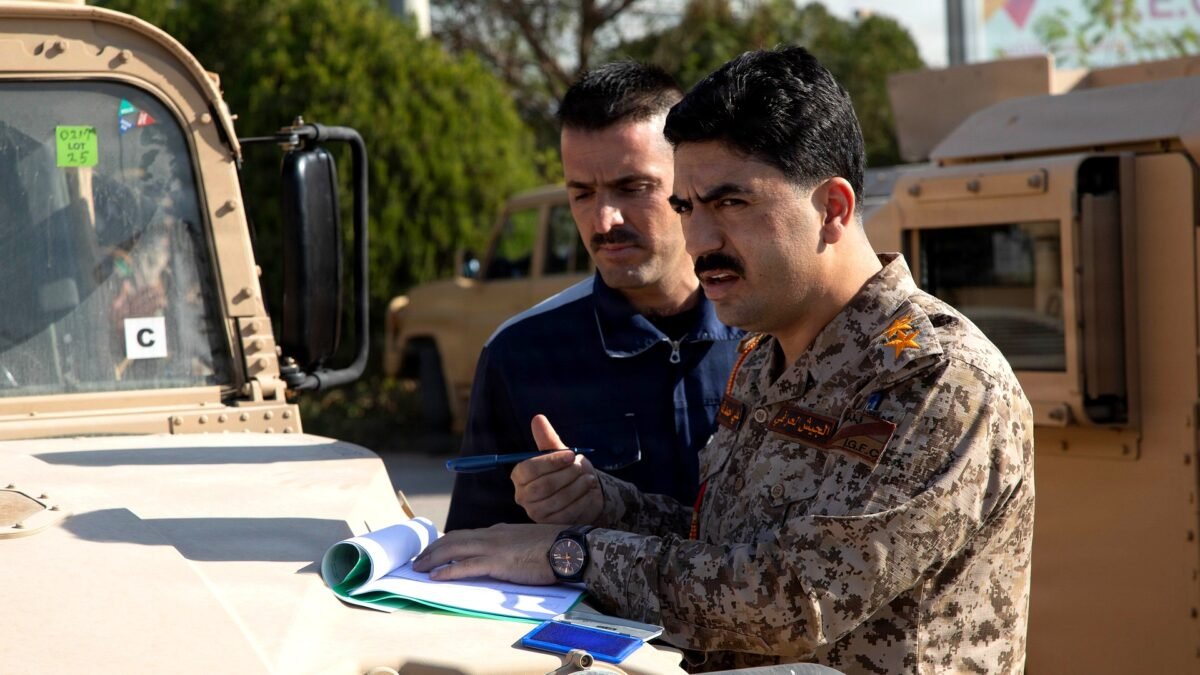
Iraqi Prime Minister Ali al-Zaidi has ordered the army into Jurf al-Nasr, a town south of Baghdad held for years by the Iran-backed armed group Kataib Hezbollah, and has given the faction until Friday to leave, in the sharpest test yet of the Iraqi state’s authority over the powerful militias that operate inside it. The order, announced on Monday, follows a government investigation that accuses people in the town of stealing crude oil from a state pipeline on an industrial scale, and it sets up a confrontation that both sides have spent years avoiding.
Government spokesman Haidar al-Aboudi told the state-run Iraqi News Agency that the prime minister had “ordered the armed forces to enter” the town, which was formerly known as Jurf al-Sakhar, and that “a deadline has been set for the armed faction to exit the area”, according to Al Jazeera. A senior Iraqi official told Al Jazeera Arabic that the deadline is Friday. A security source gave the same deadline to the Agence France-Presse news agency, according to a report carried by CNA.
Al-Zaidi has told military and security commanders to deploy additional forces around the town and to prepare for government troops to go in, Al Jazeera reported. Security agencies have also been instructed to stop tankers carrying oil or petroleum products from leaving the area. Military units were already moving towards the area on Monday, and the Iraqi Air Force was ready to support ground troops once the Friday deadline expires, The National reported, citing a senior government official. As of Monday morning in the United States, there was no confirmed report that government forces had entered the town or that fighting had begun.
The order is the culmination of a sweeping anti-corruption crackdown that began with an intelligence report and has already cost nine senior officials their jobs. On Saturday, the Iraqi government said an investigation committee had confirmed oil smuggling in Jurf al-Nasr, and it dismissed nine senior security and oil officials and ordered everyone implicated to be referred to the courts. Those dismissed included the Babil police chief, the province’s intelligence and security commanders and the director of the state-run Oil Pipelines Company, according to Reuters.
According to Reuters, which spoke to senior security, army, police and oil officials, the smuggling network has robbed the government of hundreds of millions of dollars dating back to 2021. The network was run with accomplices among some security and oil officials, the officials told the news agency. Two Iraqi oil officials with direct knowledge of the investigation said it was too early to put a precise figure on the losses without knowing how long the tapping points had been in operation, but they estimated that the value of the crude potentially siphoned since 2021 could amount to hundreds of millions of dollars.
The pipeline at the centre of the case
The investigation committee entered Jurf al-Nasr on Friday, accompanied by members of Kataib Hezbollah, and inspected six sites on the basis of information from the Federal Intelligence and Investigations Agency, according to The National. The committee found what the government spokesman described as “clear tampering with pipelines passing through the area, as well as attempts to bury and conceal traces of that tampering”.
Two security sources who took part in the inspection mission on Saturday told Reuters what the investigators found. Smugglers had punctured a crude oil pipeline and siphoned crude into makeshift storage pits dug into the ground, they said. Investigators also found concealed pumping equipment inside several hangars, used to avoid aerial surveillance while loading tanker trucks with the siphoned crude, and a small oil refinery concealed in the area.
The pipeline at the centre of the case is 26 inches wide and carries at least 200,000 barrels of crude a day, according to an Iraqi Oil Ministry document reviewed by Reuters. The state-owned Oil Pipelines Company said on Sunday that its director general’s on-camera remark during the inspection, that the pipes in Jurf al-Nasr had no problem, covered only the 200 to 300 metres he had personally inspected, while the pipe in the area runs for about 5,100 metres, according to a report on the group’s denial carried by EuropeSays.
The case had been building for days before the prime minister acted. On Wednesday, the Iraqi News Agency reported that “intelligence documents” containing satellite images “showed crude oil and oil-derivatives smuggling operations carried out by an armed faction” in Jurf al-Sakhar, accusing the unnamed faction of tapping into a pipeline there, according to an AFP report carried by Hathalyoum. A parliamentary inquiry made up of members of seven committees questioned Oil Minister Basim al-Abadi on Sunday and was due to host the interior and defence ministers on Monday, according to the same report.
Babil’s governor, Ali Turki, said he had resigned over the case, according to the report, and later described the site named in the intelligence report as an old fuel station used to fuel Federal Police and Popular Mobilisation Forces vehicles. The differing accounts of what the site actually is have become part of the dispute itself.
The group’s answer: denial and defiance
Kataib Hezbollah has rejected the allegations outright and has said it will not give up its weapons. In a statement on Sunday, the group said the prime minister’s office was “fabricating lies” and that it was being subjected to “the largest blackmail operation aimed at forcing us to abandon” its weapons, according to the CNA account of the AFP report. The group said the investigating committee, which visited on Friday accompanied by members of the armed group, “found no violations whatsoever of the oil pipelines” running through the area, and that this “definitively proves that the smuggling claims are false”.
“We are therefore being subjected to the greatest campaign of blackmail aimed at forcing us to relinquish the weapons of dignity that have upheld sovereignty and protected the rights of Iraqis at multiple stages,” the group said in a statement quoted by both Reuters and Al Jazeera. The group said that all that was documented in photographs and on site was “fuel tanks and a simple plant, of which there are hundreds like it in Iraq, that works to improve quality”, and that the plant supplies military vehicles, heavy machinery, diesel generators and war machines, according to the EuropeSays report.
In a separate statement on Monday, the group declared that it would not lay down its weapons, as government authorities ordered the army to enter its stronghold, according to Press TV. The group has repeatedly maintained that the weapons of the Iraqi anti-terror resistance factions are a matter of faith, morality and principle, and has stressed that it will not surrender them under domestic or foreign pressure. It also denounced Mr al-Zaidi for yielding to pressure from the United States, Saudi Arabia and the United Arab Emirates.
The group’s position is not new. Kataib Hezbollah and other Iranian-backed armed groups have resisted repeated calls by both Mr al-Zaidi and his ally, US President Donald Trump, to disarm, according to Al Jazeera. They have struck US troops and targets in Saudi Arabia and the United Arab Emirates in solidarity with Tehran since the United States and Israel launched their war against Iran in February.
A group with an army’s arsenal
Kataib Hezbollah, which the United States has branded a terrorist organisation, is one of dozens of heavily armed pro-Iranian groups that have semi-official status in Iraq, according to Reuters. The groups sit inside the Popular Mobilisation Forces, the state-sponsored umbrella of mostly Shia armed factions that was formalised after the war against Islamic State, yet they answer in practice to their own commanders and, in the case of Kataib Hezbollah, to Tehran as much as to Baghdad.
The arsenals these groups have built up include assault rifles, machine guns, anti-tank guided missiles, mortars, rockets and armed drones and, according to Iraqi security reports and assessments cited by Reuters, some short-range ballistic and cruise missile capabilities supplied by Iran or derived from Iranian systems. That is the military reality behind the prime minister’s order: the force he is sending into Jurf al-Nasr would be entering a town held by a group that is armed, organised and dug in.
Jurf al-Nasr, also known as Jurf al-Sakhar, lies about 50 kilometres south of Baghdad in Babil province, according to Reuters, or about 60 kilometres south-west of the capital, according to The National. The town has been under the group’s control since it was retaken from Islamic State in 2014, and its displaced Sunni residents have never been allowed to return, a fact that has made the town a symbol of the militias’ power over the Iraqi state for more than a decade. The government has long been unable to exercise normal authority there, and the oil investigation is the first time Baghdad has tried to force the issue with troops.
Washington’s pressure, and the wider war
The crackdown is set against a backdrop of mounting American pressure on Iraq over the role of pro-Iranian groups in the country’s oil sector, according to Reuters. In May, Washington sanctioned Iraq’s deputy oil minister, alleging that he had facilitated the diversion of Iraqi oil for the benefit of Iran and its proxy militias. Sanctions were also imposed on militia leaders and networks that Washington said were exploiting Iraq’s oil wealth to finance Tehran-aligned groups.
Reuters reported in 2024 that a fuel oil smuggling network had raked in $1 billion for Iran and its proxies, a figure that gives the scale of the trade Baghdad is now trying to shut down. The order to move on Jurf al-Nasr comes amid pressure on Baghdad from the United States and some of its Gulf-state allies to counter Tehran’s influence in Iraq, according to Al Jazeera.
The timing is also shaped by the war that began in February, when the United States and Israel launched their attacks on Iran. Since then, Iranian-backed armed groups in Iraq have struck American troops and targets in Saudi Arabia and the United Arab Emirates in solidarity with Tehran, according to Al Jazeera. The war has turned Iraq into a front line of a regional conflict, and it has made the question of who controls the country’s armed groups a matter of immediate strategic importance for Washington as well as for Baghdad.
That is the context in which the oil investigation must be read. While officially framed as an initiative to protect public funds, analysts believe the oil probe is a calculated strategy to sever the financial arteries of armed factions that refuse to integrate into Iraq’s state apparatus, according to Al Jazeera. The smuggling, in this reading, is both a crime and a lever: a way to attack the groups’ finances, their political protection and their claim to be above the law, all at once.
Analysis: Why It Matters
The oil is the point, and the weapons are the point too
The most important thing to understand about this confrontation is that it is about two things at once, and neither can be understood without the other. On the surface, it is a criminal investigation. A pipeline was tapped, crude was siphoned into pits in the ground, tanker trucks were loaded under cover of hangars built to defeat aerial surveillance, and a small refinery was hidden in the area. Nine officials lost their jobs. Hundreds of millions of dollars are said to have been stolen from the Iraqi state since 2021. That is a straightforward story of corruption, and it would be a major scandal on its own.
But the investigation landed on a town that is not an ordinary town, and on a group that is not an ordinary criminal gang. Jurf al-Nasr is a place where the Iraqi state has not exercised normal authority for more than a decade. Kataib Hezbollah is a group that holds territory, commands an arsenal that includes missiles and drones, and answers to a foreign capital as much as to its own. When the prime minister sends the army into such a place over an oil theft investigation, he is not only pursuing a crime. He is testing whether the state can enforce its law against a group that has, until now, been effectively above it.
The group understands this perfectly, and its statements say so. Its claim that the investigation is “the largest blackmail operation aimed at forcing us to abandon” its weapons is not a denial of the facts so much as a reframing of them. The group is telling its supporters, and Baghdad, that the oil is a pretext and the weapons are the real target. That framing matters, because it tells us how the group will fight this battle: not by arguing about pipeline diameters and inspection reports, but by presenting itself as a defender of resistance against a government doing Washington’s bidding.
Both readings can be true at the same time. The oil theft can be real, and the investigation can also be a deliberate instrument for cutting off the group’s money and forcing the question of its weapons. In fact, that is the most likely reading of events. Governments that want to confront powerful armed groups rarely do so by announcing a disarmament campaign, which invites a direct and possibly violent refusal. They do it by attacking the money, the logistics and the legal impunity that make the group’s power possible. The oil probe gives Mr al-Zaidi a case that is hard to argue against in public, a set of officials he can sack, and a legal basis for sending troops into a town his government has not controlled for twelve years. The question is whether the group will accept that framing, or whether it will treat the troops as an invasion and respond as an army would.
A prime minister picks a fight he cannot afford to lose
The second thing to grasp is the scale of the gamble Mr al-Zaidi has taken. Jasim al-Bahadli, an Iraqi security analyst who specialises in studying armed Shia groups aligned with Iran, told Reuters that the prime minister is “effectively challenging a group with deep security, political and economic influence, and that carries significant risks for both sides”. That is a careful understatement. The risks are not symmetrical, and they are not small.
For the prime minister, the danger is that he issues an order the state cannot carry out. If the deadline passes on Friday and Kataib Hezbollah is still in Jurf al-Nasr, and the army either does not enter or enters and is forced to withdraw, the government’s authority will be weaker than it was before the order was given. Armed groups across Iraq will have learned that Baghdad’s deadlines are negotiable and its threats are empty. The prime minister’s political rivals, including the Shia political alliance that backs the militias, will have learned the same thing. A failed confrontation would be worse than no confrontation at all.
For the group, the danger is the opposite. If the army does enter the town, and does so without a fight, the group will have lost the one thing that has protected it for a decade: the assumption that no Iraqi government would dare to challenge it on its own ground. Its control of Jurf al-Nasr is not only a military asset. It is a demonstration, to every other armed group and to every politician in Baghdad, that the militias are beyond the reach of the state. Once that demonstration fails, the whole architecture of impunity begins to crack, and the other groups that have watched this confrontation will start to calculate their own positions.
That is why both sides have spent the days since the investigation began raising the stakes rather than lowering them. The government has sacked nine officials, referred suspects to the courts, moved troops towards the town and put the air force on standby. The group has denied everything, accused the prime minister of fabricating lies, vowed to keep its weapons and denounced him for yielding to American, Saudi and Emirati pressure. Neither side has left itself much room to climb down, and that is the most dangerous fact in this story.
Friday is a deadline, not a battle plan
The third point is about the deadline itself. Friday is a date, not a plan, and what happens on Friday will depend on decisions that have not yet been made, by people who have not yet shown their hands. There are at least three ways this can go, and each of them leads somewhere different.
The first is that Kataib Hezbollah leaves, or at least appears to leave, and the army enters without a shot being fired. This is the outcome Baghdad wants, and it is the outcome the deadline is designed to produce. A deadline gives the group a way to withdraw without admitting defeat, and it gives the government a way to claim that its authority has been restored without having to test it in a firefight. But it is hard to see how the group gets there from where it is now. It has spent the last two days saying it will not disarm and will not surrender its weapons. Leaving its stronghold would be read, by its supporters and its enemies alike, as a retreat, and the group’s entire identity is built on never retreating.
The second possibility is that the group stays, and the army goes in anyway. This is the outcome both sides have been preparing for, and it is the one that carries the greatest risk of bloodshed. The Iraqi Air Force is ready to support ground troops, according to The National, and the group has an arsenal that includes rockets, drones and missiles. A firefight in a town that has been a militia stronghold for twelve years would not be a brief skirmish. It would be a battle, and it would be fought in front of a national audience and a regional one, with Iran watching closely and the United States watching just as closely.
The third possibility is the one that experienced observers of Iraqi politics will be watching for most carefully: a deal. A quiet agreement, brokered by Shia political leaders or by Iran, in which the group withdraws some of its fighters, hands over some of its facilities, and allows the government to claim a victory, while keeping its weapons and its organisation intact. This is how most confrontations between the Iraqi state and the militias have ended in the past, and it is how this one may end too. But a deal of that kind would leave the fundamental question unanswered, and it would leave the next confrontation to be fought another day.
Washington’s fingerprints are all over this
The fourth point is about the American role, which is visible in almost every part of this story even though no American official has given the order. The United States has been pressing Baghdad for months to curb Tehran’s influence in Iraq, and it has used the oil trade as its principal lever. In May, Washington sanctioned Iraq’s deputy oil minister, alleging that he had facilitated the diversion of Iraqi oil for the benefit of Iran and its proxy militias. Sanctions were also imposed on militia leaders and networks that Washington said were exploiting Iraq’s oil wealth to finance Tehran-aligned groups. The investigation in Jurf al-Nasr is, in this sense, the Iraqi government doing what Washington has been demanding, and doing it in the place where the demand is hardest to meet.
The war that began in February has made the American pressure harder to resist. Since the United States and Israel launched their attacks on Iran, Iranian-backed groups in Iraq have struck American troops and targets in Saudi Arabia and the United Arab Emirates. Iraq has become a front line in a regional war, and the question of whether Baghdad can control the armed groups on its own territory has become a question that Washington asks every day. A prime minister who cannot control Kataib Hezbollah cannot credibly promise the United States that American troops in Iraq are safe, and cannot credibly promise the Gulf states that their territory will not be attacked from Iraqi soil.
But the American connection is also the group’s strongest weapon. By denouncing Mr al-Zaidi for yielding to pressure from the United States, Saudi Arabia and the United Arab Emirates, Kataib Hezbollah is telling its supporters that this is not an Iraqi government enforcing Iraqi law, but an Iraqi government doing the bidding of Iraq’s enemies. That argument has power in a country where the American invasion of 2003 is still a living memory, and where the militias built their legitimacy by presenting themselves as the defenders of Iraqi sovereignty against foreign occupation. The prime minister’s challenge is to make the case that the law applies to everyone, including the groups that claim to defend the nation, without being cast as the agent of a foreign power.
The town that never went home
The fifth point is about Jurf al-Nasr itself, and about why this particular town has become the place where the Iraqi state has chosen to make its stand. The town was retaken from Islamic State in 2014, and its displaced Sunni residents have never been allowed to return. For more than a decade it has been a closed zone, controlled by Kataib Hezbollah and closed to the people who used to live there. That history is not a footnote. It is the reason the town matters.
A state that cannot return displaced citizens to their homes is a state that does not control its own territory. A group that can keep a town closed for twelve years, against the wishes of its residents and the orders of successive governments, is a group that has replaced the state. The oil investigation gives Baghdad a reason to enter the town, but the town itself is the reason the confrontation has been waiting to happen. Every year that Jurf al-Nasr stayed closed was a year in which the militias demonstrated that they could defy the government and pay no price.
If the army enters the town on Friday, or in the days after, it will be the first time in twelve years that the Iraqi state has asserted its authority there. That would be a moment of genuine historical significance, whatever the circumstances that produced it. And if the army does not enter, the town will remain what it has been: a reminder, visible on the map a short drive south of Baghdad, that the Iraqi state does not govern all of Iraq. That is the real stake in this confrontation, and it is larger than any amount of stolen oil.
What to Watch Next
- The Friday deadline. Kataib Hezbollah has until Friday to leave Jurf al-Nasr, according to a senior Iraqi official who spoke to Al Jazeera Arabic and a security source who spoke to AFP. Whether the group withdraws, stays, or negotiates will determine everything that follows.
- Whether government troops enter the town. Military units were moving towards the area on Monday, and the Iraqi Air Force was ready to support ground troops once the deadline expires, according to The National. The first reports of troops entering Jurf al-Nasr, or of resistance to their entry, will be the decisive moment.
- The group’s next statement. Kataib Hezbollah has denied the smuggling allegations and vowed to keep its weapons. Any change in its language, or any sign that it is seeking mediation through Shia political leaders or Iran, will be a signal of how it intends to play the deadline.
- The parliamentary inquiry. A parliamentary inquiry made up of members of seven committees questioned Oil Minister Basim al-Abadi on Sunday and was due to host the interior and defence ministers on Monday. Its findings could widen the investigation beyond Jurf al-Nasr.
- The court cases. Nine senior security and oil officials have been dismissed and referred to the courts. Whether prosecutions follow, and what they reveal about the smuggling network, will show whether this is a genuine anti-corruption drive or a political operation.
- Washington’s response. The United States has sanctioned Iraqi officials and militia networks over oil smuggling and has pressed Baghdad to curb Tehran’s influence. American statements in the coming days will show whether Washington sees the crackdown as sufficient, or whether it wants more.
- The wider militia question. Kataib Hezbollah is one of dozens of armed pro-Iranian groups with semi-official status in Iraq. How the other groups react to the confrontation in Jurf al-Nasr, and whether the government moves against any of them next, will determine whether this is an isolated operation or the start of a campaign.
Sources
- Reuters — “Iran’s proxy in Iraq rakes in hundreds of millions through oil smuggling”
- Al Jazeera — “Iraq deploys army to stronghold of Iran-backed Kataib Hezbollah” (full-text reproduction)
- Agence France-Presse, via CNA — “Iraq Orders Its Army Into a Kataib Hezbollah Stronghold”
- Press TV — “Iraqi resistance group rejects disarmament as army moves into its stronghold”
- EuropeSays — “Kataib Hezbollah denies Jurf al-Sakhar oil smuggling, accuses Iraq PM”
- Agence France-Presse, via Hathalyoum — “Iraq sacks nine officials over oil smuggling in pro-Iran group’s bastion”

About the Author — Abdul Mannan
Related Articles
Four Western Allies Tell Israel to Let 150,000 Tents Into Gaza Before Winter Closes In
The foreign ministers of Britain, Australia, Canada and Italy say 150,000 tents are being held at Gaza's border…
Saudi Arabia Intercepts Two Houthi Missiles Aimed at Riyadh and Three Drones Over Its Oil Heartland
Saudi air defences intercepted two Houthi ballistic missiles aimed at Riyadh and three drones over the Eastern Province…
Jordan Sentences Three Men to Death Over Church Funeral Attack That Killed Nine in Karak
Jordan's State Security Court has sentenced three men to death for the 23 October attack on a Greek…