
The Bridge Burns Again: Ukraine’s Record Drone Storm and the Shadow of Shenzhen

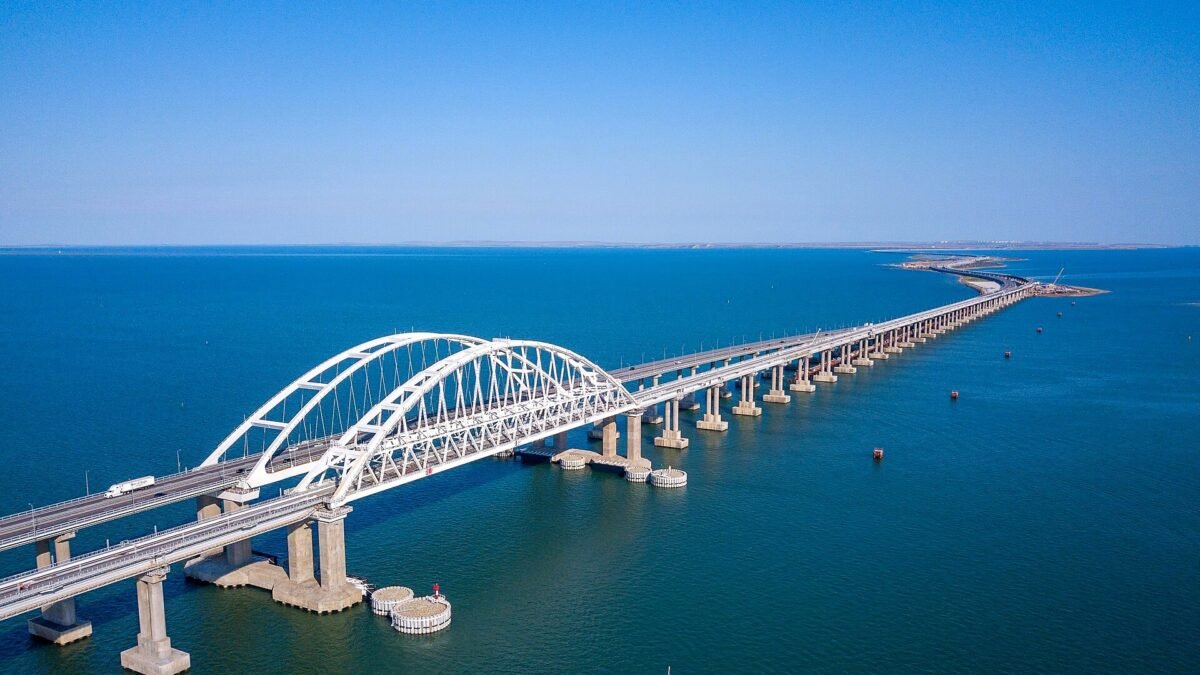
What do you call a bridge that has been bombed three times and still stands? A triumph of engineering — or a monument to a lie that refuses to die?
On the night of Sunday, 16 November 2026, the sky over Russia filled with more drones than at any point since this war began. Ukraine launched what Russian defence ministry data itself described as the biggest overnight drone attack on Russia since the start of the full-scale war in 2022 — 1,336 drones intercepted across sixteen regions, according to Moscow’s own count, surpassing the previous record of 1,254 set on 29 October. And in the middle of that storm, the target that mattered most was struck again: the Crimean Bridge, the nineteen-kilometre road and rail crossing that Vladimir Putin built across the Kerch Strait to bind a seized peninsula to his empire.
The Russian-installed governor of Crimea, Sergei Aksyonov, confirmed the strike himself. The Kremlin, as it always does, called the damage minor. Road traffic was suspended from 02:22 Moscow time while repairs were undertaken; rail traffic, the transport ministry said, continued as normal. Then, within twenty-four hours, the bridge was struck a second time. I ask you, the reader, to hold that image in your mind: a bridge built to declare permanence, hit twice in a single day, while its builders insist nothing has happened.
A Bridge Built to Say “Forever”
Every empire builds a bridge. The Romans built them to march their legions across conquered rivers. The British built railways across India — not, as their schoolbooks claimed, as a gift to the people, but as iron arteries to move troops and treasure and to hold a subcontinent that did not belong to them. A bridge is never only concrete and steel. It is a sentence written in stone: this land is ours now, and it will remain ours.
Putin understood that grammar perfectly. When Russia seized Crimea in 2014, the peninsula was connected to the Russian mainland by nothing but ferries. So the Crimean Bridge was built — road opened in May 2018, rail in December 2019 — the longest bridge in Europe, a signature project of the Russian president himself, opened by him, celebrated by him, stamped on coins and postage stamps. It was meant to make the annexation irreversible, to turn a military seizure into a geographical fact.
And yet history has a habit of answering monuments with fire. The bridge was hit in October 2022. It was hit again in July 2023. Now it has been hit twice in twenty-four hours. Three times the bridge has been struck, and three times the Kremlin has called the damage minor. A bridge that must be repaired three times is not a symbol of permanence. It is a symbol of a claim that cannot hold.
I do not celebrate the burning of bridges. I am asking you to notice what the fire means.
The Night of 1,336 Drones
Let us be precise about what happened, because in war the first casualty is always the truth, and the second is proportion.
Russia’s Defence Ministry said its air defences brought down 1,336 Ukrainian drones across sixteen regions. Those numbers could not be independently verified, and I will not pretend otherwise. But the scale of the night is not in doubt. Moscow’s mayor, Sergei Sobyanin, said about 600 drones had been launched toward the capital region alone since Sunday evening, with 191 intercepted. Drones were also reported downed over Crimea, over the Black Sea and the Sea of Azov. Oil refineries were targeted across Russia. President Volodymyr Zelenskyy claimed on Sunday that Ukrainian strikes had disabled more than half of Russia’s refining capacity — a figure that, again, could not be verified, but which tells you where this war is now being fought: not only on the battlefield, but in the fuel tanks and the power grids.
While the drones flew, Russia answered in its own language. Overnight on 17 November, Russian missiles struck Kharkiv’s Kholodohirskyi district and industrial infrastructure in Zaporizhzhia, with at least six strikes reported on critical infrastructure in the region. Two weeks earlier, a Russian strike on Komyshuva in the Zaporizhzhia region killed 72 people, with four still missing when the search ended on 16 November. Nuclear safety regulators from thirty-eight countries have warned of an exceptionally high accident risk in Ukraine this winter. This is the season the war has entered: cold, dark, and aimed at the things that keep ordinary people alive — heat, light, water.
You must understand what has changed. This is no longer the war of tanks and trenches alone. The drone has become the artillery of the poor and the determined. A weapon that costs thousands can threaten a bridge that cost billions. That is not a military detail. It is a revolution in the arithmetic of power — and it is why the powerful are suddenly afraid of the sky.
The Shadow of Shenzhen
Now look at the calendar, because the calendar is the real story. On Thursday, 19 November, in Shenzhen, China, three men will sit down together: Donald Trump, Vladimir Putin, and Xi Jinping. China confirmed on Monday that the trilateral meeting will take place on the sidelines of the Asia-Pacific Economic Cooperation summit — the first time China has hosted the gathering since 2014. The agenda, we are told, includes nuclear arms control and the war in the Middle East. The war in Ukraine will hang over the room like smoke.
Here history holds up its mirror, and I beg you to look into it honestly.
In February 1945, at Yalta, three men — Roosevelt, Churchill, and Stalin — sat in a palace in Crimea, not far from the strait this bridge now crosses, and redrew the map of Europe over the heads of the nations whose fate they were deciding. Poland was not at the table. The Baltic states were not at the table. Millions of people learned their future from the communiqués of others. In September 1938, at Munich, four powers decided the fate of Czechoslovakia without Czechoslovakia in the room — and called it peace.
I am not saying Shenzhen is Munich. I am saying that whenever great powers gather to discuss a smaller nation’s fate while that nation is not seated at the table, the smaller nation has every reason to be afraid — and every right to make its voice heard by other means. The drones over the Kerch Strait on Sunday night were, among other things, a message: Ukraine will not be a footnote in someone else’s summit. A nation that can strike the bridge of its occupier twice in a day is a nation that insists on being heard.
And notice the timing. The strike came days before the summit, just as US-brokered talks in Abu Dhabi last week produced a major prisoner-exchange agreement but no breakthrough over territory. Trump’s special envoy Steve Witkoff is set to travel to Norway this week for the next round of negotiations — talks expected to include Zelenskyy, the Norwegian prime minister, the E4 of Britain, France, Germany and Poland, the European Union, and NATO. The diplomats are circling. The drones are the punctuation.
The Cracks in the Alliance
There is another story inside this story, and it is the one the headlines are trying not to tell. The relationship between Washington and Kyiv is fraying in public. On Monday, President Trump told reporters that someone other than President Zelenskyy should negotiate on Ukraine’s behalf. “Zelenskyy is a man that should have had settled this war a long time ago,” he said. “If he would have listened to me, he would have made a much better deal a long time ago.” On Sunday, Trump claimed on social media that Zelenskyy does not want to end the war. Zelenskyy, speaking to US senators on Monday, said the Trump administration’s decisions “are hard to explain between friends” — arms shipments delayed, intelligence sharing restricted.
I have seen this scene before, in other wars and other centuries. When a great power grows tired of a war, it does not say so plainly. It begins by blaming the ally. It begins by suggesting that the victim is the obstacle to peace. It begins by defending sanctions waivers for the aggressor — as Trump did in the same social media post — on the grounds of keeping Moscow at the negotiating table. And then, almost as an afterthought, it announces that Russia will supply more than 300,000 metric tonnes of diesel to American and global markets, to bring down fuel prices.
Read that again, slowly. The country that invaded its neighbour is being offered a place at the table and a market for its fuel, while the country that was invaded is told its president is the problem. Is this peacemaking — or is it the old script, in which the strong are accommodated and the weak are instructed to be reasonable?
Meanwhile, in Paris, a revelation of a different kind: Radio France Internationale reported on 16 November that French troops have been operating inside Ukraine since at least summer 2026, as part of a confidential mission codenamed “Volia.” And in Moscow, the newspaper Vedomosti reported the same day that Kremlin officials had instructed lawmakers from Putin’s United Russia party to prepare for “victory” and the return of personnel from the battlefield — no timetable given, no withdrawal ordered, no decision announced. Two governments, two secrets, both surfacing on the same day. The war is being fought in the shadows as much as in the sky.
And Europe? The European Union’s Council approved nearly eight billion euros in a ninth Ukraine Facility payment on 16 November, and the EU has proposed a forty-five billion euro loan for 2027. At the same time, the EU has rejected Russia’s demands on NATO and set conditions for any peace talks. Europe is paying for a war it did not start, to defend a continent it thought it had made safe forever. The bill keeps growing. The patience, one suspects, is not infinite.
What the Bridge Teaches
So what does it all mean — the drones, the bridge, the summit, the fraying alliance?
It means this war has entered its most dangerous phase: the phase in which the fighting escalates precisely because the talking is about to begin. Each side is trying to shape the table before anyone sits down. Ukraine strikes the bridge to prove it cannot be ignored. Russia strikes the power grid to prove it cannot be defied. America prepares to preside over a settlement, and the man it would settle with is the man whose bridge is burning.
History teaches us that bridges built by force are tested by force, and that settlements imposed over the head of a nation do not settle anything — they only postpone the reckoning. The bridge across the Kerch Strait was built to say “forever.” Three explosions later, it says something else: that what is taken by force must be held by force, and force is the most expensive landlord in the world.
I end with a question, not an answer. When the three leaders sit down in Shenzhen on Thursday, will they be making peace — or will they be making another Yalta, another Munich, another arrangement in which the fate of a nation is decided by men who do not live in it? The drones have already given their answer. The bridge has already given its. The question now is whether the men in the room are listening — or whether, like so many powerful men before them, they believe that a bridge of steel is stronger than the will of a people.
The people of Ukraine have answered that question with fire, three times. The world would do well to listen before a fourth answer becomes necessary.
Sources & References
- Reuters — “Ukraine launches biggest drone attack on Russia since war began, defence ministry data shows,” 16 November 2026 (Andrew Osborn and Gleb Stolyarov).
- Fox News — “Ukraine hits Putin’s prized bridge in record drone blitz as Kremlin tells lawmakers to prepare for ‘victory’,” 16 November 2026.
- New York Post — “Ukraine strikes Putin’s prized Crimea bridge — largest drone attack on Russia so far,” 16 November 2026.
- Al Jazeera — “US-Ukraine relations sour as Trump, Zelenskyy clash over talks, arms,” 17 November 2026.
- LinkedIn / Daily Buzz — “Daily Buzz: 17 November 2026” — China confirms trilateral Trump–Putin–Xi talks in Shenzhen.
- Wikipedia — Crimean Bridge — bridge history: road opened 16 May 2018, rail December 2019; attacks in 2022 and July 2023.
- DroneXL — “Crimean Bridge Hit As Russia Counts 1,336 Ukrainian Drones Overnight,” 16 November 2026.

About the Author — Abdul Mannan
Related Articles
Russian Strikes Hit Two Kyiv Bridges and Cut Water and Heat as Zelensky Warns of More Attacks
Russian forces struck Kyiv's North and South bridges late on Monday, cutting water and heating in parts of…
Five EU Countries to Open Migrant Deportation Hub in Rwanda in 2027 in Landmark Return Deal
Five European countries have unveiled plans to send rejected asylum seekers to a deportation hub in Rwanda, with…
Estonia to Close All Border Crossings With Russia From 1 December After GRU-Linked Arson Attempt on Drone Maker
Estonia will shut all three of its border crossings with Russia from 1 December after blaming Russia's GRU…