
Trump’s Board of Peace Warns Gaza Ceasefire Could Collapse as Israel and Hamas Both Fail to Honour Deal

The body created to oversee Donald Trump’s plan to end the war in Gaza has warned the United Nations that the ceasefire at the heart of that plan could collapse, accusing both Israel and Hamas of failing to honour the commitments they made more than a year ago. In a 12-page report to the UN Security Council, seen by Reuters, the Board of Peace delivers its bleakest assessment yet of a truce that has stopped the worst of the fighting but delivered almost none of what was promised after it.
“The distance between what has been agreed and what is happening on the ground nonetheless remains the principal risk to the process,” the report says, warning that “a ceasefire that delivers nothing visible cannot be sustained indefinitely.” It is the board’s second report to the Security Council since the US-backed ceasefire came into effect 13 months ago, and the Associated Press, which also obtained a copy, reported the same warning in its own account of the document.
The board, established and headed by Mr Trump to supervise his plan to end the war, is expected to present the report’s findings to a meeting of the Security Council in New York at the end of November. The timing matters. Gaza is entering its second winter since the ceasefire, more than two million people are still living in tents and damaged buildings, and the report says that if the agreement falls apart now, there will be nothing to replace it. “Should it collapse, there would be no road map to return to, no administration to deploy and no enabling environment to rebuild,” the report says, according to the Associated Press.
Neither the office of Israeli Prime Minister Benjamin Netanyahu nor a spokesperson for the political office of Hamas immediately responded to requests for comment on the report, according to Reuters.
A Report Written in the Language of Failure
The report’s central charge is that both sides have fallen far short of what they agreed. Israel has carried out near-daily strikes on Gaza since the ceasefire took effect, while Hamas fighters have continued attacks on Israeli troops. The commitment to cease all military activities, the report says, “has not been met in full by the parties”.
That framing is deliberate and important. The Board of Peace is not an outside critic of Mr Trump’s plan; it is the plan’s own governing body. Its director-general is Nickolay Mladenov, a former United Nations envoy to the Middle East, and its first report, delivered to the Security Council in May, already acknowledged that the truce had stalled soon after it took effect in October 2025, with the deadlock over disarming Hamas paralysing progress. Six months later, the second report says the same problems have not merely persisted but deepened, and that the population now faces “another winter in tents and rubble”.
The report’s language is unusually blunt for a document produced by a body chaired by the American president whose plan it oversees. It does not describe a peace process under strain. It describes a process in which the gap between paper and ground has itself become the main threat. The ceasefire, it says, has halted major fighting, but the wider plan — Hamas disarming, Israeli troops withdrawing, reconstruction beginning — has “effectively stalled since soon after it came into effect last year”.
That stall is not a matter of interpretation. The international stabilisation force that was supposed to secure Gaza during the transition has not arrived. The Palestinian technocratic committee created to run Gaza’s civilian affairs on an interim basis has still not been allowed by Israel to take up its work inside the territory. The civilian police force meant to replace Hamas as Gaza’s law enforcement authority has not been trained or deployed. Reconstruction at any meaningful scale has not begun. Thirteen months after the ceasefire, the plan exists mostly as a document.
What Each Side Is Accused Of
The report spreads its criticism across both parties, and the details it gives for each side are specific rather than general. On Israel, its sharpest phrase is an “absence of decisions”. The board criticised the Israeli government for failing to decide on the arrangements needed to train and deploy a civilian Palestinian police force, saying this was impeding the full implementation of the plan. “The absence of decisions by the government of Israel on the necessary conditions and arrangements for the training, deployment and return of civilian police to Gaza continues to impede full implementation of the Comprehensive Plan,” the report says.
The board also faulted Israeli restrictions on the entry of supplies and equipment, which it said, combined with funding shortfalls, had hindered the ability of Gazans to prepare for and respond to seasonal flooding. Heavy rain inundated displacement camps across Gaza last week, and more rain is expected later this month. The report called for the immediate “scaled-up entry of shelter and winterisation materials” and for approvals for pumps, generators and heavy machinery. The flooding is not a new problem: earlier this month, winter storms swamped tens of thousands of tents and killed four people, and the United Nations has said the deadly flooding was preventable.
At the same time, the report says Israel has carried out strikes against Hamas targets almost every day since the ceasefire, and it draws a direct line between those strikes and the failure of the political process. “Every day that Israel continues strikes against Hamas targets, it delays putting Hamas’ agreement to the roadmap to the test,” the report says. The point is that the strikes are not only a violation of the ceasefire in themselves; they also provide a reason — or a pretext — for everything else to stay frozen.
On Hamas, the report says the group’s fighters have continued attacks on Israeli troops, and it accuses Hamas of collecting taxes on goods entering Gaza in ways that affect the availability of basic commodities. It also notes that the group has not disarmed, which is the single largest obstacle to the plan’s next phase. The board’s message to both sides is contained in a single sentence that cuts through the mutual blame: “Neither party may treat the other’s delay as licence for its own inaction, and together these obligations are the only route to Israeli withdrawal and reconstruction at scale.”
The Roadmap That Never Started
The clearest illustration of the deadlock is the disarmament roadmap. According to Reuters, Hamas agreed in July to a Board of Peace roadmap under which it would surrender its weapons and transfer governance of Gaza to a civilian transitional authority. Israel rejected the roadmap, saying it will not withdraw until Hamas is dismantled. That rejection has held ever since. On Wednesday, Defence Minister Israel Katz said Israel would not withdraw from Gaza until Hamas was dismantled and Gaza was demilitarised.
The sequence matters because it shows how each side’s position makes the other’s impossible. Hamas says it will not give up its weapons while Israeli forces remain in Gaza. Israel says its forces will not leave until Hamas has given up its weapons. The Board of Peace’s own director-general, Mr Mladenov, put forward a disarmament proposal in March that envisaged gradual disarmament over eight months in exchange for Israeli commitments, including allowing reconstruction materials into Gaza. That proposal went nowhere.
In July, Hamas took a step that was, on paper, significant: it announced that it would dissolve the governing body that has administered Gaza for roughly two decades, and said it was ready to hand governance to the National Committee for the Administration of Gaza, the technocratic Palestinian committee envisaged under the peace plan to run civilian affairs. But that committee has remained based outside Gaza for months, reportedly because of Israeli objections to allowing it to enter the territory. The Associated Press reports that the board’s latest report laments the same fact: the technocratic civil administration it created to run Gaza on an interim basis has still not been allowed by Israel to take up its job in the territory.
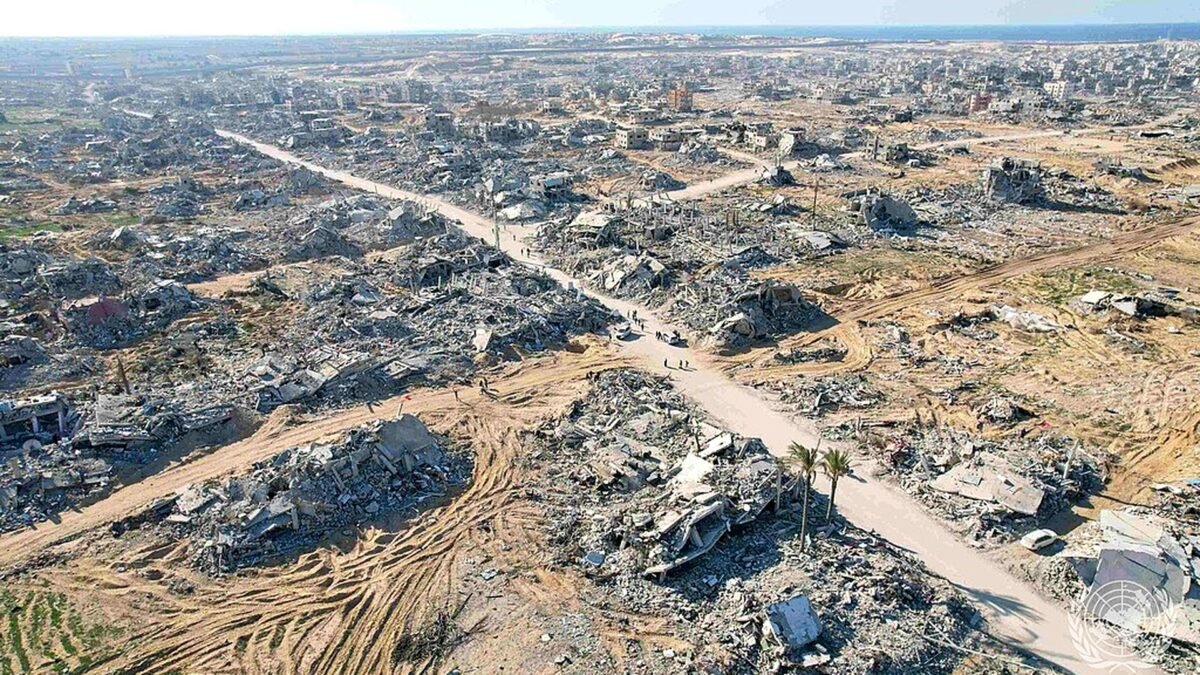
The result is a vacuum. Hamas still controls the roughly one-third of Gaza where most of the population lives, in makeshift tents and damaged buildings. Israel occupies about two-thirds of the territory, which has been largely razed and depopulated — up from roughly half the territory when the ceasefire began, according to an analysis by NPR of maps of areas now off-limits to aid groups alongside public statements from Israeli officials. There is no civilian authority ready to govern, no police force ready to keep order, and no international force ready to secure the transition. The plan’s institutions exist, but they exist outside Gaza, waiting for decisions that have not been taken.
A Second Winter in Tents
For the people of Gaza, the report’s warnings are not abstract. More than two million Palestinians live confined to around a third of the coastal territory, mostly in makeshift tents and damaged buildings. The report says they face “another winter in tents and rubble”, and the flooding last week showed what that means in practice: camps inundated, families wading through muddy water, tents collapsing, and little equipment available to pump the water away or to repair the damage.
The human cost of the ceasefire’s failure to hold in full is measured in the casualty figures the report and the news agencies cite. As many as 1,650 Palestinians have been killed in Gaza since the ceasefire took effect, according to Gaza health authorities cited by the Associated Press, and Reuters reports that more than 1,600 Palestinians, including many civilians, and five Israeli soldiers have been killed in Gaza since the US-mediated ceasefire was struck in October 2025. Those deaths have come in strikes and clashes that the ceasefire was supposed to have ended.
The wider toll of the war is far larger. Around 1,200 people were killed in Israel in the Hamas-led attacks of October 2023, and the Israeli assault on Gaza since then has killed 74,000 Palestinians, according to Reuters. The ceasefire stopped the full-scale bombardment, but it did not stop the killing, and it has not brought the reconstruction that was meant to follow. The report’s warning that a ceasefire “that delivers nothing visible cannot be sustained indefinitely” is, in that sense, a description of what Gazans already experience every day: a truce that has not changed the conditions of their lives.
The report also notes that the lack of Israeli approvals has delayed the deployment of the international stabilisation force, which is described as key to three things at once: Israel’s withdrawal of troops from Gaza, the disarmament of Hamas, and the start of reconstruction. Without the force, none of those three can happen; without any of those three, the force has no mission to deploy into. It is the same circular logic that governs the disarmament question, and it is the reason the board’s report reads less like a progress update than like a diagnosis of a system designed to stall.
Thirteen Months of a Ceasefire That Barely Held
To understand how the plan reached this point, it helps to retrace its short history. The war began in October 2023, when Hamas-led attacks from Gaza killed around 1,200 people in Israel, and Israel launched an assault on Gaza in response. Nearly two years later, on 29 September 2025, Mr Trump announced a 20-point peace plan at the White House alongside Mr Netanyahu. Hamas agreed to release the remaining hostages and to hand over the administration of Gaza to a Palestinian body of independent technocrats. The agreement was signed on 9 October and took effect the following day, 10 October 2025, with the release of the remaining living hostages in exchange for 2,000 Palestinian prisoners, including 250 serving life sentences, within 72 hours of Israeli forces withdrawing to pre-designated lines.
The plan was endorsed by the United Nations Security Council on 17 November 2025, in Resolution 2803, and it received strong international backing from countries including France, Germany, Russia, Italy, Spain, the United Arab Emirates, Egypt, Turkey, Qatar, Jordan, Indonesia, Pakistan, Canada and the United Kingdom. The Board of Peace itself, however, has been met with scepticism from many of Washington’s Western allies, who have questioned its structure and its authority.
The second phase of the plan was announced by US Special Envoy Steve Witkoff on 14 January 2026, but negotiations have remained stalled since, because of repeated Israeli attacks since the October ceasefire and disagreements over the disarmament plan. Hamas has said it will not discuss the second phase, which includes disarmament, until Israel fully implements the first phase. Israel has said it will not implement the later phases until Hamas disarms. Each side has made its own compliance conditional on the other’s, and the Board of Peace, which was created to break exactly that kind of deadlock, has found itself unable to do so.
The board has not been idle. On Friday 13 November, it said it had held “very constructive discussions” with 17 countries on a civilian Gaza police force. But CNN has described the board as sidelined and unable to make substantive progress on the 20-point plan, and the facts support that description: the technocratic committee has not entered Gaza, the stabilisation force has not arrived, and the disarmament process has not begun. The board’s own report now says so, in its own words, to the Security Council.
Israel’s own politics add another layer of uncertainty. Mr Netanyahu’s right-wing coalition government remains in power in a caretaker capacity despite losing its majority in an inconclusive election last month, and the president, Isaac Herzog, has been holding consultations with the Knesset factions about forming a new government. A caretaker government facing its own survival questions is not well placed to take the difficult decisions the Board of Peace is demanding — on withdrawing troops, on allowing a technocratic administration into Gaza, on approving a civilian police force. The report’s complaint about an “absence of decisions” may partly reflect that political reality, but it does not excuse it.
Analysis: Why It Matters
The board is now warning about its own plan
The most striking thing about this report is who wrote it. The Board of Peace is not a hostile observer. It was created by Mr Trump, it is headed by Mr Trump, and its job is to make his plan work. When its own second report to the Security Council says the ceasefire could collapse and that the gap between agreement and reality is now the principal risk to the process, that is not outside criticism. It is the plan’s own management telling the world that the plan is failing. That carries a weight that no outside condemnation could match, and it also raises an awkward question: if the body in charge of the plan cannot make the plan work, who can?
Disarmament is the deadlock that eats everything else
Every element of the plan depends on disarmament, and disarmament depends on trust that does not exist. Hamas agreed in July to a roadmap to surrender its weapons, but Israel rejected it. Israel demands disarmament before withdrawal; Hamas demands withdrawal before disarmament. The board’s March proposal for gradual disarmament over eight months was an attempt to break the circle by making both sides move in small steps at the same time, but it was never adopted. Until that circle is broken, nothing else can move either: no stabilisation force, no reconstruction, no civilian administration. The report understands this, which is why it treats the disarmament deadlock not as one problem among many but as the problem from which the others flow.
Israel’s “absence of decisions” is itself a decision
The report’s phrase about an “absence of decisions” deserves attention, because it captures something important about how the plan has stalled. The Israeli government has not formally rejected the civilian police force or the technocratic administration. It has simply not decided on them. Not deciding has the same practical effect as rejecting — the police are not trained, the administrators do not enter Gaza — but it avoids the political cost of an open refusal. The board is calling this out: delay, it says, is not neutral. Every day without a decision is a day in which Hamas keeps governing the strip where most Gazans live, in which no alternative authority can establish itself, and in which the plan’s institutions remain paper bodies. Inaction, the report implies, is a policy, and it should be judged as one.
The numbers describe a ceasefire in name only
A ceasefire in which around 1,650 people are killed in thirteen months is not a ceasefire in any meaningful sense. It is a reduction in the scale of killing, not an end to it. The report’s own figures make this plain, and they sit alongside the physical reality of Gaza today: two-thirds of the territory under Israeli occupation, largely razed and depopulated; two million people crowded into the remaining third; near-daily strikes; and a winter in which tents flood and there are not enough pumps, generators or heavy machinery to cope. The board’s warning that a ceasefire “that delivers nothing visible cannot be sustained indefinitely” is, in effect, an admission that the people of Gaza have been asked to sustain it for thirteen months already, on the promise of a reconstruction that has not begun. Promises wear thin. That is the report’s real warning: not that the ceasefire will be broken by a single dramatic act, but that it will be worn away by the accumulation of days in which nothing changes.
The warning has a deadline attached
The report is expected to be presented to the Security Council at the end of November, which gives the parties roughly two weeks from now to show movement. That is not much time, and the board knows it. Its appeal to the Council to put its “full weight” behind the agreement and to urge the parties to stop delaying is an attempt to create pressure that the board itself has been unable to generate. Whether the Council can do so is doubtful: the board’s own structure was met with scepticism by many Western allies, and the Council’s endorsement of the plan in Resolution 2803 has not, so far, translated into leverage over either party. But the deadline matters because the report also says what happens if it passes without action. If the ceasefire collapses, it says, there will be no road map to return to, no administration to deploy, and no enabling environment to rebuild. The warning is not that the parties will have to start again. It is that there will be nothing to start again with.
What to Watch Next
- The Security Council meeting at the end of November, where the Board of Peace is expected to present the report’s findings, and whether any member state pushes for concrete measures rather than another statement of support.
- Whether the Israeli government takes any decision on the civilian police force or on allowing the technocratic administration into Gaza — the two “absence of decisions” the report singles out.
- Whether Hamas takes any further step towards the disarmament roadmap it agreed in July, and whether Israel responds to it differently than it did the first time.
- The winter weather in Gaza, where more rain is expected later this month, and whether shelter and winterisation materials are allowed in at the scale the report demands.
- Whether the near-daily strikes and Hamas attacks continue at the same pace, or whether the report’s public warning produces even a temporary pause.
- The formation of a new Israeli government after last month’s inconclusive election, and whether a government with a working majority is more willing — or more able — to take the decisions the board is demanding.
- Whether the international stabilisation force moves from discussion to deployment, and which countries, if any, commit troops or funding to it.
Sources
- Reuters — “Trump’s Board of Peace faults Israel and Hamas for failure to end Gaza war”, 18 November 2026
- Australian Associated Press — “Gaza facing ‘another winter in tents and rubble'”, 18 November 2026
- Intelligence Report — “Israel Gaza Ceasefire: Why Strikes Continue a Year After the Truce”, 16 November 2026
- TM Africa — “Nine Months Into the Ceasefire, Israel’s Expanding Grip on Gaza Leaves Trump’s Peace Plan in Limbo”
- Wikipedia — Gaza peace plan (Comprehensive Plan to End the Gaza Conflict), background and timeline
- QNC News — “Board of Peace Warns UN That Gaza Ceasefire Could Collapse Soon”, 18 November 2026

About the Author — Abdul Mannan
Related Articles

Iran Fires Third Round of Drones at US Radar in Bahrain as US Strikes Qeshm Island and Gulf States Sound Overnight Alerts
Iran fired drones at a US radar base in Bahrain for the third time in five days on…
Iraq Orders Army Into Kataib Hezbollah Stronghold as Oil-Smuggling Crackdown Reaches a Showdown
Iraqi Prime Minister Ali al-Zaidi has ordered troops into Jurf al-Nasr, a Kataib Hezbollah stronghold south of Baghdad,…
Four Western Allies Tell Israel to Let 150,000 Tents Into Gaza Before Winter Closes In
The foreign ministers of Britain, Australia, Canada and Italy say 150,000 tents are being held at Gaza's border…