
Iran Fires Third Round of Drones at US Radar in Bahrain as US Strikes Qeshm Island and Gulf States Sound Overnight Alerts

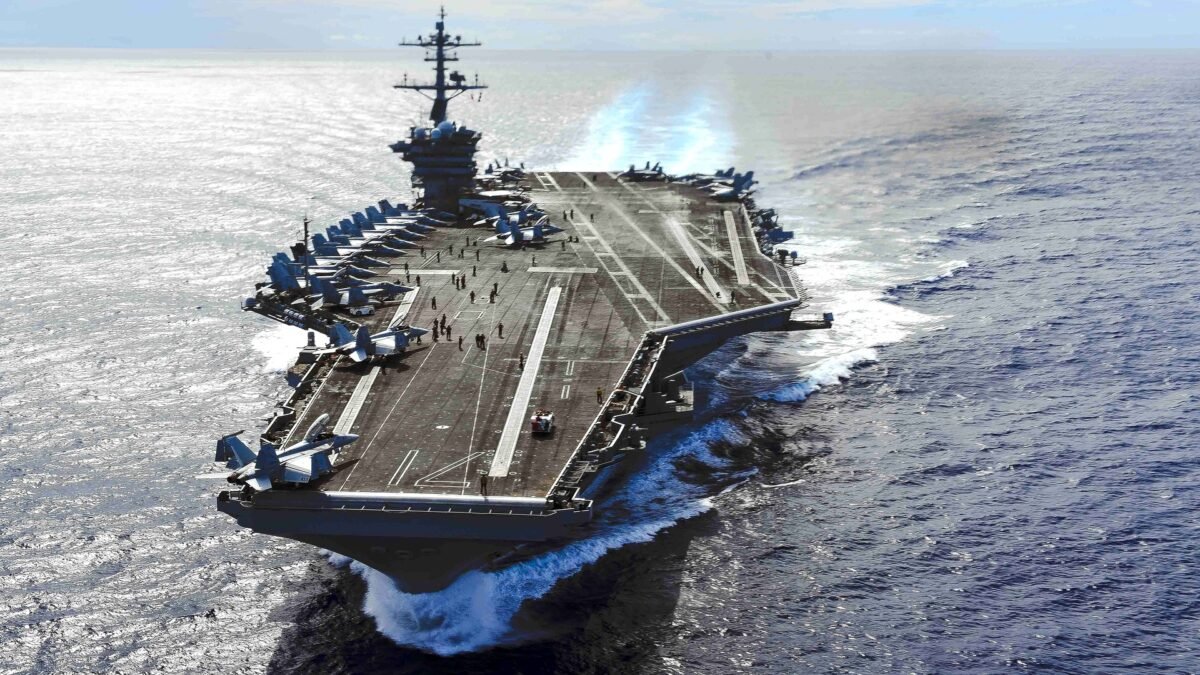
Iran fired drones at an American radar installation in Bahrain on Tuesday, the third Iranian attack in five days on United States military targets in the tiny Gulf kingdom, and the United States answered within hours by striking a missile launch site on an Iranian island in the Strait of Hormuz. Before dawn on Wednesday, Bahrain and Kuwait were sounding air-raid alerts again, as a war that had settled into a grim, low-level rhythm suddenly quickened.
According to the Associated Press, Iranian drones targeted a radar system operated by American forces at Sheikh Isa Air Base in Bahrain on Tuesday. Bahrain said its air defences had intercepted what it called the “treacherous Iranian aerial attacks”, and the United States military said the attack had caused no damage to American equipment and no injury to American personnel. Hours later, a United States fighter jet fired precision munitions at a missile launch site belonging to Iran’s paramilitary Revolutionary Guard on Qeshm Island, in the Strait of Hormuz, according to a United States military official who spoke to reporters on condition of anonymity. Iranian media, citing an Iranian official, said the American strike had not damaged infrastructure, and a local official, Ahmad Nafisi, said it had caused no damage to residential or commercial areas.
The exchange ended a roughly two-month lull in the fighting and came on the same day that Iranian and Qatari officials were meeting to discuss ending the war. It also came as the United States moved a third aircraft carrier into the region, a build-up that now leaves more American naval power in the Middle East than was deployed when the war began. The message from both sides, delivered in drones and missiles rather than in words, was that neither is prepared to accept the present stalemate for much longer.
Bahrain is home to the headquarters of the United States Navy’s Fifth Fleet, and it has been hit often by Iranian drones and missiles since the United States and Israel attacked Iran on 28 February. According to the Associated Press, the Fifth Fleet’s headquarters has already sustained damage in earlier attacks. The island kingdom, a Shi’ite-majority country ruled by a Sunni Muslim family, has become the most exposed front line of a war that began as an American and Israeli campaign against Iran and has since spread to the Gulf Arab states that host American bases.
A third attack in five days
Tuesday’s attack was the third on American military targets in Bahrain in five days, according to the Associated Press. On Friday, Iran targeted an American early-warning radar facility in the country. The Revolutionary Guard claimed it had destroyed the radar; the United States Central Command said its forces had shot down two one-way attack drones launched towards Bahrain, with no injuries or damage. On Sunday, Iran fired at a radar system at an American helicopter base at Al-Rifaa. On Tuesday, the target was the radar system at Sheikh Isa Air Base.
Iran said the attacks were retaliation. According to the Associated Press, they followed United States strikes on Iranian communications towers and continuing American drone surveillance operations. “Continued aggression against the country’s airspace, as well as the use of regional military bases and facilities for hostile acts against Iran, will not go unanswered,” the Revolutionary Guard said in a statement.
The pattern matters because it is different from the pattern of the summer. For months, according to the Associated Press, Iran largely waited for an attack and then retaliated. The attacks of the past five days suggest something else: a deliberate effort to hit the operational capability of American bases, rather than simply to answer the last blow. “Iran’s attacks could signal a shift in its strategy after months during which it waited for an attack and then retaliated to target the operational capability of bases,” Tehran-based security analyst Mostafa Najafi told the Associated Press.
The timing also matters. Tuesday’s attack followed the sentencing in Bahrain of 64 people, mostly Shi’ite clerics, to life in prison on charges of colluding with Iran to undermine the state. According to Reuters, Iran’s Foreign Ministry condemned the court’s ruling on Tuesday and said the accusations were baseless, and Tehran has long denied interfering in Bahrain’s internal affairs. A Revolutionary Guard spokesman, Hossein Mohebbi, said Bahrain had made “three key mistakes”, which he listed as “cooperating in the invasion of the Islamic Republic of Iran, remaining within the US security bubble, and encroaching on the sanctity of Shi’ite religious authority”. Those mistakes, he said, “if continued, will jeopardize its survival in the region’s new security order”. The warning was aimed at Bahrain’s government as much as at its American guests.
Egypt, Qatar, Saudi Arabia and the United Arab Emirates each condemned Iran’s attack on Bahrain, calling it a violation of Bahraini sovereignty and a threat to its security and stability, according to the Associated Press. Qatar went further. In a statement, Doha said Iran’s “continued attacks” on Bahrain “undermine diplomatic efforts”, and its Foreign Ministry spokesman, Majed Al Ansari, speaking at a news briefing in Doha, warned that any escalation in the fighting posed an “extremely grave danger” to the prospects of reaching an agreement. Qatar is one of the mediators trying to end the war; its warning was a measure of how close the fighting has come to the diplomacy.
The American answer: Qeshm Island
The United States response was swift and deliberately limited. According to the Associated Press, a United States fighter jet carried out a strike on a missile launch site in the Strait of Hormuz belonging to Iran’s Revolutionary Guard, hours after the Bahrain attack. A United States military official, speaking on condition of anonymity to detail sensitive military operations, told the Associated Press that “precision munitions” were used in the strike on Qeshm Island and that the United States was responding to “aggression” towards United States personnel. According to Reuters, the official said the strike was in response to Iranian “aggression targeting US personnel and assets”.
Qeshm Island sits at the mouth of the Strait of Hormuz, the narrow waterway through which about a fifth of the world’s oil and liquefied natural gas supplies passed before the war. The island has been struck before. According to the Associated Press, the United States military has periodically carried out what appear to be limited strikes on Qeshm Island and other Iranian targets this month. The pattern of the American response — a single precision strike on a military target, announced through an anonymous official rather than a presidential address — suggests a government that wants to answer without escalating, at least for now.
Whether that restraint holds is an open question. United States President Donald Trump has been circumspect about his next steps for the Iran war, according to the Associated Press, despite an initial promise that it would last only a matter of weeks. He has said new strikes are highly unlikely, but he has also sent a third aircraft carrier and thousands more troops to the Middle East, and he has told Vice President JD Vance that talks are not needed at this time. The contradiction is the policy: a president who says he does not want a bigger war while building the force that would fight one.
Overnight alerts in Bahrain and Kuwait
The fighting did not stop with Tuesday’s exchange. According to Reuters, Bahrain issued an all-clear early on Wednesday, nearly an hour after warning of a potential threat and urging residents to move to the nearest safe location. The Bahraini Interior Ministry did not specify the nature of the threat in its post on X. It had also issued an alert on Tuesday, two days after Bahrain said it had intercepted an Iranian aerial attack on its territory that Tehran said had targeted a United States military base. In a later update, Bahrain’s defence force said its air defences had intercepted Iranian aerial attacks on Wednesday, accusing Tehran of maintaining a “systematic hostile approach” towards the country.
Separately, according to Reuters, Kuwait’s air defences were also countering hostile drone attacks early on Wednesday, the Kuwaiti army said in a statement, without providing further details. Kuwait hosts American forces too, and the overnight alerts in two Gulf states at once were a reminder that the war’s geography is wider than any single base. Civilians in the Gulf’s richest and most crowded cities are now living with air-raid warnings as a recurring fact of life, nearly nine months after the war began.
No casualties or damage were reported in the overnight incidents, according to the reports available at the time of writing. That is worth stating plainly, because in a war fought largely through competing claims — Iran claiming destroyed radars, the United States claiming intercepted drones — the absence of verifiable damage is itself a fact. Both sides have an interest in claiming success; neither has produced evidence of it in this round.
The carrier build-up
The arrival of the USS Theodore Roosevelt carrier strike group in the region, announced by the United States military’s Central Command on Tuesday, is the most concrete sign of where American policy is heading. According to the Associated Press, the Roosevelt joins the USS George H.W. Bush and the USS George Washington aircraft carriers, as well as smaller United States Navy ships, in the region to maintain the blockade of Iranian shipping. With the Roosevelt’s arrival, the combined United States naval assets in the Persian Gulf, Arabian Sea, Red Sea and Mediterranean now exceed the force deployed when the United States and Israel launched the war, according to a new analysis by Israel’s Institute for National Security Studies cited by the Associated Press.
The build-up serves two purposes at once. The first is the blockade. The United States has enforced a naval blockade on Iranian ports for months in and around the Strait of Hormuz, curbing the flow of Iranian crude to the global market and, according to the Associated Press, damaging Iran’s economy. Oil tankers moving through the strait under United States military protection have helped return Gulf oil shipments to roughly prewar levels, but Iranian exports have been throttled. The second purpose is the threat of escalation. The presence provides greater offensive firepower and missile interception capacity, according to the Institute for National Security Studies analysis. Central Command would not comment on whether it plans to keep all three carrier strike groups in the region.
The blockade is the centre of the war’s economics, and the centre of its diplomacy. According to Reuters, Mr Trump has said he will maintain the naval blockade on Iran because Tehran has continued to disrupt shipping in the strait, and the blockade is a sticking point in negotiations. Iran has proposed ending the American blockade and lifting some sanctions in exchange for halting its disruption of shipping, but the gap between the two sides remains wide. The blockade is, in the words of one analyst, the pressure that makes Iran want to escalate — and the escalation is the risk that makes the United States want to keep the pressure on.
The dirty-bomb report and Washington’s response
The week’s fighting has unfolded against the background of a separate and alarming report. CNN reported on Monday, citing seven United States officials, that new American intelligence indicates Iran is developing plans to target senior Trump administration officials by detonating a so-called dirty bomb or a chemical weapon in Washington, DC. According to CNN, sources familiar with the latest intelligence characterised the Iranian planning as, for now, an effort to give itself options rather than an indicator of an imminent attack, but said the plotting picked up by the United States had been very specific, including locations and targets, and had sparked a flurry of American contingency planning.
It is important to be precise about what is known and what is not. The report rests on unnamed American officials speaking to a single news organisation; no other outlet has independently confirmed the underlying intelligence, and the White House said in a statement to CNN that the United States is “monitoring any and all potential threats, but at this time there are no credible threats to the homeland”. Homeland Security Secretary Markwayne Mullin called Iran’s planning “aspirational”, adding that it did not constitute a “new threat”, and said on Tuesday that “the homeland is secure”. Iran’s mission to the United Nations said Iran “considers the use of chemical weapons under any circumstances to be wholly illegitimate and categorically rejects and unequivocally refutes the false and fabricated allegations circulated in this regard”. Its Foreign Minister, Abbas Araghchi, compared the report to “Iraq War-style propaganda”, and its Foreign Ministry spokesman, Esmaeil Baghaei, said those who started the war “are attempting to manufacture a veneer of legitimacy for further aggression and atrocities”.
Mr Trump, asked about the report on Tuesday while in the Philippines, said Iran would “pay a price the likes of which no country has ever paid before” if it attacked Washington, adding that the administration was taking the matter “seriously”. Mr Mullin, speaking on CNBC, warned that “if you were to go after one of our cities or go after Washington, DC, you would cause an all-out war”. The gap between the White House’s calm — no credible threat — and the president’s warning — an unprecedented price — is itself a signal. The administration is trying to deter Iran without alarming the American public, and to take the intelligence seriously without treating an unconfirmed plan as a fact. That is a difficult balance, and the history of American intelligence claims about weapons of mass destruction, invoked openly by Mr Araghchi, is the reason it is difficult.
The tanker war in the Strait of Hormuz
While the drones flew over Bahrain, the war at sea continued. According to Reuters, attacks on tankers have increased this month in the Strait of Hormuz, and the United Kingdom Maritime Trade Operations agency said the crew of a tanker passing through the waterway was unaccounted for after being attacked north of the Omani port city of Khasab. Iran’s Revolutionary Guard and navy said on Tuesday that a ship carrying liquefied natural gas and two oil tankers had caught fire in the strait. Reuters said it could not independently verify those reports.
The tanker attacks are the other half of Iran’s strategy. If the attacks on Bahrain are aimed at American military capability, the attacks on shipping are aimed at the world’s energy supply — and at the willingness of the Gulf states and the United States to keep paying the cost of the war. The strait carried about a fifth of global oil and liquefied natural gas supplies before the war, according to Reuters, but it is now partly blocked by Iran. Benchmark Brent crude futures were up 0.4 per cent at 92.76 dollars a barrel on Tuesday, according to Reuters, much higher than before the war but well below April’s wartime peak of 126.41 dollars. The oil market, in other words, is pricing in a war that continues but does not spiral — a judgement the events of this week are testing.
The Houthis, Iran’s allies in Yemen, are part of the same pressure. According to Reuters, the Houthis said on Tuesday they had launched a total of five drones towards two pumping stations along the vital Saudi East-West pipeline in the Riyadh area, and the war continues to spill over into other parts of the Middle East as Iran puts pressure on Washington through its Houthi allies, who have carried out attacks on Saudi Arabia and seized areas along the Yemeni coast on the Bab el-Mandeb Strait. The Houthis have now solidified their control of the Bab el-Mandeb Strait, according to the Associated Press, another critical shipping route. The Saudi pipeline was attacked earlier this month as well, and the pattern — drones at energy infrastructure, far from the battlefield — is the same one Iran is using in Bahrain: hit the things the other side needs to function, and make the cost of the war felt beyond the military.
The wider region: Gaza’s winter
The war in the Gulf is not the only crisis in the region, and the two are connected by the same winter. In Gaza, the United Nations migration agency warned on Tuesday of further deaths from hypothermia and called for more funding and shelter supplies ahead of winter after a baby died from the cold, according to Reuters. Israeli gunfire and strikes killed at least four Palestinians, including a six-year-old boy, in the Gaza Strip on Tuesday, according to local health officials cited by Reuters. The ceasefire between Israel and Hamas, which came into effect a year ago, has held in name while the fighting has continued in practice, and the coming winter is now the most urgent threat to the nearly two million Palestinians who remain displaced.
On Sunday, the foreign ministers of Britain, Canada, Australia and Italy issued a joint statement urging Israel to “allow immediate, rapid and unimpeded humanitarian access throughout Gaza”, saying the humanitarian situation on the ground was “dire” and that recent floods had “brought further suffering” for Palestinians living there. According to the statement, 150,000 tents and other vital supplies were being held at the border and prevented from entering Gaza. The Israeli military authority that controls the Gaza crossings has said it is coordinating with the United States-led Board of Peace and the United Nations on a winter plan, and that 93,000 tents and 8,600 aid trucks with winter supplies had entered the territory, according to the BBC. The gap between the two figures — 150,000 tents held outside, 93,000 tents said to have entered — is the gap between a humanitarian crisis and a political argument, and it is the people in the tents who pay for it.
Mediation continues — and stalls
For all the firing, the talking has not stopped. According to Reuters, Qatari and Iranian officials met on Tuesday for talks aimed at “bridging perspectives and narrowing the gap between proposals presented on the ground”, in the words of the Qatari spokesman, Majed Al Ansari. The talks coincided with a visit to Oman by the Iranian Foreign Minister, Abbas Araghchi, who discussed safeguarding maritime corridors and ensuring the smooth flow of global shipping and trade, as well as preventing military escalation, with Oman’s foreign minister, according to Oman’s Foreign Ministry. Mr Araghchi said in a post on Telegram that he also met Oman’s Sultan Haitham bin Tariq and informed him about Iran’s diplomatic initiative to end the war.
But the mediation is running against the fighting. According to the Associated Press, negotiations to end the war have stagnated, despite intensified mediation efforts from Qatar. Mr Trump has said he might hold off from attacking Iran if the United States does not face what he described as provocations from Tehran or the Iran-backed Houthi group in Yemen, according to Reuters — a formulation that leaves the decision entirely in his hands, and that treats Iranian attacks on American bases as the trigger for American escalation. The Iranians, for their part, have said they are open to a negotiated deal but have also signalled a readiness to escalate in the face of tightening sanctions and the blockade throttling their economy, according to the Associated Press. Iranian officials have termed the current situation “no war, no peace” and vowed to end it.
According to Reuters, the war has ground to a stalemate, with Mr Trump and Tehran each acting as if they have time on their side, a calculation that has locked them in a stalemate that is almost impossible for either to break. The events of Tuesday suggest that calculation is changing. Iran is escalating because it believes the costs of restraint have grown greater than the risks of escalation. The United States is building up its forces because it believes the threat of escalation will keep Iran in check. Both cannot be right.
Analysis: Why It Matters
The lull is over, and both sides chose to end it
The most important fact about Tuesday’s exchange is not that it happened but that it ended a two-month lull. Lulls in war are rarely accidents. They are usually the product of a calculation: both sides have something to lose from fighting, and both are waiting to see whether the other will give way. The lull of September and October was the product of exhaustion and of diplomacy — the Abu Dhabi talks, the Qatari mediation, the American calculation that the blockade was working without further bombing. Its end is the product of a different calculation on both sides. Iran has concluded that waiting is costing it more than fighting. The United States has concluded that a limited answer will cost it less than no answer at all. The danger is that each side’s calculation is based on the other side behaving as it did during the lull, and the lull is precisely what has ended.
Bahrain is the new front line
The choice of Bahrain as the target is not incidental. Bahrain hosts the Fifth Fleet, which makes it the most valuable American military address in the Gulf, and it is also the most politically fragile. A Shi’ite-majority population ruled by a Sunni monarchy, a history of unrest, and now a mass sentencing of Shi’ite clerics on charges of colluding with Iran — Bahrain is a country where an external attack and an internal grievance can reinforce each other. The Revolutionary Guard’s warning that Bahrain’s “three key mistakes” would “jeopardize its survival in the region’s new security order” was not only a threat to the government in Manama. It was a message to every Gulf state that hosts American forces: your alliance with Washington is itself a target. The condemnations from Egypt, Qatar, Saudi Arabia and the United Arab Emirates show that the Gulf states understood the message — and that they are, for now, standing together against it. But solidarity is easier to declare than to sustain, and the longer the attacks on Bahrain continue, the harder the question becomes for the Gulf capitals: how much risk does hosting the Americans carry, and how much protection does it actually buy?
Three carriers is a message, not just a deployment
The arrival of the Theodore Roosevelt matters beyond the number of aircraft it carries. Three carrier strike groups in one region is a force larger than the one that opened the war, and it is a force that cannot be kept in place indefinitely. Carriers need maintenance, crews need rest, and the American navy has other obligations. The build-up is therefore a clock as well as a threat: it signals that the United States is prepared for a larger war, and it also signals that the present posture cannot last for ever. Either the build-up produces a diplomatic result, or it produces a war, or it is quietly drawn down — and a drawdown after such a public deployment would itself be read in Tehran as a retreat. Mr Trump has boxed himself in with his own deployment. That may be the point. A president who has said he does not want a bigger war may be betting that the sight of three carriers will convince Tehran that he does. The bet only works if Tehran believes him, and Tehran’s actions this week suggest it is testing whether he means it.
The dirty-bomb report matters even if the plot never happens
The CNN report about Iranian planning for a dirty-bomb attack in Washington should be read carefully, and the care is the point. The report is based on unnamed officials and has not been independently confirmed; the White House says there is no credible threat; Iran denies it entirely and compares it to the intelligence claims that preceded the Iraq War. None of that makes the report unimportant. Intelligence reports, whether accurate or not, change behaviour. They trigger contingency planning, they harden positions, and they give both sides a reason to act as if the worst is possible. Mr Trump’s warning that Iran would pay an unprecedented price, and Mr Mullin’s warning of “all-out war”, are the language of deterrence — but deterrence only works if the other side believes the threat is real, and the other side has just spent the week demonstrating that it is not deterred. The report’s real significance may be domestic: it gives the administration a public reason to keep the blockade and the build-up going, and it gives its critics a reason to ask whether the war is about to expand. The question to watch is not whether the plot is real. It is whether the report is used to justify the next escalation.
Mediation is running out of road
The most discouraging fact in this week’s news is not the fighting but the fact that the fighting and the talking are happening at the same time, in the same week, with the same people. Qatari and Iranian officials met on Tuesday to narrow the gap between proposals; on the same day, Iranian drones flew at an American base and American jets struck an Iranian island. That is not how wars end. It is how wars continue while the diplomats pretend otherwise. The stalemate described by Reuters — both sides acting as if they have time — is stable only while neither side tests it. Iran is now testing it, and the United States is answering. The test will not go on for ever. Either the mediation produces something concrete — an agreement on the blockade, a ceasefire, a channel that both sides trust — or the fighting will produce its own logic, and the logic of fighting is escalation. The trilateral meeting between Mr Trump, China’s Xi Jinping and Russia’s Vladimir Putin in Shenzhen on Thursday is the next opportunity for the war to be discussed at the highest level. Whether it is used for that purpose, or whether Iran is even on the agenda, will tell us a great deal about how much longer the “no war, no peace” can last.
What to Watch Next
- Whether the overnight alerts in Bahrain and Kuwait become a nightly pattern, and whether further Iranian attacks on Gulf bases follow Tuesday’s strike on Sheikh Isa Air Base.
- Whether the United States continues its pattern of limited, single-target strikes on Qeshm Island and other Iranian sites, or whether the next answer is larger.
- What the Theodore Roosevelt carrier strike group actually does in the region, and whether the United States keeps all three carrier strike groups deployed — a decision Central Command has so far declined to discuss.
- The fate of the tanker crew reported unaccounted for after an attack north of Khasab, and whether attacks on shipping in the Strait of Hormuz continue to rise.
- Whether the Houthis follow their claimed drone attack on the Saudi East-West pipeline with further strikes on Saudi energy infrastructure, and whether the coalition’s interceptions hold.
- The trilateral meeting between Mr Trump, Mr Xi and Mr Putin in Shenzhen on Thursday, and whether the Iran war features in the discussions.
- Whether the four-nation appeal for Gaza aid produces any change in the entry of tents and winter supplies, and whether the United Nations’ warning of further hypothermia deaths is answered before the winter deepens.
Sources
- Associated Press (via NPR), “Iran launches a third round of strikes on Bahrain, host of U.S. Navy’s 5th Fleet”, 17 November 2026
- Reuters (via Devdiscourse), “US, Iran exchange fire despite talks with mediators”, 18 November 2026
- Reuters (via WIXX), “Bahrain says air defences intercepted Iranian attacks”, 18 November 2026
- CNN, “Exclusive: US intel indicates Iran developing plans to potentially detonate a dirty bomb in Washington, sources say”, 16 November 2026
- Associated Press (via Military.com), “A 2-Month Lull Ends With Iran’s Third Strike on US Targets in Bahrain”, 17 November 2026
- Al Jazeera, “Australia, Canada, Italy and the UK urge Israel to allow aid into Gaza”, 15 November 2026

About the Author — Abdul Mannan
Related Articles
Iraq Orders Army Into Kataib Hezbollah Stronghold as Oil-Smuggling Crackdown Reaches a Showdown
Iraqi Prime Minister Ali al-Zaidi has ordered troops into Jurf al-Nasr, a Kataib Hezbollah stronghold south of Baghdad,…
Four Western Allies Tell Israel to Let 150,000 Tents Into Gaza Before Winter Closes In
The foreign ministers of Britain, Australia, Canada and Italy say 150,000 tents are being held at Gaza's border…

Saudi Arabia Intercepts Two Houthi Missiles Aimed at Riyadh and Three Drones Over Its Oil Heartland
Saudi air defences intercepted two Houthi ballistic missiles aimed at Riyadh and three drones over the Eastern Province…