
Bilawal Wants Shehbaz Sharif to Become the First Pakistani PM to Serve a Full Five-Year Term

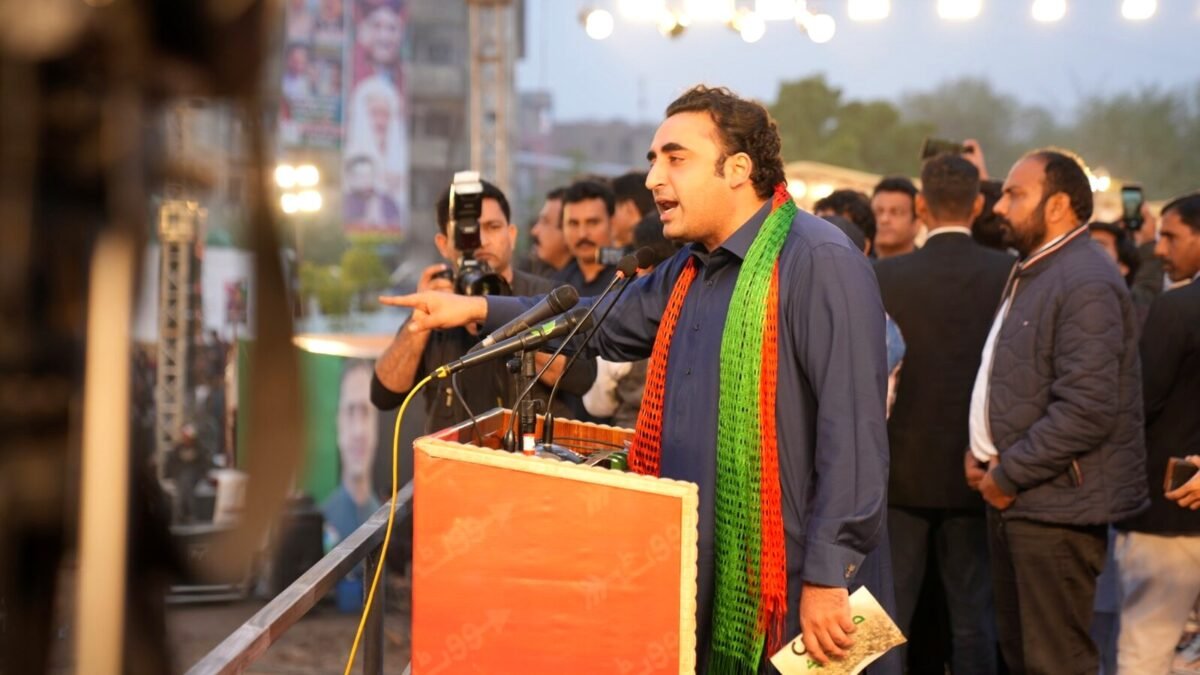
Pakistan Peoples Party (PPP) Chairman Bilawal Bhutto-Zardari said on Friday that he wanted Prime Minister Shehbaz Sharif to become the first prime minister in Pakistan’s history to complete a full five-year term in office, in a speech in Karachi that softened his tone towards the coalition government while holding firm on the one issue that has strained the alliance most: the future of Sindh.
Addressing the launch of the Sindh Wheat Growers Support Programme 2026 in Karachi, Bilawal said he wanted to “strengthen the prime minister’s hand” and reminded his audience that his party had helped make Shehbaz Sharif prime minister twice. No elected prime minister has ever completed a five-year term in Pakistan since independence in 1947, according to The News, and Bilawal said he wanted that record to change.
“I want Shehbaz Sharif to be the first prime minister of this country to complete a full five-year term,” he said, according to multiple reports of the speech.
The remarks came at the end of a week in which the PPP chairman had publicly attacked the government he helps to sustain. Three days earlier he had called for a “political reset”, saying the system had been “deliberately destroyed”. On Wednesday he warned that any forced division of Sindh would spill blood. On Thursday he called for general elections within six months, said there should be no referendum on new provinces, and hinted that the PPP could move to the opposition benches. Friday’s speech did not withdraw the PPP’s opposition to dividing Sindh, but it pulled back sharply from the threat to the coalition itself.
The shift matters because the PPP is the prop on which the Pakistan Muslim League-Nawaz (PML-N) government stands. The party backed Shehbaz Sharif into office after the February 2024 general election, just as it had after the no-confidence vote that removed Imran Khan in April 2022. Bilawal’s father, Asif Ali Zardari, is the president. When the PPP chairman talks about toppling a government or saving one, he is not commenting from the sidelines; he is describing a decision his own party would have to make.
An economy first, politics second
Bilawal framed his argument around the economy rather than the coalition’s survival. He said Pakistan was going through an economic crisis amid war-like conditions in the region, and that every citizen was bearing the burden of war on their shoulders.
“I have not seen such a difficult economic time in my life,” he said, according to The News.
He said no peace agreement between the United States and Iran was visible yet, and that it would take considerable time for Pakistan to emerge from the economic crisis. He credited the prime minister and his team with working hard to establish peace when the war began, but said Shehbaz Sharif had not been given the chance to focus on the economic crisis or to tell all political parties his plan for steering the country out of it.
His sharpest complaint was aimed inside the government itself. Whenever the prime minister makes a plan to tackle the economic crisis, Bilawal said, “a minister” stands up and announces their own agenda. He did not name the minister. The remark, reported by The News and the Islamabad Post, was the clearest sign in the speech that the PPP’s frustration is not only with policy but with the way decisions are taken and announced inside the coalition.
Bilawal said all political parties should be called for consultation on the economic crisis, and that the prime minister should tell them his plan to protect people from inflation, unemployment and poverty. “One or two political parties alone cannot solve the country’s problems,” he said, adding that joint efforts at the national level were needed and that national interest should be prioritised over personal revenge.
The economic pressure he described is visible in the prices farmers pay. Diesel and fertiliser prices are rising, Bilawal said, a point underlined by reports putting diesel at about Rs355 a litre and petrol at about Rs323 as of 19 November. The wheat programme he was launching is a Sindh government initiative worth Rs17 billion, and Bilawal said 600,000 farmers would be supported through the Hari Card scheme. He also said an emergency had been declared in Tharparkar because of drought, and that the Sindh government would provide Rs8,000 to poor families there through the Benazir Income Support Programme.
He used the occasion to list what he presented as the PPP’s record in Sindh: one million houses being built with ownership rights given to women, employment opportunities created in the province’s economy, and free treatment through CyberKnife, which he described as the most expensive treatment of its kind in the world and free in Sindh.
Engage the opposition, including PTI
The second half of Bilawal’s message was aimed at the opposition. He said the Pakistan Tehreek-e-Insaf (PTI), founded by the jailed former prime minister Imran Khan, would have to be engaged if the country’s problems were to be faced together, because the party held the most opposition seats in parliament.
“If we want to face the problems together, PTI will have to be engaged,” he said, according to The News. “We invite the opposition to return to parliament and play its role.”
He said the incarcerated PTI founder should play his role in parliament despite the differences between the parties, and that the issues of Imran Khan were separate from the fact that his party was in parliament. He named Jamiat Ulema-e-Islam-Fazl (JUI-F) chief Maulana Fazlur Rehman alongside Khan as opposition leaders who should be engaged, saying that whether or not people liked Fazlur Rehman, he was on the opposition benches.
The call for engagement follows Bilawal’s own statement earlier this week, at a “Meet the Press” programme at the Karachi Press Club, where he answered affirmatively when asked whether he considered Imran Khan a political prisoner. That acknowledgement, reported by Dawn, attracted considerable attention because it came from the chairman of a party that is a key parliamentary ally of the PML-N government. Friday’s speech did not repeat the phrase, but its logic pointed in the same direction: the government, in Bilawal’s telling, cannot stabilise the country while its largest opposition party is shut out of the process.
The timing is pointed. The government’s confrontation with the opposition has sharpened in recent days. On Thursday, an Islamabad anti-terrorism court issued non-bailable arrest warrants for Mufti Abrar, an aide to Fazlur Rehman, in a case over a gathering and road blockade. The JUI-F chief’s security has been withdrawn, and opposition leaders have condemned the move. Bilawal’s answer to that spiral is dialogue rather than escalation, and he said it was up to Prime Minister Shehbaz Sharif whether or not to heed the PPP’s suggestions.
The Sindh red line has not moved
What Friday’s speech did not do was soften the PPP’s position on new provinces. Bilawal has repeatedly opposed dividing Sindh, and reporting of the speech stressed that he had softened his tone towards the prime minister but not on Sindh. The PPP’s position rests on the provincial assembly’s stance against splitting the province, and Bilawal has warned that a forced division could trigger unrest.
The new-provinces debate is the sharpest fault line inside the coalition. The Muttahida Qaumi Movement-Pakistan (MQM-P) has called for a referendum on new provinces, possibly in December, and the PML-N has been pressed on whether it supports public consultation on the question. The PPP says the matter should not be decided by referendum and has proposed instead that reserved seats be returned to opposition parties. Bilawal dared the government earlier this week to debate the new-provinces question openly in parliament.
That dispute was the backdrop to Thursday’s meeting between President Zardari and Prime Minister Shehbaz Sharif at Aiwan-e-Sadr in Islamabad, where the two leaders agreed to resolve outstanding matters through dialogue and mutual consultation. Interior Minister Mohsin Naqvi also attended the meeting, according to The News. The presidency said the two leaders reviewed the prevailing political situation, but the meeting produced no public timetable, negotiating committee or list of concessions, and the underlying disputes remain unresolved.
Bilawal’s speech on Friday can be read as the PPP’s terms for that dialogue: the government stays, the prime minister is given room to govern, and in return the coalition consults the opposition, drops the politics of revenge, and leaves Sindh intact. It is a stabilising gesture, but it is conditional, and the condition that matters most to the PPP has not changed.
A record no prime minister has broken
The five-year term Bilawal invoked is one of the most durable facts of Pakistani politics. Since independence in 1947, no elected prime minister has completed a full five-year term in office. Prime ministers have been removed by military coups, dismissed by presidents, disqualified by courts, and voted out by parliament. Shehbaz Sharif himself first became prime minister in April 2022 after a no-confidence vote removed Imran Khan, and returned to the office after the February 2024 election produced a hung parliament in which the PPP’s support was decisive.
Bilawal’s wish that Shehbaz become the first to break that record is therefore not a small compliment. It is a promise of sorts: that the PPP will not be the party that cuts this government’s term short. It also carries a warning inside it. A prime minister who completes five years needs a coalition that holds for five years, and this week has shown how quickly that coalition can fray when one partner feels ignored on a question as sensitive as the map of the country.
The PPP’s own history sharpens the point. The party has governed Sindh continuously for years and presents itself as the defender of the province’s boundaries and of small farmers. Bilawal recalled the party’s traditional slogan of roti, kapra, makan — food, clothing and shelter — and said that whether one province was created or a thousand, the public’s only worry was having access to meals twice a day. The line was aimed at the new-provinces campaign, and it reframed the debate as a distraction from the economic hardship he said should come first.
Analysis: Why It Matters
Friday’s speech is best understood as a course correction, not a surrender. Bilawal spent the week escalating: a call for a political reset, a warning about bloodshed over Sindh, a demand for elections within six months, and a hint that the PPP could sit on the opposition benches. Each step raised the price of ignoring the PPP. Friday’s speech cashed in that leverage for a different prize: a public commitment to the government’s survival, offered on the PPP’s terms.
That is a familiar pattern in coalition politics, and it is also a risky one. A party that threatens to walk out and then publicly promises to stay can look indecisive, and Bilawal’s critics inside the PML-N have already suggested that he should resign his own seats if he believes the reserved seats belong to the PTI. But the logic of the move is clear. The PPP does not want an election now. An election within six months, which Bilawal himself demanded on Thursday, would be fought in the middle of an economic crisis the PPP would be blamed for sharing, and on a map of Sindh the PPP would have to defend. A government that survives to a full term, with the PPP able to claim it protected both the federation and the province, is a better story for the party to tell.
The speech also reveals where the real argument inside the coalition lies. Bilawal’s complaint about an unnamed minister announcing a separate agenda whenever the prime minister presents an economic plan is not a complaint about the opposition at all. It is a complaint about decision-making inside the government, and it echoes the PPP’s broader charge that it is treated as a junior partner to be informed rather than a coalition ally to be consulted. The Zardari-Shehbaz meeting on Thursday was meant to answer that charge with a process — dialogue and mutual consultation — but a process is only as good as the decisions it produces, and Friday’s speech keeps the pressure on by making the PPP’s expectations public.
The call to engage the PTI is the most consequential part of the speech, and the hardest to deliver. The government’s instinct in recent days has been the opposite: warrants, arrests and withdrawn security for opposition figures. Bilawal is asking the prime minister to reverse that instinct and bring the largest opposition bloc into parliamentary committees and national consultations. His argument is practical rather than sentimental. A country facing an economic crisis, a war on its western border region, and a region in turmoil cannot be governed by one or two parties alone, he said. The counter-argument, which the government has not had to state out loud, is that engaging the PTI while its founder remains in jail and its leaders face cases is politically costly for the PML-N, and that the party’s own base would read it as weakness.
That tension is why the speech’s treatment of Imran Khan matters. Bilawal did not demand Khan’s release, and he did not repeat his “political prisoner” description on Friday. He asked instead that Khan be allowed to play a role in parliament, a formulation that keeps the door open without making a demand the government cannot meet. It is a careful distinction, and it tells us something about where the PPP thinks the possible space for compromise lies: not in the courts or the jail, but in parliament, where the PTI already sits and where its participation could be restored without any single dramatic concession.
What should be watched next is whether the prime minister acts on any of this. Three tests will tell. The first is the expected meeting between Shehbaz Sharif and Bilawal in Karachi, which was reported to be on the cards for Friday: if it happens, and if it produces a joint statement or a concrete consultation mechanism, the speech will look like the opening of a negotiation rather than a monologue. The second is the new-provinces question. If the government presses ahead with a referendum or a parliamentary move on new administrative units, the PPP’s red line will be tested in the open, and Friday’s softening will count for little. The third is the PTI. If the government invites the opposition into parliamentary committees and the economic consultation Bilawal proposed, the speech will have changed something real. If instead the warrants and security withdrawals continue, the speech will be remembered as a moment when the PPP asked for dialogue and the government chose confrontation.
There is also a longer question hanging over the speech, and it is the one Bilawal himself raised: whether Pakistan can finally have a prime minister who serves a full term. The country has had the constitutional machinery for a five-year government since 1973, and it has never once produced one. The reasons have always been a mixture of courts, coups, coalitions and crises, and the present moment contains all four in some form. A speech does not change that record. But a coalition partner publicly committing to a full term, while naming the price of that commitment in public, is the closest thing to a plan for breaking the record that Pakistani politics has produced in some time. Whether the plan survives contact with the new-provinces debate, the PTI question and the economy will decide whether Friday’s speech is remembered as a turning point or as another week in which a coalition nearly broke and then, for now, did not.
Sources
- The News — “Bilawal wishes Shehbaz to become first PM to serve full term”
- Islamabad Post (DNA) — “Bilawal says minister pushes own agenda when PM seeks to present economic plan”
- The AZB — “Bilawal Bhutto Calls for National Unity to Tackle Pakistan’s Economic Crisis”
- Khabr — “Bilawal wants PM Shehbaz to complete full five-year term”

About the Author — Abdul Mannan
Related Articles
Pakistan’s Cybercrime Agency Busts Rs240 Billion Online Gambling Ring in Karachi, Saying the Network Could Reach Rs1 Trillion
Five people have been arrested and 40 named in an FIR after the NCCIA traced about Rs240 billion…
Government Withdraws Fazlur Rehman’s Security as Police Serve Arrest Warrants on His Secretary in Escalating JUI-F Crackdown
The government has withdrawn the state security of JUI-F chief Maulana Fazlur Rehman and his son Asad Mehmood,…
Bilawal Hints PPP Could Move to Opposition Benches as Coalition Row Over New Provinces Deepens
Bilawal Bhutto-Zardari has hinted the PPP could leave the treasury benches and sit on the opposition benches if…