
Puka Nacua Likely Out for the Season After Knee Surgery, a Day After Three-Game NFL Suspension

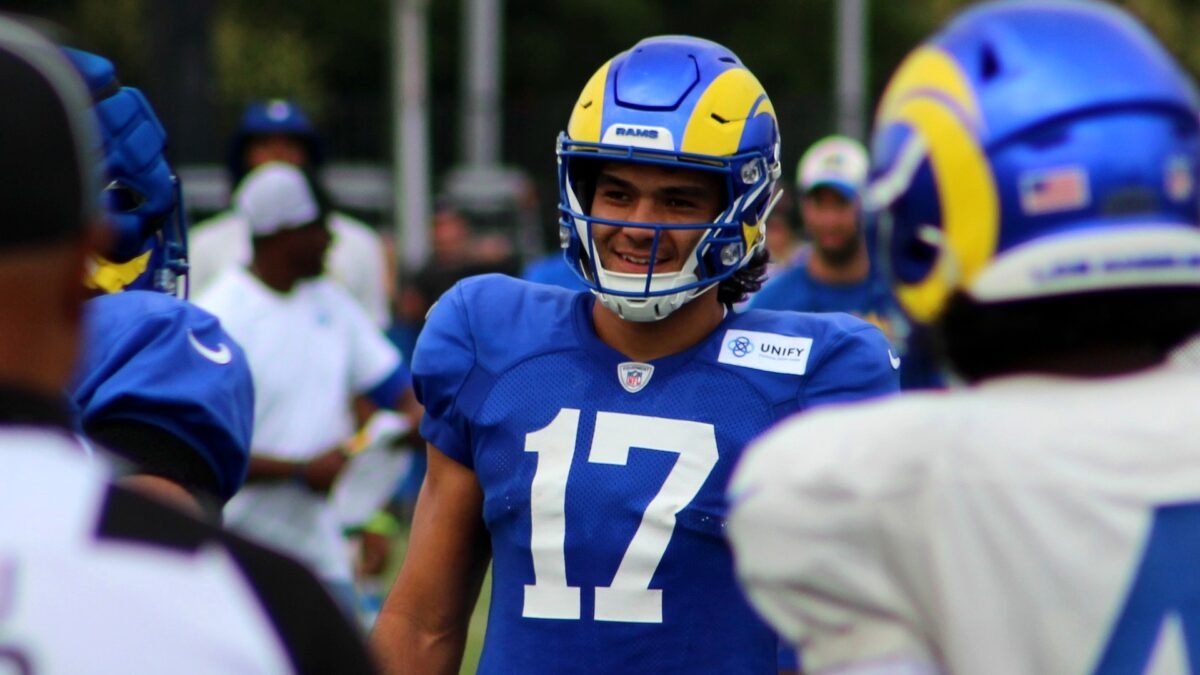
Los Angeles Rams wide receiver Puka Nacua is likely to miss the rest of the NFL season after undergoing surgery to repair a knee ligament, head coach Sean McVay said on Friday, according to Reuters. The operation came just one day after the league suspended the All-Pro receiver for three games for violating its personal conduct policy, a punishment that will cost him close to one million dollars in lost pay but, because he is already on injured reserve, will not cost him a single additional game.
McVay told reporters that Nacua could be sidelined for “a couple of months” after the surgery, a timeline that runs into January and, according to the Associated Press, is likely to keep him out for the remainder of the season. The Rams are 6-4 and sit two and a half games behind the San Francisco 49ers, who lead the NFC West at 8-1, according to Reuters, so the loss of their most productive receiver lands at the worst possible moment of a playoff race.
Nacua suffered the injury on the final offensive snap of the Rams’ 20-13 victory over the Washington Commanders on 8 November, according to Reuters. He sustained sprains to both the medial collateral ligament and the posterior cruciate ligament in his knee, as well as a turf toe injury. The Rams placed him on injured reserve on 12 November, and he missed the team’s Week 10 game against the Arizona Cardinals.
The surgery was performed on Tuesday, according to theScore, and McVay confirmed the outcome on Friday. ESPN reported, according to Reuters, that the NFL did not know Nacua had already undergone the operation when it imposed the suspension the day before.
The surgery and the timeline
Before Friday’s announcement, the expectation had been that Nacua might return in mid-December. Ian Rapoport of NFL Network said on “The Pat McAfee Show” that the hope for Nacua was mid-December, with the medial collateral ligament the greater concern of his three injuries, according to Athlon Sports. That hope is now gone. A recovery measured in a couple of months leaves almost no room for a return before the regular season ends, and the Rams will have to plan as though their star receiver is finished for the year.
The earliest Nacua could have returned under the injured reserve rules was 20 December, when the Rams host the Dallas Cowboys in Week 15, according to Rams Wire. He is also eligible for reinstatement from his suspension on Monday 14 December, the day after the Rams face the 49ers in Week 14, according to USA Today. But the surgery has made those dates largely academic. As McVay acknowledged on Friday, the knee will need far longer than the minimum stay on injured reserve.
The numbers explain why the blow is so heavy. Nacua, 25, has 70 receptions for 715 yards and four touchdowns in seven games this season, according to Reuters. Across 51 career games he has 383 catches for 4,906 yards and 23 touchdowns. He was selected to the Pro Bowl in 2023 and 2025 and was named first-team All-Pro last season, according to Reuters. He was a fifth-round pick in the 2023 NFL Draft, and he has become the focal point of the Rams’ offence in four seasons, according to the Associated Press.
He is also in the final season of his four-year rookie contract. According to Reuters, the deal had an original value of 4.08 million dollars, and a performance escalator raised his base salary to 5.76 million dollars for the 2026 season, according to Spotrac. He is set to become an unrestricted free agent in 2027, according to Reuters, which means the final months of this season were supposed to be the stage on which he made his case for a second contract worth many times more.
A suspension that costs money, not games
The suspension, announced by the NFL on Thursday, covers three games for a violation of the league’s personal conduct policy, according to USA Today. Because players are permitted to serve a suspension while on injured reserve, Nacua will miss no more time than his injury already required. He had already missed one game, in Week 10, and must miss at least three more while on injured reserve, according to USA Today, so the ban runs concurrently with his enforced absence.
What the suspension does take is money. Nacua will forfeit three game cheques, worth about 961,167 dollars, according to Tom Pelissero of NFL Network, as reported by USA Today and Front Office Sports. ESPN’s Field Yates put the figure at roughly 950,000 dollars. Either way, it is close to one-sixth of his 5.767 million dollar base salary for the season, according to Front Office Sports, a steep price for a player in the final year of a rookie deal.
The suspension also carries a formal warning. According to ESPN’s Adam Schefter, the league told Nacua that “any further violation of the Personal Conduct Policy, including failing to satisfy the conditions of his diversion program, will subject him to additional and more substantial discipline, including banishment from the League.” That is the strongest language the NFL can use short of expulsion, and it puts Nacua on notice that his margin for error is now zero.
The ban covers the Rams’ games against the Green Bay Packers, the Kansas City Chiefs on 3 December and the San Francisco 49ers on 13 December, according to Flashscore. The Rams are idle this week, on their Week 11 bye, before the run of fixtures the suspension covers.
There are practical restrictions too. According to Adam Grosbard of the LA Daily News, as reported by Rams Wire, Nacua will not be allowed to rehabilitate his injuries at the team’s facility during the first week of his suspension, although he will be permitted to return to the facility for the final two weeks. For a player recovering from knee surgery, even a week’s separation from the team’s medical staff is a real inconvenience, and it underlines that the league intends the punishment to be felt even if it does not show up on the injury report.
What led to the suspension
The NFL’s announcement did not name a specific incident. But the suspension follows a league investigation into an incident on New Year’s Eve 2025, according to USA Today. Earlier this year, a woman accused Nacua of biting her on the shoulder on 31 December 2025 and of making an antisemitic remark, according to a lawsuit she filed in March, as reported by USA Today.
The civil lawsuit, filed by Madison Atiabi, accused Nacua of assault and battery, gender violence and negligence, according to Front Office Sports. It alleged that he made an antisemitic remark that made the woman uncomfortable because of her Jewish faith, and that he forcibly bit her on the shoulder, leaving a circular imprint, while the two were in a vehicle on New Year’s Eve, according to Front Office Sports. The alleged incident took place after a group dinner in the Century City area of Los Angeles, according to USA Today.
Nacua has denied the allegations. His attorney denied the antisemitic allegation and characterised the biting as “horseplay”, according to Pro Football Network. Nacua entered a rehabilitation programme in April, according to USA Today, and Rams Wire reported that he checked into a rehabilitation facility citing problems with alcohol and worked to improve himself off the field. A Los Angeles judge has scheduled a trial date in the civil case for 27 March 2028, according to the New York Post.
The suspension was not imposed after a disciplinary hearing. According to Tom Pelissero, the NFL and the NFL Players Association reached a negotiated settlement in Nacua’s personal conduct case, as reported by Rams Wire and NBC Sports. The alternative was a full hearing before Judge Sue L. Robinson, the former federal judge jointly appointed by the NFL and the players’ union to decide disciplinary cases, according to NBC Sports and Front Office Sports. A source told Front Office Sports that the settlement was reached in discussions between the NFL, the players’ association and Nacua’s representatives before the case would have gone before Robinson.
The negotiation explains the shape of the punishment. The league, according to NBC Sports, may have been concerned that Nacua would not be suspended at all if the case went to a hearing, since Robinson’s findings of fact cannot be appealed by the NFL to the commissioner. A three-game ban, served while the player is already injured, was the compromise: the league secured a suspension and a public warning, while Nacua avoided a hearing that could have produced a longer ban or, from the league’s perspective, no ban at all.
It also explains why the suspension landed when it did. The case had hung over the start of the 2026 season, according to Rams Wire, and the settlement arrived only after Nacua was already on injured reserve. The timing meant the punishment would cost him pay but not playing time, a result that drew immediate criticism from fans and commentators who saw a suspension served on the treatment table as no suspension at all. The NFL, for its part, has said that a player’s injury designation does not delay discipline or prevent a suspension from being served, according to NBC Sports, and that the ban begins when it is imposed, consistent with prior cases.
The Rams without their stars
For the Rams, the problem is not the suspension. It is the depth chart. Nacua is the second of the team’s two elite receivers to be lost to a serious injury. Davante Adams went on injured reserve after Week 6 with a ruptured hamstring tendon, suffered in a non-contact play in the final minutes of an 18-16 loss to the Arizona Cardinals on 18 October, according to Pro Football Network. He underwent surgery to repair the tendon and was placed on injured reserve on 20 October, with a six-to-ten-week recovery window, according to the same report.
McVay has said the Rams believe Adams will return “sooner than later”, according to Athlon Sports, and Rapoport reported that Week 12 is the target for Adams. The Rams’ Week 12 game is a prime-time Thanksgiving Eve meeting with the Green Bay Packers on 25 November, the first day Adams can come off injured reserve, according to Athlon Sports. But even if Adams returns on schedule, the Rams will have played a month of football without either of their two best receivers.
The Rams knew the state of both injuries before the trade deadline on Tuesday 10 November, according to Rapoport, as reported by Athlon Sports, and they chose not to trade for a replacement receiver. Instead, they brought back Xavier Smith from the San Francisco 49ers’ practice squad, according to Athlon Sports. Rapoport said the team never really looked hard at outside receivers, reasoning that its offensive system is so specific that a newcomer would struggle to contribute immediately, and that going with the players already in the building was the better option.
That decision now looks like a gamble. In the two games since Adams was injured, Nacua had become even more central to the offence, according to the Associated Press, taking 43.2 per cent of the team’s targets in the last three games Adams missed, including 19 targets in one week, according to Athlon Sports. With both men out, the leading options on the depth chart are Tutu Atwell, Konata Mumpfield and rookie CJ Daniels, according to Rams Wire, and Jordan Whittington is also injured, according to Packers Wire. Atwell has two catches and Mumpfield one since Adams went down, according to the Associated Press, and Whittington has none.
The strain falls most heavily on quarterback Matthew Stafford and on McVay’s play-calling. The Rams entered the season expected to contend for the Super Bowl, according to Athlon Sports, and Rapoport said the team’s hope is to “be regular” until its injured players return and then hit their stride in the play-offs. That plan depends on Adams returning on schedule and on the rest of the roster holding the line through a difficult stretch of the schedule. The Packers, the Chiefs and the 49ers are all formidable opponents, and the Rams face them without their two most dangerous weapons.
There is also the question of what the offence becomes without Nacua’s particular gifts. He is not only a receiver. He is a physical, yards-after-the-catch player who blocks, runs the ball on jet sweeps and end-arounds, and does the unglamorous work that makes McVay’s scheme function. He was injured, tellingly, while carrying the ball on the final offensive snap against Washington, according to Reuters. Replacing his production is one problem. Replacing his versatility is another.
Analysis: Why It Matters
The Nacua case is, on its surface, a story about a knee and a suspension. Looked at more closely, it is a story about how the NFL disciplines its players, how a franchise manages risk in a championship window, and how quickly a career-defining season can unravel.
A disciplinary system built for negotiation
The most revealing detail of the suspension is not its length but the way it was reached. The NFL and the players’ union negotiated it, according to multiple reports, rather than letting a jointly appointed judge decide it. That is not an accident. It is the system working as designed.
Under the current personal conduct policy, a hearing before Judge Robinson carries real risk for both sides. For the league, her findings of fact cannot be appealed to the commissioner, which means a hearing could end with no violation found and no punishment at all. For the player, a hearing could produce a longer suspension than a negotiated deal. Both sides therefore have a strong incentive to settle, and the three-game ban is the price of that mutual caution.
The result is a punishment that satisfies neither side’s critics. Those who wanted a severe sanction see a ban served while the player is already injured, at no cost in games missed. Those who defend the player see a fine of nearly a million dollars and a public warning of banishment, imposed without a hearing, for allegations that are still the subject of an unresolved civil lawsuit. Both readings are defensible, and both miss the point: the settlement was never really about Nacua’s conduct alone. It was about both institutions avoiding a precedent they did not want.
That is the deeper problem with the policy. When discipline is negotiated rather than adjudicated, the outcome reflects bargaining power as much as behaviour. A star player in a contract year, represented by the union, facing a league that feared losing a hearing, produced a suspension that looks severe on paper and costs nothing on the field. The next player in the same position may get a different deal for the same conduct, and nobody outside the room will know why. Transparency, not severity, is the missing ingredient.
A contract year turned upside down
For Nacua personally, the timing could hardly be worse. He is 25, a two-time Pro Bowler and a first-team All-Pro, and he is playing the final year of a rookie contract that pays him a fraction of what the market’s best receivers earn. This season was meant to be his argument for a contract worth tens of millions of dollars. Instead, he has played seven games, will lose close to a million dollars to suspension, and will spend the rest of the season recovering from surgery.
The suspension warning makes the stakes even higher. The league has told him, in the plainest terms, that any further violation could bring “more substantial discipline, including banishment”. Banishment from the league is not a figure of speech. It is the ultimate sanction, and it now hangs over a player who has not yet signed his second contract. Any team weighing a long-term investment in Nacua will have to weigh that warning too, along with the unresolved civil lawsuit and the trial date set for March 2028.
None of that means his career is in danger. He is one of the best receivers in football, and talent of that order is almost always given another chance. But the leverage has shifted. A player who might have entered free agency as the most coveted receiver on the market will instead enter it with questions attached, and questions cost money in contract negotiations even when they never become answers.
There is also the human side, which the coverage of fines and fixtures tends to obscure. Nacua sought help in April, entering a rehabilitation programme, and former receiver T.J. Houshmandzadeh said this week that Nacua has “done a whole 360” in how he carries himself, according to Pro Football Network. The suspension and the surgery arrive together, in the same week, at the moment his season was supposed to peak. Whatever view one takes of the allegations against him, the coming months will be a test of whether the changes he has made off the field hold up under the worst professional circumstances of his career.
The Rams’ gamble
For the Rams, the story is about a decision made at the trade deadline and now being tested. They knew both receivers were injured. They chose not to trade for a replacement, trusting their system, their depth and their timetable for Adams’ return. That is a defensible philosophy. McVay’s offence has always been built on scheme as much as personnel, and the Rams have a history of finding production from unheralded players.
But the margin for error has now disappeared. The Rams are 6-4, chasing a 49ers team that has lost only once, and they face Green Bay, Kansas City and San Francisco in the three games Nacua’s suspension covers. Those are the games that decide whether a season is a play-off run or a disappointment. Playing them with Tutu Atwell, Konata Mumpfield and a rookie as the leading receivers is a very different proposition from playing them with Nacua and Adams.
The front office’s calculation was that the system would carry the team until the stars returned. The surgery has broken that calculation in one place. If Adams returns in Week 12 as hoped, the Rams will have one elite receiver for the run-in. If his recovery slips, they will have none, and the decision not to add a receiver at the deadline will be revisited with the benefit of hindsight, which is always unkind.
There is a broader lesson here about roster construction in the modern NFL. Teams build around a small number of irreplaceable players and fill the rest of the roster with cheaper, interchangeable parts. That model works until two irreplaceable players are injured at the same time. The Rams’ season now depends on whether their depth, which the front office trusted at the deadline, is as good as they believed.
What the league is really saying
Finally, the warning of banishment deserves attention on its own terms. The NFL does not use that word lightly. It is the league telling a 25-year-old star, in writing, that his career is conditional on his behaviour. It is also the league telling every other player that the personal conduct policy has teeth, even when the immediate punishment looks soft.
Whether that message lands depends on what happens next. If Nacua returns, plays well, stays out of trouble and signs a big contract, the suspension will be remembered as a footnote. If there is another incident, the warning will be the first thing anyone quotes. The league has, in effect, outsourced the enforcement of its own warning to the future. That is a gamble too, and it is one the NFL has made many times before, with mixed results.
What to Watch Next
Several things will decide how this story ends. The first is Adams’ recovery. If he returns against Green Bay on 25 November, as the Rams hope, the offence regains its most experienced receiver for the hardest stretch of the schedule. If he does not, the Rams will be dangerously thin at the position that defines McVay’s offence.
The second is the Rams’ record over the next three games. Green Bay, Kansas City and San Francisco are all play-off calibre opponents, and the Rams face them without Nacua and, for at least the first of them, without Adams. Dropping two of the three would leave the Rams fighting for a wild-card place rather than the division title. Winning two would keep the season on track and validate the front office’s faith in its depth.
The third is Nacua’s rehabilitation. A recovery of “a couple of months” puts a return before the end of the regular season out of reach, but the play-offs, should the Rams reach them, are a different question. The team will not rush a player it hopes to keep for years, but a deep play-off run changes every calculation. Watch for updates on his progress in December, and for whether the team leaves the door open to a January return.
The fourth is the civil lawsuit. A trial date has been set for 27 March 2028, according to the New York Post, which means the legal process will run alongside Nacua’s free agency and, very likely, his next contract negotiations. Any settlement, or any new development in the case, will be news in its own right, and it will shape how teams value him.
The fifth is the diversion programme. The league’s warning was explicit: failing to satisfy the conditions of his diversion programme could bring further discipline, including banishment. Nacua’s compliance, or lack of it, will be watched closely by the league, and any misstep would put his career at risk in a way that no knee injury ever could.
For now, the Rams must do without the player who has carried their offence, and Nacua must watch from the treatment room as his team plays the most important games of its season. A week ago, he was the focal point of a Super Bowl contender. Today he is a suspended, injured free agent-in-waiting, nearly a million dollars poorer, with a warning of banishment on his record and a knee that needs months to heal. It is a remarkable fall, and it happened in the space of two days.
Sources
- Reuters — Rams WR Puka Nacua has MCL surgery, likely out for season
- Associated Press (via NBC Sports Philadelphia) — Rams WR Puka Nacua gets knee surgery, likely out for season
- USA Today — NFL suspends Puka Nacua for three games. Why it won’t change Rams’ plans
- Front Office Sports — Rams’ Nacua Suspended Three Games Under NFL Conduct Policy

About the Author — Abdul Mannan
Related Articles
Nicholls’ Unbeaten 175 and Jaiswal’s 85 Leave Wellington Test Finely Balanced After Day Two
Henry Nicholls batted almost ten hours for an unbeaten 175 as New Zealand made 368 in Wellington, before…
Ben Shelton Books First ATP Finals Semi-Final as Alcaraz Rematch Awaits and Zverev Stays Perfect in Turin
Ben Shelton reached his first ATP Finals semi-final after beating Rafael Jodar in Turin, setting up a Saturday…
Ash Barty Elected to International Tennis Hall of Fame as Class of 2027 Honours Her Short, Brilliant Career
Ashleigh Barty has been elected to the International Tennis Hall of Fame in her first year on the…