
Nicholls’ Unbeaten 175 and Jaiswal’s 85 Leave Wellington Test Finely Balanced After Day Two

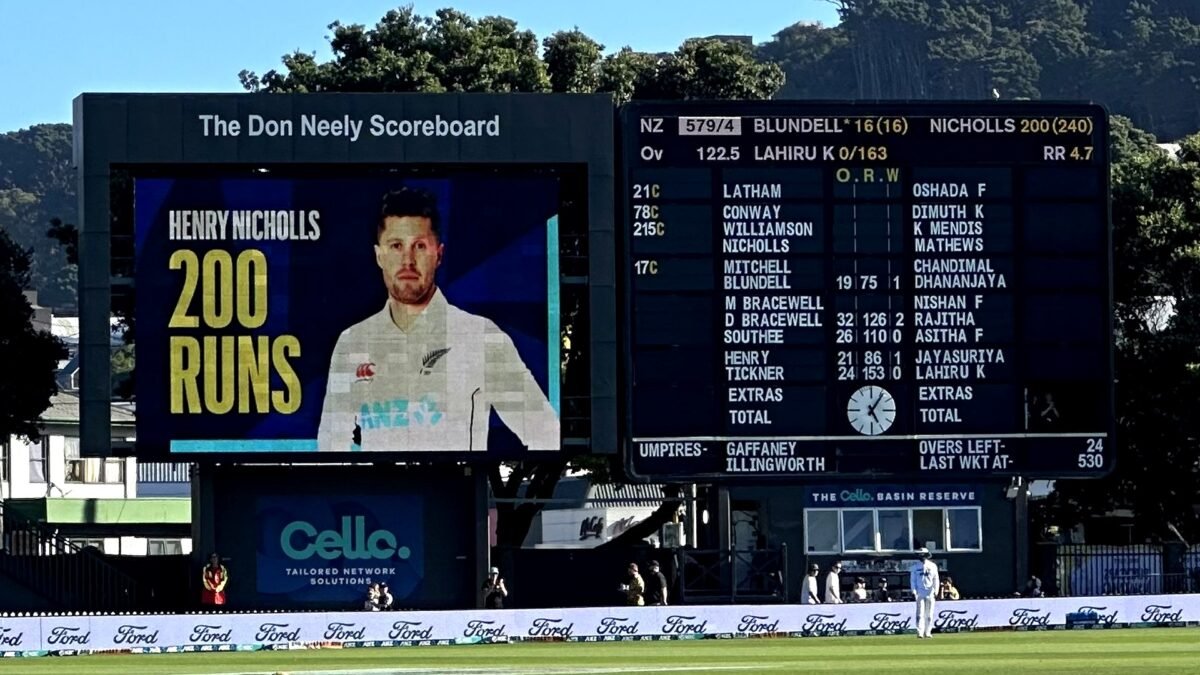
Henry Nicholls batted for almost ten hours and finished unbeaten on 175 as New Zealand posted 368 on the second day of the first Test against India at the Basin Reserve in Wellington on Friday, before Yashasvi Jaiswal and KL Rahul led a strong Indian reply that left the match finely balanced at stumps.
India closed on 159 for 1, still 209 runs behind, after Jaiswal made 85 and Rahul remained unbeaten on 52, according to ESPNcricinfo’s live scorecard. The pair put on 130 for the first wicket — India’s first century opening stand in 17 Tests — and by the close the visitors had turned a day that began with New Zealand firmly in control into one that neither side could claim.
It was a day of two halves, and of two very different kinds of batting. In the morning and afternoon, Nicholls and Glenn Phillips completed a rescue that had begun on the first day, when New Zealand had been 70 for 5. In the evening, India’s openers played with a freedom that suggested the Basin Reserve pitch, so lively on the first morning, had already begun to change its character.
New Zealand had resumed on 243 for 5, with Nicholls on 102 and Phillips on 94, according to Cricbuzz. The pair extended their sixth-wicket partnership to 216 before Phillips fell for 118, and although India took the remaining wickets for 125 runs, Nicholls was still there at the end, stranded on 175 when the last wicket fell. New Zealand’s innings lasted 121 overs.
For India, the reply could hardly have started better. Jaiswal, who had been dismissed cheaply in the first innings of so many recent matches, struck 16 boundaries in an 85 from 89 balls, while Rahul played the anchor’s role with an unbeaten 52 from 99 balls — his 22nd Test half-century, according to the Associated Press. Devdutt Padikkal, who joined Rahul after Jaiswal’s dismissal, was unbeaten on 16 at stumps.
The first Test of the two-match series, played from 19 to 23 November, is now set up for a decisive third day. India have nine wickets in hand and a deficit of 209; New Zealand have a lead, but one that already looks smaller than it did at lunch. The next session, both captains know, will shape the match.
How the second day unfolded
The day began with New Zealand in a position of strength that would have seemed impossible 24 hours earlier. When India captain Shubman Gill won the toss on Thursday and sent the home side in on a green-top at the Basin Reserve, Jasprit Bumrah had been at his most threatening, according to the Associated Press. He bowled New Zealand captain Tom Latham with the third ball of the match, and Nicholls walked to the crease to face the fourth ball of the innings.
Bumrah also dismissed Daryl Mitchell and Tom Blundell, and New Zealand were 70 for 5 in the 29th over when Phillips joined Nicholls. What followed was one of the great recoveries in recent New Zealand Test history. The pair batted through the rest of the first day to reach 243 for 5 at stumps, with Nicholls on 102 and Phillips on 94, and they resumed on Friday with the partnership already worth 173.
The second morning was, by the reports of those watching, a largely subdued one for India. Their bowlers struggled to find intensity and penetration, according to Cricbuzz, and the surface offered little help, making batting look comfortable. Bumrah did not seem at his best, and India were also poor with their reviews — a detail that would matter again later in the day.
Phillips brought up his hundred early on Friday, his second in Tests, and the partnership reached 216 before Akash Deep provided the breakthrough. The ball, released wider on the crease, moved away to hit the top of off stump, according to Cricbuzz, and Phillips departed for 118. It was a wicket India had earned, but it came after the damage had been done.
Nicholls, meanwhile, remained unflustered at the other end, making steady progress and frustrating India’s bid to break the partnership, as Cricbuzz put it. He crossed 150 with a cover-driven boundary off Prasidh Krishna, and he kept finding support from the tail even as wickets fell around him.
Nathan Smith assisted Nicholls in a stubborn stand worth 32 runs in 15 overs before Prasidh Krishna struck in the second over after lunch, nipping one back into Smith and trapping him leg before wicket. A well-directed short ball from Akash Deep then forced Kyle Jamieson to glove the ball to slip, and Bumrah got his fourth wicket by trapping Matt Henry plumb in front.
Jacob Duffy helped add 20 runs for the final wicket, but Nicholls was left stranded on 175 when the number 11 fell to a short ball from Anshul Kamboj. New Zealand were all out for 368, and the innings had occupied 121 overs — the great bulk of them with Nicholls at the crease.
The bowling figures told the story of India’s day. Bumrah finished with 4 for 92, Akash Deep with 3 for 53, Kamboj with 2 for 69, and Prasidh Krishna with the remaining wicket. It was honest, hard work on a surface that had stopped helping the bowlers, but none of the four could dislodge the one man who mattered most.
Nicholls and the long innings
Nicholls’ 175 not out was his 12th Test century, and his fifth at the Basin Reserve, according to the Associated Press. The hundred itself came from 188 balls, but the numbers only hint at the scale of the effort. He came to the crease on the fourth ball of the match, watched his captain fall to the third, and was still there almost ten hours later when the innings ended.
That is the kind of innings that defines a career, and for Nicholls it arrives at a moment when his place in the side has been anything but secure. According to the Associated Press, his position in the New Zealand team has not always been certain, but he won back his place after the retirement of Kane Williamson during the first Test against England this year, and made 121, batting in Williamson’s place at number three, in the second Test.
There is a particular resonance in that. Williamson, for a decade the anchor of New Zealand’s batting and the man whose wicket opposition teams prized above all others, has gone. Nicholls, long cast as a useful but replaceable middle-order batter, has now produced the two most significant innings of his career in the space that Williamson left behind. The 121 against England was the statement; the 175 against India, against the best fast bowler in the world on a green pitch, is the confirmation.
What stood out, according to the match reports, was not power but organisation. Phillips, his partner through the long middle of the innings, described him afterwards as “a fantastic guy to bat with”, adding: “He’s really well organised, and I think that makes you feel solid in your own game as well at the other end.” It is the highest praise one batter can pay another, and it explains how a partnership worth 216 runs can be built from a position of 70 for 5.
Nicholls’ innings also carried a quiet rebuke to those who had written him off. He did not dominate the bowling; he outlasted it. He left the ball, he defended, he waited for the loose delivery, and when it came he put it away. On a first day when the ball moved and Bumrah was unplayable, that discipline kept New Zealand alive. On a second day when the pitch flattened out, it allowed him to accumulate without ever seeming to hurry.
The measure of the innings is in the scorecard around it. The next-best score by a New Zealand batter was Rachin Ravindra’s 15, according to the Associated Press. Phillips made 118, and after him no one else passed 32. Nicholls made 175 not out — more than double the next-highest score in the innings, and nearly half of his team’s total, alone.
Phillips completes a rare set
If Nicholls provided the spine of the innings, Phillips provided its momentum. His 118 was his second Test century, and it came in consecutive Tests, after he made exactly 100 in New Zealand’s 253-run win over England at The Oval in June, according to the Associated Press.
It was also a century with a distinction attached. Phillips has now scored hundreds for New Zealand in all three formats, and according to Cricbuzz he became the first New Zealand batter to score centuries against the same opposition in all three formats. He was also only the second player to do so against an opposition in a calendar year, after Rohit Sharma against Sri Lanka in 2017.
That is a remarkable record for a player who began his career as a wicketkeeper-batter and a white-ball specialist, and who has had to fight for a regular place in the Test side. His hundred at The Oval was the breakthrough; this one, on a difficult pitch against a high-class attack, was the proof that it was no one-off.
Phillips looked solid through the first hour of the second day, according to the Associated Press, and his dismissal, when it came, was a good delivery rather than a mistake. Akash Deep, coming wider on the crease, got one to move away and hit the top of off stump. Phillips had done his job. The partnership was worth 216, New Zealand had gone from 70 for 5 to 286 for 6, and the match had been transformed.
He also offered, afterwards, the most useful observation of the day about the pitch. “It looks like the pitch is getting slower and lower, which we’re accustomed to now with how things went over in England earlier this year,” Phillips said, according to the Associated Press. It was a warning, as much as an observation — and one that India’s openers would soon confirm with the bat.
India’s openers end the drought
India’s reply began in testing circumstances. New Zealand started with four successive maidens, according to Cricbuzz, and India’s first runs came only in the fifth over, when Jaiswal edged Matt Henry past the slip cordon for four. Rahul survived a review in a Jamieson over, and was also fortunate when New Zealand did not opt for a review after Henry rapped him on the pad — replays, according to Cricbuzz, revealed it would have been three reds.
But the openers survived the new ball, and then they began to score. Jaiswal, whose batting had been streaky at first — a leading edge here, a tentative dab there — grew confident as the session progressed, according to Cricbuzz, bringing out the straight drives and even a ramp shot for boundaries. Rahul, patient and decisive in his choice of shots, according to the Associated Press, played the steadier hand.
The pair added 81 runs in 15 overs in the first hour after tea, with Jaiswal dealing mostly in boundaries, and the hundred came up in the second hour of the third session when Jaiswal played another ramp shot for four. It was, according to Cricbuzz, India’s first century stand for the opening wicket in 17 Tests, with the last one coming in Perth in November 2024 — a stand of 201 between these same two batters.
That statistic matters. Opening partnerships are the foundation of Test batting, and India’s had been a problem for more than a year. Seventeen Tests without a century opening stand is a long drought by any standard, and it had put pressure on every batter who followed. To end it in the first innings of a new series, away from home, against a disciplined attack, was a statement of its own.
Jaiswal reached his fifty from 66 balls with a four off Jacob Duffy, followed by two more fours, one of which was an edge. He hit 16 boundaries in all, according to the Associated Press, and was batting fluently when he played at a wider delivery from Matt Henry with wicketkeeper Tom Blundell standing up to the stumps. The umpire rejected New Zealand’s appeal for caught behind, but Henry insisted “there was a huge noise”. New Zealand reviewed, and replays showed a clear edge. Jaiswal was out for 85 from 89 balls, 15 short of a century.
It was a dismissal that summed up the day for New Zealand’s bowlers: a wicket earned through persistence and a good review, but one that came after the damage had been done. Henry finished the day with 1 for 43, and Duffy, who had troubled Padikkal late in the day, went wicketless for 72 runs.
Rahul, meanwhile, brought up his fifty with a single off Henry, and finished the day unbeaten on 52. It was his first fifty-plus score against New Zealand in Tests, according to Cricbuzz, and his 22nd Test half-century overall. He was joined before stumps by Padikkal, who got off the mark with an inside-edged four off Duffy and survived a watchful start to finish on 16 not out.
India’s position at stumps — 159 for 1, trailing by 209, with nine wickets in hand — was a strong one. But it was built on an opening stand, and the real test of the innings still lay ahead.
The pitch is now the third team
The most important development of the second day may not have been any individual performance, but the changing nature of the Basin Reserve surface. On the first morning it was a green-top, bright with grass, and Bumrah made it talk. By the second evening it had, in the words of the Associated Press, lost its bright green tinge, and the India openers found it conducive to stroke play.
Phillips’ observation — that the pitch was getting slower and lower — was borne out by the cricket. New Zealand’s bowlers found little help as the ball became older, according to Cricbuzz, and the openers scored at a good clip in the post-tea session. The ball that had swung and seamed on Thursday was now sitting up to be hit.
There was also a telling tactical detail. Blundell, the New Zealand wicketkeeper, stood up to the stumps for the seamers, something rarely seen in Test cricket. Phillips explained the thinking afterwards: it was about “trying to keep guys crease-bound”. In other words, New Zealand were already trying to stop India’s batters from using their feet and taking the pitch out of the equation. It was a defensive move, made on the second day of a Test in which New Zealand held a lead — and it said a great deal about how the home side read the surface.
If the pitch continues to slow down, the third and fourth days could bring a different kind of contest altogether. The seamers will have less to work with, the ball will sit up rather than nip away, and the team that bats last may find the surface at its most docile — or, if it begins to turn and bounce unevenly, at its most treacherous. Either way, the toss, which Gill won and used to bowl first, may prove to have been less decisive than it looked on Thursday morning.
New Zealand’s bowlers will also have noted that India were poor with their reviews on the second day, and that their own review — the one that dismissed Jaiswal — was the product of a bowler’s insistence rather than a captain’s certainty. In a match this close, the small decisions accumulate.
Where the series stands
The context of this Test matters. New Zealand arrived in the series on the back of a strong one-day leg, including a 244-run win over India in the fourth one-day international, a match in which Matt Henry took a career-best 6 for 27. India, for their part, came to New Zealand looking to reassert themselves in the format that has been their strongest suit in recent years, and to do it away from home.
The first day had suggested that New Zealand’s bowlers, or rather India’s, would decide the match. Bumrah’s opening spell was the kind that wins Tests, and at 70 for 5 the home side looked beaten. The second day suggested something else: that this series will be decided by batting, by patience, and by whichever side best reads a pitch that is changing by the session.
For India, the day’s work was restorative. The openers ended a drought that had lasted 17 Tests, Rahul passed fifty against New Zealand for the first time in Tests, and the team that had spent the first day chasing the game ended the second day with nine wickets in hand and a deficit that can be wiped out in a single good session. The concern is that the middle order, which has carried India so often, has yet to be tested in this match — and that the first-innings lead, if New Zealand’s bowlers strike early on the third morning, could still become a substantial one.
For New Zealand, the day was a reminder of both their strength and their fragility. Nicholls and Phillips produced a partnership of 216 from 70 for 5, which is the mark of a team with character. But the rest of the batting contributed almost nothing — Ravindra’s 15 was the next-best score after the two centurions — and the bowlers, having toiled for 121 overs in the field, found the pitch offering them little by the evening. If they are to win this Test, they will need early wickets on the third morning, and they will need them before India’s middle order can build on the platform the openers have laid.
That is the shape of the match as the players return on Saturday. A first-innings lead of 209, nine wickets in hand, a pitch getting slower and lower, and two teams who have each had a day. The third day will decide which of them carries the advantage into the second half of the match.
Analysis: Why It Matters
Nicholls and the art of the long innings
Test cricket is often described as a young man’s game now — fast scoring, aggressive fields, batters who attack from the first ball. Nicholls’ innings was the opposite of all that, and it was worth more because of it. He faced the fourth ball of the match and was still there when the innings ended, almost ten hours later, having scored 175 of his team’s 368. In an era of instant cricket, there is still no substitute for a batter who simply refuses to get out.
The innings matters beyond the runs because of who made them. Nicholls’ place in the side has been questioned for years, and he won it back only after Williamson’s retirement. To respond with 121 against England and then 175 against India, against Bumrah on a green pitch, is to answer every question that has ever been asked of him. Selectors remember innings like this. So do opposition captains, who must now plan for a batter they previously thought they could wait out.
A partnership that changed the series
At 70 for 5, New Zealand were not just in trouble in this Test; they were in danger of losing the series before it had begun. A collapse to 150 would have handed India a lead they could have turned into a match-winning position, and the psychological damage would have carried into the second Test. The 216-run stand between Nicholls and Phillips did not just rescue the innings; it rescued the series.
Partnerships of that size, built from that position, change the way both teams think. New Zealand now know they can recover from anything. India now know that even their best bowling — Bumrah at his most threatening, on a pitch made for him — is not enough on its own. That knowledge will sit in the back of both dressing rooms for the rest of the series, and it will matter most when the next collapse threatens.
India’s openers finally end the drought
Seventeen Tests is a long time to go without a century opening stand, and the drought had become a structural problem for India. When the openers fail, the middle order bats under pressure, the lower order is exposed early, and the whole innings is compressed. Jaiswal and Rahul’s 130 did not just put runs on the board; it gave India’s innings a shape it has too often lacked.
The manner of it mattered as well. This was not a flat-track accumulation. The openers survived four maidens, a review, a missed review, and a dropped catch, and then they scored freely. Jaiswal’s 85 from 89 balls, with 16 boundaries, was the innings of a player who had decided that attack was the best form of defence. If India are to win away from home consistently, they need their openers to play like this — not just to survive the new ball, but to take the game away from the opposition while it is still hard.
The pitch is now the third team
The Basin Reserve surface has been the quiet protagonist of this Test. On Thursday it was green and lively, and Bumrah was unplayable. On Friday it was slower and lower, and the openers scored at more than four runs an over. If the trend continues, the team that bats last will face a surface very different from the one the team that batted first faced — and in a two-Test series, that could decide not just this match but the balance of the tour.
Blundell standing up to the stumps was the most eloquent testimony to the change. Wicketkeepers do not stand up to fast bowlers in Test cricket unless the pitch has gone dead. New Zealand were, in effect, conceding that the seamers could no longer do the job alone, and trying to manufacture pressure with field placings and keeper positions instead. It worked, in the end, to dismiss Jaiswal. But it is a tactic born of necessity, not choice, and it tells India that the surface is now on their side.
Day three decides the shape of the match
The third day is where this Test will be won or lost. India resume on 159 for 1, 209 behind, with nine wickets in hand. A good first session takes them past New Zealand’s total with wickets to spare, and turns a first-innings deficit into a first-innings lead. A bad one — two or three early wickets, the middle order exposed to the new ball — hands New Zealand a lead of 150 or more, and with it control of the match.
For New Zealand, the task is clear: strike early, and strike often. Their bowlers toiled for 121 overs in the field, and they will need to find something extra on a pitch that is offering them less and less. For India, the task is equally clear: bat once, bat big, and make New Zealand bat last on a wearing surface. The team that wins the third day will, in all likelihood, win the Test.
What to Watch Next
- The first hour on day three. Rahul and Padikkal resume with India 209 behind. If they survive the first hour, the deficit will shrink quickly; if New Zealand strike twice, the match tilts back towards the home side.
- Captain Shubman Gill’s arrival. The middle order has yet to bat in this match. Gill, who won the toss and chose to bowl, will want to lead from the front and turn the openers’ platform into a first-innings lead.
- New Zealand’s new-ball plans. Henry and Jamieson will have the second new ball in due course. How they use it — and whether the pitch offers them anything at all — will decide whether India are bowled out cheaply or bat deep into the third day.
- Whether the pitch keeps slowing down. Phillips has already warned that it is getting slower and lower. If that continues, batting will get easier before it gets harder, and the team batting last may face a very different surface.
- Bumrah’s workload. India’s spearhead bowled long spells across two days and took 4 for 92. How fresh he is for a second innings, and how India manage his overs, will matter if the match goes into the fourth and fifth days.
- New Zealand’s second innings. Whatever lead India establish, New Zealand will have to bat again — and this time without the benefit of a green first-morning pitch. Nicholls and Phillips showed the way; the rest of the batting will need to follow it.
- The second Test. With only two Tests in the series, the result in Wellington will shape everything that follows. A win for either side puts the series on the line in the second match; a draw leaves it all to play for.
Sources
- Cricbuzz — NZ vs IND, 1st Test: Jaiswal, Rahul blunt New Zealand’s advantage after Henry Nicholls 175* in Wellington
- Associated Press via CricToday — India end Day 2 at 159-1 in reply to New Zealand’s 368 in 1st Test
- ESPNcricinfo — New Zealand vs India, 1st Test, live scorecard, Basin Reserve, Wellington
- Cricket World — Jaiswal and Rahul lead India’s strong response on second day
- The Daily Jagran — IND vs NZ 1st Test Day 2 Highlights: KL Rahul’s unbeaten fifty headlines India’s strong fightback at stumps
- CricSearch — NZ vs IND 1st Test Day 2: Nicholls 175* lifts New Zealand to 368; Jaiswal 85 as India reach 159 for 1

About the Author — Abdul Mannan
Related Articles

Ben Shelton Books First ATP Finals Semi-Final as Alcaraz Rematch Awaits and Zverev Stays Perfect in Turin
Ben Shelton reached his first ATP Finals semi-final after beating Rafael Jodar in Turin, setting up a Saturday…

Ash Barty Elected to International Tennis Hall of Fame as Class of 2027 Honours Her Short, Brilliant Career
Ashleigh Barty has been elected to the International Tennis Hall of Fame in her first year on the…

Pochettino Vows to ‘Change Things’ as Manchester United’s New Era Begins at Anfield
Mauricio Pochettino has vowed to 'change things' at Old Trafford as he prepares for a baptism of fire…