
Tennessee Is Dead: When a City Grows So Fast It Forgets Its Own Name

What do you call a place that is still standing, still shining, still full of people — and yet no longer itself? What do you call a home whose walls are intact but whose voice has changed? On 18 November 2026, a woman from Tennessee found the words, and she did not soften them. “Tennessee is dead,” Kennedy Kemp wrote on Facebook. “At least the Tennessee I grew up in is.”
I have read those two sentences many times since, and each time they land the same way: not as a complaint, but as an obituary. A woman stood at the grave of her own childhood and wrote the epitaph herself, because nobody else would. And then something extraordinary happened. Thousands of strangers gathered around that grave and said: we are mourning too.
A Facebook Post That Spoke for Thousands
Kemp lives outside Nashville, in the state where she was born and raised. Her post was not a policy paper and not a protest. It was a cry, and cries travel further than arguments ever do. Within two days it had gathered roughly 2,800 likes, more than 700 comments and some 866 reposts, and Kemp told The Tennessean that about forty people had written to her privately — and only one of them disagreed with her.
Read her words slowly, because they are not angry. They are heartbroken. “I don’t think people understand how heartbreaking that is for those of us who were born and raised here,” she wrote. “People move to our state every single day, only to complain about everything we don’t have. They want this restaurant, that store, and all the conveniences of wherever they came from. And little by little, the locally owned restaurants, family businesses, and places that gave this city and state its personality are disappearing, only to be replaced by another chain you can find in 30 other states.”
That is the whole argument in one paragraph, and it is sharper than any economist’s report. The newcomers did not come to join Tennessee. They came to rebuild it in the image of the places they left. And the locals watched, street by street, as the things that made their home lovable were taken down and replaced with things that could be anywhere.
When Kemp spoke to the newspaper, she reached for a phrase that I cannot stop thinking about. “I’m missing the manners, I’m missing the morals, I’m missing being able to walk into a restaurant and know all your neighbors or your friends are going to be there,” she said. “Change is inevitable, but the change that we’re experiencing here is unfathomable. It feels like we’re in an AI-generated state now. Nothing feels authentic anymore.”
An AI-generated state. Think about that image. A place that looks perfect in the photograph and feels empty in the room. A skyline that gleams and a street that means nothing. She is not describing poverty or ruin. She is describing a counterfeit — a home that has been copied so well that the original has been lost.
The Numbers Behind the Grief
Now, I know what the defenders of progress will say, and I want to hear them fairly, because their numbers are real. Tennessee is booming. The state added 68,785 residents between July 2024 and July 2025, and net domestic migration — people moving in from other American states — came to about 42,389, the fourth-highest figure in the entire country, according to the Tennessee State Data Center’s reading of U.S. Census Bureau estimates. Nashville anchors the surge. Davidson County alone added roughly 9,300 residents in a single year.
The corporations have arrived too, and they did not come quietly. In April 2024, Oracle announced it was moving its world headquarters from Austin, Texas, to a new campus on the East Bank of the Cumberland River in Nashville, with some 8,500 jobs promised. Elon Musk’s xAI built its Colossus supercomputer in Memphis, a machine holding around 200,000 Nvidia GPUs and drawing an estimated 300 megawatts of power — nearly a third of a nuclear reactor. Across the state, roughly 60 data centres are operating or under construction, more than a third of them around Nashville. The money is not imaginary. The cranes are not imaginary. The jobs are not imaginary.
And the tourists keep coming. A record 16.8 million visitors came to Nashville in 2023, spending $10.77 billion, according to the Nashville Convention & Visitors Corp. That is about $29 million a day flowing through honky tonks, hotels, restaurants and shops.
So why, in the middle of all this prosperity, does a woman say her state is dead? Because prosperity and belonging are not the same thing, and a society that confuses the two will always be surprised when its people grieve in the middle of a boom. Here is the number that answers her critics: in January 2026, a study by the travel insurer InsureAndGo, analysing more than 1.3 million Google Maps reviews across 144 cities, ranked Nashville the fourth least authentic city in the entire world — behind only Chicago, Venice and Las Vegas — with an authenticity score of 3.8 out of 100. The study’s verdict on Broadway, the famous strip at the heart of Music City, was brutal: branded bars and polished venues had overshadowed the organic local music scene. The city that sold the world its songs had begun to sell a performance of itself.
You see, the numbers do not contradict Kemp. They confirm her. Growth arrived. Authenticity left. Both things are true at once, and that is precisely the tragedy.
History Has Seen This Arrival Before
Reader, I ask you to step back with me, because this story is older than Nashville, older than America, older than any Facebook post. I have written before about the East India Company, and I return to it now because the pattern has not changed in three hundred years — only the costumes have.
The Company did not arrive in India with an army. It arrived with a ledger. It came to trade, and it found the local rulers welcoming, because trade brings wealth and wealth brings friends. But the traders complained about the local ways, and then they demanded the local laws be adjusted to their convenience, and then they built their own quarters where their own customs ruled, and one morning the people of Bengal woke up to discover that the guests had become the landlords and the landlords had become the servants in their own house. The conquest was not announced with drums. It was completed with paperwork.
Do not misunderstand me. I am not saying that a family moving from California to Tennessee is the East India Company. I am saying that the shape of the wound is the same, and wounds repeat their shape across centuries. A place opens its doors in generosity. The newcomers arrive in numbers. They love the place — but they love it on condition that it becomes more like the place they left. And the old residents, who asked for nothing except to be left in the home they built, find themselves strangers on streets their grandfathers paved.
Nashville knows this story in its own bones. The Grand Ole Opry began on the radio in 1925, a humble barn dance broadcast from a studio. The Ryman Auditorium, the Mother Church of Country Music, carried those songs for generations. Opryland, the theme park where families spent their summers, closed in 1997 and was replaced by a shopping mall — a sentence that tells you everything about the modern world, if you let it. The songs did not die. The buildings did not all fall. But the ground beneath them quietly changed hands, and the music became a product before it could remain a prayer.
Every boomtown in history has lived this moment. The gold rush towns of California. The oil towns of Texas. The mill towns of England. The newcomers always bring money, and money always builds, and building always looks like progress — until the day the people who were there first realise they can no longer afford the town they made desirable, can no longer recognise the street they grew up on, and can no longer hear their own accent in the crowd.
The Difference Between Growing and Erasing
Kemp ended her post with a distinction that deserves to be carved in stone above every city hall in the world. She wrote about “the difference between growing a city and erasing everything that made people fall in love with it in the first place.” Growth and erasure. Two words. Two opposite destinies wearing the same clothes.
Growth is when a city adds rooms to its house and the old rooms still stand. Erasure is when a city knocks down its house and builds a hotel on the same address, then wonders why the family that lived there no longer comes home. Growth is when the newcomer learns the local song. Erasure is when the newcomer demands the band play his song instead. Growth is a city becoming more of itself. Erasure is a city becoming more of everywhere else.
And I ask you, honestly: which one is happening in Nashville? When the family restaurant that served three generations closes and a chain opens in its place — a chain you can find in thirty other states — has the city grown, or has it been erased one storefront at a time? When musicians are told what songs to play and how to perform on the stages that once belonged to them, has the music grown, or has it been tamed? When a woman walks into a restaurant and no longer knows a single face, has her neighbourhood grown, or has it been replaced while she was still sitting in it?
The defenders will say that nostalgia is not a policy, that no city can be frozen in time, that the young need jobs and the old must make way. And there is truth in that, as there is truth in every excuse that power offers. Change is inevitable — Kemp herself said so. But inevitability is not a moral argument. Death is inevitable too, and we still call murder a crime. The question was never whether Tennessee would change. The question is who gets to decide what it changes into — the people who loved it, or the people who bought it?
What Dies When a Place Forgets Itself
So I return to the sentence that started all of this, and I ask you to hear it not as a slogan but as a warning. “Tennessee is dead. At least the Tennessee I grew up in is.” She did not say the buildings are gone. She did not say the economy has collapsed. She said something far more terrible: the place is still there, and it is no longer hers.
That is how a home dies in the modern world. Not by earthquake, not by war, not by famine. It dies by improvement. It dies by investment. It dies by every well-meaning person who arrives and says, “This place would be perfect if only it were a little more like where I came from.” And one morning the locals wake up in a city with their name on it and someone else’s soul inside it.
The tragedy of Tennessee is not Tennessee’s alone. It is the tragedy of every place that is loved to death — every old neighbourhood, every fishing village, every hill town that becomes fashionable and then becomes a photograph of itself. The world is filling up with beautiful places that nobody belongs to anymore, and we call that development, and we count the money, and we wonder why the people are so sad in the middle of so much success.
Kennedy Kemp wrote four words, and thousands of people answered because they recognised their own grief in hers. They were not mourning a state. They were mourning the idea that a home is something you inherit, something you keep, something that keeps you in return. A city is not its skyline. A state is not its statistics. A home is the place where you walk into a room and somebody knows your name — and when that is gone, no amount of glass towers can bring it back.
The question Tennessee has asked the world is the question every growing place must now answer: will we grow, or will we erase? And the answer will not be given by developers or by data centres or by headquarter announcements. It will be given by ordinary people, in ordinary streets, deciding — while there is still something left to decide — whether the place they love is a home to be kept, or a product to be sold. Tennessee is waiting for that answer. So is everywhere else.
Sources & References
The Tennessean — “Is ‘Tennessee dead’? Behind the Facebook post mourning the state’s lost identity”, 20 November 2026 (Peter Burditt). Source for Kennedy Kemp’s post, her quotations, and the engagement figures.
The Tennessean — “Is Nashville a ‘tourist trap?’ Why Music City ranked among world’s ‘least authentic’ cities”, January 2026. Source for the InsureAndGo study (1.3 million Google Maps reviews, 144 cities; Nashville ranked 4th, authenticity score 3.8/100) and the 2023 visitor figures (16.8 million visitors; $10.77 billion in direct spending, Nashville Convention & Visitors Corp).
Objective Analyst — “Tennessee’s No-Income-Tax Machine: Who’s Moving to Music City”, citing the Tennessee State Data Center (February 2026) reading of U.S. Census Bureau estimates: 68,785 residents added July 2024–July 2025; net domestic migration of about 42,389, fourth-highest in the United States.
Wikipedia — Oracle Corporation — Oracle announced in April 2024 that it was moving its world headquarters from Austin, Texas, to a new complex in Nashville, Tennessee, with 8,500 jobs planned.
WEKU — “Tennessee has 60 data centers. Nashville probably has more than you think”, November 2025. Source for the statewide data-centre count, Oracle’s East Bank campus, and xAI’s Colossus facility in Memphis (around 200,000 Nvidia GPUs; an estimated 300 MW of power).
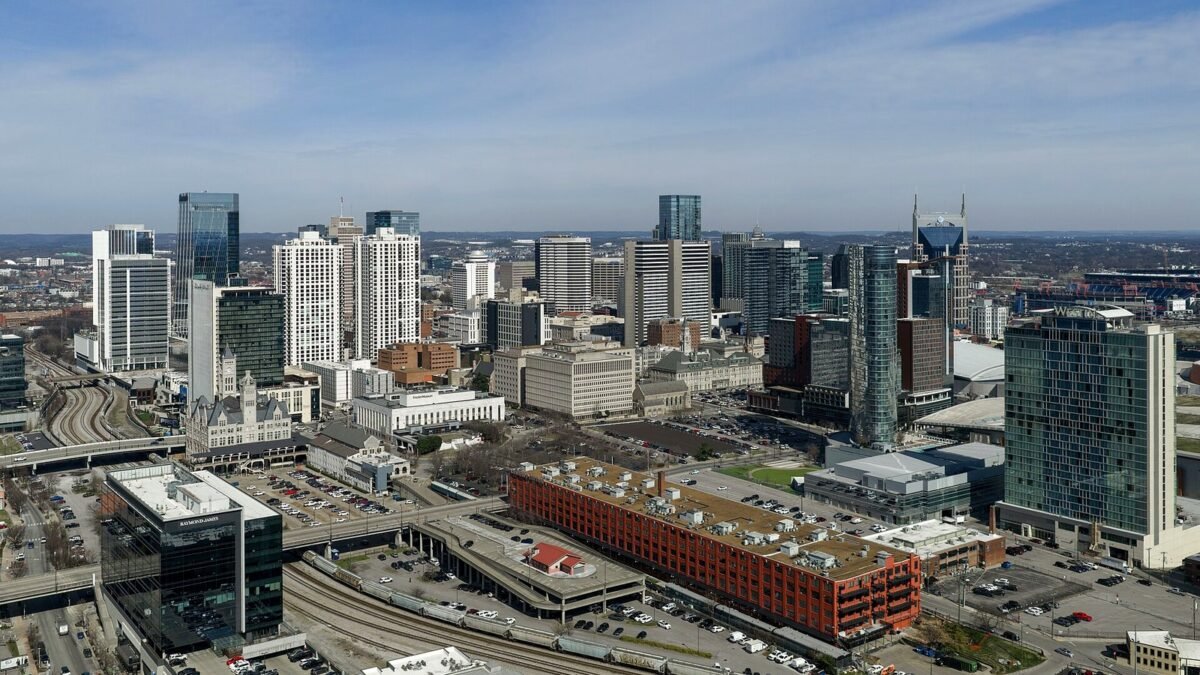
Wikimedia Commons — File: Nashville, TN skyline.jpg — Featured photograph: downtown Nashville skyline, by Quintin Soloviev, 24 February 2026, licensed under Creative Commons Attribution 4.0 International (CC BY 4.0).

About the Author — Abdul Mannan
Related Articles
When Fame Stops Protecting Its Own: The Week Britain’s Curtain Fell
In two days, Britain's entertainment world cracked twice: Russell Brand was jailed for ten and a half years,…
Wuzhen 2026: Who Will Own the Future of Our Shared Digital Life?
In a thousand-year-old water town, the world gathers to decide who owns our digital future — and 2.2…
Greece Has Voted to Be a Parent: The Under-15 Social Media Ban and the Oldest Argument on Earth
On October 23, Greece became the latest country to ban social media for children under 15. But every…