
Wuzhen 2026: Who Will Own the Future of Our Shared Digital Life?

A Town of Old Canals Asks the Newest Question on Earth
Who owns the future?
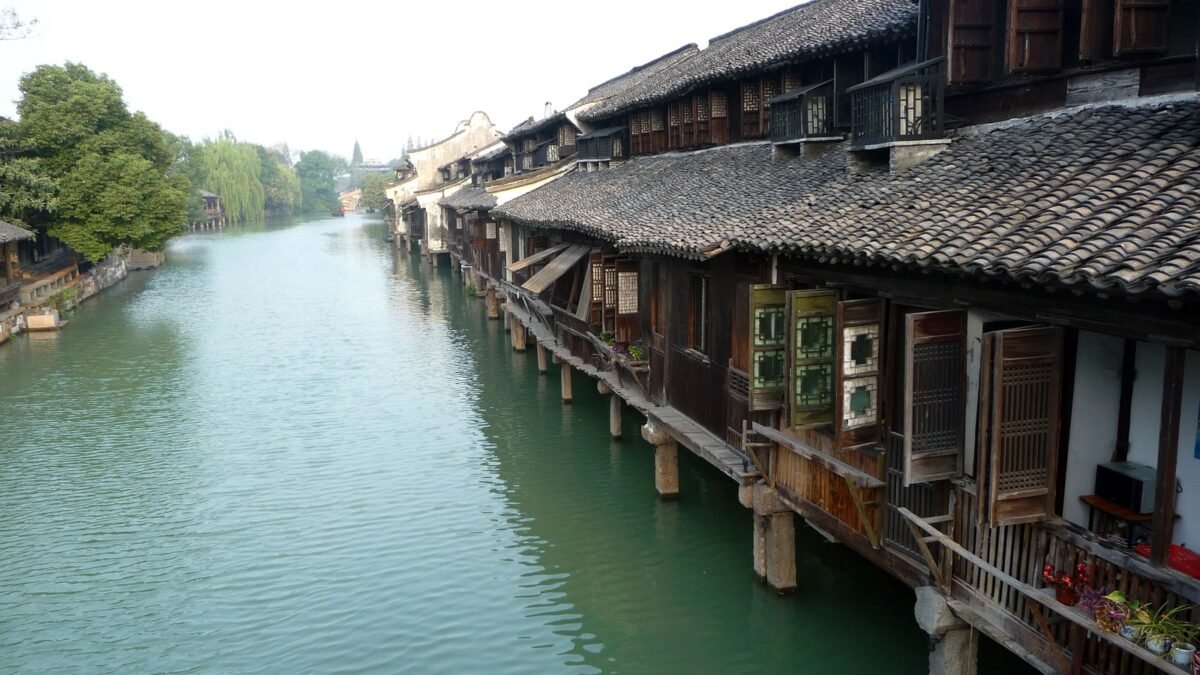
It is a question I have asked before, in other words and in other centuries, but never has it been asked quite so plainly, or in quite so strange a place. This week, in Wuzhen — a water town in eastern China whose canals have carried boats for more than a thousand years, a town of whitewashed walls, arched stone bridges and wooden boats sliding beneath them — the world has gathered to decide who will own the digital life of all of us. The 2026 World Internet Conference Wuzhen Summit opened on 3 November, and its theme reads like a promise and a warning in the same breath: “Open Source and Openness, Collaborative Development and Shared Benefits — Jointly Building a Community with a Shared Future in Cyberspace.”
Pause on that phrase for a moment. A shared future. Not a sold future. Not a rented future. A shared one. The men and women in that hall — representatives of governments, technology companies, universities and international organisations from dozens of countries — have come to a town built on water to argue about the most valuable thing in the world today: the network that now carries our words, our work, our art and our friendships. And you, reader, whether you know it or not, are a party to that argument. Your life is already inside it.
History Is a Mirror — and the Mirror Is Not Flattering
Whenever I look at the present, I reach for history, because history is the only mirror that does not flatter us. Consider the Grand Canal, which runs past Wuzhen itself. Begun under the Sui Dynasty more than fourteen centuries ago, stretching some 1,794 kilometres from Hangzhou to Beijing, it was the greatest engineering work of its age — a man-made river that bound an empire together, carried its grain, its silk, its scholars and its soldiers. Whoever controlled the canal controlled the movement of a civilisation. The canal was never only water. It was power, drawn in a line across the map.
Now look at the network we live inside. It, too, was sold to us as a river — a free-flowing stream of knowledge, open to all. And like every river in history, it has been dammed, channelled and owned. The East India Company, remember, first came to our shores as traders. They brought goods, they brought ships, they brought promises of mutual benefit. They stayed to rule. I do not say this to frighten you; I say it because the pattern is the oldest in the book, and we are watching it repeat itself in a new costume. Today the traders arrive not with ships but with platforms; not with muskets but with algorithms.
The printing press once did to knowledge what the canal did to grain: it made it move. But the press, too, was captured by those who owned the presses. The question of every age is the same — will the new instrument of connection belong to the many, or will it be enclosed by the few? That is the question Wuzhen is asking, and it is the question of our lifetime.
What Is Actually Happening in Wuzhen
Let me set out the facts plainly, because a moral argument built on rumour is worth nothing. The 2026 Wuzhen Summit runs from 2 to 5 November. It features a record 27 sub-forums — the most in the summit’s history — covering artificial intelligence agents, robotics and embodied intelligence, digital health, AI for science, and the green transition driven by digital technology. More than 670 enterprises from 54 countries and regions are exhibiting over 1,000 technologies at the Light of Internet Expo, including more than thirty humanoid robots. The main forum hosts a special “AI Wuzhen Dialogue”, where executives of global technology firms, open-source large-model institutions and AI scholars are debating how to build a global open-source artificial intelligence ecosystem — and what rules should govern it.
There is genuine hope in this. Open source is the closest thing our age has to a commons: code that anyone may read, use and improve. The summit’s open-source ecosystem experience hall, which opened on 1 November at the Wuzhen World Internet Science and Technology Museum, is a small symbol of a large idea — that the tools of the future need not be locked behind the gates of a handful of corporations. The summit is supported by the United Nations Department of Economic and Social Affairs, the World Intellectual Property Organization and the GSMA. A global competition, “Straight to Wuzhen”, drew 1,347 project applications from 31 countries and regions. More than 2,600 young people from over 140 countries applied for the Global Youth Leadership Program.
And yet — and yet. The very same week, in Berlin, Germany’s Digital Summit opened with its own arguments about the same questions. Two summits, two continents, one unresolved argument: who writes the rules of the digital age, and in whose interest?
The Promise and the Price
Here is where I must ask you to look at the other side of the ledger, because no honest column hides the cost of a promise. In February this year, UNESCO released the latest edition of its flagship report, Re|Shaping Policies for Creativity, drawing on data from more than 120 countries. Its warning is blunt: as generative artificial intelligence expands across every sector of society, the people who work in cultural and creative industries — the writers, the musicians, the painters, the filmmakers, the craftspeople who give a civilisation its soul — are expected to bear some of the greatest losses. Creators face projected revenue losses of up to 24 percent by 2028, as AI-generated content floods the markets and the laws that should protect intellectual property lag years behind the technology.
Consider what that means. A machine can now produce a song in seconds, a painting in a breath, a story before you have finished your tea. It does so by learning from the work of human beings — often without their permission, almost always without paying them. The report’s numbers are stark: essential digital skills are held by about 67 percent of people in developed countries, but only 28 percent in developing nations. Direct public funding for cultural sectors remains below 0.6 percent of global GDP — and it is projected to fall further.
Ask yourself, honestly: when a song is written by no one, who does it belong to? When a story is told by nothing, who is responsible for its truth? These are not technical questions. They are moral ones. And a civilisation that cannot answer them will find that its culture has been quietly sold out from under it — not by an invading army, but by a terms-of-service agreement nobody read.
The Billions Left Outside the Room
There is a second ledger, and it is heavier still. In October, the United Nations Department of Economic and Social Affairs released the World Social Report 2026, a study built on twenty-five years of data across 168 countries. Its headline finding should shame every delegate in Wuzhen: an estimated 2.2 billion people — 26 percent of humanity — had no internet access at all in 2025. While the robots dance in the exhibition halls, more than a quarter of the human race cannot even get through the door.
The report warns that the same transformations we celebrate — artificial intelligence, digitalisation, the green energy shift — risk deepening exclusion for those already left behind. Entire communities without affordable connectivity and without digital skills will fall further behind, not closer. Fifty-eight percent of the world’s workers were informally employed in 2025, beyond the reach of labour protections. Twenty-seven percent of young women aged 15 to 24 were neither in employment nor in education or training.
Read those numbers again, slowly. They are not statistics. They are people — farmers, weavers, young women, day labourers — for whom the “shared future in cyberspace” is a phrase spoken in a language they have never been taught, about a room they have never entered. A future that excludes a quarter of humanity is not a shared future. It is a gated community with very good public relations.
Openness Is a Door — but Who Holds the Key?
And so we return to Wuzhen’s theme: open source and openness, joint contribution and shared benefits. I want to believe in it. The idea that the code of the future should be open — readable, improvable, owned by no one and available to all — is the most hopeful idea in technology today. It is the printing press refusing to be captured. It is the canal refusing to be dammed.
But openness is a door, and a door is only as open as the hand that holds the key. Open-source models still need vast computing power to train and run — power owned by a few. Open platforms still need the skills to use them — skills held by 67 percent in the rich world and 28 percent in the poor. An open door at the top of a staircase nobody can climb is not an open door. That is why the UNESCO report calls for more than 8,100 policy measures across the countries it studied — not to stop the technology, but to bend it toward justice: protections for creators, investment in skills, funding for culture, and rules that make the powerful answerable.
The Verdict History Will Deliver
I began with a question: who owns the future? Let me end with a warning, and with a hope.
The warning is this. Every great instrument of connection in history has faced the same fork in the road. The canal could carry grain to the hungry or tribute to the emperor. The press could print the truth or print the propaganda. The internet can be a commons or a colony. The difference was never in the instrument. It was in the people who decided what it was for — and whether the rest of us were paying attention while they decided.
The hope is this. The people are paying attention now. The 2,600 young leaders from 140 countries who applied to be part of this conversation, the creators demanding to be paid for their work, the villages waiting for a connection — they are not asking for charity. They are asking for a share. A share in the tools, a share in the rules, a share in the future.
Wuzhen’s canals have carried boats for a thousand years because nobody owned the water — they only learned to navigate it together. That is the lesson the old town offers the new world. The future, like the river, cannot be owned. It can only be shared. And if we forget that, history — that patient, pitiless mirror — will show us, once again, exactly what we chose.
Sources & References
- Xinhua via AsiaNet — “Open-Source, Digital Governance in Spotlight as World Internet Conference Wuzhen Summit Kicks Off” (3 November 2026)
- People’s Daily Online / Xinhua — “China’s World Internet Conference summit to focus on open-source AI” (29 September 2026)
- China Daily via BCCCI — “2026 WIC Wuzhen Summit to focus on open source and openness” (23 October 2026)
- Inter Press Service — “‘Prioritize Social Inclusion as Rapid Transformations Risk Leaving Millions Behind’” (UN DESA World Social Report 2026) (16 October 2026)
- Funds for NGOs — “UNESCO Report: Digital Transformation and AI Risk Creators’ Livelihoods” (Re|Shaping Policies for Creativity) (20 February 2026)
- Inter Press Service via Saudi News Dimension — “Generative AI Could Deepen Inequality, Revenue Losses in Creative Industries” (UNESCO) (25 February 2026)

About the Author — Abdul Mannan
Related Articles
Greece Has Voted to Be a Parent: The Under-15 Social Media Ban and the Oldest Argument on Earth
On October 23, Greece became the latest country to ban social media for children under 15. But every…
Paris Under Curfew: What France’s Worst Riots in Years Are Really Telling the World
As Paris imposes its first curfews in years, this column reads France's worst riots in a generation through…
The Great Fence: Why the World Is Banning Children From Social Media — and Why Gen Z Is Cheering
In one week, Türkiye banned under-15s from social media, Greece tabled its own ban, Britain launched a 5,000-child…