
Shehbaz Sharif to Make First Official Visit to Russia on 30 November for Putin Talks on Energy, Trade and Defence

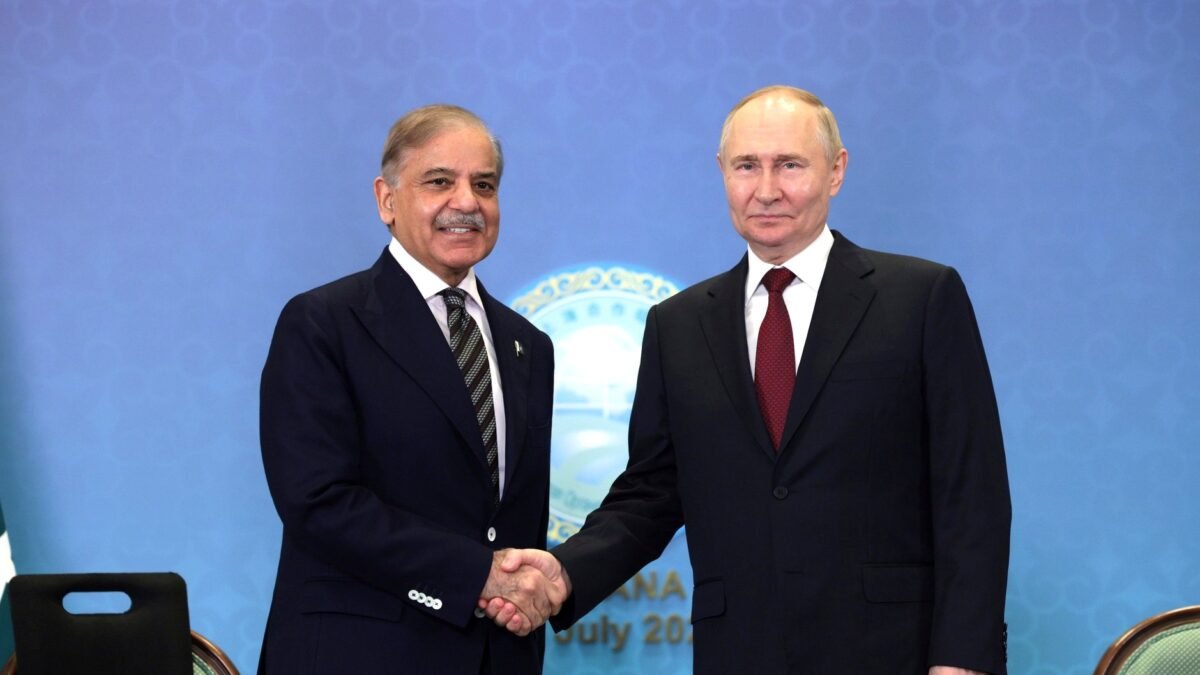
Prime Minister Shehbaz Sharif will undertake his first official visit to Russia from 30 November, holding talks with President Vladimir Putin in Moscow on energy, defence, trade and regional security, before flying directly to Tehran to represent Pakistan at the 18th Economic Cooperation Organisation (ECO) summit.
The three-day visit, from 30 November to 2 December, will be only the third visit to Moscow by a Pakistani prime minister, according to The News, following Nawaz Sharif’s landmark trip in April 1999 and Imran Khan’s visit in February 2022. It comes at the invitation of President Putin, and it is being described by Pakistani officials and diplomats as a historic step in a relationship that has travelled a long way from Cold War hostility to a pragmatic, multi-dimensional partnership.
During his meeting with President Putin, discussions are expected to focus on energy cooperation, defence relations, trade, regional security and investment, a source in the Prime Minister’s Office told Dawn. The revival of Pakistan Steel Mills, built with Soviet assistance in the 1970s, is also likely to feature prominently, alongside potential Russian investment in Pakistan’s oil and gas sectors.
Pakistan’s Ambassador to Russia, Faisal Niaz Tirmizi, told Russian media that 15 to 16 agreements were expected to be signed during the visit, covering trade, culture, education and people-to-people contacts. He described the visit as highly historic and said major progress was expected in relations between the two countries.
The prime minister will be accompanied by a large delegation of businessmen and will address a joint business forum in the Russian capital, according to Dawn. The emphasis, Pakistani officials have stressed, is on concrete economic outcomes rather than ceremony. According to one account of the preparations, the prime minister did not want the visit limited to photographs and signatures, but sought a consolidated foundation for future economic and diplomatic ties.
Before the prime minister lands, a high-level Pakistani delegation is in Moscow on 23 and 24 November for technical talks on a bilateral payment mechanism, Business Recorder reported. The delegation was sent after a request from the Foreign Office issued on 16 November, and the Russian government agreed to host it to address outstanding issues that have forced transactions through third countries, adding costs for consumers and manufacturers.
Ambassador Tirmizi identified banking, visa and logistics constraints as the three main impediments to expanding commerce between the two countries. The two sides are working towards direct commercial transactions through mutually acceptable financial institutions and currencies, subject to regulatory compliance, Business Recorder reported. Pakistan has operated a limited business-to-business barter trade mechanism covering Russia, Iran and Afghanistan since June 2023, but officials say a more sustainable arrangement is needed.
The ambassador also announced that the first freight train from Islamabad to Moscow would depart by the end of this year. He said the train would travel from Islamabad through Quetta and Taftan, passing through Iran before reaching Russia, opening a new overland trade route between the two countries.
The Russian leg of the trip holds particular significance because Prime Minister Sharif is expected to extend a formal invitation to President Putin for a maiden visit to Pakistan next year, The News reported. The invitation is for the Shanghai Cooperation Organisation (SCO) heads of state summit scheduled to take place in Islamabad in September 2027, which Pakistan will host as part of its SCO chairmanship for 2026-27. According to the WANA news agency, the prime minister will also invite Iranian President Masoud Pezeshkian to the same summit.
Following his Moscow engagements, the prime minister will fly directly to Tehran for the two-day 18th ECO summit beginning on 3 December, where leaders of the organisation’s member states will discuss regional trade, connectivity, energy, transportation, investment and industrial cooperation. The summit comes as Pakistan assumes the ECO’s rotating chairmanship for 2026-2027, having taken over from Kazakhstan last week.
According to The News, the summit will bring together heads of state and government from ECO’s member states: Pakistan, Iran, Türkiye, Azerbaijan, Kazakhstan, Kyrgyzstan, Tajikistan, Turkmenistan and Uzbekistan, while Afghanistan’s membership remains suspended, although Kabul has claimed it received an invitation from Tehran to attend. Leaders are expected to deliberate on the Strategic Goals of Economic Cooperation 2035, regional trade and investment, modernising the ECO Trade Agreement, multimodal transport and energy connectivity, digital technology and climate resilience. Diplomatic sources in Tehran confirmed that Pakistan was the first country to officially confirm its participation in the summit.
The official schedule for both visits has yet to be announced by either government, but the broad contours of the trip have now been confirmed by multiple outlets. A visit planned for last March was cancelled, and the rescheduled trip is being described as historic, and as a sign of how far the Pakistan-Russia relationship has travelled in recent years.
A relationship transformed
The visit is the latest marker in one of the most remarkable transformations in Pakistan’s foreign relations. For most of the Cold War, Pakistan and the Soviet Union stood on opposite sides. Pakistan joined the Western anti-communist pacts SEATO and CENTO, hosted a secret American U-2 spy base at Badaber near Peshawar, and acted as the frontline state in the Soviet-Afghan war of 1979-1989. The Soviet Union, for its part, repeatedly vetoed United Nations resolutions favourable to Pakistan on Kashmir and, through the Indo-Soviet Treaty of Friendship of August 1971, provided India with the diplomatic shield under which East Pakistan was lost.
Yet even in those hostile decades there were moments of cooperation. The Soviet Union mediated the Tashkent Declaration between Pakistan and India in January 1966, after the September 1965 war. And in 1973, under Prime Minister Zulfikar Ali Bhutto’s policy of bilateralism, Moscow provided soft loans, design engineering and more than 100 Soviet metallurgists to build Pakistan Steel Mills at Bin Qasim near Karachi, the country’s largest industrial project. Diplomatic relations between the two countries were formally established on 1 May 1948, and the Soviet Union supplied tens of thousands of tonnes of food grain to the newly independent state in its early years, as well as helping to build thermal power plants at Muzaffargarh, Multan and Guddu.
Since the dissolution of the Soviet Union in 1991, relations have warmed steadily. The two countries carried out their first-ever joint military exercises, codenamed Druzhba, in 2016, and Russia lifted its arms embargo on Pakistan in 2014, selling four Mi-35 attack helicopters. Pakistan joined the Shanghai Cooperation Organisation as a full member in 2017, and the two sides signed an agreement for the Pakistan Stream Gas Pipeline from Karachi to Kasur. In 2023, bilateral trade turnover exceeded $1 billion, and Pakistan began importing discounted Russian crude oil, the first cargo arriving in June that year.
Prime Minister Sharif himself has met President Putin before, on the sidelines of SCO summits, including in Astana in July 2024 and again in Beijing in September 2025, where the two leaders reaffirmed their commitment to deepening cooperation in trade, agriculture, transport, pharmaceuticals and steel. But a standalone official visit to Moscow, with a full bilateral agenda and a large business delegation, is a different order of engagement, and it is the first of its kind for Sharif.
Energy at the centre
Energy is widely reported to be the most important item on the Moscow agenda. Pakistan, a country with huge and growing energy needs, imports most of its oil and gas, and the cost of those imports is a permanent strain on its foreign exchange reserves and its trade balance. Russia, one of the world’s largest energy producers, has been looking for new markets since Western sanctions cut off much of its European business, and discounted Russian crude has already become part of Pakistan’s energy mix.
Discussions are expected to cover oil and gas supplies as well as possible Russian investment in Pakistan’s energy sector, including exploration and production. The Pakistan Stream Gas Pipeline, a long-discussed project to carry gas from Karachi to Kasur in Punjab, has been on the bilateral agenda for years, and Russian companies have also been linked to the CASA-1000 power transmission project. What the Moscow talks may produce is not yet clear, and officials have been careful to describe topics expected to be discussed rather than agreements already reached, but the direction of travel is unmistakable.
The payment question is the immediate bottleneck. Because Russia is under extensive Western sanctions, ordinary banking channels between the two countries barely function. Trade has had to pass through third countries, or through the barter mechanism introduced in June 2023, both of which add cost and friction. The technical talks on 23 and 24 November are the first test of whether the economic agenda can move from discussion to agreement before the prime minister lands. If the two sides can settle on direct transactions through mutually acceptable banks and currencies, as Business Recorder reported they are attempting, it would remove the single biggest practical obstacle to larger trade.
The railway and freight train announcement points in the same direction. A regular Islamabad-Moscow freight service, running through Quetta, Taftan and Iran, would give Pakistan an overland route to Russia and onwards to Central Asia and Europe, and give Russia a route to the Arabian Sea. It is the kind of connectivity project that has been talked about for years in the context of the International North-South Transport Corridor, and the ambassador’s statement that the first train will depart by the end of this year suggests the two sides now want to show results rather than intentions.
The steel mill that symbolises the relationship
No single project captures the history of Pakistan-Russia relations quite like Pakistan Steel Mills. Built with Soviet help in the 1970s, it was the flagship of Pakistan’s industrial ambitions, a symbol of the friendship between the two countries, and at its peak one of the largest employers in the country. It has been idle since 2015, a rusting monument to decades of mismanagement, political interference and failed privatisation attempts.
Its revival has been discussed in almost every round of Pakistan-Russia talks for years, and it is on the agenda again in Moscow. Russia was involved in the mill’s original construction, which is one reason the topic keeps returning. Whether Moscow is willing to put money into restoring it, and on what terms, is an open question. Pakistan’s government has not yet announced any specific proposal for the mill, and earlier attempts to revive it with foreign partners have come to nothing. But the fact that it features so prominently in the visit’s agenda shows how much symbolic weight both sides attach to it: for Pakistan, a working steel mill would be proof that the country can still build and make things; for Russia, it would be a visible return to a project its engineers created half a century ago.
The ECO summit and Pakistan’s chairmanship
The second leg of the trip, to Tehran for the ECO summit, matters in its own right. The Economic Cooperation Organisation groups ten countries across Central Asia, the Caucasus and South Asia, and Pakistan has just taken over its rotating chairmanship for 2026-2027. The summit’s agenda, the Strategic Goals of Economic Cooperation 2035, modernising the ECO Trade Agreement, multimodal transport, energy connectivity and climate resilience, is the practical work of turning a sometimes sleepy regional body into a functioning economic bloc.
Pakistan being the first country to confirm its participation, as diplomatic sources in Tehran told The News, is a small but telling detail: it signals that Islamabad intends to take the chairmanship seriously. The summit will also be watched for how it handles Afghanistan, whose membership remains suspended but which claims to have been invited by Tehran, and for the bilateral meetings on its sidelines, including the prime minister’s expected talks with the Iranian president.
Taken together, the two legs of the trip amount to a concentrated week of diplomacy in which Pakistan will engage two of its most important regional neighbours, chair a regional organisation, and host the groundwork for a major summit it will hold in Islamabad in 2027.
Analysis: Why It Matters
The Moscow visit matters for three reasons, and each of them goes beyond the handshakes and the photograph.
First, it is about energy security, which is Pakistan’s most persistent economic vulnerability. Pakistan spends a large share of its scarce foreign exchange on imported fuel, and every spike in global oil prices feeds directly into inflation, electricity tariffs and the current account deficit. Discounted Russian crude, a gas pipeline and possible Russian investment in exploration would not solve that problem on their own, but they would diversify supply and give Pakistan leverage in its dealings with other suppliers. The risk is equally clear: deeper energy ties with a sanctioned Russia invite scrutiny from the United States and other Western partners, and Pakistan will have to manage that tension carefully. The payment mechanism talks are, in this sense, the real heart of the visit. Without a workable way to pay, the energy agenda stays on paper.
Second, the visit is about Pakistan’s place in a changing regional order. For decades, Pakistan’s foreign policy was anchored in its alliance with the United States and its rivalry with India. Both of those anchors have shifted. The United States has drawn closer to India, Pakistan’s relationship with Washington is thinner than it was, and the institutions of Eurasian cooperation, the SCO and now the ECO chairmanship, offer Pakistan a different kind of platform. A prime ministerial visit to Moscow, followed immediately by chairing a regional summit in Tehran, is a statement that Pakistan intends to be active in that Eurasian space rather than a bystander in it. The invitation to President Putin to attend the SCO summit in Islamabad in 2027, which would be his first visit to Pakistan, underlines the point.
Third, the visit is a test of whether Pakistan can convert diplomatic warmth into economic results. The history of Pakistan-Russia relations is full of ambitious announcements, the gas pipeline, the steel mill revival, the trade targets, that have faded for lack of follow-through. The 15 to 16 agreements expected in Moscow will be judged not by their number but by whether they are implemented, and the freight train, the payment mechanism and the business forum are the practical benchmarks to watch. If the train runs by the end of the year, if a payment channel opens, and if the agreements lead to actual investment, the visit will have been a success. If they do not, it will join a long list of promising beginnings.
There are also risks that should not be glossed over. The new-provinces debate, coalition tensions and economic pressures at home mean the prime minister travels with a contested domestic position. The ECO summit and the SCO chairmanship will demand sustained diplomatic attention over the coming year. And the balancing act between Russia, the United States, China and the Gulf states, each of which matters to Pakistan for different reasons, will only get harder as the Moscow relationship deepens.
What to watch next is straightforward. Watch the joint statement and the list of agreements signed in Moscow on 30 November and 1 December, and in particular whether the payment mechanism and the steel mill produce anything concrete. Watch whether the first freight train actually departs by the end of the year. Watch the ECO summit in Tehran for signs of how Pakistan intends to use its chairmanship. And watch whether President Putin accepts the invitation to Islamabad in 2027, which would be the most visible symbol yet of how far this relationship has come.
Sources
- The News — PM to undertake back-to-back visits to Russia, Iran from 30th
- Dawn (via Newslive) — PM to attend ECO moot in Iran after Russia trip, 23 November 2026
- RIA Novosti (via NAMPA) — Pakistan’s Prime Minister Will Arrive in Russia on November 30 for 3-Day Visit
- Capital News Point — Pakistan and Russia Set to Sign Up to 16 Agreements During PM Shehbaz’s Moscow Visit
- Newsy Today (citing Business Recorder) — Pakistan PM Shehbaz Sharif to Visit Russia; Technical Talks Set for Nov 23-24

About the Author — Abdul Mannan
Related Articles
Pakistan Minister Dodges Indus Waters Questions in New Delhi: ‘You Have Not Invited Me to Discuss It’
Pakistan's climate change minister Musadik Malik declined to discuss the Indus Waters Treaty or terrorism during his New…
Pakistan’s Slow Internet to Last Until 6 December as Repairs Continue on Faulty SMW5 Undersea Cable
Transworld Associates says repairs to the faulty SEA-ME-WE 5 submarine cable should finish by 6 December, with slower…
Zardari’s Five Ordinances Strip Khyber Pakhtunkhwa Lawmakers of Key Privileges as Governor’s Rule Deepens
President Asif Ali Zardari has promulgated five ordinances for Khyber Pakhtunkhwa, stripping provincial lawmakers of most of their…