
Trump Awards Rudy Giuliani the Presidential Medal of Freedom in Private White House Ceremony

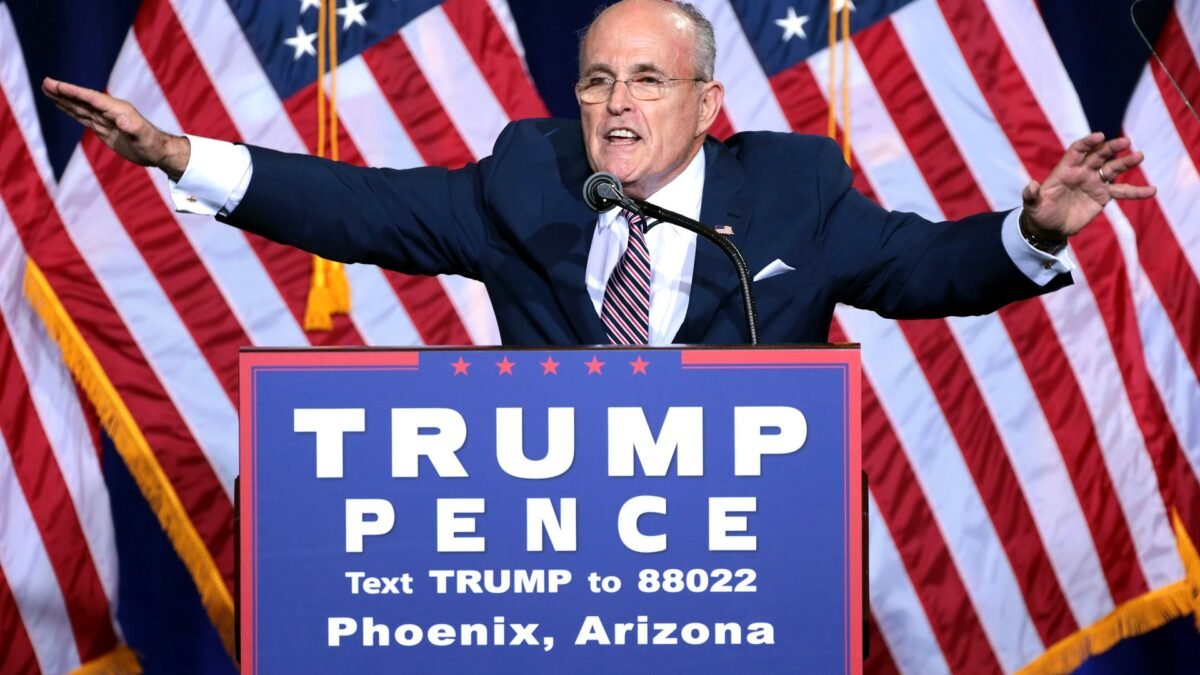
President Donald Trump on Tuesday awarded the Presidential Medal of Freedom, the highest civilian honour in the United States, to Rudy Giuliani, the former mayor of New York who led the city through the September 11 attacks and later became the president’s personal lawyer in the effort to overturn the 2020 election. The medal was presented in a private ceremony in the Oval Office, closed to reporters, more than a year after Mr Trump first promised the honour to his longtime ally.
Mr Giuliani, 82, received the award in recognition of what the White House described as a lifetime of service to the American people. His son, Andrew Giuliani, a former Trump administration official, told reporters outside the White House afterwards that the small gathering of relatives, friends and supporters had been emotional, with Mr Trump and Mr Giuliani reminiscing about a friendship that stretches back decades in New York.
“I am honored and humbled to receive the Presidential Medal of Freedom from my nation and from our Commander-in-Chief, President Donald J. Trump,” Mr Giuliani said in a statement, according to Reuters. “I share the credit with all the men and women who worked with me, disagreed with me, and loved me — particularly those who lost their lives in the causes we undertook together.”
The White House did not explain why the ceremony was closed to the press. Olivia Wales, a White House spokeswoman, called Mr Giuliani “a dedicated public servant whose decisive leadership has left a lasting impact on New York City and our nation,” according to Reuters.
Mr Giuliani is the third person to receive the Medal of Freedom from Mr Trump in his second term, after the conservative activist Charlie Kirk, honoured posthumously in October 2025, and Welles Crowther, the equities trader known as the “man in the red bandanna” who rescued several people during the September 11 attacks. The award fulfils a promise Mr Trump made in September 2025, days after Mr Giuliani was seriously injured in a car crash in New Hampshire.
A promise made after a crash
Mr Trump first announced his intention to honour Mr Giuliani on 1 September 2025, in a post on his Truth Social platform. “As President of the United States of America, I am pleased to announce that Rudy Giuliani, the greatest Mayor in the history of New York City, and an equally great American Patriot, will receive THE PRESIDENTIAL MEDAL OF FREEDOM, our Country’s highest civilian honor,” he wrote.
The announcement came two days after Mr Giuliani was hurt in a collision on a New Hampshire highway. On the evening of Saturday 30 August 2025, his vehicle was struck from behind at high speed on Interstate 93 in Manchester, according to his head of security, Michael Ragusa, and the New Hampshire State Police. Mr Giuliani was taken to a trauma centre, where he was diagnosed with a fractured thoracic vertebra, multiple lacerations and contusions, and injuries to his left arm and lower leg.
Minutes before the crash, Mr Giuliani and his spokesman, Ted Goodman, who was driving, had stopped after a woman flagged them down and said she was a victim of domestic violence. Mr Ragusa said Mr Giuliani rendered assistance and contacted the emergency services, remaining at the scene until officers arrived. After he re-entered the vehicle, it was hit from behind. The police identified the other driver as Lauren Kemp, 19, of Concord, whose Honda HR-V rear-ended the rented Ford Bronco Mr Goodman was driving. Both vehicles were sent into the median and heavily damaged. Three people, including Mr Giuliani, were taken to hospital with injuries that were not life-threatening.
The crash, and the president’s swift promise of the medal, came at a moment when Mr Giuliani’s public standing had fallen to its lowest point. The honour, presented more than a year later in the Oval Office, closes one chapter of a career that has swung from national hero to disbarred lawyer, and now to a recipient of the country’s highest civilian award.
From prosecutor to “America’s Mayor”
Rudolph William Louis Giuliani was born in Brooklyn in 1944 and built his reputation first as a federal prosecutor. Under President Ronald Reagan he served as associate attorney general and then as United States Attorney for the Southern District of New York, the most prominent federal prosecutor’s office in the country. In that role he became famous for using the Racketeer Influenced and Corrupt Organizations Act, a statute designed for organised crime, against the leadership of New York’s five mafia families. The Mafia Commission Trial of the mid-1980s convicted the heads of the city’s crime families and made Mr Giuliani a national figure.
He was elected mayor of New York in 1993 and served two terms, from 1994 to 2001. His mayoralty was defined by a sharp fall in crime, driven by the aggressive policing strategy associated with his police commissioner, William Bratton, and by a combative style that made him both admired and divisive. Violent crime in the city fell by more than half during his eight years in office, a record his supporters still cite as his defining achievement, while his critics argued that the tactics behind the fall, including stop-and-frisk policing, fell disproportionately on Black and Hispanic New Yorkers.
Then came 11 September 2001. In the final months of his mayoralty, Mr Giuliani became the public face of New York’s response to the terrorist attacks that destroyed the World Trade Center. His calm, visible leadership in the days after the attacks, as he walked the streets of lower Manhattan and addressed the city and the nation, earned him the title “America’s Mayor” and made him one of the most popular political figures in the United States. Time magazine named him Person of the Year for 2001, and Queen Elizabeth II made him an honorary knight.
He left office at the end of 2001, at the limit of the city’s two-term rule, and built a lucrative career in consulting and security. He sought the Republican presidential nomination in 2008, entering the race as the early frontrunner before his campaign collapsed, and he abandoned a run for the United States Senate in 2000 after being diagnosed with prostate cancer.
The 2020 election and the fall
Mr Giuliani’s second act in national politics began when he became Mr Trump’s personal lawyer. After Mr Trump lost the 2020 election to Joe Biden, Mr Giuliani became the most visible advocate of the claim, made without evidence, that the election had been stolen through widespread fraud. He held a now-famous press conference at Four Seasons Total Landscaping, a small Philadelphia gardening business, where he made claims about the vote that were widely rebutted, and another at the headquarters of the Republican National Committee at which hair dye was seen running down his face.
The courts rejected the fraud claims again and again. According to USA Today, Mr Trump lost 60 court cases challenging the 2020 result. A former Republican speaker of the Arizona House, Rusty Bowers, quoted Mr Giuliani as telling him: “We’ve got lots of theories, we just don’t have the evidence.” Mr Giuliani made repeated claims of fraud without evidence in swing states including Arizona, Pennsylvania and Georgia.
The consequences for Mr Giuliani were severe and lasting. Two Georgia election workers, Ruby Freeman and her daughter Wandrea “Shaye” Moss, sued him for defamation after he falsely accused them of manipulating ballots. A federal jury awarded them 148 million dollars in December 2023. Mr Giuliani later reached a settlement with them in January 2025, on the morning a trial was due to decide whether he would also lose his Florida condominium and his World Series rings. Under the settlement he kept his New York home, his Florida condominium and his personal belongings, paid compensation in an undisclosed amount, and promised never to defame the two women again. According to Reuters, he “fully satisfied” the terms of the judgment in February 2025.
Days after the jury’s verdict, in December 2023, Mr Giuliani filed for Chapter 11 bankruptcy, listing about 10.1 million dollars in assets against 152.7 million dollars in liabilities. The case never reached a plan: in July 2024 a judge dismissed it, finding that Mr Giuliani had not been transparent about his finances, which left his creditors free to pursue him individually.
His law licence was suspended in New York in June 2021, and he was formally disbarred in New York in July 2024 after a court found he had made false statements about the election. Washington, DC, followed with its own disbarment that September, ending the legal career that had made him famous. He also faced state criminal charges of election interference in Georgia and Arizona. According to USA Today, the charges were dropped in both cases after Mr Trump returned to the White House, although Arizona’s attorney general, Kris Mayes, said in June that she could seek another indictment.
Mr Trump pardoned Mr Giuliani in November 2025, along with 76 other people, for their roles in contesting the 2020 result. A presidential pardon covers only federal offences, so it did not touch the state cases, but by then most of the legal weight bearing down on Mr Giuliani had lifted.
The medal and its politics
The Presidential Medal of Freedom was established by President John F. Kennedy in 1963 for “meritorious contribution” to the security or national interests of the United States, to world peace, or to cultural or other significant public or private endeavours. It is the highest civilian honour an American president can bestow, and presidents have used it to define the figures and values they believe the country should celebrate.
With Mr Giuliani’s medal, Mr Trump has now awarded the honour 27 times across his two terms, according to Reuters. He has predominantly reserved it for former athletes: fourteen of his awards have gone to retired sports stars, some of whom also served in public office. In his first term he recognised 24 people, including the campaign contributor Miriam Adelson, the musician Elvis Presley, the baseball great Babe Ruth and the late Supreme Court Justice Antonin Scalia, according to USA Today.
In his second term, the choices have been more political. Mr Kirk, the conservative activist who was assassinated in September 2025, received the medal posthumously the following month. Mr Crowther, who died in the September 11 attacks, was honoured for his heroism that day. Mr Trump has also said he plans to award the medal to the retired baseball pitcher Roger Clemens, whose career was clouded by performance-enhancing drug allegations, to the United States national hockey team goaltender Connor Hellebuyck, and to Ben Carson, his former housing secretary.
Mr Giuliani’s award fits that pattern. It is, at once, a recognition of his leadership after September 11, a reward for loyalty, and a statement about the 2020 election. Mr Trump has never conceded that he lost that election, and honouring the man who led the legal effort to overturn it is a public declaration that the president regards Mr Giuliani’s conduct as service to the country rather than an attack on its democratic process. The private, closed-press character of the ceremony suggests the White House was aware of how the award would be received, and chose to present it without the television cameras that usually accompany such occasions.
Analysis: two Giuliani’s, one medal
Few figures in modern American public life present as sharp a split as Rudy Giuliani. There is the Giuliani of the 1980s and 1990s: the fearless prosecutor who broke the mafia’s grip on New York, the mayor who presided over a dramatic fall in violent crime, and the leader who held a shattered city together in September 2001. That Giuliani is the one the Medal of Freedom was designed for, and the citation’s language about a lifetime of service reaches back to him.
Then there is the Giuliani of the 2020s: the lawyer who promoted claims about an election that courts, including judges appointed by Mr Trump himself, found to be baseless; who was disbarred in two jurisdictions; who was found liable for defaming two ordinary election workers, whose lives were upended by the threats that followed his accusations; and who filed for bankruptcy under the weight of a 148 million dollar judgment. That Giuliani is the one his critics see when they look at Tuesday’s ceremony.
The medal does not resolve that split. It chooses a side. By honouring Mr Giuliani in the Oval Office, Mr Trump is telling the country that the first Giuliani is the real one, and that the second was a man persecuted for loyalty. That is a political judgment, not a historical one, and it will be argued over for as long as the 2020 election is argued over.
There is also a narrower, human story here that should not be lost in the politics. Mr Giuliani is 82 years old. A year ago he was lying in a New Hampshire trauma centre with a fractured vertebra, his finances in ruins and his law licence gone. The medal is, among other things, an act of personal rehabilitation by a president who has made a habit of pardoning and honouring allies who paid a price for serving him. Mr Giuliani thanked, in his statement, the men and women who “lost their lives in the causes we undertook together”, a line that reached back to the firefighters and police officers who died on September 11, and to the Reagan administration in which he began his public career. He credited advice from President Reagan for guiding his service, a reminder that his career began long before Mr Trump entered politics.
The award also says something about how Mr Trump uses the Medal of Freedom. Previous presidents have generally treated it as a non-partisan honour, shared across the political divide. Mr Trump has used it more narrowly, as a reward for allies and for figures who embody his movement. Fourteen of his 27 recipients have been retired athletes, a safe and popular category. But the political choices, Mr Kirk, Mr Giuliani, and the planned honour for Mr Clemens, show a president using the medal to build a pantheon of his own.
That approach carries a cost. The Medal of Freedom draws its prestige from the belief that it stands above politics, that it recognises service to the nation rather than service to a president. Every time it is awarded to a figure as contested as Mr Giuliani, that belief is tested. Supporters will say the medal recognises a lifetime, not a single chapter, and that Mr Giuliani’s leadership after September 11 alone justifies it. Critics will say the award rewards the man who did more than almost anyone to spread the false claim that an American election was stolen, and that it cheapens an honour previously given to figures such as Nelson Mandela, Mother Teresa and Martin Luther King Jr.
Why it matters
The ceremony matters for three reasons. First, it is a marker of where Mr Trump stands on the 2020 election as he governs in his second term. Six years after the election, with the courts having settled the matter and his own attorney general having found no evidence of outcome-changing fraud, the president is still honouring the lawyer who led the challenge. That tells his supporters, and his opponents, that he has not moved on, and that loyalty on that question is still rewarded at the highest level.
Second, it completes Mr Giuliani’s rehabilitation. In the space of a year he has been pardoned, seen his state cases dropped, settled the defamation judgment that threatened to strip him of his homes, and now received the nation’s highest civilian honour. Whatever history concludes about his role in 2020, the immediate political verdict from the White House is unambiguous: he is to be celebrated, not condemned.
Third, it is a test of the Medal of Freedom itself. The honour has survived controversial recipients before, and it will survive this one. But each award shapes what the medal means to the public. When future presidents consider whom to honour, Mr Giuliani’s name will now sit on the list alongside the names of presidents, scientists, artists and civil rights leaders. That is a choice with consequences that will outlast this administration.
What to watch next
Several things are worth watching in the weeks ahead. The first is the reaction from the two Georgia election workers, Ms Freeman and Ms Moss, who have said little publicly since the settlement and whose lives were transformed by Mr Giuliani’s accusations. Any statement from them, or from their lawyers, will carry weight.
The second is whether Mr Trump follows through on the other medals he has announced, for Mr Clemens, Mr Hellebuyck and Mr Carson, and whether those ceremonies are held in public or in private. The closed-press character of Tuesday’s event may become a pattern for the most contested recipients.
The third is the longer question of how Mr Giuliani’s story is told. He is 82, and the medal is likely the last great public honour of his career. The history books will have to decide which Giuliani to remember: the prosecutor and mayor who led New York through its darkest day, or the lawyer who helped spread a falsehood about an election and paid for it with his licence, his fortune and his reputation. Tuesday’s ceremony was Mr Trump’s answer to that question. It will not be the last word.
Sources
- Reuters — Trump awards Rudy Giuliani the Medal of Freedom
- USA Today — Trump awards Rudy Giuliani, former NY mayor, Medal of Freedom
- Fox News — Trump to award Giuliani Presidential Medal of Freedom
- New York Post — Trump to honor ‘America’s Mayor’ Rudy Giuliani with the Presidential Medal of Freedom
- CNN — Rudy Giuliani injured but recovering after car accident in New Hampshire

About the Author — Abdul Mannan
Related Articles
Unsealed Court Records Show Federal Case Against Ilhan Omar Spans ‘Crimes Over Decades’
A federal court has unsealed 169 pages of redacted records from the search of Representative Ilhan Omar's home,…
Virginia and Oregon Sue Musk’s SpaceX Over Grok’s Sexualised Deepfakes of Women and Children
Virginia and Oregon have become the first states to sue Elon Musk's SpaceX over Grok, accusing the AI…
US Blacklists Megaspeed, the Nvidia-Linked Firm at the Centre of the Huang Spy Scandal
The Commerce Department has added Singapore-based Megaspeed to its Entity List, cutting the Nvidia-linked firm off from US…