
Tiger Woods Is Back — and This Time the Question Is Not Whether He Can Win

Eight Hundred and Sixty-Four Days
Guess who’s back? Back again. Tell a friend. Eminem wrote the line, but this week it belonged to golf. On Tuesday, 17 November, Tiger Woods confirmed what the whispers had been saying for weeks: he will tee it up at the Hero World Challenge in the Bahamas on 3 December, his first competitive round in eight hundred and sixty-four days.
Social media did what it always does with Tiger. It erupted. The believers posted the old highlights, the fist pumps, the red shirt on a Sunday at Augusta. The doubters posted the old headlines, the missed cuts, the withdrawals, the police photographs. And somewhere between the two choruses, the rest of us were left with the only question that has ever truly mattered about this man: why does he keep coming back?
Let us first be precise about what is happening, because precision is a form of respect. The Hero World Challenge is the tournament Woods himself hosts at Albany Golf Club in the Bahamas. It runs from 3 to 6 December, it has a field of only twenty players, there is no cut, and it carries a purse of five million dollars, one million of it for the winner. It is not an official PGA Tour event, but it does award world ranking points, and it raises money for his TGR Foundation. Woods enters as one of three exemptions, alongside Rickie Fowler. Gary Woodland was the third, until a knee operation forced him to withdraw. The field also includes the world number one, Scottie Scheffler, and the defending champion, Hideki Matsuyama.
Woods has not played an individual tournament since he missed the cut at the Open Championship at Royal Troon on 21 July 2024. He has not completed four rounds of a tournament since the Masters of that same year. He missed all four of golf’s major championships in 2026. When he walks to the first tee at Albany, it will have been eight hundred and sixty-four days since his last start. That number comes from Golfweek, and it is worth sitting with for a moment. In that time, entire careers have begun and ended. In that time, the sport he once owned has carried on without him, politely, and a little emptier.
The Body Keeps the Score
No comeback in sport is ever only about sport, and this one least of all. If you want to understand why the world stopped to listen when a fifty-year-old golfer said he would play a twenty-man exhibition in the Bahamas, you must first read the medical file, because the medical file is the story.
In September 2024, Woods had surgery for a nerve impingement in his lower back. In March 2025, while ramping up his training for a return, he ruptured his left Achilles tendon, an injury that wiped out his entire season. In October 2025, he underwent his seventh back operation, a lumbar disc replacement. And then, in March of this year, came the episode that threatened to end the conversation altogether: a rollover crash near his home in Jupiter, Florida, an arrest on suspicion of driving under the influence, and a withdrawal from public life to seek treatment. In September he accepted a plea agreement that included a five-year suspension of his driving licence and a one-thousand-dollar fine. A ruptured Achilles. A replaced disc in the spine. A seventh operation on the same back. A car turned over on a Florida road. A man who once seemed bulletproof, taken apart piece by piece, in public, at fifty years of age.
And yet, on the tenth of November, speaking to SiriusXM PGA Tour Radio, he said this: “I’m feeling better, no doubt about that. I’ve been training quite a bit. I will be at Hero either way, so I’ll see you there.”
I have covered enough sport to know the difference between a man who is selling something and a man who is simply telling the truth. That sentence was the second kind. He did not promise a victory. He did not promise a score. He promised only his presence. And for Tiger Woods, presence has always been the whole argument.
Hogan’s Ghost Walks the Fairway
Here is where history, as it always does, steps forward to hold up a mirror. Golf has seen this story before, and the man who lived it first was Ben Hogan. In February 1949, Hogan’s car collided head-on with a bus on a foggy Texas road. He was so badly injured that doctors wondered whether he would ever walk again, let alone play golf. Sixteen months later, in June 1950, he won the United States Open at Merion in an eighteen-hole playoff, on legs held together by willpower and wire. He went on to win six more major championships. Golf still calls it the greatest comeback the game has ever seen.
And then there is Jack Nicklaus, the only man ahead of Woods on the list of major champions, winning the Masters in 1986 at the age of forty-six, when the whole world had already written his eulogy. And then there is Woods himself, in April 2019, winning the Masters at forty-three, eleven years after his previous major, two years after spinal fusion surgery had left him wondering whether he would play competitive golf again at all. He came from two shots behind after fifty-four holes, something he had never done before in a major, and the roar that went up on the eighteenth green at Augusta was the sound of a sport remembering what it had almost lost.
Do you see the pattern? The great ones do not return because their bodies allow it. They return because something in them refuses to accept the ending that has been written for them. Hogan returned on ruined legs. Nicklaus returned against the calendar. Woods returned in 2019 against his own spine. And now, at fifty, with an Achilles repaired and a disc replaced and a year that nearly swallowed him whole, he is returning again.
This will be, according to Golf Channel, the sixth time since 2014 that Woods has made his comeback at the Hero World Challenge. That is not a coincidence. He knows this stage. There is no cut, so he is guaranteed four rounds. The course at Albany is famously flat, an easy walk for damaged legs. He is the host, the field is small, the pressure is his own. If a man wanted to test whether his body still belongs in competition, he could not design a kinder laboratory.
What the Practice Ground Whispers
And what of the golf itself? The optimists have their evidence. On the No Laying Up podcast this week, a report circulated that a man who had recently played alongside Woods described him as “melting the ball”, flying bunkers that sit three hundred and twenty, three hundred and twenty-five yards away. The phrase has travelled across social media like wildfire, because golf fans are romantics at heart, and we all want to believe that the swing is still in there, untouched by the surgeons.
Let me be honest with you, as a columnist owes his readers honesty. Practice-ground reports are not tournament golf. A man can stripe a driver on a quiet Tuesday and still find that his body has other plans by Saturday afternoon. The real question at Albany is not whether Tiger Woods can hit a golf ball three hundred and twenty yards. The real question is whether he can do it seventy-two times, over four days, walking a golf course on a repaired Achilles and a rebuilt back, against the best player in the world. Nobody who matters is asking him to win. The question is whether he can finish four rounds, and whether the Masters in April then becomes a real conversation.
Scottie Scheffler is the world number one, and he does not hand out nostalgia. Hideki Matsuyama is the defending champion. These are not ceremonial opponents. They are the present tense of the sport, and they will not slow down so that history can catch up. Woods knows this better than anyone. He has been the young man on the other side of that equation. He remembers what it felt like to be the future arriving, and now he must discover what it feels like to be the past refusing to leave.
The Question That Matters
And so we arrive at the question I promised you at the beginning. Why does he keep coming back?
It is not money. As of this year, Forbes estimated his net worth at one and a half billion dollars. It is not fame; there is no fame left for him to collect. It is not the record, though eighteen majors still sits there, three beyond his reach, the one number that has always eluded him. Fifteen majors, eighty-two PGA Tour victories, tied with Sam Snead for the all-time record, six hundred and eighty-three weeks as the world number one. What more could a man want from a game?
I think the answer is simpler, and it is the reason I have never been able to look away from this man. Tiger Woods keeps coming back because he has never accepted that a human being is finished when the world says he is finished. Every obituary written about his career has been premature. They wrote it in 2010, after the scandal. They wrote it in 2017, after the surgeries. They wrote it in 2021, after the crash in California that nearly cost him his right leg. They wrote it this year, after the crash in Florida. And every time, he has walked back onto a golf course and made the obituary look foolish.
There is a lesson in that for all of us, and it has nothing to do with golf. Most of us are given one ending by life, and we accept it. We accept the injury, the failure, the year that went wrong. We sign the settlement. Woods refuses to sign. He keeps appealing the verdict, even when the court is his own body, even when the evidence is against him, even when the whole gallery has gone home.
Perhaps he will win again. Perhaps he will not. Perhaps the Hero World Challenge will be one more brave chapter that ends in a missed putt and a quiet flight home. But I will tell you what I know. On the third of December, in the Bahamas, a fifty-year-old man who has had seven operations on his back, who has ruptured his Achilles, who has been arrested and treated and written off more times than any athlete alive, will walk to a tee, place a ball on the ground, and try again. And in a world that is very good at telling people to stay down, that is not a small thing. That is the whole thing.
After Albany, the calendar offers him one more stage before the year ends: the PNC Championship later in December, where he is expected to play alongside his son Charlie. The father who keeps refusing to finish, playing beside the son who is only beginning. The past and the future, sharing a golf cart, walking the same fairway in opposite directions.
Watch him on the third of December. Not because you expect a miracle. Watch him because comebacks are the truest thing in sport, and because this one, of all of them, asks us the question we spend our whole lives avoiding. When everything has been taken from you, when your body has betrayed you and your reputation has been tried in public, when the sensible people have all agreed that it is over — what do you do?
Tiger Woods has answered that question the same way, every single time. You come back.
Sources & References
- Golf Channel — Tiger Woods returning at Hero after a break is his favorite playbook
- Golfweek / USA Today — How long has Tiger Woods been gone? The eye-popping numbers behind his return
- Flashscore — Woods to make competitive return at Hero World Challenge in December
- Golf News — Tiger Woods set to play in Hero World Challenge
- talkSPORT — Hero World Challenge 2026 field, dates and location as Tiger Woods returns in $5m shootout
- Golfmagic — Tiger Woods confirms stunning golf return after injury hell
- Wikipedia — List of career achievements by Tiger Woods
- TigerWoods.com — Career timeline
- Wikipedia — Ben Hogan: the 1949 crash and the miracle at Merion
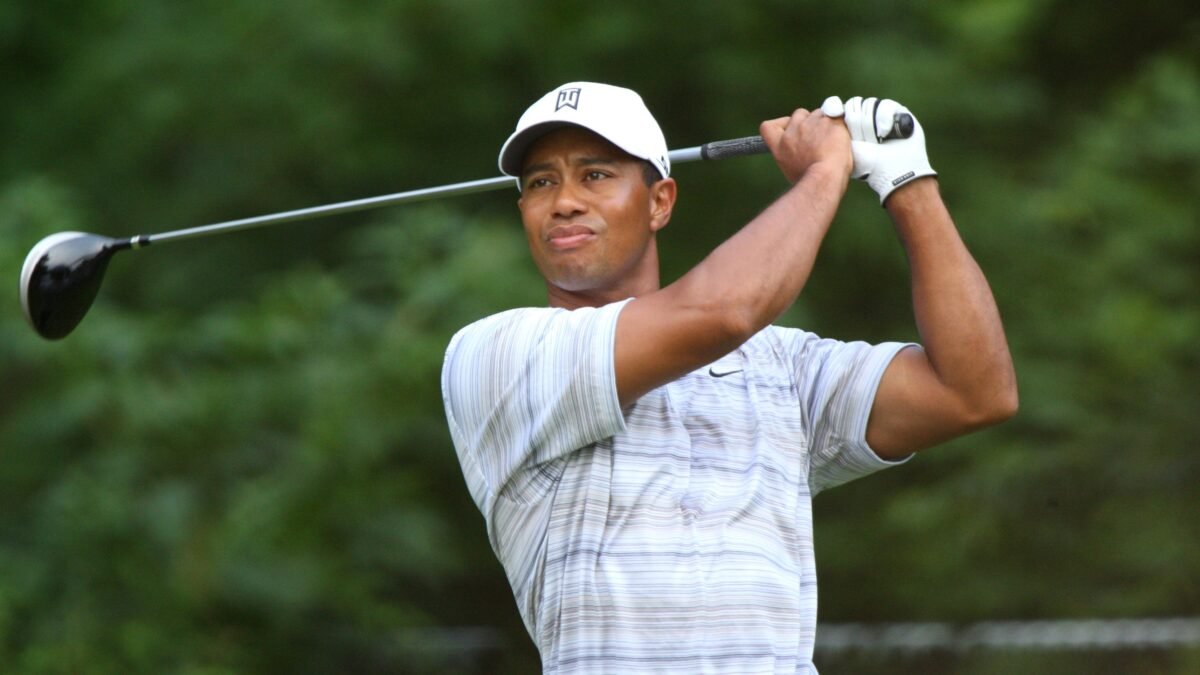
Photo: Tiger Woods at the Quicken Loans National, 2018. Credit: Keith Allison / Wikimedia Commons, CC BY-SA 2.0.

About the Author — Abdul Mannan
Related Articles
Senegal Reinstated as AFCON 2025 Champions as CAS Overturns Morocco’s Title Award
Ten months after the most chaotic final in Africa Cup of Nations history, sport's highest court has given…

Infantino Took 39 Private Jet Flights in 115 Days, BBC Finds, as FIFA Election Fight Heats Up
A BBC Sport investigation found FIFA president Gianni Infantino took at least 39 private jet flights to 32…

UK Confirmed as Host of the 2035 Women’s World Cup, the First World Cup on British Soil Since 1966
FIFA has confirmed England, Scotland, Wales and Northern Ireland as hosts of the 2035 Women's World Cup —…