
Infantino Took 39 Private Jet Flights in 115 Days, BBC Finds, as FIFA Election Fight Heats Up

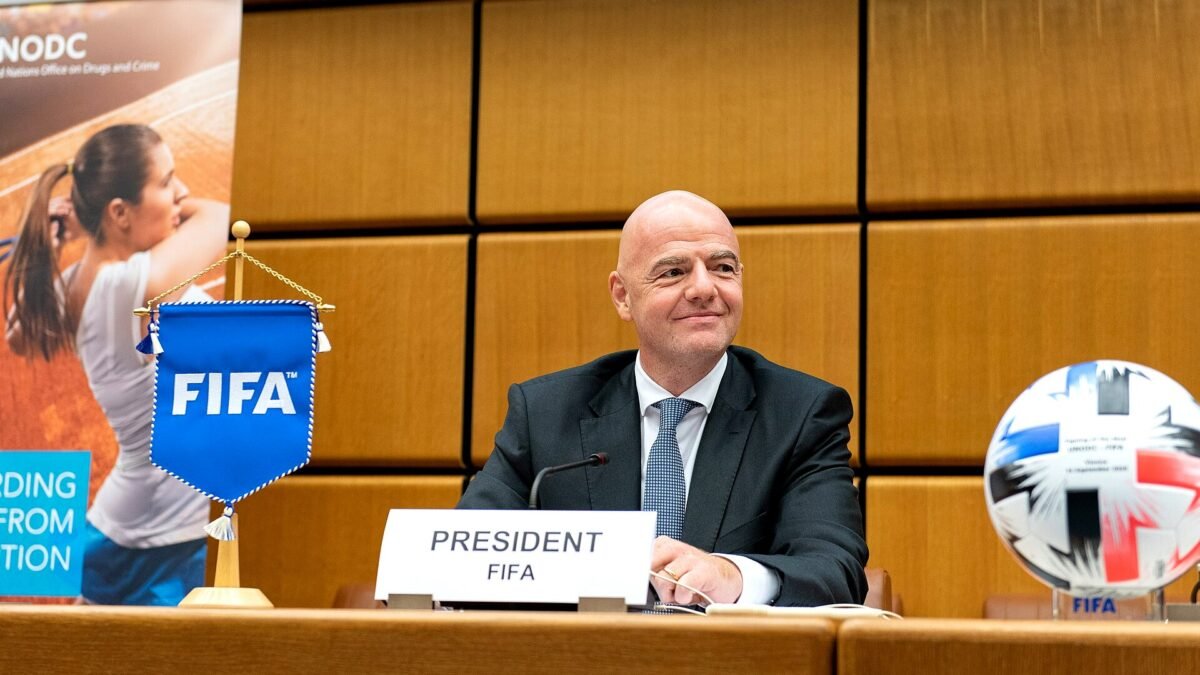
FIFA president Gianni Infantino took at least 39 private jet flights to 32 countries in the space of 115 days, according to a BBC Sport investigation published on Tuesday, in a period that began just as his plan to sell a stake in the World Cup was collapsing and ended with his re-election campaign facing its first serious challenge in a decade.
The investigation, based on flight-tracking records and Infantino’s own social media posts, found that the 56-year-old flew more than 102,800 air miles and spent just under nine days in the air between late July and late November. The aircraft he used are operated by Qatar Executive, the private-jet arm of the Qatar Airways Group, one of FIFA’s sponsors. FIFA did not dispute the figure of 39 flights.
Critics told the BBC that the travel blurred the line between running world football and campaigning to keep running it. FIFA’s presidential election takes place on 18 March 2027 in Rabat, and Infantino is seeking a fourth term in office. Until last week he had looked set to be re-elected effectively unopposed. Now he faces a contested vote, and the scale of his travelling has become one of the central questions of the race.
The findings land at a moment when Infantino’s authority has already been shaken. His proposal to hand the commercial rights of FIFA’s competitions to a new for-profit company was abandoned in August after three continental confederations opposed it, and leaked documents published this week showed the scheme would have run for up to 96 years. Against that background, the question his critics keep returning to is a simple one: when the president of FIFA flies somewhere on a sponsor’s private jet, is he doing the job, or is he campaigning?
How BBC Sport tracked the flights
BBC Sport built its log of Infantino’s travel from two sources: postings on the FIFA president’s own social media accounts, which showed where he had been and when, and flight-tracking records matched against the registrations of the Qatar Executive fleet. The broadcaster counted at least 39 flights since the start of August, a figure FIFA did not challenge when it was put to the governing body.
The tally covers the 115 days since 28 July, the day The Times revealed Infantino’s plan to sell stakes in the World Cup and other competitions to private investors. In that period, according to the BBC’s calculations, Infantino spent 213 hours and 49 minutes in the air and travelled about 102,870 air miles. That works out at roughly one private flight every three days.
He also visited nearly double the number of countries he travelled to over the same stretch in 2025, when the total was 18. The reasons given for the trips, according to the BBC, included meetings with football association presidents, the opening of pitches, meetings with politicians and attendance at confederation gatherings.
The itinerary shows how much of the travelling took him to the people who will decide his future. Three weeks after the World Cup sell-off plan failed, Infantino attended a Caribbean Football Union presidents’ meeting and a junior football tournament in the Dominican Republic. He then flew to Paris, where he attended the esports World Cup alongside French President Emmanuel Macron and Saudi Arabia’s Crown Prince Mohammed bin Salman.
On his Instagram account, Infantino said he had “pledged Fifa’s support” for the Pakistan Football Federation president’s development plans when he met him in the United States in September. A few days later, he described a “wonderful discussion” with the president of the Latvian Football Federation during a visit to Riga, calling him “my dear friend”.
During a visit to Indonesia in October for the final of the FIFA ASEAN Cup, he met the presidents of the football federations of Afghanistan, Bangladesh, Brunei Darussalam, Cambodia, Hong Kong, Indonesia, Malaysia, Maldives, Mongolia, Myanmar, Pakistan, Philippines, Qatar, Singapore, Thailand and Timor-Leste. “Having your support and shared passion on this momentous occasion means a great deal and together we will continue driving this game forward,” he said. And during a recent trip to Manila, he performed on stage as part of a quartet called the “Backache Boys”, alongside officials from the Asian Football Confederation and the football federations of Malaysia and the Philippines.
None of those trips is, on its own, improper. The president of FIFA is expected to travel, and FIFA says he has a statutory duty to do so. The issue the BBC investigation raises is the volume, the timing and the means: 39 private flights in 115 days, on jets run by a subsidiary of a FIFA sponsor, in the months when his re-election campaign was taking shape.
The plan that started the clock
The 115-day window begins with the story that, for a few days in the summer, looked as though it might end Infantino’s presidency. On 28 July, The Times reported that he had been devising a plan to sell stakes in the World Cup and other competitions to private investors, under a proposal called FIFA Forward Enterprise, or FFE.
Under the blueprint, a new company would have been formed to control the commercial and operational delivery of FIFA’s top men’s and women’s competitions, including the World Cup and the Club World Cup. FIFA confirmed to The Times that Thrive Capital, the investment firm founded by Joshua Kushner, the brother of United States President Donald Trump’s son-in-law Jared Kushner, was expected to lead the proposed investor group, and that JP Morgan was FIFA’s financial adviser on the project.
The new company would have had an initial value of about $20 billion, according to people familiar with the plan. Private investors would have bought an initial 20 to 30 per cent stake for multibillions of dollars, while FIFA would have kept a majority and its 211 member associations would each have held a small stake. Before the plan was abandoned, Infantino wrote to all 211 member associations saying they would receive $40 million each if they backed it.
The backlash was swift. The prime minister of the United Kingdom, Andy Burnham, condemned the plan on the evening it emerged. UEFA, the European confederation, said it would boycott FIFA competitions until the proposal was scrapped, and the Asian Football Confederation and CONCACAF, the confederation for North America, Central America and the Caribbean, also opposed it. Infantino announced in the early hours of 1 August that the plan would not proceed.
“The FIFA Forward Enterprise project was intended to provide a basis for further strengthening our FIFA Member Associations and our sport worldwide, especially in those countries where support is most needed,” Infantino said in a statement at the time. “Having listened carefully to all the views, it has become clear that the project has created divisions of a nature that, regardless of the level of support, are no longer in the interest of the objective set out in the first place.”
The plan’s collapse cost Infantino politically. UEFA said he had “lost the confidence” of European football. His senior adviser, Carlos Cordeiro, resigned, and FIFA’s chief operating officer, Kevin Lamour, described the project as “a project of one person”, according to the Associated Press. The French Football Federation formally withdrew its support for Infantino’s re-election bid in September, with its president, Philippe Diallo, saying the trust placed in the FIFA president had been broken.
Leaked documents published on Monday by The Guardian and the New York Post showed the scale of what had been proposed. According to the reports, all commercial rights for FIFA competitions would have been handed to FFE for commercial exploitation for up to 96 years, under rolling 12-year licence periods, and only a severe breach of contract by FFE could have ended the agreement. The documents also indicated a management bonus pool that could have paid out $50 million for every $1 billion added to the business’s initial $20 billion valuation, and a $250 million break fee if FIFA had breached the deal. The board of FFE was to be chaired by the sitting FIFA president. FIFA has consistently said the proposal would have needed the approval of the member associations and the FIFA Council, and that Infantino would not have profited from it. The governing body has invited Council members to review the files at its headquarters in Zurich.
A crowded election race
When the World Cup ended on 19 July, Infantino looked set to be re-elected unopposed, effectively by coronation. FIFA said at the time that he had about 200 letters of support from the 211 federations that will vote in March in Rabat, according to the Associated Press. The Asian Football Confederation gave him its backing on 23 October, and, according to Le Monde, the support of Asia, Africa and South America together already accounts for 110 of the 211 federations eligible to vote, a majority.
That picture changed on 16 November, when UEFA’s executive committee met and unanimously invited Diallo, the president of the French Football Federation, to stand as a candidate. Diallo, 63, accepted, and his candidacy was ratified by the French federation’s executive committee the following day. He joins Kozo Tashima, the honorary president of the Japanese Football Association, and Ramon Vega, a former Swiss defender who played for Tottenham Hotspur, as challengers. Diallo and Tashima both submitted their candidacies ahead of the deadline, each accompanied by nomination letters from five member federations, as FIFA’s rules require, according to USA Today.
Should the challengers pass the eligibility and integrity checks carried out by FIFA’s review panel, Infantino will face his first contested election since he took office in 2016, following the corruption scandal that ended Sepp Blatter’s presidency. Diallo has said he wants to restore “broken” trust in the sport’s governance and rid the game of the “poison of division”.
The race is not only about the ballot. UEFA is pursuing legal action in the United States courts and is seeking discovery of evidence for a possible criminal complaint against Infantino in Switzerland, alleging financial mismanagement, according to the Associated Press. A former member of the Confederation of African Football’s executive committee has also indicated that a challenge could be submitted to the Court of Arbitration for Sport over Infantino’s eligibility, according to The Guardian, centred on whether his initial three-year term after Blatter’s resignation should count towards FIFA’s three-term limit. The FIFA Council has previously determined that it should not count, clearing him to stand for another four-year mandate.
What the critics say
Miguel Maduro, a former head of FIFA’s governance committee, told BBC Sport that Infantino’s travelling was “part of his campaign”. “The issue here is that Fifa does not have rules on campaign funding, so the president can claim that he’s going there on official business when indirectly he’s using that to campaign,” he said. “And anyone else running against him very likely will not have the financial means to compete with that.”
Maduro said there were no regulations within FIFA on the “use of public money to support their campaign”. “There’s no independent authority that controls that, there is no regulation of campaign funding,” he said. “That’s again a confusion between his role as president of Fifa and his role as candidate to Fifa presidency.”
Lars-Christer Olsson, a former chief executive of UEFA, told the BBC that the “important” question was “what does he promise and what are the conditions, as he already did when he promised cash if the members supported his FFE project?” On the flights themselves, Olsson asked: “What do these trips cost and who is paying, which are the implications for the total football community? Is he provided with transport in his private campaign with the idea of getting something back in return if he is elected? If Fifa is paying for private jets, would it not be better to invest this money in the member associations?”
FIFA’s answer, given to the BBC, was that the president has a statutory duty to travel. A spokesperson said the organisation’s objectives were to “improve football constantly and promote it globally”, and that “the Fifa president has a statutory duty to maintain and develop good relations between and among Fifa, the confederations, 211 member associations, political bodies, and international organisations”.
“To do that, he travels around the world and attends Fifa’s tournaments and events,” the spokesperson added. “Mr Infantino is elected until 18 March 2027, when the next Fifa presidential election will take place. Fifa has put in place rules which establish the framework for flights and travel by any Fifa official. The Fifa president routinely travels around the world for various duties, together with relevant officials, on business and tournament-related matters and strives to visit member associations of Fifa whenever he can. Fifa expenses are published in our annual report, and all travel is in line with Fifa’s regulations. Fifa’s money belongs to the 211 member associations and an increased investment to $6.35bn for the upcoming cycle reinforces our unwavering commitment to further supporting football development and access globally.”
But FIFA declined to comment on how the use of Qatar Executive flights affects the money available from the Qatar Airways sponsorship for the benefit of global football, and it also declined to say when Infantino had last taken a commercial flight. Those two refusals are likely to matter as much as the flight count itself, because they go to the question Olsson raised: who is paying, and what does it cost football?
The climate cost
The investigation also put a number on the environmental cost of the travel. Based on its log of the flights, the BBC calculated that Infantino spent 213 hours and 49 minutes in the air and travelled about 102,870 air miles. For the type of private jet he was using, that would produce an estimated 1,673 tonnes of carbon dioxide equivalent, according to the BBC’s calculations, which it described as conservative estimates based on average fuel burn rates. That is equivalent to the emissions 252 people would accumulate on average in an entire year, according to European Union data.
Freddie Daley, from the Cool Down Sport for Climate Action Network, said Infantino’s behaviour was “emblematic of Fifa’s approach to environmental sustainability under his leadership: total and utter disregard”. “Despite numerous pledges, Fifa has failed to deliver any significant plan on how it will achieve them and has instead gone backwards,” he added.
FIFA has also been criticised for expanding the number of teams at World Cups and hosting them in multiple countries, thereby increasing the amount of travel. The 2026 World Cup was described as the “most polluting World Cup ever”, according to the BBC. Maduro said FIFA’s support for climate initiatives, which included being a signatory of the United Nations’ Sports for Climate Action Framework, was “window dressing”. FIFA did not directly respond to a question about its justification for the environmental impact caused by Infantino’s extensive travelling.
The climate question cuts deeper than one man’s travel diary. FIFA is the body that asks host nations, clubs and fans to accept the disruption and cost of ever-larger tournaments, and it presents itself as a force for development in the countries most exposed to climate change. When its president’s own travel produces, in less than four months, the annual emissions of a small village, that message becomes harder to carry.
A familiar argument
This is not the first time Infantino’s use of private jets has drawn scrutiny. Swiss federal prosecutors closed an investigation into his use of a private jet in 2017, for a chartered flight from Suriname to Switzerland, and FIFA said at the time that it had been confirmed the travel arrangements were in line with its compliance rules. FIFA’s ethics committee had cleared Infantino in the same case in August 2020.
The Guardian has previously reported that FIFA’s ethics committee also investigated Infantino’s election expenses, with sources indicating he declared only 500,000 euros in campaign expenditure. That history matters because it shows the pattern the BBC investigation is describing is not new: questions about how the president travels, who pays, and where the line sits between official business and personal advantage have followed Infantino for years, and FIFA’s answer has consistently been that its rules were followed.
What has changed is the context. In 2017, Infantino was a new president consolidating power after a corruption scandal. In 2026, he is a president seeking a fourth term after a plan to sell a stake in the World Cup collapsed, after three confederations opposed him, after his senior adviser resigned, and after UEFA, the richest confederation in the game, put up a candidate against him. The same questions now land in a contested election, where they can be asked by rivals with a platform, rather than only by journalists.
Analysis: Why It Matters
The Infantino flights story is not, at its core, a story about aeroplanes. It is a story about the structure of power in world football, and about what happens when the person who runs an organisation is also the person running to keep running it, with no rules to separate the two roles.
The blurred line is the point
Every FIFA president has travelled the world meeting federation presidents. That is the job. The problem the BBC investigation identifies is not that Infantino met the president of the Latvian federation, or pledged support to Pakistan’s football plans, or attended the ASEAN Cup final in Indonesia. It is that he did all of it, and much more, on private jets operated by a sponsor’s subsidiary, in the four months after his standing was damaged by the FFE affair, and that FIFA has no campaign finance rules that would let anyone judge where official business ends and electioneering begins.
Maduro’s observation is the sharpest in the BBC report: because there are no rules, the president can always say a trip was official business, and no independent authority exists to test the claim. That is not an accusation that any particular trip was improper. It is an observation that the system makes the question unanswerable, which is itself the governance failure. A challenger such as Diallo, Tashima or Vega cannot match 39 private flights in 115 days, not because they lack support, but because they lack the office. The incumbent’s advantage is built into the furniture.
The sponsor question
The choice of aircraft matters as much as the number of flights. Qatar Executive is a subsidiary of the Qatar Airways Group, and Qatar Airways is one of FIFA’s sponsors. FIFA declined to say how the use of those jets affects the money available from the sponsorship for the benefit of global football. That silence leaves open the question Olsson asked: if the sponsorship is, in effect, paying for the president’s travel, is football getting the full value of the deal, or is some of it being spent on keeping the president in the air?
There is no suggestion in the BBC report that Qatar Executive or Qatar Airways did anything wrong. Sponsors provide services to the organisations they sponsor; that is normal. But when the beneficiary of a sponsor’s generosity is also the individual seeking re-election, and when the sponsorship’s value to the sport is not disclosed, the arrangement invites the suspicion that the sport is subsidising the campaign. FIFA could close that argument quickly by publishing what the travel cost and how it was accounted for. It has chosen not to.
The climate credibility gap
The emissions figure, 1,673 tonnes of carbon dioxide equivalent, is small beside the footprint of a World Cup. But it is large beside the footprint of a person, and that is the comparison that will stick. FIFA asks the world’s poorest football nations, many of them on the front line of climate change, to trust it as a development partner. It has signed the United Nations’ Sports for Climate Action Framework. Its president then spent nine days in the air on private jets in less than four months. The gap between the pledge and the practice is the story, and it is why Daley’s phrase, “total and utter disregard”, will be quoted more than the numbers themselves.
What the election now turns on
For months, the assumption in world football was that Infantino would be re-elected without a contest. The BBC reported that many observers now regard him as the favourite, but the emergence of Diallo, backed unanimously by UEFA, has changed the shape of the race. Diallo does not need to win over Asia, Africa and South America, where Infantino’s support is strongest. He needs to make the case that the governance of FIFA itself is the issue, and the flights investigation hands him that case in a form voters can understand: 39 flights, 32 countries, 115 days, one election.
Infantino’s defence is that he was doing his job, and that the job requires travel. That is true, and it is also incomplete. The job also requires that the people who elect the president can see the difference between the job and the campaign. Until FIFA publishes the cost of the travel, explains the Qatar Executive arrangement, and adopts campaign finance rules, that difference will remain a matter of trust. And trust, as the FFE affair showed, is exactly what Infantino has been losing.
What to watch next
The first test comes from FIFA’s own review panel, which must decide whether Diallo, Tashima and Vega pass the eligibility and integrity checks required to stand. If all three are cleared, the vote on 18 March 2027 in Rabat will be the first genuinely contested FIFA presidential election in a decade.
The second test is whether FIFA answers the questions the BBC investigation left open: what the 39 flights cost, who paid, how the Qatar Executive arrangement is accounted for in the Qatar Airways sponsorship, and when Infantino last flew commercially. The governing body publishes its expenses in its annual report, but the annual report will not arrive before the election.
The third test is the Court of Arbitration for Sport question over Infantino’s eligibility, and UEFA’s legal action in the United States courts. Either could reshape the race before a single vote is cast. And the fourth is the simplest: whether Infantino’s travel slows down now that it is being counted. The BBC’s log ends in late November. If the pace of private flying continues into the election period, the story will not go away. If it stops, the critics will say the scrutiny worked, and the president will say he was only ever doing his job.
Sources
- BBC Sport – Fifa presidential race: Gianni Infantino private-jet flights under scrutiny
- QNC News – Infantino Took 39 Private Jet Flights in 115 Days, BBC Finds
- Le Monde – Philippe Diallo emerges as unexpected challenger to Gianni Infantino for FIFA presidency
- Sportsnet (Associated Press) – Diallo aims to restore ‘broken’ trust in bid for FIFA presidency
- LiveScore – Gianni Infantino’s controversial World Cup sell-off plan was ‘set to run for 96 years’

About the Author — Abdul Mannan
Related Articles
UK Confirmed as Host of the 2035 Women’s World Cup, the First World Cup on British Soil Since 1966
FIFA has confirmed England, Scotland, Wales and Northern Ireland as hosts of the 2035 Women's World Cup —…

Dylan Larkin Traded to Montreal Canadiens in Blockbuster Deal Ending Months-Long Red Wings Saga
Montreal has acquired former Detroit captain Dylan Larkin in a blockbuster trade, ending a months-long standoff that saw…
Pochettino’s Manchester United Reign Begins in Ruins as Liverpool Run Riot in 4-0 Anfield Rout
Mauricio Pochettino's first match as Manchester United head coach ended in a 4-0 defeat at Liverpool, with Leny…