
Achakzai Proposes National Government to End Pakistan’s Political Deadlock at Lahore Opposition Conference

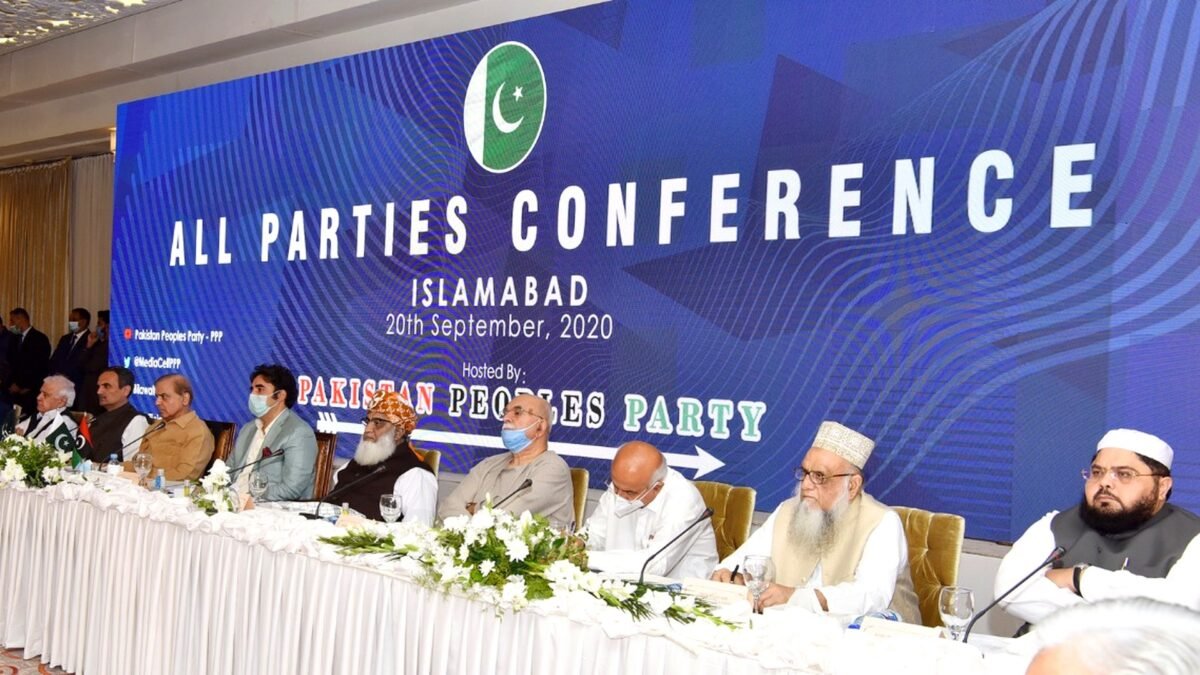
Pakistan’s opposition leader has put a radical proposal on the table: a national government, bringing together the country’s major political parties and state institutions, to steer the country out of a political crisis that has deepened with every passing month. Mahmood Khan Achakzai, the leader of the opposition in the National Assembly, made the call at a multi-party conference in Lahore on Tuesday, arguing that no decision of national importance should be taken without consultation among elected representatives and all democratic forces.
According to Dawn, Achakzai wants a national government of major state institutions, political parties and stakeholders. He said it should address past injustices, introduce constitutional reforms and give the military a constitutional and dignified exit from politics. The proposal was the centrepiece of a gathering at the Javed Iqbal Auditorium in Lahore, held under the umbrella of the Lahore High Court Bar Association, which brought together opposition leaders, senior lawyers and journalists at a moment when the government and its allies are openly divided over a proposed referendum on new provinces.
Achakzai, who also heads the opposition alliance Tehreek-i-Tahafuz-i-Ayeen-i-Pakistan, stressed constitutional supremacy, parliamentary sovereignty and the restoration of democracy in his address, and he praised the Lahore bar for what he described as its historic role in the struggle for constitutional rule. He named no leader for the setup he proposed and set no timetable, but he set out the principle clearly: no major decision without consultation, and no settlement that leaves the military’s political role unaddressed.
What Achakzai proposed
The core of Achakzai’s plan is a negotiated settlement rather than a unilateral one. Decisions of national importance, he told the conference, should come through consultation among elected representatives and all democratic forces, not from a handful of individuals. The national government he envisages would bring the major institutions, the political parties and other stakeholders into a single framework, and it would be charged with three tasks: addressing past injustices, introducing constitutional reforms, and giving the military a constitutional and dignified exit from politics.
That last element is the most striking part of the proposal, and the one that sets it apart from the routine calls for dialogue that fill Pakistan’s political calendar. Achakzai has long argued that the country’s crises cannot be resolved while the armed forces retain a political role, and his formula treats that question not as something to be avoided but as something to be settled by agreement, in a way that preserves the institution’s dignity while returning it to its constitutional boundaries. The language matters: a “constitutional and dignified exit” is an offer of a negotiated settlement, not a demand for a confrontation.
The proposal also carries an implicit rebuke to the way the government has handled the most divisive question in Pakistani politics today, the future of the provinces. While ministers have floated a referendum on creating new provinces, Achakzai’s answer is a negotiated settlement built around elected representatives, with every major party and institution involved. Instead of a referendum framed by the government, he wants a settlement framed by consultation.
Whether the proposal gains traction will depend above all on the Pakistan Peoples Party and the other opposition parties. For now, Achakzai has put an alternative on the table, and the government has yet to respond.
A conference shaped by an empty chair
The Lahore gathering was shaped as much by who was absent as by who spoke. Maulana Fazlur Rehman, the chief of the Jamiat Ulema-i-Islam-Fazl, was prevented from attending, and his absence became part of the story. Achakzai condemned what he described as the detention of the JUI-F chief in Lahore and the denial of permission for him to attend the conference.
According to reporting on the day, police deployed a heavy contingent outside Fazlur Rehman’s residence in Lahore, placed containers at the main gate and restricted movement in and out of the house for about twelve hours, preventing him from addressing the lawyers’ conference in person. He addressed the gathering by video link instead, and a habeas corpus petition was filed in the Lahore High Court challenging the restrictions. The police confirmed the deployment and said he had been asked to limit his movement; no written order was produced, according to his party’s legal team.
Senate opposition leader Allama Raja Nasir Abbas, who also addressed the conference, said the country needed a return to constitutional rule and respect for the mandate. He said freedom and fundamental rights were divine, and nobody had the authority to take them away. He questioned whether jailed PTI leaders Yasmin Rashid, Umar Sarfraz Cheema, Ejaz Chaudhry and Aleema Khan were terrorists, and he asked about the whereabouts of the suspended Khyber Pakhtunkhwa chief minister, Sohail Afridi. He also questioned whether the federal government intended to decide unilaterally how the federating units should remain part of the federation, and he said the existing system had failed because it offered nothing to the poor.
Former bar president Hamid Khan and other bar leaders also spoke at the conference, underlining the lawyers’ central role in the gathering. The event was hosted by the Lahore High Court Bar Association, and its character as a lawyers’ event mattered: the bar has historically been the institutional home of Pakistan’s movements for constitutional rule, from the lawyers’ movement of 2007 to the present day, and the conference deliberately placed itself in that tradition.
The Imran Khan question
No opposition gathering in Pakistan today can avoid the question of Imran Khan, and Achakzai addressed it directly. Referring to the PTI founder, he said the people had given him a majority mandate which was taken away. He expressed concern over Imran Khan’s health and circumstances, and he alleged that attempts were being made to break his resolve and isolate him. He said he and Abbas would not allow such attempts to succeed.
The concern over Khan’s health has become a running theme of opposition politics. Earlier in the week, opposition leaders wrote to senior judges raising concerns about the former prime minister’s health and medical treatment, and the issue has been raised repeatedly in parliament and in the courts. Khan, who has been in prison since August 2023, has told the courts that he fears for his life and has sought medical treatment, including for an eye condition that has required repeated injections. His party says his meetings with lawyers and family have been restricted, and it has accused the authorities of isolating him.
PTI secretary general Salman Akram Raja, who also spoke at the Lahore event, was blunter still. “You are going to destroy this nation,” he told the gathering, according to Pakistan Point. He said Imran Khan was not ready to bow his head and that the party would stand firm to restore justice and the rule of law. He said Khan had told him at their last meeting that Achakzai and Abbas were their leaders and would not be bought.
Raja also alleged that Fazlur Rehman had been placed under house arrest to challenge the lawyers, and that the state could not tolerate discussion of the Constitution and law. He said the courts had upheld the trial of civilians in military courts, and he alleged that unconstitutional decisions had been made against Imran Khan, whose trials, along with those of his wife Bushra Bibi, had been held in closed courtrooms under the 26th and 27th constitutional amendments. He alleged that people had been abducted to secure passage of the amendments, and he said people were now being told that a 28th Amendment was being introduced. He also referred to talk of a referendum, noting that one had been brought by Pervez Musharraf as well.
Raja said the country was being pushed towards destruction, that Imran Khan was in jail, and that people were engaging in opportunistic politics. He added that Bilawal Bhutto-Zardari had himself described Imran Khan as a political prisoner, and that those who had brought about the amendments should not expect the opposition’s support.
Law and order, and a country under strain
Achakzai also expressed concern over the deteriorating law and order situation. He said unrest and bloodshed in Khyber Pakhtunkhwa and Balochistan had spread to Azad Jammu and Kashmir, and he deplored the daily casualties. He said protecting citizens’ life and property should be the foremost responsibility of state institutions and the political leadership.
The warning reflects a security situation that has worsened steadily. Khyber Pakhtunkhwa has faced a sustained militant campaign, Balochistan has seen repeated attacks on security forces and infrastructure, and Azad Jammu and Kashmir witnessed violent protests earlier this year. The federal government imposed emergency rule in Khyber Pakhtunkhwa in October, a step the opposition has denounced as unconstitutional and which has become one of the central grievances driving the opposition alliance together.
The conference itself grew out of weeks of opposition coordination. According to Dawn, opposition leaders met Fazlur Rehman in Islamabad on 4 November to plan a multi-party conference, agreeing to strengthen their alliance, coordinate in parliament and hold the gathering within ten days. Committees were formed to resolve differences between the opposition parties and to organise the conference. Tuesday’s gathering in Lahore was the next step in that process, and Fazlur Rehman’s enforced absence became part of the story the conference told about itself.
The provinces row behind the proposal
Achakzai’s proposal cannot be understood without the row over new provinces that has consumed Pakistani politics for weeks. The controversy began when Interior Minister Mohsin Naqvi proposed creating smaller administrative units, arguing that surveys showed most people favoured new provinces and that the question should go to a referendum. Planning Minister Ahsan Iqbal has discussed increasing the country’s existing four provinces to between twelve and fifteen, and Defence Minister Khawaja Asif has indicated that discussions on a possible referendum could take concrete shape early next year, with a vote likely in the first months of 2027.
The proposal has split the ruling coalition in public. The Pakistan Peoples Party, which has governed Sindh since 2008, has drawn a red line against any forced division of the province. Its chairman, Bilawal Bhutto-Zardari, warned on 17 November that forcing Sindh’s division could lead to bloodshed, and he repeated the warning in Multan on Tuesday, saying that no constitutional amendment, referendum or creation of new provinces could be imposed through an order, and that a “Reset Pakistan” was possible only under the 1973 Constitution. According to ARY News, he said attempts were being made to create anarchy and that he would not support any such move, adding that he would share more details soon at a Meet the Press event in Multan.
The PPP’s position rests on the Constitution itself. Under Article 239(4), a constitutional amendment altering a province’s boundaries needs two-thirds approval in that provincial assembly as well as in the National Assembly, which gives each province an effective veto over its own division. The Sindh Assembly passed a resolution on 3 September rejecting any division of the province, and on 22 November thousands of Sindhi nationalists staged a massive protest in Karachi against the proposed division, organised by the Jeay Sindh Rahbar Committee, an alliance of four Sindhi nationalist parties. The demonstrators also renewed demands for an independent Sindhudesh and threatened an economic blockade of Punjab.
Yet the PPP’s opposition may not be the end of the story. The News reported on Tuesday, citing a senior government official speaking on condition of anonymity, that the PPP may eventually agree to take part in a referendum and subsequently support the broader proposal for administrative restructuring. According to the official, the party’s current opposition may not necessarily translate into a sustained political confrontation, and if a referendum produces a clear popular endorsement, it could become difficult for the PPP to maintain its opposition. The proposed restructuring, which has also been discussed in connection with a possible 28th Constitutional Amendment, envisages the creation of twelve or more provinces across the country.
The row has also drawn in other parties. The Muttahida Qaumi Movement-Pakistan has supported the creation of new provinces, while Jamaat-i-Islami has announced rallies starting at Minar-i-Pakistan in Lahore on 29 November, with further meetings in Peshawar on 12 December and Karachi on 20 December, to mobilise people over public rights and the demand for new provinces. Its chief, Hafiz Naeemur Rehman, has warned that demands for new provinces will emerge if people are denied their rights, resources and representation, and he has demanded that petrol prices be reduced to Rs225 per litre and that the petroleum levy be abolished.
It is against this background that Achakzai’s proposal should be read. The government and its allies are divided in public over the referendum, and the prime minister has had to intervene after open exchanges between ministers. Achakzai’s answer is to take the question out of the government’s hands and into a negotiated settlement built around elected representatives, with every major party and institution involved. It is, in effect, the opposition’s alternative to the referendum: consultation instead of a vote framed by the government, and a settlement that addresses the military’s political role rather than leaving it untouched.
Analysis: why it matters
Achakzai’s proposal matters for three reasons, and none of them is that it is likely to be adopted in its present form. The first is what it reveals about the state of Pakistan’s politics. When the leader of the opposition in the National Assembly proposes a national government, he is saying, in terms that cannot be misunderstood, that the normal machinery of politics has broken down. His own words make the point: decisions of national importance should come through consultation among elected representatives and all democratic forces, not a handful of individuals. The implication is that they do not do so now. That is a charge that goes beyond the usual opposition rhetoric about a stolen mandate, and it is aimed at the structure of power itself rather than at any single government.
The second reason is the proposal’s treatment of the military’s political role. Pakistani politicians have argued about the armed forces’ place in politics for as long as the country has existed, but they have almost always done so in one of two registers: defiance or deference. Achakzai’s formula attempts a third register, that of a negotiated settlement. A “constitutional and dignified exit” is language designed to be acceptable to the institution it concerns, and it is worth noting that Achakzai has paired it, in the past, with praise for the army as an institution, insisting that he has no enmity with the armed forces and that the country cannot run without them. The distinction he draws is between the institution and its political role, and his proposal is an attempt to separate the two by agreement rather than by confrontation. Whether that is realistic is another question, and it is one on which reasonable people will disagree. But the attempt itself is significant, because it is the only kind of proposal that could, in principle, break a deadlock that confrontation has repeatedly failed to break.
The third reason is the timing. Achakzai’s call comes at a moment when the government is visibly divided over the provinces question, when the PPP is publicly warning of bloodshed, when the opposition has spent weeks building a common platform, and when the lawyers’ movement is once again providing the opposition with an institutional base. The Lahore conference was not a one-off event. It was the product of weeks of coordination that began with the 4 November meeting in Islamabad, and it brought together parties that rarely sit on the same platform: the PTI, the JUI-F, the Majlis Wahdat-e-Muslimeen, the Pashtunkhwa Milli Awami Party and the lawyers’ leadership. The breadth of that coalition is itself a political fact, and it is one the government will have to reckon with whether or not it engages with Achakzai’s specific proposal.
There are, however, formidable obstacles, and they should not be minimised. Achakzai’s own party, the Pashtunkhwa Milli Awami Party, holds only one seat in the National Assembly, and his authority rests on his position as leader of the opposition and head of the opposition alliance, not on parliamentary numbers. The PTI, the largest opposition party, has not committed itself to the national government idea: when The News on Sunday canvassed PTI leaders about the proposal earlier this year, they said it was not on their agenda. The government, for its part, shows no sign of interest in a settlement that would require it to share power with an opposition it regards as illegitimate. And the constitutional arithmetic is forbidding. As Ahmed Bilal Mehboob, the president of the Pakistan Institute of Legislative Development and Transparency, told The News on Sunday, a national government can be formed in two ways. The first is constitutional: the opposition parties in parliament join the government and the cabinet. That is difficult to achieve and may not be practical. The second is to bring in technocrats from beyond the National Assembly, and that, he said, can only be done in violation of the Constitution.
Achakzai himself has proposed versions of this idea before, and they have gone nowhere. In January this year, after meeting the Qaumi Awami Tehreek chief Ayaz Latif Palijo in Hyderabad, he proposed that five major political parties form a national government for four months to hold transparent elections, after which power would be handed to the winning party, alongside a three-day roundtable conference of all stakeholders. In August last year he again proposed a national government, calling on all parties to sign a public interest charter, pledge to respect the mandate and promote tolerance. The recurrence of the proposal is itself telling: it suggests that Achakzai regards it not as a tactic for a particular moment but as his answer to a structural problem, the inability of Pakistan’s political system to resolve its crises through normal electoral competition.
The deeper question is whether the country’s crises are, in fact, soluble by a negotiated settlement of the kind Achakzai proposes, or whether they require something else entirely: a genuine electoral contest, a judicial settlement, or a change in the balance of power that no conference can deliver. Achakzai’s proposal assumes that the parties to the crisis can be brought to the table and that a settlement can be negotiated. The history of Pakistan’s politics offers support for that assumption in some moments, the Charter of Democracy of 2006, negotiated between Benazir Bhutto and Nawaz Sharif in exile, is the most obvious example, and it offers warnings in others. The Charter of Democracy itself was never fully implemented, and the settlement it promised gave way, within a few years, to the very polarisation it was meant to end.
What is clear is that the proposal changes the terms of the debate. Until now, the argument over new provinces has been conducted as a dispute about procedure: referendum or constitutional amendment, Article 239(4) or Article 48(6), the assemblies or the people. Achakzai’s intervention reframes it as a dispute about who decides, and his answer is that nobody should decide alone. That is a principle on which the PPP, for all its differences with the opposition, might find common ground: Bilawal Bhutto-Zardari’s own position, that no constitutional change can be imposed through an order and that the 1973 Constitution is the only route, is, in substance, a demand for consultation and consent. The convergence between the PPP chairman’s language and the opposition leader’s proposal is one of the more interesting developments in Pakistani politics this week, and it is worth watching closely.
It is also worth watching what the government does next. The prime minister has already had to intervene to stop public exchanges between his own ministers over the referendum, and the defence minister’s claim that a referendum is likely early next year has not been matched by any formal decision. If the government presses ahead with a referendum, it will do so against the opposition of the PPP and the opposition alliance, and against the Sindh Assembly’s resolution. If it retreats, it will have to explain why a proposal it allowed its ministers to promote for months has been abandoned. Either way, the provinces question is not going away, and Achakzai’s proposal ensures that it will now be debated alongside a larger question: whether Pakistan’s political system, as presently constituted, is capable of resolving its own crises at all.
What to watch next
Several things will determine whether Achakzai’s proposal becomes a serious political initiative or remains a speech. The first is the PPP’s response. The party has not yet commented on the proposal, and its attitude will be decisive: without the PPP, the opposition alliance lacks the parliamentary weight to make a national government credible, and with the PPP, the proposal becomes a genuine challenge to the government. Bilawal Bhutto-Zardari’s remarks in Multan on Tuesday suggest that the PPP’s thinking is moving in a direction that overlaps with Achakzai’s, but the party has also been reported to be open to eventually participating in a referendum, which would point in a different direction entirely.
The second is the PTI’s position. Imran Khan remains the central figure in opposition politics, and his party’s attitude to the proposal will matter more than any other single factor. The PTI has so far treated the national government idea with caution, and its leaders have said it is not on their agenda. But the party’s core committee has directed it to expand the political alliance and reach out to Fazlur Rehman and other opposition parties, and the Lahore conference itself was, in part, a demonstration of that expanded alliance. Whether the PTI is willing to go further, and to put its weight behind a negotiated settlement, is an open question.
The third is the government’s response, or lack of it. The government has yet to respond to the proposal, and it may choose to ignore it. But it cannot ignore the politics that produced it: a coalition in public disagreement over the provinces, an opposition that is coordinating more effectively than it has in years, and a lawyers’ movement that is once again providing the opposition with a platform. The next test will come on 29 November, when Jamaat-i-Islami begins its rallies at Minar-i-Pakistan, and on 26 November, when the JUI-F holds its gathering in Sargodha. Both will show whether the opposition’s coordination in Lahore can be translated into pressure on the streets.
The fourth is the courts. The habeas corpus petition filed over Fazlur Rehman’s confinement is listed for hearing, and the courts’ handling of it will be watched closely, as will the wider litigation over the 26th and 27th Amendments, the emergency in Khyber Pakhtunkhwa and the detention of the suspended chief minister. Pakistan’s politics has repeatedly been decided in the courtroom as much as in parliament, and the coming weeks are likely to be no exception.
For now, Achakzai has done what opposition leaders do when they cannot win power: he has changed the subject. Instead of arguing about a referendum, he is arguing about the system that produces referendums. It is a bold move, and it may come to nothing. But it is also the most interesting proposal in Pakistani politics this week, and it deserves to be taken seriously.
Sources
- Feature Pakistan — Achakzai National Government Proposal to End Crises
- Pakistan Point — You Are Destroying This Nation; Imran Khan Is Not Ready To Bow: Salman Akram Raja
- The News on Sunday — Unite to govern?
- Pakistan Point — No Constitutional Amendment Can Be Forced Through An Order: Bilawal Bhutto Zardari
- The News — PPP may eventually back referendum on new provinces: key official

About the Author — Abdul Mannan
Related Articles
Police Confine Fazlur Rehman to Lahore Home for 12 Hours, Blocking His Address to Lawyers
Police surrounded JUI-F chief Maulana Fazlur Rehman's Lahore home for about 12 hours on 24 November, stopping him…

Pakistan’s First Astronaut Muhammad Zeeshan Ali to Fly to China’s Tiangong Space Station on Shenzhou-24
Wing Commander Muhammad Zeeshan Ali will become the first Pakistani in space and the first foreign astronaut to…
Shehbaz Sharif to Make First Official Visit to Russia on 30 November for Putin Talks on Energy, Trade and Defence
Prime Minister Shehbaz Sharif will make his first official visit to Russia from 30 November for talks with…