
Police Confine Fazlur Rehman to Lahore Home for 12 Hours, Blocking His Address to Lawyers

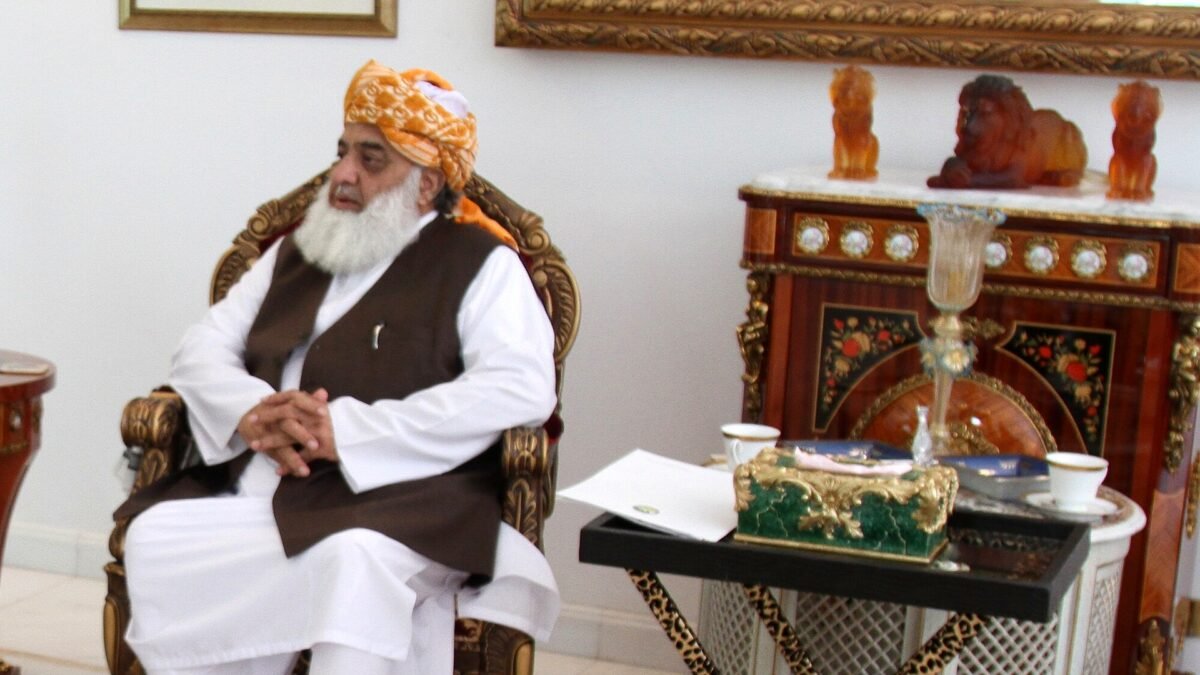
Police in Lahore confined Jamiat Ulema-i-Islam-Fazl (JUI-F) chief Maulana Fazlur Rehman to his residence for about 12 hours on Tuesday, 24 November 2026, surrounding the house with a heavy contingent, containers and a water cannon and preventing him from addressing a lawyers’ conference he had been invited to speak at. The JUI-F chief eventually addressed the gathering by video link, accusing the authorities of placing him under what he called a “state siege”, while his party filed a habeas corpus petition in the Lahore High Court challenging what it described as his unlawful detention. Police withdrew from the area in the evening, after the conference had ended.
According to the JUI-F, Fazl arrived in Lahore on Monday night and was due to address an all-parties conference organised by the Lahore High Court Bar Association on Tuesday. Instead, police took up positions outside his residence in Park View City, near Thokar Niaz Baig in the Chuhng area, and stopped him from leaving. Containers were placed at the housing society’s main gate, a water cannon was brought in, and police personnel were also deployed in a park opposite the residence. Residents of the society were stopped from entering or leaving, according to the party.
Police did not deny the deployment. According to Centreline, police said personnel had been deployed outside Fazl’s residence and that the JUI-F chief had been asked to limit his movement. The police account and the party’s account agree on the central fact — a large police presence ringed the house and Fazl did not leave it for most of the day — but they differ sharply on why the deployment happened and whether it amounted to confinement.
Senator Kamran Murtaza, a senior JUI-F leader, condemned the restrictions in the strongest terms. “Maulana Fazl is the head of a major political party in the country. Preventing him from leaving his residence runs against fundamental civil liberties and democratic traditions,” he said, according to Centreline. He added that political differences were no justification for obstructing any leader’s freedom of movement, and demanded that the barriers be removed at once.
Murtaza also said the police neither allowed the party’s legal team to meet Fazl nor produced any written order authorising his confinement. The party says no formal detention order was shown to Fazl’s staff despite repeated demands. That absence of paperwork is central to the legal challenge now before the courts.
Petition filed in the Lahore High Court
A petition was filed in the Lahore High Court on Tuesday seeking Fazl’s recovery, arguing that police had cordoned off his residence and restricted his movement, effectively placing him under house arrest. The plea was filed by JUI-F worker and lawyer Advocate Abrar Hussain, who named the Punjab police chief, the Lahore deputy commissioner and other officials as respondents. The petitioner asked the court to order Fazl’s release and allow him freedom of movement, and sought an immediate hearing.
According to WePunjab, the court has fixed the petition for hearing on Wednesday morning before Justice Jawad Zafar. The hearing will decide whether the restrictions outside Fazl’s residence were lawful and whether any order should be passed against the police action. The petition argues that the confinement was imposed without any legal order authorising detention or house arrest.
The episode also drew a reaction inside the lawyers’ conference itself. Pashtunkhwa Milli Awami Party chairman and opposition leader Mahmood Khan Achakzai addressed the Lahore High Court Bar Association conference and condemned the alleged confinement of Fazl, according to WePunjab. Achakzai is a central figure in the opposition alliance that has been coordinating with both the JUI-F and the Pakistan Tehreek-i-Insaf (PTI) in recent weeks.
Fazl speaks by video link and alleges a “state siege”
Unable to attend in person, Fazl addressed the all-parties conference through a video link. He alleged that the rulers had placed him under a “state siege” and said roadblocks and checkpoints had effectively choked Lahore, preventing him from reaching the event. He also alleged that JUI-F workers in Bhakkar, Mianwali, Khushab and Sargodha were facing arrests and harassment ahead of the party’s planned public gathering in Sargodha on 26 November, and vowed that the gathering would go ahead, accusing the authorities of using pressure tactics to prevent mobilisation.
The confinement lasted for about 12 hours, according to a detailed account of the day’s events, and police reportedly withdrew in the evening, by which time the lawyers’ event had already concluded. Fazl’s message to the conference therefore reached his audience only through the recorded video, not in person.
A second, conflicting account of the day
Not every account of the day agrees with the JUI-F’s version of events. Burak Digital, in a fact-check published on Tuesday, presented a different explanation, saying its information indicated that Fazl had visited Park View to inspect properties linked to him, accompanied by JUI-F secretary general Maulana Abdul Ghafoor Haideri, Senator Kamran Murtaza and an associate, and that a heated dispute had broken out over a property-related matter, with firearms reportedly drawn. According to that account, residents contacted emergency police services, and the police deployment was a response to the disturbance rather than an attempt to stop Fazl from attending the lawyers’ event.
That version of events has not been confirmed by any other outlet, and it contradicts the JUI-F’s account and the statements of the party’s own leaders, who were present in Lahore. It also sits uneasily with the fact that the police deployment included containers, a water cannon and prisoner vans — equipment associated with crowd control and the sealing of an area, rather than a routine response to a neighbourhood dispute. The dispute over what happened in Park View City is, for now, unresolved, and this article reports both accounts as claims rather than as established fact. What is not in dispute is that a heavy police contingent was deployed, that Fazl did not attend the conference in person, and that he addressed it by video instead.
The incident also recalls a similar controversy on 19 November, when the JUI-F claimed police had established a checkpoint outside Fazl’s Islamabad residence to restrict his movement. Islamabad Police rejected that claim, saying the checkpoint was part of security arrangements. The pattern of competing claims — the party alleging restrictions, the authorities offering a security explanation — has now repeated itself in Lahore, and it is one reason the Lahore High Court petition matters: a judicial finding would settle, at least in law, whether Tuesday’s deployment was a security measure or a confinement.
Imran Khan directs PTI to reach out to Fazl on the same day
The Lahore episode unfolded on the same day that the PTI’s core committee was told of fresh instructions from the party’s incarcerated founder, Imran Khan, directing the party to expand its political alliance and extend outreach to Fazl and other opposition parties. The timing links the two developments: on the day one opposition leader was confined to his home, another opposition leader, from prison, was ordering his party to build a broader front with him.
According to a statement issued after the PTI core committee’s overnight meeting, which began on Monday and was chaired by party chairman Barrister Gohar Ali Khan, Imran Khan had expressed his complete confidence in the opposition leadership and directed that the political alliance be further expanded, with outreach extended to Maulana Fazlur Rehman and other opposition parties, with the objective of forming a broader political alliance and initiating vigorous political activities. The instructions were conveyed to the committee by lawyer Sardar Latif Khosa, who had briefed members on his meeting with Imran Khan and his wife, Bushra Bibi, at Adiala jail on 11 November, a meeting said to have lasted three hours.
The core committee also discussed Imran Khan’s instructions on the debate over creating new provinces. It decided that the matter would be deliberated in detail at a forthcoming meeting of the PTI parliamentary party, with recommendations to be presented to Imran Khan for his decision. The committee expressed serious concern about the health of Imran Khan and Bushra Bibi, demanded implementation of the Supreme Court’s 18 August decision directing that Imran be transferred to Shifa International Hospital in Islamabad, and called for unrestricted access for his personal physicians. It also decided to observe 26 November nationwide as Martyrs’ Day, marking the second anniversary of the deaths reported during the 2024 protests in Islamabad, when deaths were reported among both protesters and security personnel.
The committee strongly condemned the continued detention of Sohail Afridi, who has been rendered non-functional as the Khyber Pakhtunkhwa chief minister following the imposition of governor’s rule, along with other PTI lawmakers. It particularly condemned the extension of detention orders under Section 3 of the Maintenance of Public Order against elected representatives and political workers, maintaining that the continued detention of elected representatives and restrictions on their political activities were contrary to fundamental constitutional, democratic and human rights. It appealed to the Federal Constitutional Court to modify the existing stay order concerning Section 3 of the Maintenance of Public Order and provide relief to political leaders and workers who had been granted bail by the Peshawar High Court before 5 November but whose release orders remain unimplemented.
Early in November, leaders of the opposition alliance Tehreek-i-Tahaffuz-i-Ayeen-i-Pakistan, which includes the PTI, had met Fazl, and the two sides had agreed to strengthen their alliance and parliamentary coordination. Opposition parties appear to have increased their coordination after the 11 October imposition of emergency and governor’s rule in Khyber Pakhtunkhwa, where the PTI had been in power — a move that also drew criticism from Fazl.
Background: a confrontation building for weeks
The Lahore confinement did not come out of nowhere. Tensions between Fazl and the federal government have escalated steadily since mid-October, and the events of the past week form a clear sequence leading to Tuesday.
On 11 October, the federal government imposed governor’s rule and a state of emergency in Khyber Pakhtunkhwa, the province where the PTI held power. Fazl criticised the move sharply, and he has accused the Centre of reneging on its commitments despite his efforts to mediate between the ruling Pakistan Muslim League-Nawaz (PML-N) in the Centre and the PTI. He has also accused the establishment of turning against him over his criticism of the exploitation of mineral resources in the former tribal areas, and of interfering in politics more broadly.
On 5 November, Fazl hosted opposition unity talks at which the opposition parties agreed to hold an all-parties conference within ten days — the conference that was ultimately organised by the Lahore High Court Bar Association and that he was prevented from attending in person on Tuesday.
Last week, the pressure intensified. On Wednesday evening, 18 November, police and Federal Constabulary personnel assigned to provide security to Fazl and his family were withdrawn from their residences in Islamabad and Dera Ismail Khan. According to Dawn, the withdrawn security covered Fazl, his son Asad Mehmood and his brother Maulana Attaur Rehman. JUI-F leaders said the security staff were directed to report back to police lines, and some were told to leave their posts within 15 minutes. The party said the withdrawal came despite a threat letter, and warned that the rulers would be responsible if the leadership was harmed.
The withdrawal drew condemnation across party lines. Opposition members of the JUI-F and the National Party walked out of the Balochistan Assembly on Monday, 23 November, in protest against the reported withdrawal of security for Fazl, before returning after persuasion by provincial ministers. Khyber Pakhtunkhwa Governor Faisal Karim Kundi called for the restoration of Fazl’s security, saying the JUI-F chief was the head of a political party and deserved respect, and that providing security to every political leader was the government’s responsibility. The News reported Kundi as saying that if Fazl faced a security threat, he must be provided with adequate protection.
On 19 November, the Islamabad Anti-Terrorism Court issued non-bailable arrest warrants for Mufti Abrar Ahmed, Fazl’s personal secretary, in connection with a first information report relating to a gathering outside Farooq-i-Azam Masjid in Islamabad’s Sector I-9/4 on 7 November, held without a no-objection certificate. The warrants were served at the mosque on 19 November. Fazl’s son, former federal communications minister Asad Mahmood, has also been summoned by the National Accountability Bureau over alleged irregularities in appointments at Pakistan Post during his 2022-23 tenure, and according to NAB sources cited by Centreline, he did not appear before the anti-graft watchdog despite receiving two consecutive summonses, for 10 and 14 November.
Speaking to party workers after Friday prayers in Peshawar on 20 November, Fazl warned that attempts to intimidate his party through retaliatory actions would fail. He said the government had repeatedly urged his party to join the ruling arrangement, claiming it could not function without JUI-F support and offering the provincial government, and that after the JUI-F refused, the authorities had threatened to reopen cases against party leaders. He said his party would continue a political struggle without weapons. He also accused the same people who had once united the four provinces of now talking about dividing each province, and said governor’s rule and an emergency had been imposed in Khyber Pakhtunkhwa because the Mines and Minerals Act had not been passed there.
The new-provinces debate sits at the centre of the wider crisis. Interior Minister Mohsin Naqvi first raised the idea of creating new provinces on 31 July, and the proposal — which could see the number of provinces rise to as many as 14 — has divided the ruling coalition ever since. The PPP, whose base is Sindh, has resisted any division of the province, and its chairman, Bilawal Bhutto-Zardari, has warned that a forced division of Sindh would spill blood. The PML-N has argued for a referendum to gauge public opinion, and Defence Minister Khawaja Asif has said a referendum on new provinces could move forward in early 2027. Prime Minister Shehbaz Sharif has now directed his ministers to stop attacking each other publicly over the issue, after a series of open exchanges between cabinet colleagues, including a row involving Naqvi and senior PML-N figure Rana Sanaullah. The PTI, for its part, has backed a referendum in principle while deferring its final position to its parliamentary party.
Fazl himself is no stranger to confrontation with the state. He faced detention during the martial law regimes of General Ziaul Haq and General Pervez Musharraf, and he leads one of Pakistan’s most organised religio-political parties, rooted in the Deoband school of Islamic thought, with a street network that can mobilise quickly across Khyber Pakhtunkhwa and Balochistan. That history is part of why Tuesday’s events carry weight beyond a single day’s policing: Fazl is not a marginal figure, and the treatment of a party chief who has survived multiple assassination attempts and led a major parliamentary bloc is read, by his supporters and his critics alike, as a signal of how the government intends to handle the opposition as a whole.
Analysis: why it matters
Tuesday’s events matter for three reasons, and each of them reaches beyond the gates of one housing society in Lahore.
First, the confinement — whatever its cause — has turned Fazl from a critic of the government into a symbol of its treatment of the opposition. The images and reports that circulated through the day — containers at the gate, a water cannon, residents stopped from moving — are the kind of scenes that harden political positions rather than soften them. When a party chief is prevented from attending a lawyers’ conference, the story is no longer about one man’s movements; it becomes a question about the space available for opposition politics itself. The JUI-F’s language reflects that shift: it spoke of fundamental civil liberties and democratic traditions, and of a “state siege”, framing the day as a test of whether the government respects the rights of its opponents. Even if the authorities’ explanation is accepted at face value — that the deployment was a security response — the optics of sealing off a major opposition leader’s home on the day he was due to speak to lawyers are damaging, and the government has so far offered no detailed public explanation of its own.
Second, the day has accelerated the opposition’s consolidation. The most consequential development of Tuesday may not be the confinement itself but what happened alongside it: Imran Khan’s directive, issued from Adiala jail, ordering the PTI to build a broader alliance with Fazl and other opposition parties and to begin vigorous political activities. The PTI and the JUI-F have a complicated history — they have been rivals as often as allies, and Fazl spent years as a central figure in the Pakistan Democratic Movement that ousted Imran Khan in 2022. But the shared experience of the past six weeks — governor’s rule in Khyber Pakhtunkhwa, the withdrawal of Fazl’s security, the detention of PTI lawmakers, the new-provinces fight — has pushed them together. The early-November meeting between the Tehreek-i-Tahaffuz-i-Ayeen-i-Pakistan leadership and Fazl, and the agreement to strengthen their alliance and parliamentary coordination, was the first step; Imran Khan’s instruction is the second. If the alliance formalises, the government will face a combined opposition that spans the PTI’s mass base, the JUI-F’s organisational network and the smaller parties grouped in the constitutional-protection movement, with the lawyers’ community — historically a powerful political force in Pakistan — as a natural ally. That is a materially different opposition from the fragmented one the government has faced so far.
Third, the courts are becoming the arena where these confrontations are decided. The habeas corpus petition filed on Tuesday, fixed for hearing on Wednesday morning before Justice Jawad Zafar, is the latest in a series of cases in which the judiciary has been asked to rule on the legality of the government’s actions against its opponents. The PTI’s core committee, in the same statement that carried Imran Khan’s alliance directive, appealed to the Federal Constitutional Court to modify its stay order on detention orders under the Maintenance of Public Order, and demanded implementation of the Supreme Court’s August decision on Imran Khan’s medical treatment. The pattern is clear: with parliament offering the opposition little leverage, and with street mobilisation carrying high risks, the courts have become the opposition’s principal forum. How the Lahore High Court handles the Fazl petition — and how quickly — will be watched closely, not least because the petition’s central claim, that no written order authorised the confinement, is the kind of procedural point on which courts can rule without entering the political merits of the dispute.
There is also a narrower but important question that Tuesday leaves unresolved: what exactly happened in Park View City. The JUI-F’s account and the Burak Digital fact-check cannot both be right about why the police were there, and the truth matters — for the court, for the public, and for the credibility of everyone involved. If the deployment was a political decision to stop Fazl from addressing the lawyers’ conference, it raises serious questions about the use of police power against an opposition leader. If it was a response to a genuine disturbance, then the party’s account misled the public and escalated a local incident into a national political crisis. The police have confirmed the deployment but have not, in the reporting so far, given a full public account of the reasons for it. That silence is itself part of the story, and it is one the Lahore High Court hearing may help to fill.
What happens next will be determined by three dates in the immediate future. On Wednesday, the Lahore High Court hears the habeas corpus petition, and its order will establish whether the restrictions were lawful. On Thursday, 26 November, the JUI-F plans a public gathering in Sargodha, and the PTI plans to observe Martyrs’ Day nationwide — two opposition events on the same day, in a climate already charged by Tuesday’s events, will test whether the authorities allow the opposition to mobilise or move to prevent it. And in the weeks that follow, the question of whether the PTI and the JUI-F turn Imran Khan’s directive into a formal, working alliance will shape the politics of the new-provinces debate, the fate of governor’s rule in Khyber Pakhtunkhwa, and the government’s ability to hold its coalition together. Tuesday in Lahore was, on its face, a dispute about one man’s movements for twelve hours. Its consequences are likely to be measured in the politics of the months ahead.
Sources
- Centreline — JUI-F moves LHC against ‘house arrest’ of Maulana Fazl in Lahore
- WePunjab — Establishment Tightens Screws on Maulana Fazlur Rehman
- PTI core committee statement — Imran Khan directs PTI to reach out to Fazlur Rehman and opposition parties
- Pakistan Point — Police Deployed at Maulana Fazlur Rehman’s Lahore Residence, Told to Restrict Movement
- Burak Digital — Fact Check: Fazlur Rehman Was Not Barred From Leaving Home

About the Author — Abdul Mannan
Related Articles

Pakistan’s First Astronaut Muhammad Zeeshan Ali to Fly to China’s Tiangong Space Station on Shenzhou-24
Wing Commander Muhammad Zeeshan Ali will become the first Pakistani in space and the first foreign astronaut to…
Shehbaz Sharif to Make First Official Visit to Russia on 30 November for Putin Talks on Energy, Trade and Defence
Prime Minister Shehbaz Sharif will make his first official visit to Russia from 30 November for talks with…
Pakistan Minister Dodges Indus Waters Questions in New Delhi: ‘You Have Not Invited Me to Discuss It’
Pakistan's climate change minister Musadik Malik declined to discuss the Indus Waters Treaty or terrorism during his New…