
Solomon Islands Signs Landmark Treaty with Australia, Vowing No Foreign Military Base on Its Soil

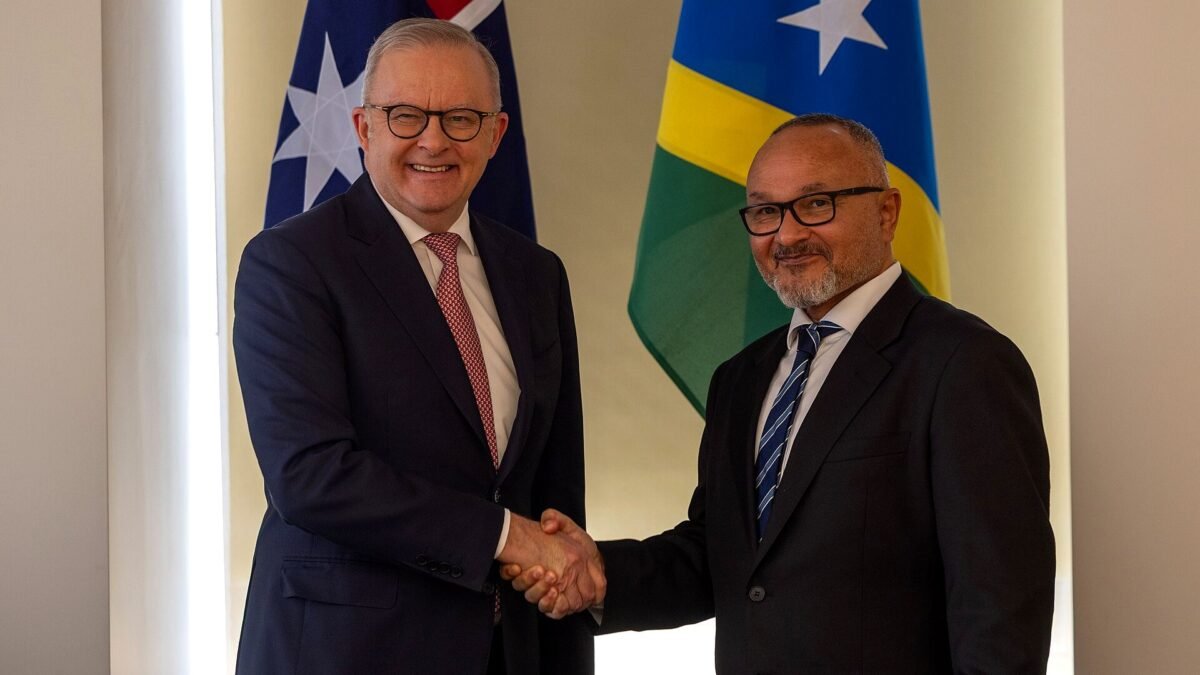
The Solomon Islands has signed a landmark treaty with Australia pledging that no foreign military base will ever be built on its soil, in a sharp reversal of the Pacific nation’s course four years after it signed a secretive security pact with China that alarmed Canberra and Washington.
Solomon Islands Prime Minister Matthew Wale and Australian Prime Minister Anthony Albanese signed the Australia–Solomon Islands Treaty in Canberra on Wednesday, 25 November 2026, according to a joint statement issued by the two leaders. The treaty names Australia as the Solomon Islands’ “primary security partner” and records Honiara’s sovereign decision that there will be no foreign military or security base in the country, and that its sensitive infrastructure will remain free from militarisation, foreign interference and unauthorised access.
“Solomon Islands has been for a number of years a source of uncertainty and doubt in the region,” Mr Wale said at a joint press conference at Parliament House in Canberra. “Those days are done. Gone. We don’t want to be there again.”
Mr Albanese said the treaty elevated the relationship to a “level which has never been seen before and has never been stronger”. The signing was the fifth meeting between the two prime ministers this year, and Mr Wale travelled to Canberra with 17 members of his cabinet, according to Mr Albanese.
The agreement is the most significant setback yet for China’s ambitions in the South Pacific, according to analysts, and the latest in a series of security pacts through which Australia has sought to lock in its position as the security partner of choice for Pacific island states. But its authors were careful to frame it as a partnership between equals, built on sovereignty rather than rivalry, and its lasting value will depend on whether Australia delivers on the money and the promises wrapped around it.
What the treaty says
The treaty, whose text was posted online by Australia’s Department of Foreign Affairs and Trade, commits the Solomon Islands to keeping its sensitive infrastructure free from militarisation. That covers ports, airports, energy and telecommunications networks, as well as road and bridge construction — the sectors where Chinese firms have been most active in the islands through Beijing’s Belt and Road Initiative. The clause will not apply retrospectively to deals already signed, according to reports of the treaty text.
The Solomon Islands will also have to consult Australia before making deals involving its critical infrastructure or security cooperation with any country outside the Pacific Islands Forum, the regional bloc of which Australia is a member but China is not. In return, Australia will continue to help the country strengthen its police force and improve border security, and will support the expansion and development of the Royal Solomon Islands Police Force.
“Australia is proud to be the Solomon Islands’ main security partner, and that’s a responsibility that we take seriously,” Mr Albanese said. “We’ll continue working with Solomon Islands to keep its communities safe, to strengthen its police force and improve border security, and we’ll do that in a way that completely respects Solomon Islands sovereignty.”
The joint statement issued by the two leaders describes the treaty as opening “a new chapter in our bilateral partnership” that will make “Australia, Solomon Islands and the region safer and more prosperous”. It says the two countries are “connected by history, geography, faith and friendship”.
Mr Wale said he would seek legislation to “bed down the treaty” in the Solomon Islands parliament, a step intended to make it harder for any future, more China-friendly government to unwind the arrangement. He told reporters he had the support of parliament to ratify the treaty, and that the decision to sign had been taken by his caucus and his entire cabinet. “There was unanimity to sign, and so that’s what we’ve done,” he said, according to the Australian Associated Press.
The money and the people-to-people offer
The treaty is far broader than security. Australia will provide A$740 million — about US$490 million — over the next decade to fund free education and other programmes in the Solomon Islands, according to reports of the agreement. The package comprises A$670 million in grants and A$70 million in concessional loans, and is due to be in place by January. The money will support the Solomon Islands government’s free education policy, a signature initiative of Mr Wale’s government, as well as health, policing, resources, energy and climate resilience, and will help fund a sovereign wealth fund and road and bridge construction.
The Solomon Islands parliament will return in January to approve significant reforms, including the pledge of free education, according to officials quoted by Agence France-Presse.
The treaty also widens opportunities for Solomon Islanders to live and work in Australia. Under a “PALM Plus” approach, Australia will increase the Solomon Islands’ participation in its Pacific Australia Labour Mobility scheme, opening new opportunities in the aged care and childcare sectors, expanding access to new locations and increasing skills training. Solomon Islanders will benefit from improved visa arrangements, including longer stay periods, extended visa validity and in-country visa facilitation in Honiara, where Australia will open a new visa office.
The two leaders also agreed to strengthen ties through sport, culture, faith and connections with First Nations Australians. Mr Albanese said the treaty would “strengthen our security partnership” and “create more opportunities for our people”, and that the agreement was “part of something much bigger as well”.
The breadth of the package is deliberate. As Oliver Nobetau, the Pacific Islands program director at the Lowy Institute, a Sydney think tank, told the Australian Broadcasting Corporation, the treaty is “significant and fine-tuned to the Solomons’ priorities”. “It demonstrates that Australia is listening to what the Pacific partners want,” he said.
The China question
The signing followed weeks of reports that Honiara was preparing to step back from the security arrangement it struck with Beijing in 2022. Australian media reported on Wednesday that the Solomon Islands’ pact with China had been scrapped, although Mr Wale declined to confirm or deny the reports at the press conference, citing a non-disclosure clause in the Chinese agreement.
“Unfortunately there is a non-disclosure clause in the treaty with China,” Mr Wale told reporters. “So I am unable to talk about that. We have ongoing discussions with China.”
Under the 2022 arrangement, which was due to run for five years, the Chinese security pact would expire in early 2027. Australian media have reported that the Solomon Islands government has told Beijing the pact will not be renewed when it lapses. Mr Nobetau said that for the Solomon Islands to let the agreement lapse in April 2027, Australia would have had to offer “something substantial”.
In Beijing, a spokesperson for China’s foreign ministry did not directly answer a journalist’s question on Tuesday about whether the Solomon Islands had said it would end the Chinese security pact. “China always follows the principle of mutual respect and equality in developing relations with the Solomon Islands,” the spokesperson, Guo Jiakun, said, according to the Associated Press. “There is no element of geopolitical rivalry or bloc confrontation in cooperation between China and Pacific island countries, including the Solomon Islands.”
China has denied that it is seeking to open a military base in the Solomon Islands. A spokesman for China’s foreign ministry said this week that Beijing’s diplomacy in the Pacific was “not for geopolitical contest” and criticised efforts to thwart China’s regional engagement, according to the Wall Street Journal.
The distinction matters. Nothing in the new treaty formally cancels the 2022 Chinese pact, which runs until next year, and Mr Wale was careful not to present the agreement with Australia as a rupture with Beijing. But the practical effect is unmistakable: a country that four years ago signed a secretive deal that could have allowed Chinese warships to dock and Chinese forces to deploy on its soil has now signed a public treaty that forbids any foreign military base and gives Australia a say over its future security and infrastructure deals.
Why the Solomon Islands matter
The Solomon Islands is a nation of fewer than 900,000 people spread across about 1,000 islands some 2,000 kilometres (1,200 miles) north-east of Australia, according to the Associated Press. Its strategic importance is out of all proportion to its size.
The archipelago sits astride the sea route between the United States and Australia. During the Second World War, United States allies fought pivotal battles against Japanese forces on the islands, above all the six-month campaign for Guadalcanal in 1942–43, one of the Pacific War’s turning points. The country remains, in the Associated Press’s words, “strategically imperative territory in the U.S. struggle against China for global influence”.
That history explains why the 2022 pact caused such alarm. A Chinese naval foothold in the Solomon Islands would sit across the shipping lanes that link Australia to the United States and to Asia, and within easy reach of Australia’s east coast. For Canberra, the prospect of a strategic adversary establishing a base less than 2,000 kilometres from Queensland was the most serious security challenge in the Pacific since the Second World War.
The islands’ modern history has also made them a testing ground for outside intervention. After years of ethnic tension known as “the Tensions”, an Australian-led regional force, the Regional Assistance Mission to Solomon Islands, deployed in 2003 and stayed for 14 years, restoring order and rebuilding institutions. Australia has been the country’s largest development partner ever since, and Australian police and officials have remained a constant presence in Honiara.
Four years of alarm: the 2022 pact
The roots of Wednesday’s treaty lie in a document that was never meant to be seen. In March 2022, a draft security agreement between China and the Solomon Islands was leaked online and verified as genuine by the Australian government. It said the Solomon Islands could, “according to its own needs”, request China to send police, armed police, military personnel and other law enforcement and armed forces to assist in “maintaining social order, protecting people’s lives and property”. It also said China could, with Honiara’s consent, “make ship visits to, carry out logistical replenishment in and have stopover and transition in the Solomon Islands”, with the Solomon Islands providing “all necessary facilities”.
The draft set off alarms throughout the Pacific. Charles Edel, the inaugural Australia chair at the Center for Strategic and International Studies, said at the time that a base in the Solomon Islands “would significantly degrade Australia and New Zealand’s security, increase the chances of local corruption and heighten the chances of resource exploitation”. The then leader of the opposition in Honiara, Matthew Wale himself, warned that the “very general, overarching, vague” agreement could be used for anything, and said its purpose was “all about political survival for the prime minister” — a reference to Manasseh Sogavare, who led the government at the time.
The pact was signed the following month, in April 2022, by Chinese Foreign Minister Wang Yi and his Solomon Islands counterpart Jeremiah Manele, according to Radio Free Asia. The United States responded by sending a delegation led by Kurt Campbell, the National Security Council’s Indo-Pacific coordinator, and Daniel Kritenbrink, the Assistant Secretary of State for East Asian and Pacific Affairs, to Honiara for a 90-minute meeting with Mr Sogavare. Washington said it would “respond” if steps were taken to establish a de facto permanent military presence, power-projection capabilities or a military installation. Mr Sogavare gave the delegation three assurances: there would be no military base, no long-term presence and no power-projection capability.
Those assurances did little to calm the region’s neighbours. The Solomon Islands government insisted the agreement did not invite China to establish a base, and Mr Sogavare told parliament his country sought only peace and prosperity, citing its foreign policy mantra: “We are friends to all and enemies to none.” But the secrecy surrounding the deal — Mr Sogavare said he would only share its details with China’s permission — deepened the suspicion, and the agreement became a symbol of Beijing’s growing reach into a region Australia had long regarded as its own backyard.
The pact followed the Solomon Islands’ decision in 2019 to switch diplomatic recognition from Taiwan to Beijing, a move that contributed to riots in Honiara in November 2021, when crowds burned buildings in the Chinatown district and Australian police were flown in to restore order. Chinese police trainers have since been stationed in Honiara under the 2022 arrangement, and Chinese firms have built infrastructure across the islands under Belt and Road loans.
Wale’s pivot
Mr Wale took office as prime minister in May 2026, and he has moved quickly to reorient the country’s foreign policy. He was a long-time critic of the 2022 deal with China, echoing the United States and other Pacific nations in warning that it would upset regional security and could jeopardise relationships with existing partners. But in 2025 he led a delegation to Beijing, where he praised China’s economic development and said his party supported the one-China principle — a reminder that Honiara’s turn towards Canberra is a recalibration, not a repudiation of Beijing.
Since taking office, Mr Wale has been on what Agence France-Presse called a diplomatic sprint, travelling to Canberra and Washington to rebuild relationships with traditional partners. He visited Australia in June 2026, when he and Mr Albanese set an ambitious goal: to conclude a comprehensive treaty by early December, perhaps late November. “We’re in late November,” Mr Wale said at the press conference. “So, congratulations.”
He has also faced political headwinds at home. Earlier this year he survived a vote of no confidence against his leadership, which was eventually withdrawn, according to the Australian Associated Press. He told reporters in Canberra that the decision to sign the treaty had the backing of his parliament, his caucus and his entire cabinet.
The treaty is the culmination of that effort, and it is deliberately structured to outlast him. By seeking legislation to entrench it, Mr Wale is trying to make the no-base commitment and the Australian partnership difficult for any successor to reverse — a direct answer to the criticism levelled at the 2022 pact, which was negotiated in secret by a small circle and never put to the public.
Analysis: a win for Canberra — but the hard part is delivery
For Australia, Wednesday’s signing is the biggest success yet in a campaign that began the moment the 2022 China pact leaked. Since Mr Albanese’s government was first elected in late 2022, Canberra has been attempting to edge Chinese influence out of the Pacific through bilateral security agreements with Fiji, Tuvalu and Vanuatu. Last year it signed a mutual-defence treaty with Papua New Guinea — its first military alliance since the ANZUS treaty with New Zealand and the United States in 1951 — promising its nearest neighbour A$600 million over a decade, including funding for a rugby league team in the Australian national competition. Pacts with Vanuatu and Fiji followed in June and July 2026.
But the Solomon Islands deal goes further than any of its predecessors, and not only because of the money. Connor Graham, a research fellow in the Pacific Islands program at the Lowy Institute, said the agreement, “coupled with indications that Solomon Islands will let the China deal lapse, goes beyond the success of the previous deals” Australia has struck in the region. “It is a blow to Chinese security ambitions in the Pacific certainly,” he told CNN.
Three features make it different. First, the no-base pledge is absolute and public, written into a treaty rather than offered as a verbal assurance behind closed doors. Second, the consultation clause gives Australia a formal role in Honiara’s future decisions on critical infrastructure and security cooperation — a constraint no previous Pacific pact has contained. Third, the package is explicitly tied to the Solomon Islands’ own priorities, above all free education, rather than to Australia’s security agenda alone. That is the lesson Canberra has drawn from two decades of Pacific diplomacy: money that answers a country’s own needs buys more loyalty than money that answers Canberra’s fears.
Yet the treaty also exposes the limits of Australia’s approach. China remains the Solomon Islands’ largest trading partner, and Mr Graham warned that the country is vulnerable to potential retaliation from Beijing. “The question now is can Australia deliver on whatever promises and commitments have been made to make this worth the blowback in the long term for Solomon Islands,” he said.
That is the real test. The A$740 million is spread over a decade, and its value will be judged not in Canberra but in Honiara’s classrooms, clinics and police stations. The free education pledge must be funded, the visa changes must work in practice, and the infrastructure promises must survive the politics of both countries. If the money arrives slowly or the benefits prove thin, the treaty’s critics — in Honiara and in Beijing — will say the Solomon Islands traded a flexible relationship with China for a ribbon-cutting ceremony in Canberra.
There is also a question about what the treaty does not do. It does not formally cancel the 2022 pact with China, which runs until April 2027 and whose contents remain partly secret. It does not apply retrospectively to Chinese-built infrastructure already in place. And it does not resolve the underlying competition: Beijing’s interest in the Pacific is driven by trade, resources and strategic depth, none of which disappears because one small island state signs a treaty with Australia. China will continue to court the Solomon Islands and its neighbours, and Honiara will continue to accept Chinese trade and investment — as Mr Wale’s own 2025 visit to Beijing made clear.
The treaty’s deeper significance may therefore be less about China than about the Pacific itself. For years, small island states have been treated as prizes in a contest between great powers, courted with cheques and threatened with consequences. The Solomon Islands treaty is an attempt to break that pattern by giving the smaller partner something concrete — money for schools, visas for workers, a say in its own security — in exchange for a clear strategic choice. Whether that bargain holds will be decided not in Canberra or Beijing, but in Honiara, in the months and years after the handshakes are forgotten.
What to watch next
The first test comes in January, when the Solomon Islands parliament returns to approve the reforms underpinning the treaty, including the free education pledge, and to consider the legislation Mr Wale has promised to entrench the agreement. The Australian funds are due to be in place by the same month, and the speed with which they flow will be the first measure of whether Canberra can deliver.
The second test comes in April 2027, when the 2022 security pact with China expires. If Honiara lets it lapse without renewal, as Australian media have reported it intends to do, the break with Beijing’s security presence will be complete. If it is renewed in some form, or quietly extended, the treaty’s no-base pledge will be tested in a very different way. Watch, too, for Beijing’s response: China has so far confined itself to measured language about mutual respect and equality, but its leverage as the Solomon Islands’ largest trading partner gives it options that range from quiet diplomacy to economic pressure.
The third test is the treaty’s implementation. The consultation clause on critical infrastructure will be invoked the first time Honiara considers a major project with a non-Forum partner. The police and border-security commitments will be measured against the reality of a force that has struggled with capacity for decades. And the PALM Plus visa changes will be judged by Solomon Islanders who take up work in Australian aged care and childcare — or who find the door narrower than promised.
Finally, watch the region. Australia’s Pacific strategy now rests on a chain of bilateral pacts — Papua New Guinea, Vanuatu, Fiji, Tuvalu and now the Solomon Islands. Each one narrows the space for a Chinese military presence in the South Pacific, but each one also raises the stakes: the more Canberra promises, the more it must deliver, and the more visible any failure becomes. The Solomon Islands treaty is the most ambitious link in that chain. It is also the one with the most to prove.
Sources
Australian Department of Foreign Affairs and Trade — “Australia–Solomon Islands engagement”

About the Author — Abdul Mannan
Related Articles
Ukraine Says It Damaged Five Russian Jets, Including Kinzhal-Carrying MiG-31s, in Strike on Savasleyka Air Base
Ukraine says it damaged three MiG-31 jets and two Su-34 bombers at Russia's Savasleyka air base, 300 kilometres…
Second Russian Airspace Breach in Four Days as Poland Renews Push for Permanent US Troops
A Russian drone briefly entered Polish airspace overnight on 24 November, the second breach in four days, prompting…
Leaked Russian Data Puts War Dead at More Than 720,000, Analysis Finds
Leaked records from Russia's own statistics agency show at least 490,000 soldiers registered dead — and a real…