
Kim Jong Un Orders Tactical Nuclear Weapons Deployed Across Multiple Domains as North Korea Expands Its Arsenal

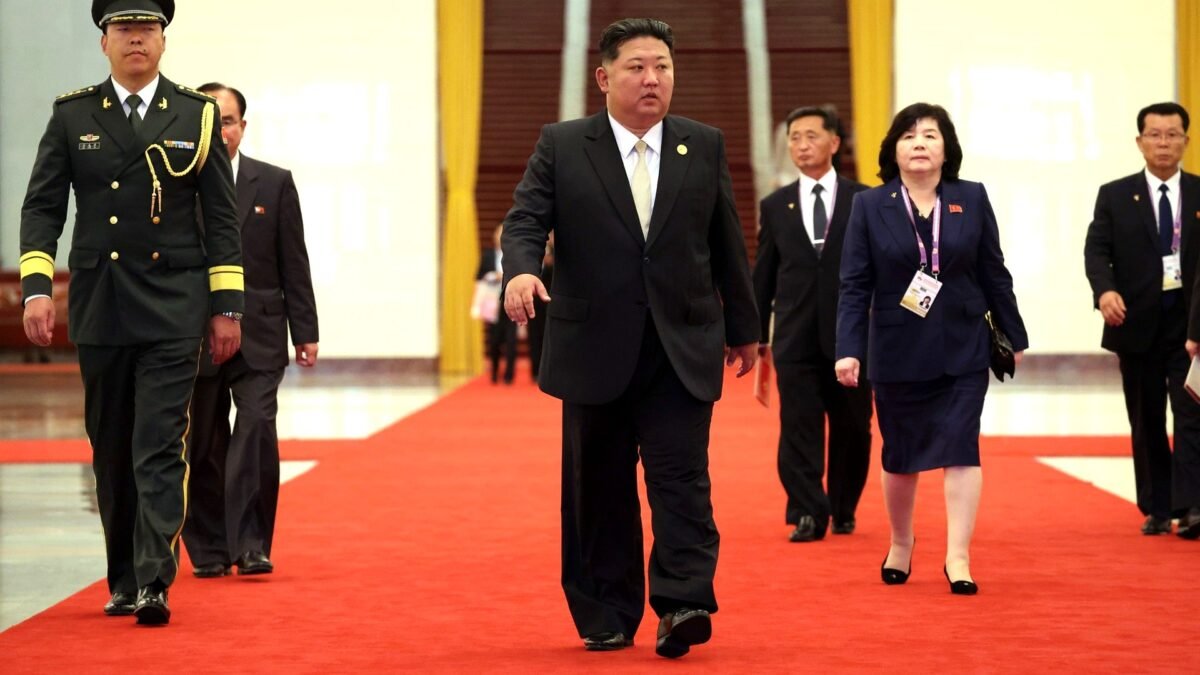
North Korean leader Kim Jong Un has ordered his country to deploy tactical nuclear weapons across multiple domains, declaring that North Korea’s status as a nuclear weapons state is “absolutely inviolable” and that its nuclear arsenal will never be given up, according to state media reports published on Thursday.
Kim issued the order during an inspection on Wednesday of nuclear material production facilities and a nuclear weapons research institute, the Korean Central News Agency (KCNA) reported. Photographs released by the agency showed Kim walking between dense rows of what analysts said looked like gas centrifuges used to enrich uranium, and touring halls displaying what were believed to be miniaturised nuclear warheads.
“Our nuclear capability is now a reality,” KCNA quoted Kim as saying. He said North Korea should “focus on utilizing tactical nuclear weapons across multiple domains for different missions” and described the deployment of such weapons as an important and urgent task. He also said nuclear material production capacity was being systematically expanded and called recent achievements in nuclear weapons production a major success in carrying out the country’s nuclear force policy.
The inspection, and the language that accompanied it, amounted to the clearest statement yet from Pyongyang that it regards its nuclear arsenal as permanent, that it intends to widen the ways in which those weapons can be used, and that it will not return to talks about giving them up. Any attempt to deny North Korea’s nuclear status, Kim said, would be regarded as “an open declaration of war”.
“Our possession of nuclear weapons is an absolutely irreversible choice as long as malicious forces exist that use nuclear weapons as a means of achieving hegemony,” Kim said, according to KCNA. He added that North Korea’s status as a nuclear weapons state would not change because of outside assertions or what he called “denuclearization rhetoric from forces that ignored objective reality and failed to recognize the changed situation.”
What Kim inspected
According to KCNA, Kim visited two nuclear materials production factories, one newly inaugurated and the other being expanded, as well as a nuclear-powered equipment production base and the Nuclear Weapons Institute. The agency did not identify the facilities or their locations, and it did not say when the photographs were taken beyond the inspection on Wednesday.
North Korea has disclosed a uranium enrichment site only a few times since it showed one at its main Yongbyon nuclear complex to visiting American scholars in 2010. In June this year, when North Korea disclosed parts of a uranium enrichment site while reporting on another visit by Kim, outside experts assessed that it was likely an additional uranium enrichment facility at Yongbyon. Analysts who studied the latest photographs said the enrichment facility shown this time appeared to have a different structure from existing ones, and assessed that it may be a new underground uranium enrichment facility.
The photographs also showed warheads carrying a series of names, including Hwasan-14, Hwasan-21, Hwasan-22, Hwasan-23, Hwasan-24 and Hwasan-25, according to analysis cited by South Korean media. Shin Jong-woo, secretary-general of the Korea Defence and Security Forum, assessed that the display indicated a move to show off a diversified range of warheads, with the Hwasan-25 presumed to be a small hydrogen bomb. The best-known of the family, the Hwasan-31, was unveiled by KCNA in 2023 as a miniaturised, standardised tactical nuclear warhead that Pyongyang said could be fitted to a range of delivery systems, including short-range missiles.
Tactical nuclear weapons are generally lower-yield warheads meant for battlefield use, unlike strategic weapons designed for longer-range strikes against cities or distant targets. The distinction matters because a country that fields tactical weapons in larger numbers, across more delivery systems, is building an arsenal designed to be usable in a regional war, not only to deter one.
Kim also reviewed the construction of a new production factory and the expansion of another facility, and praised the scientists, technicians and officials involved in advancing the nuclear programme, KCNA reported. He said the development of newly manufactured nuclear-powered equipment and devices would improve the effectiveness of North Korea’s nuclear deterrent and enhance its preparedness for actual warfare.
According to KCNA, Kim reviewed the activities and production achievements of the country’s nuclear weapons sector in 2026, and checked progress on the nuclear strategy set out at the ninth congress of the Workers’ Party of Korea earlier this year. Analysts in Seoul said the visit was also likely meant to take stock of how the state’s objectives for the nuclear programme had progressed this year, and what future goals should be set ahead of a year-end Workers’ Party conference.
The message to Washington
Kim justified the buildup by citing what he described as growing nuclear threats from the United States and its allies. The United States had “incited its vassal states” near North Korea to acquire nuclear-powered submarines by introducing the “dangerous precedent of nuclear proliferation through AUKUS to Northeast Asia,” he said, referring to the trilateral security pact involving the United States, Britain and Australia.
He also accused Washington of building a “nuclear military alliance system” by trying to share and use nuclear weapons with its allies. South Korea is pursuing nuclear-powered submarines after United States President Donald Trump approved the plan in October 2025, and the topic has also been under discussion in Japan, according to Reuters.
Analysts said the visit carried a message for Washington amid speculation about renewed diplomatic contact between the United States and North Korea. Kim ignored an offer from Trump to meet during the American president’s recent visit to Asia, and earlier this month his sister, Kim Yo Jong, ruled out talks with Washington, days before North Korea fired multiple missiles.
“This is not so much North Korea permanently closing the door to dialogue with the United States as a strategy of raising the bar: ‘denuclearisation talks’ are over, and if talks open in future, it will deal only on a ‘nuclear state versus nuclear state’ basis,” said Lim Eul-chul, a professor at South Korea’s Kyungnam University, according to Reuters.
Shin Jong-woo said Kim’s reference to “multiple domains” could signal targets beyond the Korean peninsula, including the United States mainland. “Kim’s intent seems to be that with no alternatives now, Pyongyang will build up its nuclear forces further and head toward a setup in which it can confront the US,” Shin said.
The emphasis on tactical weapons, rather than on the long-range missiles that can reach the American mainland, is itself part of the message. By presenting a diversified, battlefield-ready arsenal, Pyongyang is telling Washington and Seoul that its nuclear programme is no longer a single bargaining chip to be traded away, but a standing military capability woven into its war planning.
The submarine thread
One stop on Kim’s tour drew particular attention from analysts: the nuclear-powered equipment production base. Photographs from the site showed equipment that analysts said may be the first showing of hardware for a naval nuclear reactor programme. Ankit Panda, an analyst at the Carnegie Endowment for International Peace, wrote that the images from the base, which he described as a naval reactor facility, were “a very notable disclosure”. Shin Jong-woo assessed that the facility was believed to be producing submarine reactors and parts, adding that the pictured equipment could be used in a nuclear-powered submarine planned for next year.
North Korea has been pursuing a nuclear-powered submarine for several years. In March 2025, state media released photographs showing what it called “a nuclear-powered strategic guided missile submarine” under construction, as it reported Kim’s visits to major shipyards. That vessel appeared to be a 6,000-ton-class or 7,000-ton-class submarine capable of carrying about 10 missiles, according to Moon Keun-sik, a submarine expert at Seoul’s Hanyang University. Then, in December 2025, KCNA released images of the hull of what the North calls an 8,700-ton nuclear-powered submarine, with Kim and his daughter inspecting the vessel inside an assembly hall.
Moon said that because submarines are typically built from the inside out, the views of what appeared to be a largely completed hull suggested many core components were already in place. If North Korea obtains a submarine capable of operating stealthily for extended periods and launching missiles from underwater, it would be a worrying development for its neighbours, because such launches would be difficult to detect in advance. Questions have persisted about whether the heavily sanctioned North could obtain the resources and technology needed to build nuclear-powered submarines, and Moon has said North Korea may have received Russian technological assistance to build a naval reactor in return for supplying conventional weapons and troops to support Russia’s war in Ukraine.
The head of the International Atomic Energy Agency, Rafael Grossi, called the North’s nuclear expansion “a cause for serious concern” last week. Grossi had already warned in June about signs of uranium enrichment activity at Yongbyon and continuing construction work on tunnels at the Punggye-ri nuclear test site. Satellite imagery has also suggested that a rapidly built extension at Yongbyon could support increased production of weapons-grade uranium, according to a United States institute cited by South Korean media.
A nuclear-powered submarine would give North Korea something it has never had: a survivable second-strike platform that could remain hidden at sea. That is a different kind of threat from land-based missiles, which can in principle be located and targeted, and it is one reason the reactor facility photographs attracted such close study.
How Seoul responded
South Korea’s Defence Ministry said on Thursday that it was taking Kim’s comments on battlefield nuclear weapons seriously, and urged Pyongyang to “immediately stop trying to justify its nuclear development” and to implement United Nations Security Council resolutions. The ministry said Seoul maintained firm military readiness against Pyongyang’s nuclear threats under its alliance with the United States.
South Korea’s Joint Chiefs of Staff declined to share an analysis of the North Korean nuclear facilities shown by KCNA, calling it confidential information for South Korea and the United States. The restraint is understandable: public assessments of the photographs could reveal what allied intelligence does and does not know about the sites.
Seoul’s position is complicated by its own submarine ambitions. South Korea plans to use United States-approved low-enriched uranium reactors for conventionally armed submarines expected to enter service after the late 2030s, and the International Atomic Energy Agency said in its first report on the plan, published on 19 November, that it was satisfied with the level of engagement from Seoul. Pyongyang has seized on that plan, and on the AUKUS arrangement, to argue that the rules against nuclear proliferation are being applied selectively. The argument is self-serving, but it has an audience: it gives North Korea a justification, in its own telling, for doing openly what it accuses its rivals of doing with permission.
The wider region has watched the same pattern before. Each time North Korea has unveiled a new capability, it has presented the move as a defensive response to an outside threat, and each time the unveiling itself has become the next source of tension. The cycle is familiar; what is different this time is the breadth of the disclosure, covering enrichment, warhead diversification and naval propulsion in a single tour.
Background: a programme built in stages
North Korea has conducted six nuclear tests since 2006, with its last and most powerful test carried out in 2017. South Korea’s defence minister said in August that Pyongyang was generally believed to possess between 80 and 120 nuclear warheads, but said the estimate came from private research organisations and could not be officially confirmed.
The programme has advanced in public stages, each announced by Kim himself. In 2023, North Korea enshrined its status as a nuclear weapons state in its constitution, and unveiled the Hwasan-31 tactical warhead. This week’s tour was Kim’s fourth publicised visit to a nuclear site, following earlier tours in September 2024, January 2025 and June 2026. The repetition is deliberate: each visit is a public audit of the programme, staged for domestic and foreign audiences alike.
The ninth congress of the Workers’ Party of Korea, held in February this year, set the nuclear strategy that Kim is now shown implementing. The congress formalised the direction of travel that had been clear since the constitutional change: the arsenal would grow, diversify and become more operationally usable, rather than remaining a small stockpile of strategic weapons held in reserve.
That direction has been reinforced by the wider realignment around North Korea. Its deepening military relationship with Russia, including the supply of weapons and troops for the war in Ukraine, has brought it closer to a major nuclear power at a time when its relations with the United States and South Korea have frozen. The war in Ukraine has also shown Pyongyang, in its own reading, that a nuclear arsenal is the one asset that guarantees a state cannot be coerced from outside.
Analysis: why it matters
Three things make this week’s announcement more significant than the routine statements that accompany North Korea’s nuclear programme. The first is the word “tactical”. A strategic arsenal exists to deter; a tactical arsenal exists to be used. By ordering tactical weapons deployed across multiple domains, Kim is describing an arsenal that would be woven into battlefield planning, carried on short-range missiles, and potentially on ships, submarines and aircraft. The more delivery systems a warhead can be fitted to, the more scenarios exist in which a commander might reach for it, and the lower the threshold for nuclear use becomes.
The second is the breadth of the disclosure. Enrichment capacity, warhead diversification and naval propulsion were all displayed in a single day. That is not the behaviour of a state preparing to negotiate its programme away. It is the behaviour of a state advertising that the programme is industrialising: new factories, expanded facilities, new warhead types, new propulsion systems. The message is aimed as much at North Korea’s own scientific and military establishment, which Kim publicly praised, as at the outside world. It tells the people who build the weapons that their work will continue and grow.
The third is the explicit rejection of denuclearisation as a subject for discussion. Kim’s statement that any attempt to deny North Korea’s nuclear status would be an “open declaration of war”, and Lim Eul-chul’s reading that future talks, if any, would proceed only on a “nuclear state versus nuclear state” basis, together close the door on the premise that has underpinned diplomacy with Pyongyang for three decades: that the North’s nuclear programme is a problem to be solved by negotiation. If that premise is gone, the diplomacy that replaces it would have to start from a different place, managing a nuclear-armed North Korea rather than disarming one. That is a profound shift, and it is one that Washington, Seoul and Tokyo have not yet publicly accepted.
There is also a less obvious significance in the timing. The tour came days after Kim ignored Trump’s offer to meet, and weeks before the year-end Workers’ Party conference at which new goals for the programme are expected to be set. The sequence suggests that Pyongyang is setting its own terms before any contact, and that it wants the record to show that it chose the arsenal over the meeting. For a leader who has met an American president face to face, that is a deliberate choice, and it raises the price of any future engagement.
Finally, the submarine thread deserves attention on its own. A nuclear-powered submarine would be North Korea’s most consequential new capability since its first intercontinental ballistic missile. It would complicate detection, extend the range of its deterrent, and give Pyongyang a platform that could survive a first strike. The reactor facility photographs suggest that ambition is being pursued seriously, and that the December 2025 hull was not a one-off display. If a North Korean nuclear-powered submarine puts to sea in the coming years, the security calculations of every country around the Korean peninsula will have to change.
None of this means war is imminent. North Korea’s nuclear programme has always been, above all, an instrument of regime survival, and Kim’s statements are consistent with that logic: the weapons guarantee that the state cannot be destroyed from outside. But a programme built for survival can still produce crises, because each step in its expansion narrows the options of the countries that must live with it, and because a tactical arsenal, by design, is meant to be usable. The danger is not that Kim has announced an attack. It is that he has announced a capability that makes a future miscalculation more dangerous for everyone.
What to watch next
The first thing to watch is the year-end Workers’ Party conference, where Kim is expected to set new goals for the nuclear programme. The language used there, and any specific targets announced for warhead numbers or delivery systems, will show whether this week’s tour was a statement of intent or the beginning of a further acceleration.
The second is whether North Korea stages a seventh nuclear test. It has not tested since 2017, and the tunnels at Punggye-ri have been the subject of IAEA concern. A test of a miniaturised tactical device would be the logical next step for a programme that is now emphasising battlefield weapons, and it would be read internationally as a direct consequence of this week’s announcement.
The third is the submarine. Sea trials of the vessel whose hull was shown in December 2025, and any further disclosure of the naval reactor programme, would confirm that North Korea is moving from a land-based deterrent to a sea-based one. That would be a longer-term development, but the reactor facility photographs suggest the work is further advanced than many assumed.
The fourth is the response from Washington and Seoul. The United States has not yet publicly answered Kim’s rejection of denuclearisation talks, and South Korea’s Defence Ministry has so far confined itself to urging compliance with Security Council resolutions. Whether the allies respond with new sanctions, new military deployments, or a renewed diplomatic opening will shape what happens next, and whether the door Kim appears to have closed stays closed.
The fifth is the IAEA. Grossi’s warning last week, and the agency’s monitoring of Yongbyon, are the closest thing the international system has to independent verification of what North Korea is doing. Any further findings from the agency about enrichment or test-site activity will be the most reliable indicator of how fast the programme is actually moving, beyond what Pyongyang chooses to show.
Sources
- Reuters — North Korea’s Kim visits nuclear facilities, calls for wider tactical nuclear weapons deployment
- CNN — North Korea’s Kim Jong Un urges wider tactical nuclear deployment during inspection of weapons facilities
- Associated Press (via WHRO) — North Korea’s Kim vows to build more nuclear weapons after ignoring Trump’s overture
- Aju Press — Defense Ministry: North Korea Must Immediately Halt Nuclear Development Justifications
- New Kerala — Kim Jong Un calls tactical nuclear weapons deployment across multiple domains “urgent”

About the Author — Abdul Mannan
Related Articles
Lebanon Says France Is Drafting UN Plan to Keep Peacekeepers Working After UNIFIL Mandate Ends
Lebanon's prime minister says France is preparing a UN resolution that would let peacekeepers keep clearing mines, escorting…
Trump Says He Told Putin to ‘Pull Back All Military Aggression’ Across Europe in Push for Quick Ukraine Deal
President Donald Trump has revealed that he told Vladimir Putin in Shenzhen to pull back all military aggression…

Venezuela to Scrap Law That Jailed Sanctions Supporters for Up to 30 Years as Transition Talks Advance
Venezuela's National Assembly will begin repealing the Simón Bolívar Law on 1 December, scrapping a statute that threatened…