
Trump Says He Told Putin to ‘Pull Back All Military Aggression’ Across Europe in Push for Quick Ukraine Deal

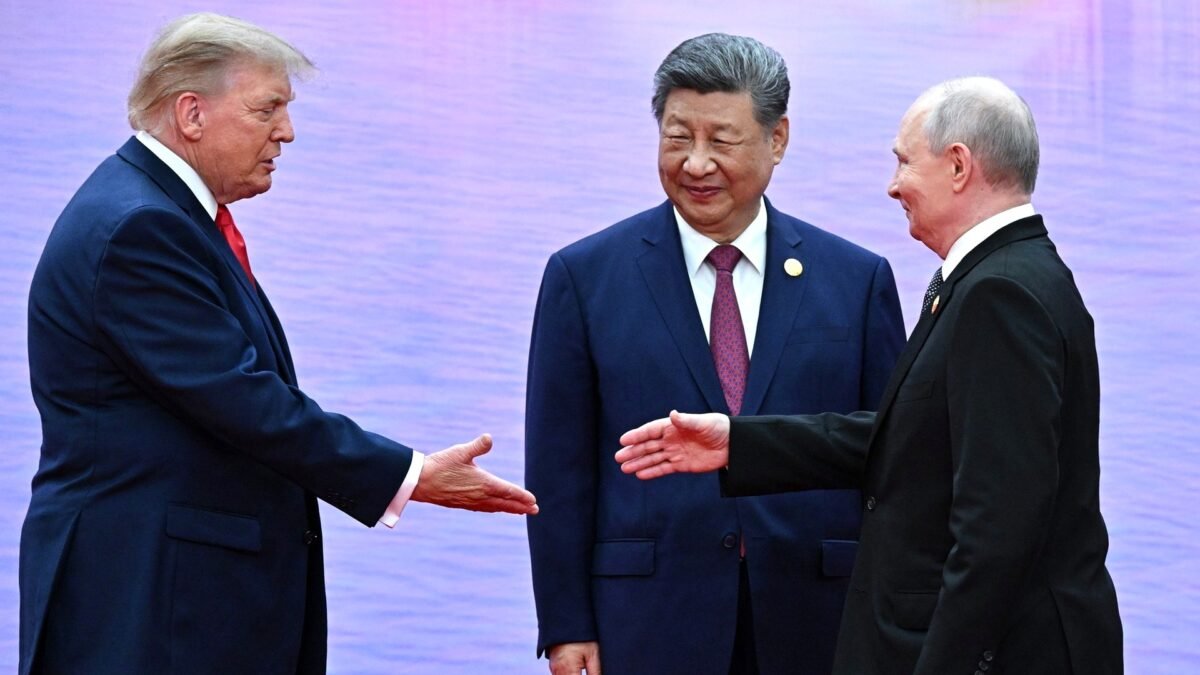
President Donald Trump has revealed that he told Vladimir Putin to pull back all military aggression across Europe when the two leaders met in China last week, offering the most detailed account yet of their conversation as he pushes for a quick deal to end the war in Ukraine.
Writing on his Truth Social network on Thursday morning, Mr Trump said he had spent “a lot of time” pressing the Russian president on the subject during their talks in Shenzhen, and that he believed a settlement was a “strong possibility”.
“During my conversations in China with President Vladimir Putin, of Russia, I spent a lot of time talking about the fact that I would like to see President Putin pull back all Military aggression against territories throughout Europe, in the hopes that a Deal can be made between Russia and Ukraine, and made quickly,” Mr Trump wrote, according to Reuters.
“I really believe this is a strong possibility,” he added. “Thousands of people are being killed each and every month, A COMPLETE BLOODBATH.”
The disclosure is the fullest public description so far of what Mr Trump said to Mr Putin at their meeting on the sidelines of the APEC leaders’ gathering in Shenzhen on 19 November, a session that also included Chinese President Xi Jinping in the first three-way meeting of its kind.
It also marks a clear change of tone from the president. In Shenzhen last week, Mr Trump warmly greeted Mr Putin, called him his “friend”, and later posted a photograph of the two men shaking hands with the two-word caption “My Friend”. The gesture renewed concern in Kyiv and in European capitals that Washington was once again drifting towards the Russian leader.
Asked on Thursday about the apparent hardening of his language, Mr Trump pushed back on the idea that he had changed course. “I don’t know if I was tougher,” he told reporters at his Mar-a-Lago estate in Florida. “I mean, I think I’m the one that gave them the anti-tank busters, right?” — a reference to the Javelin anti-tank missiles the United States supplied to Ukraine during his first term.
A week of diplomacy, and a warning from NATO
Mr Trump’s post came a day after he hosted NATO Secretary-General Mark Rutte for dinner at Mar-a-Lago on Wednesday night. The two men issued a joint statement after the meeting, saying they had “discussed the importance of Russia avoiding any actions that intentionally, or unintentionally, expand the war, and the importance of obtaining a peaceful resolution to the war as rapidly as possible”.
Hours before that dinner, Mr Rutte had given his bluntest public assessment yet of the war, telling Fox News that Ukraine was “doing exceptionally well” and that Russia’s losses were “absolutely unsustainable”.
“Well, what we are seeing is that Ukraine is doing exceptionally well at the moment,” Mr Rutte said on the programme. “They are now killing or seriously wounding. We thought in the last five, six months it was between 40 or 50,000. The latest numbers coming in from October is over 50,000 Russians dead or seriously wounded.”
He drew a comparison designed to land with an American audience, noting that the October figure alone was close to the number of American service members killed in the entire Vietnam War, which he put at about 56,000. “When you compare that to the war in Vietnam, the United States in 14 years lost 56,000,” Mr Rutte said. “Here in one month, Russia, dead or seriously wounded, 40,000. And in October, early reporting indicates this number may have climbed to over 50,000.”
Neither Ukraine nor Russia publishes its exact military losses, and casualty figures in the war are routinely disputed. The Washington-based Centre for Strategic and International Studies estimated this summer that Russian forces had suffered about 1.4 million casualties, including 400,000 to 450,000 fatalities, from the start of the full-scale invasion through June 2026. Mr Rutte’s figures are NATO’s assessment, not an independently verified count, but they underline how Western officials now describe the war’s human cost in stark terms.
Mr Rutte also pointed to what he called a telling reversal: Russia, one of the world’s great oil and gas exporters, is now importing gas and oil as Ukrainian strikes hit its refineries and energy sites. “Keeping Ukraine in the fight is exactly what we need to do, because this is testing Putin,” he said, adding that the Shenzhen meeting was part of that test. “How serious is he?”
Mr Rutte’s warning was not only about Ukraine. Speaking to the NATO Parliamentary Assembly in Berlin on Monday, he said European countries should understand how quickly Russian missiles could reach them. “These latest Russian missiles need only five minutes longer to reach Lisbon, Rome or The Hague, my hometown, than to reach Tallinn, Warsaw or Helsinki,” he said. “We face great dangers coming from Russia and the fact that Russia works so closely together with Iran, China, and North Korea, we know that Russia’s war machine at the moment is running at full speed.”
The business carrot is taken off the table
Mr Trump’s tougher public language coincides with a reported shift in the American negotiating approach. According to the Financial Times, the Trump administration has quietly shelved proposals to use business deals as an incentive for Russia to end the war, after Moscow showed little interest in the proposed energy and aviation ventures.
The newspaper reported that Mr Trump’s envoys, Steve Witkoff and Jared Kushner, told European officials that corporate tie-ups were no longer a core part of the United States’ pitch to Russia, citing five officials briefed on the change in tactics. The focus, the report said, was now on territorial and security questions instead.
For months, the administration had explored a commercial route to peace: offering the Kremlin a picture of what normal economic ties with the United States could look like if the fighting stopped. According to the Financial Times, Mr Kushner floated postwar ideas such as American companies investing in Russian oil projects and titanium production ventures, and restarting pipeline gas sales to Europe. In October, Reuters reported that top Russian and American officials, Mr Kushner among them, had discussed bringing an American investor into the Nord Stream pipelines.
Moscow, however, was not buying. The Financial Times reported that Russia initially responded positively to the idea but has since cooled, insisting instead that Ukraine give up territory and make other concessions that Kyiv considers unacceptable. One official briefed on the change put it bluntly: “It was made pretty clear that the Russians were not in the market for this kind of thing.”
The report has been contested. A United States official described it as “not accurate” when contacted for comment, saying the administration was organising its negotiating tracks and would announce them when ready, and that postwar economic engagement with Moscow “continues to be an element”. Reuters said it could not immediately verify the Financial Times report, and the White House did not immediately respond to a request for comment.
Whatever the precise status of the business proposals, Mr Kushner’s own public remarks this week suggested the emphasis has moved. In a lengthy statement on Sunday evening about the negotiations, he no longer mentioned economic incentives for Russia and instead focused on a possible postwar security architecture. In a podcast interview with Mathias Döpfner, chief executive of the German media group Axel Springer, Mr Kushner praised Mr Putin as a “grandmaster of politics” and a “historic figure”, and argued that the Russian leader had shown “restraint” by not using nuclear weapons despite the risk of the Ukraine war escalating dramatically. He said he believed Mr Putin wanted peace and improved relations with the United States.
Mr Kushner also said, after another round of peace talks, that Moscow was now “comfortable” with the idea of Article 5-style security guarantees for Ukraine, as is Mr Trump. NATO’s Article 5 states that an attack on one member is treated as an attack on all, and a similar guarantee for Ukraine would be a major commitment. “From America’s perspective, giving an Article 5-like security guarantee is a really, really big deal and I think that that is something that President Trump is open to, but obviously it has to be in America’s interest to do that,” Mr Kushner said.
What happened after Shenzhen
The test of Mr Trump’s approach is what Russia has actually done since the Shenzhen meeting — and on that evidence, the picture is mixed at best. After the meeting, Moscow ramped up its attacks on Ukraine, targeting energy infrastructure as winter sets in. Russian strikes hit Kyiv and other cities overnight into Thursday, with fires and damaged buildings reported in the capital’s Desnianskyi district, where seven people were injured.
European leaders say the pattern extends beyond Ukraine. Last week, Russian missiles entered Poland’s airspace, an incident Prime Minister Donald Tusk called an “intentional provocation” by Moscow. “We know that what landed on Polish soil came from Russia,” Mr Tusk said. “Therefore — and this is not just my own assessment, but also that of our foreign partners, including those within NATO — it does not look like an accident. It appears that we are dealing with an intentional provocation.”
Estonia recently linked an arson attack to Russia’s military intelligence service, according to Reuters, and other European countries have accused Moscow of a campaign of sabotage and hybrid attacks across the continent. German Chancellor Friedrich Merz said the Kremlin was “escalating” threats to European security, adding that “Russia knows exactly what it wants. And Russia wants more than Ukraine.”
It is against this background that Mr Trump’s phrase “territories throughout Europe” has drawn attention. Reuters noted that the wording suggests territories beyond the battlefield in Ukraine, although Mr Trump did not elaborate on what conduct he was asking Mr Putin to halt. The statement did not specifically name Ukraine, which Russia invaded in February 2022 in the largest war in Europe since the Second World War.
The peace plan and its sticking points
The Shenzhen meeting and Mr Trump’s latest comments come in the middle of the most intensive American peace push of the year. A 28-point settlement plan drawn up by Mr Trump’s team, in apparent consultation with Russian interlocutors, leaked last week and landed in Kyiv like a grenade. It would have Ukraine cede territory to Russia that Moscow has not conquered militarily, scale back the size of its armed forces, rule out hosting NATO troops on its soil, and enshrine in its constitution that it would never join the NATO alliance — all without a significant Western security guarantee.
President Volodymyr Zelenskyy said his country had to choose between “either the loss of dignity or the risk of losing a key partner” — antagonising the White House if he balked at the deal. European leaders scrambled to respond, and a joint statement by leaders from the United Kingdom, France, Germany, Italy, Spain and other allies reaffirmed that borders cannot be changed by force and cautioned against placing limits on Ukraine’s military capacity.
Urgent talks in Geneva, involving Secretary of State Marco Rubio and Mr Witkoff, produced what both the White House and Mr Zelenskyy’s office described as an “updated and refined” framework — a reworked 19-point plan aimed at a “sustainable and just peace”. A European counterproposal removed the requirement for Ukraine to formally cede territory, lifted the outright ban on NATO membership, and would allow Ukraine to maintain up to 800,000 troops in peacetime, while proposing an American-style Article 5 security guarantee and compensation through frozen Russian sovereign assets.
The thorniest issue remains the fate of a chunk of the Donetsk region that the Kremlin has been determined to seize. Moscow has repeatedly said it must control all of Donetsk, one of five Ukrainian regions Mr Putin claims are Russian. Ceding land that Ukrainian forces have held at great cost would be a massive concession by Kyiv and could have political consequences for Mr Zelenskyy.
During the latest round of American-led peace talks this week, Russia claimed it had occupied half of the territory in the Donbas that is currently under Ukrainian control, according to Mr Zelenskyy, who said Mr Putin was being misinformed and that Kremlin negotiators were using exaggerated territorial claims to influence the United States. Russia claims to have taken 6,500 square kilometres of Ukrainian territory this year, while the Institute for the Study of War estimates the real total is a Russian net gain of only 73 square kilometres. Mr Putin, the institute said, is “trying once again to breathe life into the myth of inevitable Russian military victory in order to persuade the United States and other supporters of Ukraine to compel Kyiv to surrender.”
Mr Putin has confirmed that Moscow received the American plan and said it could serve as a basis for a final settlement, while warning that Russia would continue fighting if Ukraine rejected it. Mr Trump had set a 27 November deadline for Kyiv to accept the plan, a date he later softened, and has said Mr Zelenskyy could either accept the deal or “continue to fight his little heart out”.
Analysis: a firmer tone, but the test is what follows
Mr Trump’s Truth Social post matters for two reasons, and neither of them is the words alone. The first is that it is the first time the president has described, in his own voice, what he actually asked of Mr Putin in Shenzhen. Until now, the world knew the meeting had happened, knew Mr Trump had called Mr Putin his friend, and knew almost nothing about the substance. Now there is a public record of the American ask: pull back military aggression across Europe, not only in Ukraine, and do it in the hope of a deal made quickly.
The second reason is the company the post keeps. It arrived in the same week as Mr Rutte’s casualty figures, the joint Trump-Rutte statement warning Russia against expanding the war, and the reported shelving of the business-deal incentives. Taken together, the week looks like a coordinated shift: less talk of friendship and commerce, more talk of costs, consequences and red lines. For European allies who worried after Shenzhen that Washington was drifting towards Moscow, that is the message they wanted to hear.
But the gap between words and events is the real story, and it is not flattering. Since the Shenzhen meeting, Russia has intensified its strikes on Ukraine’s energy grid, sent missiles into Polish airspace, and, according to the Kremlin’s own negotiating posture, doubled down on its demand that Ukraine surrender territory it still holds. If Mr Trump did indeed spend “a lot of time” telling Mr Putin to pull back, Mr Putin’s answer, delivered on the battlefield, has so far been no.
That is the central tension in the American approach. Mr Trump plainly believes that personal engagement with Mr Putin can unlock a deal, and he has now staked his prestige on a settlement reached quickly. Mr Kushner’s praise of Mr Putin as a “grandmaster of politics” shows how the administration’s envoys see the Russian leader: a man to be courted, not cornered. Yet the same week has shown the limits of that approach, as Moscow pocketed the flattery, ignored the business offers, and pressed its military advantage.
The removal of the business carrot, if confirmed, is the most significant part of the shift. It was the one element of the American pitch that was genuinely new — an attempt to buy peace with commerce rather than extract it with pressure. Its failure tells its own story about the Kremlin’s priorities: territory and security concessions first, economic normalisation only afterwards, if at all. That leaves the negotiation where it has always been, on the hard questions of land, troops and guarantees, where neither side has yet moved enough to meet the other.
For Ukraine, the stakes could hardly be higher. Mr Zelenskyy is being asked to accept a settlement that would formalise losses, limit his army and trade away the NATO aspiration that has defined his country’s foreign policy — in return for guarantees whose strength has yet to be tested. His warning about choosing between dignity and a key partner captures the dilemma exactly: refuse, and risk losing American support; accept, and risk losing his country.
For Europe, the week has been a reminder that its security still depends on decisions taken in Washington, Moscow and, increasingly, Beijing. The European Union’s leaders spent the same week wrestling over a 1.58 trillion euro budget and a 45 billion euro loan for Ukraine, while the Kremlin warned that funding Kyiv threatened the peace talks. Europe’s money and America’s diplomacy are supposed to be two halves of the same strategy. At the moment they look like two separate conversations.
What happens next will be decided by a handful of dates and decisions. Mr Trump said on Thursday that he was unsure whether Mr Putin would attend the G20 summit in Miami next month, “but if he wanted to come, he certainly can” — an invitation that will be watched closely in every European capital. The next round of talks, the fate of the revised peace framework, and the winter campaign against Ukraine’s energy system will show whether the firmer tone was a turning point or a passing mood.
The measure of this week will not be the president’s post, or the NATO chief’s numbers, or the fate of the business proposals. It will be whether the fighting slows, the missiles stop crossing borders, and the killing Mr Trump called a complete bloodbath begins to end. On that measure, the week has so far offered more words than results.
Why It Matters
This is the most consequential American diplomatic week on Ukraine since the summer. A president who has made ending the war his signature foreign-policy goal has now publicly set out what he asked of the Russian leader, and has done so in language that goes beyond Ukraine to cover the whole of Europe. That raises the bar for his own diplomacy: if the aggression does not pull back, the question will not be what Mr Trump said in Shenzhen, but what he is prepared to do about it.
It matters for Ukraine because the peace plan on the table would reshape the country’s borders, its army and its alliances for a generation, and because the deadline pressure from Washington has not gone away. It matters for Europe because Russian missiles have now crossed into NATO airspace and European leaders openly fear their countries could be next. And it matters for the wider world because the Shenzhen meeting put China at the centre of the diplomacy, and because a settlement — or the failure of one — will shape the relationship between the United States, Russia and China for years.
The war is in its fifth year. The diplomacy is moving faster than it has in months. The fighting is not slowing. That contradiction is the story of this week, and it will be the story of the weeks to come.
Sources
- Reuters: Trump says he asked Putin to ‘pull back’ military aggression throughout Europe (via Devdiscourse)
- New York Post: Trump tells Putin to ‘pull back all military aggression’ as he tries for peace deal to end ‘complete bloodbath’ in Ukraine
- New York Post: NATO boss says Ukraine ‘doing exceptionally well’ in war, as Trump admin sidelines plan to do business with Russia
- Reuters: US shelves plans for business deals with Russia to end Ukraine war, FT says (via Euronext)
- EuropeSays: Donald Trump urges Vladimir Putin to end ‘military aggression’ in Europe

About the Author — Abdul Mannan
Related Articles

Venezuela to Scrap Law That Jailed Sanctions Supporters for Up to 30 Years as Transition Talks Advance
Venezuela's National Assembly will begin repealing the Simón Bolívar Law on 1 December, scrapping a statute that threatened…

Myanmar’s Min Aung Hlaing Rejects Parts of World Court’s Genocide Ruling, Calling It ‘Inappropriate’
Myanmar's leader Min Aung Hlaing has said his country will not comply with parts of the International Court…
Zelensky: Putin “Can’t Be a Friend” — Ukraine’s Warning to the West
Volodymyr Zelensky has told the BBC that American delays in delivering Patriot interceptor missiles are costing Ukrainian lives,…