
Marc Marquez Announces Shock MotoGP Retirement After Record-Equalling Eighth Title

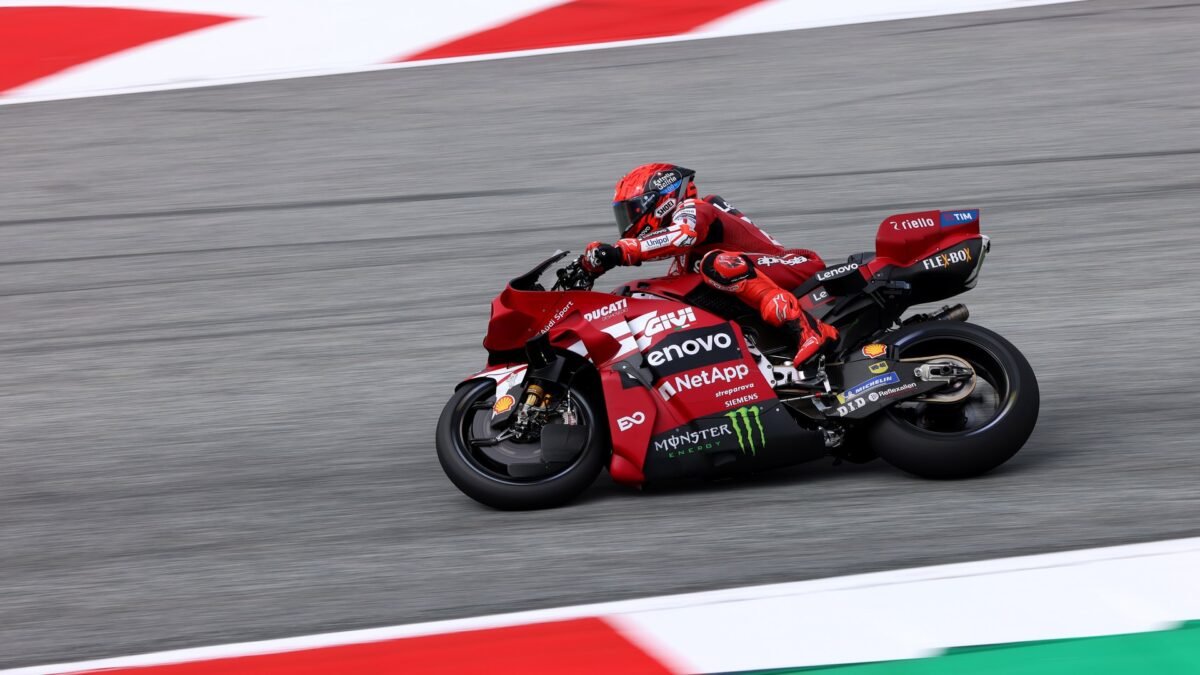
Marc Marquez will race for the final time this weekend. The reigning MotoGP world champion announced on Friday, 27 November 2026, that he is retiring from motorcycle racing with immediate effect, bringing down the curtain on one of the greatest careers the sport has ever seen just days after winning a record-equalling eighth premier-class title.
Marquez, 33, made the announcement at the Circuit Ricardo Tormo in Valencia, minutes before the opening practice session of the season-ending Valencia Grand Prix. Sitting in the Ducati Lenovo Team garage, he said nothing at first. Instead, he held up a series of handwritten placards for the television cameras. “We’ll talk later but first thank you to everyone who has been part of this journey. I hope you’ve enjoyed it as much as I have. This will be my last race in MotoGP. We made history,” the cards read, according to Autosport.
Ducati confirmed the news moments later. “It is official. @marcmarquez93 has decided to retire from @motogp, and the 2026 Valencia Grand Prix will be his final race as a professional rider and with the Ducati Lenovo Team,” the team said in a statement reported by Flashscore.
Marquez then went out and rode in first practice as if nothing had changed, finishing just 0.010 seconds from the fastest time of the session, according to Crash.net. Later, at a special press conference at the circuit, he explained a decision he said he had made weeks earlier, in private, and kept almost entirely to himself.
“I arrived in MotoGP my way, and I will go my way,” he said, according to TNT Sports. “I gave everything, but it’s time to stop.”
A decision made in secret
Marquez told reporters that he had decided to retire after last month’s Japanese Grand Prix at Motegi, and that the only person in the world who knew was his younger brother Alex Marquez, himself a MotoGP rider. He told his father about the decision on Wednesday, and his mother on Friday morning, hours before the announcement, according to Supersport.
The timing was deliberate. He had still been fighting for the championship when he made up his mind, and he did not want the announcement to become a distraction. “I decided to announce it today because it was the only way, the only chance to fight for the World Championship this year,” he said, according to Cycle News. He won that championship last weekend at the Portuguese Grand Prix in Portimao, clinching the title with a round to spare, and only then was he free to say goodbye.
The secrecy held even inside Ducati. According to The Race, team boss Davide Tardozzi had said at Portimao that he was “100%” sure Marquez would carry on. Marquez had, after all, signed a new two-year contract with Ducati in June 2026 that would have kept him with the Italian manufacturer through the 2027 and 2028 seasons, according to Autosport. He is walking away from that deal, at the peak of his powers, as champion, with two years of guaranteed factory employment left on the table.
That is what makes this retirement so startling. Riders of Marquez’s stature almost never leave like this. They fade, they lose their seat, they are pushed out by younger rivals, or they announce a farewell tour a season in advance and soak up the tributes. Marquez has done none of those things. He won the title, waited a week, and stopped.
The price of the comeback
Marquez did not give a single, simple reason for his decision, and he was open about that. “The reason for my retirement, I think we don’t need any reason sometimes. You just need to understand the situation,” he said, according to Cycle News. “But it’s true the situation was very at the limit.”
What he did talk about, at length and with unusual candour, was his body. The physical toll of his career is the thread that runs through everything that has happened to him since 2020, and it was central to his explanation on Friday. “I feel competitive, I feel fast, but the reason is the risk,” he said, according to Crash.net. “Sometimes you need to have a balance between risk and compensation. And right now, the compensation, or the thing that I can achieve is, OK, to win one more [title]. Maybe. But it was not the time to do it.”
Asked what the decision had cost him, he answered with a question of his own: “What is the price of happiness?”
The injuries are well documented. Marquez fractured his right arm in the season-opening race at Jerez in 2020, an injury that began a four-year ordeal of operations, complications and attempted comebacks. He has undergone seven operations on his right arm and shoulder since 2019, according to MotoGP News, the latest in May 2026, when surgeons removed two bent screws that had been pressing on the radial nerve in his arm and preventing him from riding naturally. That operation caused him to miss the French and Catalan Grands Prix this season, according to Supersport.
Then came the crash at last October’s Indonesian Grand Prix, which injured his shoulder and, according to Crash.net, brought back the double-vision problems he had battled before. Speaking on Friday, Marquez admitted something he had never said so plainly. “Of course you can work, of course you can fight, I’m a fighter, but it’s another point that I’m scared, and I started to feel the fear,” he said. “And it’s not the fear of the bikes. It’s not the fear of the speed. It’s an injury that is there, but at the moment it is not affecting my personal and professional life.”
It is a remarkable admission from a rider whose entire reputation was built on the absence of fear, on saves and slides that no other rider would attempt, on a willingness to crash in pursuit of a tenth of a second. The fear he described is not of the speed. It is of what another crash could do to a body that has already been rebuilt so many times, and to a life beyond racing that he is only now choosing to protect.
The 2026 season: a title won through adversity
The championship Marquez has just won may be the most impressive of his eight. He won seven grands prix and ten sprint races in 2026, according to Crash.net, but he did it after missing races through surgery and after overturning a championship deficit of more than 100 points, according to Speedcafe. He clinched the title at Portimao with one round still to run, beating Aprilia’s Marco Bezzecchi and Jorge Martin in a fight that went down to the penultimate round.
It was his second consecutive title with Ducati, and it completed one of the great comebacks in sporting history. When Marquez left Honda at the end of 2023, after eleven seasons with the Japanese manufacturer, he had not won a race in more than four years. He joined the satellite Gresini Ducati team for 2024, won at Aragon that August for his first victory since 2021, finished third in the championship, and earned promotion to Ducati’s factory team. From there, he won two world titles in two seasons.
The 2025 title was clinched early at Motegi, but his season ended soon afterwards with the crash in Indonesia that injured his shoulder. The 2026 title was harder, won through surgery, absence and a points deficit. He has now won championships in two different eras of the sport, on two different manufacturers, on either side of an injury that would have ended most careers. That is the achievement he was referring to when his placards said: “We made history.”
A career in numbers
The statistics Marquez leaves behind place him among the very greatest riders in the 77-year history of grand prix motorcycle racing.
He retires with ten world championships across three classes: the 125cc title in 2010, the Moto2 crown in 2012, and eight premier-class titles in 2013, 2014, 2016, 2017, 2018, 2019, 2025 and 2026. Only Giacomo Agostini, with 15 world titles, and Angel Nieto, with 13, have won more grand prix championships overall, according to MyKhel.
His eight premier-class titles draw him level with Agostini’s record in the top category, and move him one clear of his great rival Valentino Rossi, who won seven. Rossi remains ahead on premier-class race wins, with 89 to Marquez’s 80, but Marquez’s 80 victories put him second on the all-time list, according to MyKhel. Across all three grand prix classes he won 106 races, stood on the podium 173 times, and took 106 pole positions. In the premier class alone he claimed 134 podiums and 78 pole positions, the latter an all-time record for the category.
Some of his records may stand for a very long time. He became the youngest premier-class world champion in history in 2013, winning the title in his debut season at 20 years and 266 days, a record that still stands. In 2014 he won the first ten races of the season and 13 in total, a single-season record for the premier class. He won five of the next six championships after his debut title, and his six titles with Honda made him the most successful rider in the manufacturer’s history.
And then there is the number that frames this weekend: 80 premier-class wins heading into his final race, with a victory on Sunday at Valencia capable of taking him to 81. Whatever happens, he will leave as the rider with the most pole positions in premier-class history, the joint-most premier-class titles, and the second-most premier-class wins.
What it means for Ducati and MotoGP
Marquez’s retirement creates an immediate problem for the most successful team in the sport. Ducati will have to find a new rider to partner Pedro Acosta in its factory team for 2027, according to Autosport, just as MotoGP enters a new era of 850cc engines and Pirelli tyres, according to The Race. The factory seat alongside Acosta is now the most coveted vacancy on the grid, and the decision Ducati makes will shape the championship for years.
For MotoGP itself, the loss is harder to measure. Marquez has been the sport’s defining rider for more than a decade, and arguably its biggest star since Rossi retired in 2021. Carlos Ezpeleta, deputy chief executive of the MotoGP Group, paid tribute on Friday. “Marc is undoubtedly one of the most important riders in the history of our sport,” he said, according to Cycle News.
The championship will go on, as it always does. New riders will win races, new rivalries will form, and the 2027 season will have its own storylines. But there is a particular quality that Marquez brought to MotoGP that will be difficult to replace: the sense, every time he took to the track, that something extraordinary might happen, that a race could be won from an impossible position, that a crash could be saved by an elbow and a knee. He changed what riders believed was possible on a motorcycle, and a generation of young riders grew up copying his style.
His departure also closes a chapter in the sport’s history. Rossi retired in 2021. Now Marquez, his great rival and the rider who succeeded him as the sport’s central figure, has gone too. The riders who dominated the 2010s are all gone. The 2027 grid will belong to a new generation, led by riders like Acosta, Bezzecchi and Martin, none of whom has yet won a premier-class title. The sport is theirs now.
Analysis: why retiring at the top is the hardest decision in sport
There is a cliche in sport that a great athlete should retire at the top, on their own terms, before the game takes the decision out of their hands. It is easy to say and almost impossible to do. The psychology of elite competitors runs against it: they are wired to believe that one more title is possible, that the body will hold for one more season, that the risk is worth it because it always has been. The athletes who actually manage it are rare, and they are remembered differently from those who stay too long.
Marquez has now joined that rare group, and the decision deserves to be understood on its own terms rather than as a mystery to be solved. He is 33, he is the reigning world champion, he has a contract through 2028, and he has just won the hardest title of his career. By every external measure, there was no reason to stop. The reason was internal, and it was the one he kept returning to on Friday: risk, and the balance between risk and reward.
That balance had shifted, even if nobody outside his family could see it. The arithmetic he described was brutally simple. On one side of the scales: the chance of winning one more championship, maybe, against rivals who are younger and uninjured. On the other: the risk of another crash on a right arm that has already been operated on seven times, on a shoulder injured a year ago, on eyes that have already suffered double vision. The reward was a ninth title. The risk was his health, and perhaps his quality of life after racing. At 33, with ten world titles and nothing left to prove, he decided the trade was no longer worth making.
There is something important in the way he framed it. He did not say he was no longer fast enough. He said the opposite: “I feel competitive, I feel fast.” He did not say he had lost his love for racing. He said he had enjoyed his journey. The decision was not about decline. It was about arithmetic, and about a man who has finally allowed himself to count the cost of the thing that made him great.
That cost is worth dwelling on, because it is the hidden ledger of his career. The brilliance of Marquez’s riding was inseparable from its danger. The saves that made him famous were moments when a crash was a fraction of a second away. The style that won him eight titles was a style that punished his body relentlessly. The 2020 arm fracture was not bad luck; it was the bill coming due for a way of riding that no other human could sustain. The fact that he came back from it, and then won two more titles on a different motorcycle, is astonishing. But comebacks have a cost too, and the May surgery, the missed races, the returning double vision, the fear he admitted on Friday, are all entries in the same ledger.
This is also why the timing matters. Marquez did not retire after a bad season, when the decision would have looked like surrender, or after a serious crash, when it would have looked like fear. He retired a week after winning the championship, in the form of his life, with the sport at his feet. That is the hardest moment to walk away, because it is the moment when walking away looks most irrational. It is also the only moment when walking away is truly a choice rather than a consequence. He chose the ending. Almost nobody gets to do that.
For MotoGP, the consequences are real and immediate. The sport has lost its biggest star at the exact moment it is trying to grow, with new technical rules coming in 2027 and a new generation waiting to take over. Ducati has lost the rider around whom its factory team was built, and the scramble for his seat will dominate the off-season. But there is also an opportunity here. A championship without Marquez is a genuinely open championship, and the riders who have lived in his shadow, Bezzecchi, Martin, Acosta, Bagnaia, now have a clear path to the title. The sport will be poorer for his absence and more competitive because of it. Both things can be true.
And for Marquez himself, the question that will follow him is the one he asked on Friday: what is the price of happiness? He has spent 18 years as a professional racer, since his grand prix debut as a 15-year-old in 2008. He has given the sport everything, including, very nearly, his body. He has decided that the price of one more title is too high. On Sunday at Valencia, he will race one last time, in front of a home crowd, as the reigning champion, on a motorcycle he has mastered. If he wins, it will be the perfect ending. If he does not, it will not matter. The ending was already perfect the moment he decided, on his own terms, to stop.
Sources
- MotoGP.com — Marc Marquez announces retirement from MotoGP
- Autosport — Marquez to retire from MotoGP after Valencia GP
- TNT Sports — Marc Marquez explains shock MotoGP retirement decision
- Crash.net — Why Marc Marquez’s shock MotoGP retirement is his greatest victory
- Supersport — ‘My way’: Marc Marquez ends storied MotoGP career

About the Author — Abdul Mannan
Related Articles
Australia Drop Nathan Lyon for New Zealand Tests as 577-Wicket Veteran’s Home Career Nears Its End
Australia have left Nathan Lyon out of their squad for the four-Test series against New Zealand, ending the…

NFL Makes History on Thanksgiving as Bears, Eagles and Bills All Win in the Final Seconds
All three Thanksgiving Day games were decided by a go-ahead score in the final minute — a first…

FIFA Confirms Cyber-Attack as US Congress Investigation Into Infantino’s World Cup Sell-Off Plan Intensifies
FIFA has confirmed it was the victim of a criminal cyber-attack, as a US congressional investigation into Gianni…