
US Disables Blockade Runner in Gulf of Oman as Iran Vows to Break the Embargo and Keep Hormuz Shut

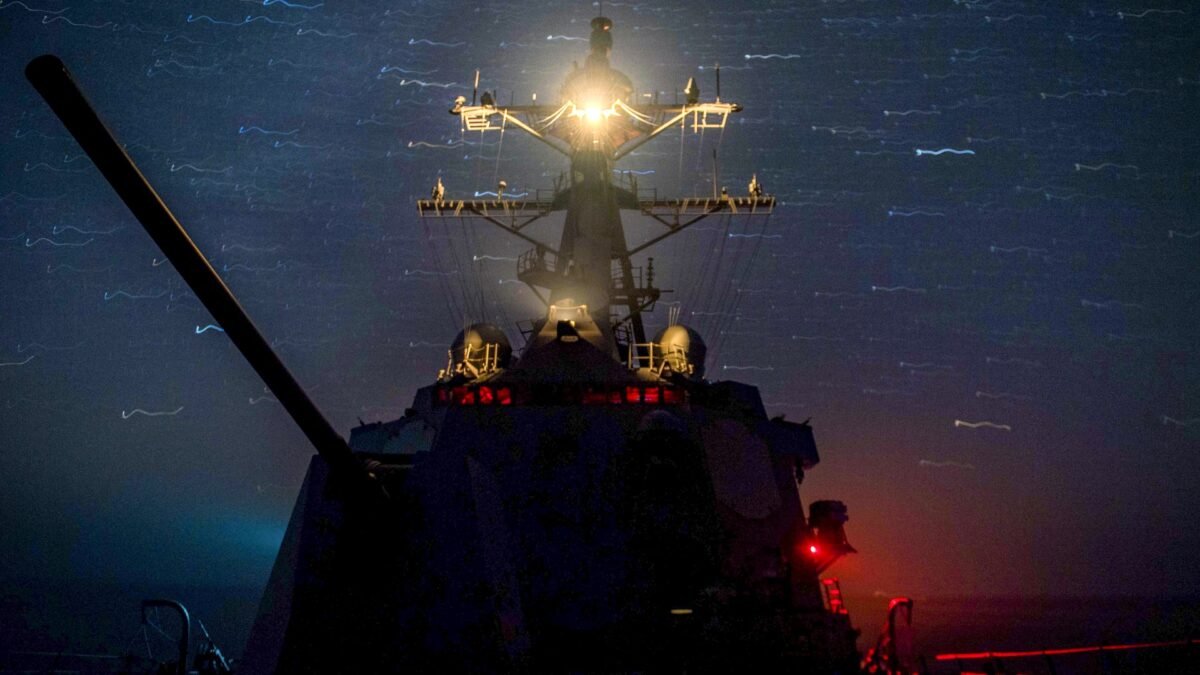
The United States military struck and disabled a commercial ship in the Gulf of Oman on Thursday after the vessel tried to run the American naval blockade of Iran, and Tehran answered within hours with a public vow to break the embargo and to keep the Strait of Hormuz closed. The exchange, announced by United States Central Command on Friday, marks the sharpest escalation yet in a nine-month confrontation over shipping in the world’s most important oil waterway.
According to Central Command, a United States military aircraft launched precision munitions that struck the stern of the Palau-flagged bulk carrier M/V Pacific Archer after the ship departed from the Iranian port city of Bandar Abbas and ignored repeated warnings. The strike disabled the vessel’s propulsion, the command said, while the civilian crew was unharmed. Central Command released video of the strike and said it would continue to enforce the blockade strictly.
The ship was the sixth vessel the United States has disabled for refusing to comply with the blockade, according to Central Command, which said it has redirected 158 other commercial vessels. The announcement came on Thanksgiving Day in the United States, and the footage of the strike circulated widely within hours of its release.
Iran’s response was swift and defiant. Mohammad Mokhber, an adviser to Iran’s Supreme Leader Ayatollah Mojtaba Khamenei, told Iranian state media on Friday that Tehran would not accept the blockade. “Neither will the Strait of Hormuz be reopened, nor will we allow the blockade to remain in place,” he said, according to the state media report. He gave no details of how Iran intends to break the embargo.
Iran’s navy commander, Admiral Shahram Irani, went further on state television, claiming that operations to break the blockade had already begun. “Breaking through the enemy blockade is underway and our ports are active today,” he said. “Contrary to all propaganda, maritime escorts are taking place and we stand with the shipowners and sailors.” He offered no ships, routes or timetable to support the claim, and said the attempt to cut off Iran’s economy had “so far failed”.
A third Iranian voice added a threat of force. Major General Majid Mousavi, commander of the aerospace force of the Islamic Revolutionary Guard Corps, wrote on X on Friday that Iran’s enemies should expect action “in the air and at sea”, and called breaking the blockade the country’s “firm mission and unwavering determination”.
What happened in the Gulf of Oman
The Pacific Archer, a bulk carrier flying the flag of Palau, left Bandar Abbas, the main Iranian port on the northern shore of the Strait of Hormuz, and sailed into the Gulf of Oman, according to Central Command. United States forces issued multiple warnings, the command said, and when the vessel continued on its course, an aircraft struck its stern. The ship’s propulsion was disabled, leaving it unable to continue its voyage, and its civilian crew was unharmed.
Central Command said the action was taken because the crew attempted to run the blockade “despite multiple warnings”. The command’s statement stressed that it “continues to strictly enforce the blockade” and urged all mariners in the Gulf of Oman and the approaches to the Strait of Hormuz to heed blockade warnings issued by its forces. According to shipping data cited in press reports, the disabled vessel had been bound for Singapore.
The blockade itself was reimposed by Washington in mid-July, following the collapse of an agreement with Tehran, and it has since become the central instrument of American pressure on Iran’s war economy. Earlier this month the United States announced Task Force Iron Gate, an effort to restrict the movement of weapons and sanctioned materials across Iran’s land borders and the Caspian Sea as well as by sea. The strike on the Pacific Archer is the most visible enforcement action on the water since the blockade was restored, and it sends an unmistakable message that Washington is prepared to use force, ship by ship, against vessels that defy it.
The incident is not the first time Iran has tested the blockade. Less than a week earlier, Iran was reported to be preparing a 14-tanker convoy to challenge the American naval cordon, a high-stakes gamble that raised the prospect of a direct confrontation at sea. The Pacific Archer appears to have been a smaller, earlier test of the same proposition: a single commercial vessel sailing out of an Iranian port in defiance of American warnings, to see whether the United States would actually fire. The answer, delivered on Thanksgiving Day, was yes.
It is worth noting what the strike was not. It was not an attack on an Iranian warship, and it was not an attack on Iranian territory. It was a disabling strike against a commercial vessel’s propulsion system, deliberately calibrated to stop the ship without harming its crew. That calibration matters, because it shows Washington trying to enforce the blockade firmly while keeping the confrontation below the threshold of a wider shooting war. Whether Tehran reads it that way is another question.
Tehran’s answer: “We will not allow the blockade to remain”
The Iranian statements that followed the strike were notable for their breadth. Three separate voices spoke within hours: Mokhber, the supreme leader’s adviser, vowed to break the embargo and to keep the Strait of Hormuz shut; Admiral Irani claimed that counter-operations were already under way and that Iranian ports were active; and General Mousavi threatened action “in the air and at sea”. The choreography suggested a deliberate message rather than a series of off-the-cuff remarks: Iran will not accept the blockade, it claims to be acting against it already, and it is prepared to escalate.
Yet the claims themselves were strikingly thin on evidence. Mokhber gave no details of Iran’s plans. Admiral Irani named no ships, routes or dates, and his assertion that Iranian ports are active and that naval escorts are taking place could not be independently verified. His further claim, reported by Al Arabiya, that United States forces were now “begging” for passage through the Strait of Hormuz and that Iran would drive them back to the Bay of Pigs in Cuba, “where they belong”, was rhetoric rather than reporting. According to the same reports, the supreme leader has lifted geographical restrictions on Iran’s military operations, giving its commanders what Admiral Irani described as “a free hand to carry out the assigned missions”.
The gap between the rhetoric and the evidence is itself part of the story. Iran’s deputy foreign minister, Kazem Gharibabadi, had already declared the blockade an “act of war” the previous Saturday, vowing that Tehran would take whatever measures were necessary to break it. The language of the past week has steadily escalated: from “act of war” to “firm mission and unwavering determination” to a threat of action “in the air and at sea”. The question now is whether the words will be followed by deeds, and what form those deeds will take.
Iran’s options are real but limited. It could attempt another convoy run, this time with naval escorts, daring the United States to fire on Iranian warships rather than a commercial bulk carrier. It could step up harassment of shipping in the Strait of Hormuz, where attacks on shipping have already reached their highest level since the war began. It could mine the strait’s approaches, as it was accused of doing when a tanker was hit by an explosion on Friday after striking a mine while attempting to cross the strait through what the Revolutionary Guards’ navy called an unauthorised route. Or it could strike at American partners in the region, as it was blamed for doing in Kuwait this week. Each option carries the risk of a much larger American response, and each would test how far Tehran is willing to go to break an embargo that is strangling its economy.
A wider regional flare-up
The Pacific Archer strike did not happen in isolation. The same day, Kuwait summoned Iran’s ambassador and delivered a formal protest note over what it said were continued Iranian attacks, including a drone strike on Thursday that killed two Italian technicians and wounded Kuwaiti and Pakistani nationals at a Kuwaiti military site. The two technicians worked for Rheinmetall Italia, a subsidiary of the German defence firm Rheinmetall. Iran has denied responsibility for the strike, and Kuwait’s Foreign Ministry said the country reserved its right to self-defence.
United Nations Secretary-General Antonio Guterres condemned the drone attack blamed on Iran and called on “all parties to exercise restraint”. His spokesman, Stephane Dujarric, said the secretary-general was “deeply concerned by the continued escalation in the region” and warned that renewed hostilities “would have devastating consequences for the region and beyond”.
Elsewhere, the diplomatic fallout spread further. Iran’s Foreign Minister Abbas Araghchi told his South Korean counterpart, Cho Hyun, by telephone on Thursday that a foreign military presence in the Gulf region would heighten tensions rather than contribute to peace, as Seoul prepares to expand the operational area of a navy unit to waters south of the Gulf of Oman. Cho reaffirmed that Seoul did not intend to join any war or deploy troops to the Gulf, according to the Iranian embassy in Seoul.
Australia, meanwhile, placed counterterrorism financing sanctions on two people on Friday, saying they had orchestrated antisemitic arson attacks on a kosher restaurant in Sydney and the Adass Israel Synagogue in Melbourne in 2024 on behalf of Iran. Foreign Minister Penny Wong said Zohair Hassib and Kazem Hamad had used a “complex chain of proxies” to carry out the attacks. The sanctions are a reminder that the confrontation with Iran is not confined to the Gulf: it reaches into the domestic security of countries far from the region, and governments are responding with tools that go beyond naval power.
And in Yemen, a Saudi strike killed 11 people on Friday, most of them children, according to Houthi media, as the Saudi-led coalition said it had shot down a drone targeting Riyadh. The war in Yemen, the war in Gaza and the confrontation in the Gulf are separate conflicts, but they are increasingly entangled, and each escalation in one theatre raises the temperature in the others.
Trump’s remarks at Mar-a-Lago
President Donald Trump addressed the Iran situation on Thursday during a short press conference with reporters at his Mar-a-Lago resort in Florida, and his remarks were revealing. He downplayed the importance of intelligence sharing between Russia and China and Iran, amid reports that Tehran’s allies have helped it target United States military bases. “My meeting with President Xi was an incredible meeting,” he said. “I think that they’re very little involved with Iran. They could get involved, but involvement to me would mean shooting, not giving them little information.”
“We do the same thing, by the way,” he added. “And you know, when they say that they may be spying on us, well, we spy on them too.” On Russia’s intelligence sharing, he said: “I don’t think they give very much.” He said both countries wanted the conflict with Iran to end and that he believed they were “helping me in that regard”.
The remarks are significant for two reasons. First, they show that the Iran conflict was discussed at the president’s recent trilateral meeting with China’s Xi Jinping and Russia’s Vladimir Putin, which places Tehran’s predicament at the centre of great-power diplomacy. Second, they suggest that Trump believes Moscow and Beijing are not deeply committed to Iran’s cause, and that he expects them to help end the conflict rather than to prolong it. Whether that confidence is justified remains to be seen: both countries have their own interests in the Gulf, and neither has shown any appetite for a direct confrontation with Washington. But neither has abandoned Tehran either, and the gap between Trump’s reading and theirs is itself a source of risk.
Trump has also warned of new strikes on Iran after the New Year, and has dismissed Tehran’s negotiators in blunt terms. The combination of a threat of future strikes and a public dismissal of diplomacy leaves little room for a negotiated settlement in the short term, and it raises the stakes of every incident at sea. When the president of the United States says new strikes are coming, and Iran’s navy chief says operations to break the blockade are already under way, the space for miscalculation narrows sharply.
Analysis: Why it matters
The confrontation over the Pacific Archer is, on its face, a small incident: one bulk carrier, one precision strike, no casualties. But small incidents at chokepoints have a way of becoming large wars, and the Strait of Hormuz is the most consequential chokepoint in the world. About a fifth of the world’s traded oil normally flows through it, and its closure since February has already reshaped global energy markets. Every ship that is stopped, every tanker that is mined, every threat that is issued in Tehran or Washington adds another layer of risk to a waterway on which the world economy depends.
The deeper significance of the episode lies in what it reveals about the strategies of both sides. The United States has chosen economic strangulation as its weapon of choice. The blockade, reimposed in July and tightened this month with Task Force Iron Gate, is designed to cut off the lifeblood of Iran’s economy: its oil exports, its weapons imports, its sanctioned trade. The strike on the Pacific Archer is the enforcement mechanism made visible. It tells every shipowner, every insurer and every trader that defying the blockade carries a physical cost, not merely a legal one. The redirection of 158 vessels and the disabling of six shows that the message is being received, at least by most.
Iran, for its part, has chosen defiance as its strategy, but defiance without a clear means of success. The vow to break the blockade and to keep the Strait of Hormuz shut sounds resolute, but it is contradicted by the facts on the water. The strait is closed to unrestricted shipping, but it is closed by Iran’s own action, and the cost of that closure falls heavily on Iran itself, which cannot export its oil freely. The blockade is strangling Iran’s economy, and Iran’s answer so far has been to threaten, to test and to harass, without yet mounting a challenge that the United States cannot answer. The 14-tanker convoy announced earlier this month was a bold idea, but it has not sailed. The Pacific Archer sailed alone, and it was stopped.
This asymmetry is the central fact of the confrontation. The United States has overwhelming naval power in the region and the demonstrated willingness to use it. Iran has geography, mines, drones and proxies, and the ability to impose costs, but not the ability to break a blockade enforced by the world’s most powerful navy. That does not mean Iran is powerless: the Kuwait drone strike, the mining of the strait, the attacks on shipping and the threats against American partners all show that Tehran can hurt its enemies. But hurting is not the same as breaking, and the gap between the two is where the danger lies. A country that cannot break a blockade by force may be tempted to break it by escalation, and escalation in the Gulf has a way of escaping the control of those who start it.
There is also a domestic dimension to the Iranian rhetoric that should not be overlooked. The blockade is squeezing the Iranian economy, and the regime’s legitimacy depends in part on its ability to show that it is not helpless. The vows to break the embargo, the claims that ports are active and escorts are under way, and the threats of action “in the air and at sea” are addressed as much to a domestic audience as to Washington. They are a performance of strength in a moment of weakness. The risk is that a performance of strength, repeated often enough, begins to demand real action, and that real action brings a real response.
The involvement of other countries adds another layer of complexity. Kuwait’s protest, the United Nations’ warning, South Korea’s careful distancing, Australia’s sanctions and the continuing diplomacy of Pakistan, which brokered a short-lived accord in June that has since collapsed, all show that the confrontation is not a bilateral affair. It is a regional crisis with global implications, and every government with interests in the Gulf is being forced to choose a position. Most are choosing caution. Kuwait is protesting but not retaliating. South Korea is expanding its naval presence but insisting it will not join a war. China and Russia are, in Trump’s telling, helping to end the conflict rather than prolonging it. But caution is a fragile commodity in a crisis, and it can evaporate quickly if a single incident produces casualties.
For the wider world, the stakes are straightforward and severe. The Strait of Hormuz is not merely a regional waterway; it is the artery through which a fifth of the world’s traded oil flows, and its prolonged closure has already imposed costs on consumers and economies everywhere. A further escalation, whether a direct naval clash, a mining campaign or a strike on a Gulf state’s infrastructure, would send those costs sharply higher. The United States has the power to enforce its blockade, and Iran has the power to make enforcement costly. Neither side has yet found a way to end the confrontation, and the longer it continues, the greater the chance that a small incident like the Pacific Archer becomes the trigger for something much larger.
The history of the Gulf offers little comfort on this point. Blockades, tanker wars and naval confrontations have a long record of producing unintended consequences, and the margin for error in a narrow strait crowded with warships, mines and drones is vanishingly small. The strike on the Pacific Archer was calibrated, deliberate and bloodless. The next incident may not be. That is why this story matters, and why it will be watched so closely in the days ahead.
What to watch next
The first question is whether Iran’s promised operations to break the blockade materialise in any visible form. Admiral Irani claimed they were already under way, but no ships, routes or dates have been named, and the claim cannot be verified. If a convoy sails, whether the 14-tanker flotilla announced earlier this month or a smaller group, and if it is escorted by Iranian warships, the United States will face a decision it has so far avoided: whether to fire on an Iranian naval vessel. That decision would mark a sharp escalation, and its consequences would be difficult to contain.
The second question is whether the mining of the Strait of Hormuz intensifies. The tanker that struck a mine on Friday was crossing through what the Revolutionary Guards called an unauthorised route, and the incident shows that mines are already in the water. A wider mining campaign would threaten all shipping in the strait, including the vessels of countries that have no part in the confrontation, and it would invite a forceful American response, including mine-clearing operations that would themselves bring warships into contested waters.
The third question is the diplomatic track. Trump’s remarks at Mar-a-Lago suggest he believes China and Russia want the conflict to end, and that he expects their help in ending it. Whether that confidence is well placed will be tested in the coming weeks. The collapse of the June accord brokered by Pakistan shows how fragile diplomacy has become, and the president’s warning of new strikes after the New Year suggests that the military option is never far from his mind. Any negotiation will have to address the blockade itself, which Iran has called an act of war, and the closure of the Strait of Hormuz, which Iran has vowed to maintain. Those are not easy issues to compromise on.
Finally, watch the Gulf states. Kuwait’s protest over the drone strike that killed two Italian technicians shows that Iran’s actions are alienating its neighbours, and the region’s governments are increasingly caught between American pressure and Iranian threats. Their choices in the coming days, whether to support the blockade, to protest Iran’s actions or to seek a diplomatic off-ramp, will shape the course of the crisis. The Pacific Archer was a single ship, but the forces it has set in motion reach far beyond the Gulf of Oman.
Sources
- Reuters — “US disables ship trying to leave Iran, as Tehran vows to confront blockade”
- The News (Reuters) — “US disables ship as Iran vows to confront blockade”
- The Wall Street Journal — “U.S. Strikes Vessel Attempting Blockade Run Near Iran”
- The Business Standard (AFP) — “US disables ship in Gulf of Oman under Iran blockade”
- Breitbart — “U.S. Disables Ship Attempting to Breach Iran Blockade — Tehran Threatens Military Action from ‘Air and Sea'”

About the Author — Abdul Mannan
Related Articles
Lebanon Says France Is Drafting UN Plan to Keep Peacekeepers Working After UNIFIL Mandate Ends
Lebanon's prime minister says France is preparing a UN resolution that would let peacekeepers keep clearing mines, escorting…
Trump Says He Told Putin to ‘Pull Back All Military Aggression’ Across Europe in Push for Quick Ukraine Deal
President Donald Trump has revealed that he told Vladimir Putin in Shenzhen to pull back all military aggression…

Venezuela to Scrap Law That Jailed Sanctions Supporters for Up to 30 Years as Transition Talks Advance
Venezuela's National Assembly will begin repealing the Simón Bolívar Law on 1 December, scrapping a statute that threatened…