
Shehbaz Urges ‘Bitter Decisions’ and National Unity to Free Pakistan from Debt as Economy Stabilises

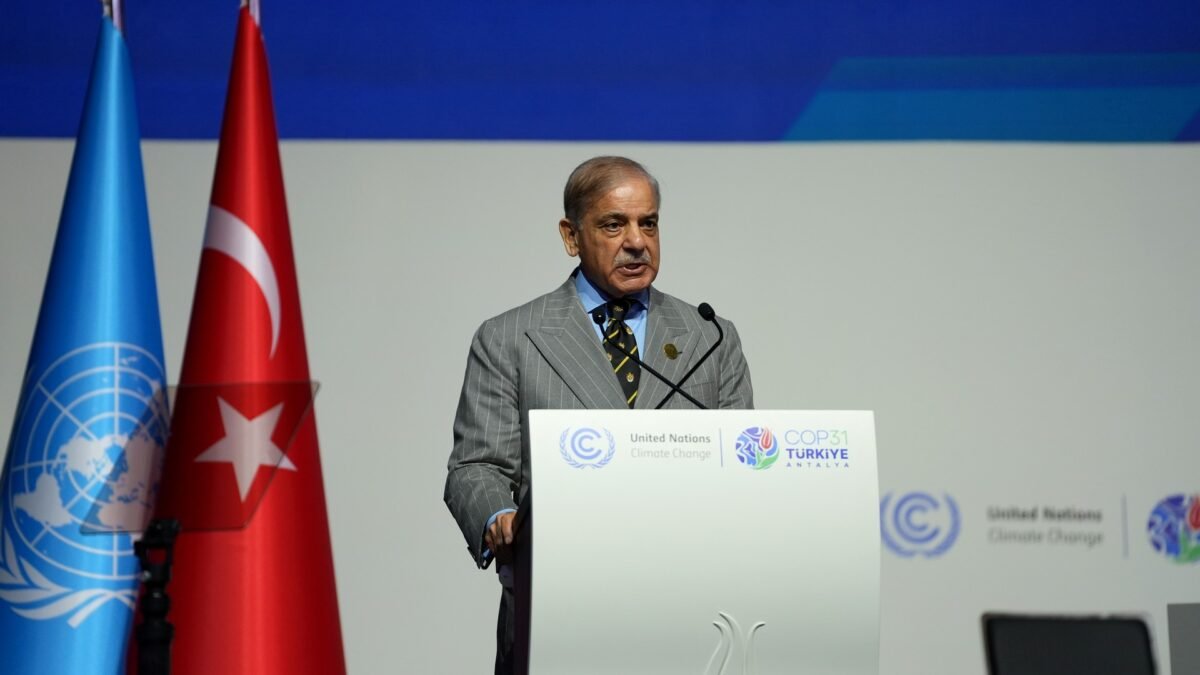
Prime Minister Shehbaz Sharif has called on Pakistan’s political parties and every section of society to unite behind what he described as “bitter decisions” to free the country from its dependence on foreign loans, telling participants at a National Security Workshop in Islamabad on Sunday that the economy is stabilising but that the hard work of reducing debt has only just begun.
Addressing the workshop on 29 November 2026, the prime minister said Pakistan’s debt had grown steadily over the past 80 years and argued that only collective commitment could reverse it. “There are solutions to this, but we will have to take bitter decisions,” he said, according to Dawn. “The nation, all political parties, segments of society, if we collectively decide, I think we can get rid of these loans.”
Shehbaz said the government had inherited an economy in serious difficulty but had, through two and a half years of difficult reforms, put it on a steadier footing. He put growth in gross domestic product at 3.5 per cent for the current year and said it needed to reach at least 6 per cent as soon as possible. Exports rose 8 per cent in the first quarter of the current fiscal year, he said, while information technology exports reached $4.6 billion in the previous fiscal year, up from roughly $1.5 billion a year earlier, according to the Associated Press of Pakistan.
The prime minister pointed to costly subsidies funded by tax revenue, widespread tax evasion and spending on loss-making state-owned enterprises as the forces that had pushed the country deeper into debt. He said the purpose of the discussion was to identify causes and find solutions rather than to assign blame, according to Geo News.
Rs900 billion recovered through tax enforcement
The centrepiece of the prime minister’s economic case was the tax system. Shehbaz told the workshop that the authorities had recovered Rs900 billion during the 2025-26 fiscal year through enforcement against tax evasion, particularly in sales tax, describing it as a record recovery. He said the government had purged corrupt elements from the Federal Board of Revenue, Pakistan’s central tax agency, working alongside the military leadership, according to the Associated Press of Pakistan.
He also defended the closure of two state institutions as part of the drive against corruption and unnecessary expenditure. The Pakistan Public Works Department had been shut down, he said, claiming the move had stopped corruption worth Rs100 billion. The state-run Utility Stores Corporation had likewise been closed, with the government paying Rs50 billion in golden handshakes to its employees, a step he said would save hundreds of billions of rupees in future spending.
Instead of subsidised shops, the prime minister said, financial assistance for deserving families had been shifted to digital wallets, with Rs27 billion disbursed directly to low-income households during Ramadan this year, according to the Associated Press of Pakistan. The reforms had been difficult and painful, he acknowledged, and ordinary citizens had borne the greatest burden — a point he repeated several times during the address, according to Geo News.
Finance Minister Muhammad Aurangzeb, who also addressed the workshop, said Pakistan’s foreign exchange reserves had risen above $21.6 billion and now covered three months of imports. The prime minister said the reserves stood at their highest level in the country’s history. Aurangzeb added that the authorities had secured about $3 billion in institutional investment without sovereign guarantees and had cleared a backlog of around $4.5 billion in profits and dividends owed to foreign investors, according to the Associated Press of Pakistan.
On privatisation, the finance minister said two major business groups had joined the process for Pakistan International Airlines, while Saudi Arabia and Türkiye had expressed interest for the first time in the privatisation of power distribution companies. Local investors had launched 11 initial public offerings in the last fiscal year and six so far this year, he said.
Shehbaz also told the workshop that at a meeting in New York in September, the managing director of the International Monetary Fund had told him that officials “have transformed Pakistan”, according to the Associated Press of Pakistan. The remark, as relayed by the prime minister, was the closest the address came to a verdict from the country’s most important lender — and it arrives less than two weeks before the IMF’s Executive Board is expected to consider releasing about $1.21 billion to Pakistan on 11 December, under the Extended Fund Facility and the Resilience and Sustainability Facility, following a staff-level agreement reached in October.
Population growth called a “time bomb”
Alongside debt, the prime minister identified rapid population growth as one of Pakistan’s most serious challenges. He put the annual population growth rate at 2.5 to 2.75 per cent and warned that it was a “time bomb”, according to the Associated Press of Pakistan. He said he had consulted the relevant stakeholders and that an Apex Committee meeting would be convened soon to discuss the issue, with national consensus and dialogue needed to bring the rate under control.
A federal-provincial task force headed by Dr Shabana Haider, a member of the Planning Commission, is now managing the population question, the prime minister said. The demographic pressure is one of the quieter threads running through the government’s economic argument: every year of growth at current rates adds millions of people who need jobs, schools, housing and power, while the tax base that must pay for them grows far more slowly.
Shehbaz called for more attention to agriculture, livestock and mineral resources, as well as investment in young people’s education and skills, including in information technology, artificial intelligence and vocational training. He said agriculture had not received the attention it needed and that modernising the sector could help generate foreign exchange, according to Geo News.
Rana Mashhood Ahmed, chairman of the Prime Minister’s Youth Programme, told the workshop that the government had launched youth business loans worth Rs292 billion, about $1.05 billion, alongside what he described as the country’s largest vocational training drive, aimed at a population in which around 60 per cent are young. Information Technology Minister Shaza Fatima Khawaja said universities had established voluntary “Green Hubs”, according to the Associated Press of Pakistan.
Iran-US talks and the trilateral defence pact
The prime minister used the workshop to set out Pakistan’s recent diplomatic record as well, describing it as “extraordinary”. He praised Field Marshal Syed Asim Munir, the chief of defence forces, and Deputy Prime Minister Ishaq Dar for their work towards regional peace, saying talks they facilitated had brought American and Iranian officials to Islamabad in June for their first direct negotiations in 47 years, yielding a memorandum of understanding, according to the Associated Press of Pakistan.
He also described the trilateral defence agreement between Pakistan, Türkiye and Saudi Arabia as a significant development, stressing that the arrangement was not directed against any other country. Pakistan concluded the trilateral pact this year, he said, following a bilateral defence pact with Riyadh last year. He described Iran as a neighbouring and brotherly Islamic country and said Pakistan was continuing its efforts to restore regional peace despite the challenges involved.
The defence pact has been one of the defining stories of Pakistan’s foreign policy this year. Pakistan, Saudi Arabia and Türkiye opened talks in Islamabad to turn the pledge into a working alliance, and the three countries issued a joint declaration in Makkah vowing to step up support for Saudi security. Turkish President Recep Tayyip Erdogan completed ratification of the pact, and Pakistan has now sent army troops to Saudi Arabia in the first deployment under the agreement, as Houthi attacks in the region escalate.
Domestically, the prime minister said that imposing governor’s rule and a state of emergency in Khyber Pakhtunkhwa’s merged districts had halted illegal river gold mining amid counterterrorism operations. He added that new rules would require local mineral processing before exports, according to the Associated Press of Pakistan.
A parliament session and a strained coalition
The address comes at a delicate moment for the government. A day earlier, a delegation led by Deputy Prime Minister Ishaq Dar met Pakistan Peoples Party Chairman Bilawal Bhutto-Zardari at Zardari House in Islamabad to seek cooperation ahead of the coming parliamentary session, and the PPP made clear that its support would not be automatic. A PPP leader told Dawn that the party would examine legislation bill by bill, saying: “No blanket agreement. We never had that. We will see bill by bill.”
The government has proposed that the National Assembly meet from 1 December to 24 December for what it has described as important legislation, though it has not identified the bills. A summary has been sent to the prime minister to convene the session on 1 December at 5pm, after which President Asif Ali Zardari would summon it, according to Pakistan Observer. Parliamentary Affairs Minister Tariq Fazal Chaudhry, who accompanied Dar to the meeting with Bilawal, said the discussions were cordial and focused on parliamentary cooperation, and that Bilawal had assured the delegation the PPP wanted the government to complete its constitutional term.
The friction behind the meeting has been building for a month. Interior Minister Mohsin Naqvi’s campaign for new provinces, which the PPP has opposed, and the government’s treatment of the Jamiat Ulema-i-Islam-Fazl have strained the coalition. Bilawal asked Dar to look personally into the reported raid on the Islamabad residence of JUI-F chief Maulana Fazlur Rehman, whose house the Capital Development Authority sealed on Saturday, a day after the property title of its registered owner was cancelled. Bilawal later telephoned Fazl to express solidarity, according to Geo News.
President Zardari separately met Naqvi in Lahore, where the proposals for new provinces and a referendum were discussed, according to The News. The prime minister had told ministers on 24 November to stop making statements against one another, days after Zardari and Shehbaz agreed to settle coalition differences through dialogue.
Against that background, the prime minister’s call for unity at the National Security Workshop was aimed as much at his own coalition as at the opposition. The government needs the PPP’s votes to pass legislation in the session that begins on 1 December, and the PPP has made it plain that each bill will be judged on its own merits.
Analysis: a speech about arithmetic as much as politics
Strip away the ceremonial setting and the prime minister’s address was, at its core, a speech about arithmetic. Pakistan borrows at interest rates of 6 to 8 per cent on some loans, with even cheaper financing costing about 3 per cent, according to Business Recorder. Growth of 3.5 per cent barely keeps pace with a population expanding at 2.5 to 2.75 per cent a year. That is the trap the “bitter decisions” language is meant to describe: an economy that grows just fast enough to stand still, while the interest bill compounds.
The figures the prime minister chose to highlight tell their own story about where the government believes the escape route lies. The Rs900 billion recovered through tax enforcement is presented as proof that the state can raise money without new taxes — by collecting what is already owed, above all in sales tax, where evasion has long been the largest single leak. The closures of the Public Works Department and the Utility Stores Corporation are offered as evidence that the state can also shrink itself, cutting the institutions that consumed money and, in the prime minister’s telling, bred corruption. And the shift from subsidised shops to Rs27 billion in direct digital-wallet payments is held up as a more honest form of support: cash to the household rather than a state-run retail chain.
Each of those claims invites a question the workshop did not answer. A one-year enforcement recovery of Rs900 billion is impressive, but enforcement drives are, by nature, episodic; the test is whether the Federal Board of Revenue can sustain the higher collection rate once the campaign energy fades. Closing institutions saves money, but the Rs50 billion paid in golden handshakes to Utility Stores employees is a reminder that shrinking the state has an upfront cost, and the promised savings of “hundreds of billions” are a projection, not a result. And the prime minister set no timetable for freeing the country from loans — he did not say when the debt burden would fall, only that it could fall if the difficult decisions continued.
The 6 per cent growth target is the most revealing number in the speech. It is nearly double the 3.5 per cent projected for this year, and the prime minister offered no detailed path to it beyond the familiar list: agriculture, livestock, minerals, information technology, vocational training. The gap between 3.5 and 6 per cent is where the politics of the speech lives. Reaching it would require the investment, the exports and the tax revenue that the rest of the address describes — and it would require them to arrive together, in the same years, rather than one at a time.
That is why the call for unity matters more than it might appear. A government that needs to pass legislation in a parliament session beginning on 1 December, that needs its coalition partner to judge each bill on its merits rather than grant blanket support, and that faces an IMF board decision on 11 December worth about $1.21 billion, cannot afford a public row with the PPP over new provinces or with the JUI-F over a sealed house. The prime minister’s language — “the nation, all political parties, segments of society, if we collectively decide” — is an appeal to a coalition that has spent the past month publicly disagreeing with itself.
The diplomatic claims in the speech serve a similar purpose. Presenting Pakistan as the mediator that brought American and Iranian officials to the same table in Islamabad for the first time in 47 years, and as a party to a trilateral defence pact with Saudi Arabia and Türkiye, casts the government as a regional actor of consequence rather than a supplicant for loans. Whether the June talks produce anything durable is unknowable from the prime minister’s account alone — he announced a memorandum of understanding, not its contents — but the framing is deliberate: a country that brokers peace between others is harder to treat as merely a debtor.
The population warning may prove the most consequential part of the address in the long run. Calling 2.5 to 2.75 per cent annual growth a “time bomb” is unusually blunt language for a prime minister, and the appointment of a task force under a Planning Commission member suggests the government intends to treat it as policy rather than rhetoric. But population policy is the slowest of all the levers the prime minister mentioned: its effects arrive in decades, not in a fiscal year, and it touches questions of education, women’s employment and health services that no single Apex Committee meeting can settle.
Why It Matters
The speech matters because it sets the terms on which the government will be judged over the next fortnight. On 1 December the National Assembly is expected to meet, and the coalition’s willingness to cooperate will be tested bill by bill. On 11 December the IMF’s Executive Board is expected to decide on about $1.21 billion in financing — roughly $1 billion under the Extended Fund Facility and about $210 million under the Resilience and Sustainability Facility — completing the fourth review of the $7 billion programme approved in September 2024 and the third review of the climate facility. Approval would take total disbursements under the two arrangements to about $5.7 billion, and both programmes are scheduled to end by September 2027.
It matters, too, because the prime minister has now put his name to a specific set of numbers — 3.5 per cent growth now, 6 per cent as the target, Rs900 billion recovered, reserves above $21.6 billion, exports up 8 per cent, IT exports at $4.6 billion. Those figures will be checked against the next set of official data, and against the IMF’s own assessment when the board meets. If they hold, the claim that the economy has stabilised gains weight. If they do not, the “bitter decisions” will be remembered as a speech rather than a programme.
For ordinary Pakistanis, the most immediate question is the one the prime minister acknowledged himself: the reforms have been difficult and painful, and citizens have borne the greatest burden. The promise of the address is that the pain buys an exit from the cycle of borrowing — that the enforcement recoveries, the closed institutions, the digital payments and the export growth add up to a country that no longer needs to borrow to pay its bills. The speech offered the arithmetic of that promise. The coming weeks — the parliament session, the IMF board, the Apex Committee on population — will show whether the politics can carry it.
Sources

About the Author — Abdul Mannan
Related Articles
PPP Rules Out Blanket Support for Government Bills as Dar Meets Bilawal to Steady the Coalition
The PPP has told the government it will judge every bill on its merits after Ishaq Dar led…
MQM-P Postpones November 29 Karachi Rally After Permission Refused in New-Provinces Row
MQM-P has called off its November 29 rally in Karachi after the city administration refused permission, citing security…
Bilawal Calls PTI a ‘Political Reality’ and Offers Reserved Seats as First Step Towards a Democratic Reset
Bilawal Bhutto Zardari has said Pakistan needs a democratic reset through parliament, with the PTI recognised as a…