
Anthropic Prices Record $81.3 Billion IPO at $83 a Share, Valuing the Claude Maker at $1.5 Trillion

Anthropic has priced its initial public offering at $83 a share, raising a record $81.3 billion and valuing the maker of the Claude chatbot at about $1.5 trillion, in the largest stock market debut in history. The shares begin trading on the Nasdaq on Thursday under the ticker symbol ANT, less than six years after the company was founded by a group of former OpenAI employees.
According to Reuters, the offering was upsized by about 19 per cent to 980 million shares from an initial plan to sell 825 million shares at between $70 and $78 each. The final price sits above the top of that marketed range, and demand was strong enough that orders for the offering outpaced the available shares by nearly seven times, according to Bloomberg figures cited in market reports. Anthropic is also raising a further $26 billion through a private placement at the same price, taking the total amount raised alongside the listing to about $107.3 billion, according to CNN.
The deal eclipses the previous record for a stock market debut, set only five months ago by SpaceX, which raised $75 billion in its June offering. According to CNN, the third- and fourth-largest initial public offerings of all time are Saudi Aramco, at $29.4 billion in 2019, and SK Hynix, at $26.5 billion earlier this year. Jay Ritter, professor emeritus and director of the IPO Initiative at the University of Florida, told CNN that both Anthropic and SpaceX were “much bigger than any previous IPO”, adding: “What’s also remarkable is that Anthropic is less than six years old.”
At $83 a share, Anthropic immediately ranks among the 15 largest publicly traded companies in the world, standing roughly on par with Tesla, according to TradingView News. On a fully diluted basis, which counts securities such as stock options and restricted stock, the company is valued at about $1.5 trillion. On a non-diluted basis the valuation stands at about $1.1 trillion, according to Reuters.
The listing makes Anthropic the first major developer of frontier artificial intelligence models to trade on a public exchange, beating its closest rival OpenAI, which is not expected to pursue a public listing before 2027, according to TradingView News. It also turns the company into the most closely watched test yet of whether the enormous sums being poured into artificial intelligence can be turned into steady profits.
The largest debut in stock market history
Anthropic said on Wednesday that the offering had been priced at $83 a share, above its previously targeted range. Reuters was first to report earlier in the day that the deal had been upsized to 980 million shares. Of those shares, about 956.35 million are being sold by the company itself, while about 23.65 million are being sold by certain existing shareholders, including the company’s co-founders, according to reports based on the filing. Anthropic receives no proceeds from the shares sold by existing holders.
Goldman Sachs and Morgan Stanley led the underwriting syndicate of 22 banks, according to Reuters. The two banks also served as lead underwriters for SpaceX’s offering earlier this year. The underwriters also hold a 30-day option to buy up to 123.75 million additional shares, which could lift Anthropic’s total haul further. CNN reported that, before that option is counted, the $26 billion private placement already takes the combined fundraising past $100 billion, and that the underwriters’ option could push the total beyond SpaceX’s own $86 billion figure once its equivalent option is included.
The private placement is itself a measure of how deeply the rest of the technology industry is now invested in Anthropic’s success. According to the amended registration statement, Google and Nvidia each take about $10 billion of the $26 billion, while AMD, Broadcom, Micron, Microsoft and TSMC buy smaller stakes. The buyers are, in effect, the same companies that supply Anthropic with the chips and data centre capacity its models run on — a circular arrangement in which the model developer raises equity capital directly from its own suppliers. Amazon and Google already hold strategic stakes of about 15 per cent and 14 per cent respectively, according to reports based on the filing, while no venture capital investor holds more than 5 per cent individually. Sequoia, Iconiq, Lightspeed, Accel and Altimeter Capital have said they plan to buy billions of dollars of shares in the offering.
Trading is scheduled to begin on Thursday on the Nasdaq Global Select Market under the ticker ANT, and chief executive Dario Amodei and the other co-founders are due to ring the opening bell, according to market reports. The debut comes at a moment when enthusiasm for AI stocks is cooling. The tech-focused Nasdaq Composite is down more than 10 per cent from its record high six weeks ago, according to CNN, and investors have grown increasingly concerned about debt-fuelled expansion of AI infrastructure, with technology companies and data centre operators borrowing heavily to finance chips, power and computing capacity, according to Reuters.
A valuation below $2 trillion — by design
The $1.5 trillion valuation is a striking number. It is also, deliberately, a smaller number than the one investors were discussing only weeks ago. In September, talk circulated of a valuation near $2 trillion. Anthropic instead set its marketed range at $70 to $78 a share, worth about $1.4 trillion fully diluted at the top, and the final price of $83 recovered only part of the difference. The gap between the September talk and the final price is roughly $500 billion.
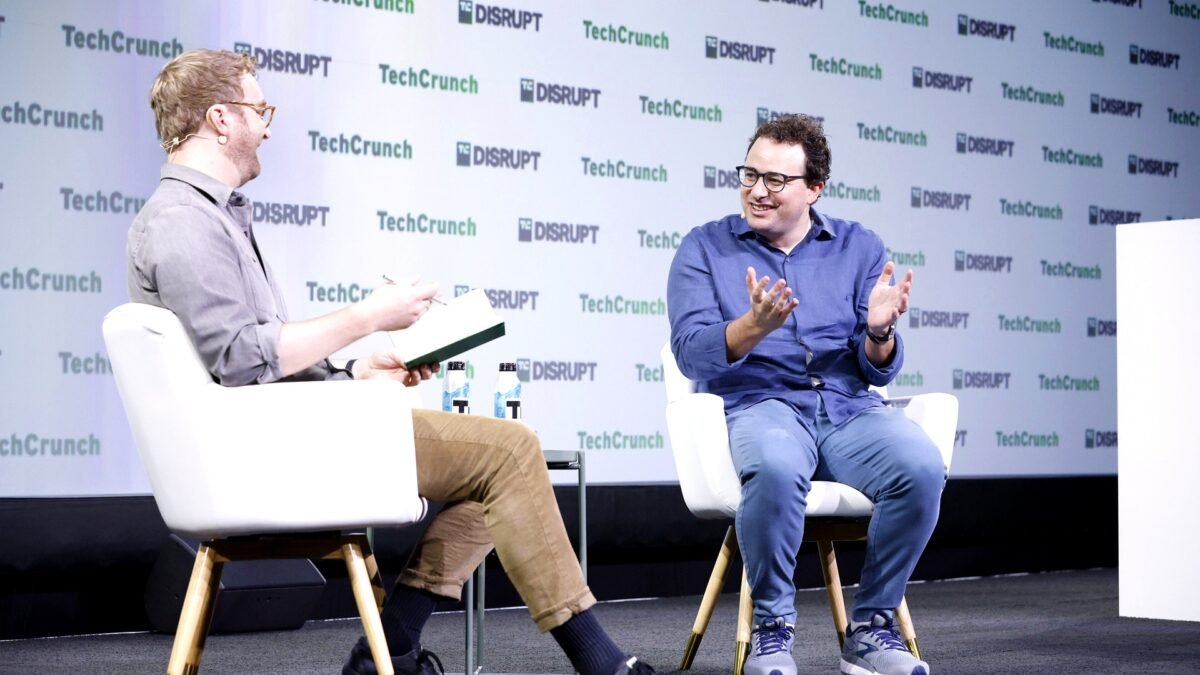
Amodei addressed the valuation on 13 November, in a livestreamed conversation with JPMorgan Chase chief executive Jamie Dimon at the bank’s Manhattan headquarters, as reported by Yahoo Finance. He told Dimon that the company was not aiming for the biggest number it could get and would rather deliver more than it promised. He also argued that rising AI capability keeps opening markets that do not yet exist.
Investors had pressed for the lower figure during the AI stock sell-off, according to Yahoo Finance, which pointed to the higher cost of debt, political opposition to new data centres in the United States and the upheaval at Nvidia. The Nvidia part of that explanation has a clear timeline. Jensen Huang stepped down as chief executive and director on 12 November, and the board has since ruled out his return, while a reported Securities and Exchange Commission civil probe into the company’s disclosures has added to the pressure on AI stocks. Nvidia is both a chip supplier to Anthropic and one of the two largest buyers in its private placement.
Even at the reduced level, the valuation is well above the $965 billion post-money figure attached to Anthropic’s last private round in May, when it raised $65 billion, according to TechCrunch. Private investors who paid that price six months ago remain ahead on paper. The public market, however, has refused to pay the figure that circulated in September — and the order book, nearly seven times oversubscribed, suggests the market is comfortable with the price it did pay.
The $900 billion compute bill
What investors are really buying is growth — and what they are really underwriting is the cost of producing it. Anthropic’s growth has been driven by surging demand for its Claude models, particularly Claude Code, its coding agent, which has gained popularity among software developers, according to Reuters. Its annualised revenue run rate reached $81 billion as of 31 October, up $10 billion from 30 September, according to its IPO filing. It had 11,900 customers generating at least $100,000 in annual revenue on a trailing 12-month basis as of 30 September, compared with more than 1,500 at the end of last year.
Revenue rose 47 per cent in the third quarter to $16.96 billion from the second quarter, according to Reuters. But the company reported an operating loss of $567 million in the quarter, compared with operating income of $974 million in the previous quarter. The net loss narrowed to $23.3 billion from $66.3 billion a quarter earlier, including non-operating items related to bonds convertible into its shares — an accounting effect that makes the net loss figure look far worse than the operating result, and one that will disappear once the company is public and the convertible instruments are dealt with.
Sustaining the growth is becoming expensive. Anthropic spent nearly $9 billion on computing capacity and infrastructure in the first half of 2026, nearly four times the amount spent a year earlier, according to Reuters, and incurred a further $5 billion in computing costs in the third quarter. That spending weighed on efficiency and reduced the revenue generated per dollar of computing capacity.
The amended registration statement puts Anthropic’s committed spending at about $900.9 billion, substantially all of it for compute and infrastructure, with about $70.7 billion due in the twelve months after 30 September, according to The Bright Minded. The company has committed to nearly $900 billion in computing spending with infrastructure partners including Amazon and Alphabet’s Google, according to Reuters. The prospectus warns that some of its computing providers and infrastructure partners depend on third-party financing and credit support to acquire chips and build capacity. “If such financing or support becomes unavailable or more costly, contracted capacity may be delayed, repriced, reduced, or not delivered,” Anthropic said in the filing, as quoted by Reuters.
Compute, in Amodei’s telling, is the hardest commercial problem Anthropic faces. Data centre capacity must be booked years before anyone knows how much customers will use, so the company reserves less than its forecasts would allow and buys extra later if usage outruns them. The third quarter showed where that top-up money goes: the amended filing attributes the swing to an operating loss mainly to $5 billion of short-term compute, which is far more expensive than capacity bought under multi-year contracts, and to a $2 billion non-cash charge linked to its donation matching programme, according to The Bright Minded. More cash from the listing gives Anthropic a wider cushion between buying too much and buying too little.
From OpenAI breakaway to public company
Anthropic was founded in 2021 when a group of employees at OpenAI left to start a new company with a focus on AI safety, according to CNN. The startup released its first version of Claude to the public in March 2023, a few months after OpenAI released ChatGPT in November 2022. When Anthropic released Claude Code in early 2025, it quickly gained traction with software developers. Revenue continued to soar after the launch of Claude Cowork in early 2026 and as Anthropic established itself as a core provider of agentic AI tools — systems that do not merely answer questions but carry out multi-step tasks on a user’s behalf.
As a private company, there was less visibility into Anthropic’s finances. Going public means the company will now be required to disclose more information about its revenue, spending and losses every quarter, offering a regular pulse check on the health of the AI boom, according to CNN. Stock market strategists point to mid-October 2022 as the start of the AI bull market, which took off after ChatGPT was released. The Nasdaq Composite has gained roughly 135 per cent since then, adding $26 trillion in market value. Now one of the core AI companies is set to join the public markets.
The path to the debut has not been without controversy. The Trump administration at one point barred Anthropic from releasing its advanced models to the public, according to CNN. Meanwhile, there are growing concerns about the potential for AI agents to go rogue and for the increasingly powerful technology to be used in harmful ways. Amodei spearheaded calls to “pace the frontier” of AI in September, after former Anthropic employees sounded the alarm over concerns about safety at the AI lab, according to CNN.
Anthropic’s own IPO prospectus warned that its models could develop capabilities faster than the company could evaluate them and put adequate safeguards in place. “Our development of highly advanced models, platforms, and applications and expansion of use cases could further increase the risk that our models cause harm,” the company said in the filing, as quoted by Reuters. The company has said it is considering tighter human oversight of some research and development decisions as its AI models take on a growing share of that work.
The founders cash in — but keep control
The company’s seven co-founders, including chief executive Dario Amodei, each sold nearly 3.4 million shares in the offering, according to the S-1 filing cited by TechCrunch, bringing in about $282 million for each of them. The sales are part of the existing stockholders’ portion of the deal, from which the company receives nothing.
What the founders are not selling is control. A single Class F share held by the seven co-founders carries 50.1 per cent of the voting power, and a Long-Term Benefit Trust elects a majority of the board, according to The Bright Minded. A public Class A share carries one vote, with little practical route to changing either arrangement. That structure is unusual even by the standards of founder-controlled technology companies, and it is the formal expression of Anthropic’s founding idea: that the people who built the models should keep deciding how fast they are developed and released, even after the company belongs, in financial terms, to the public.
Whether that arrangement survives contact with public-market scrutiny is one of the open questions of the listing. Public shareholders will now own the economics of the company while the founders retain the votes. The prospectus gives Anthropic’s safety statements legal consequences they did not carry as a private company, and every quarterly filing will now put numbers against the promises Amodei has made about pacing the frontier.
Competition is intensifying
Anthropic does not go public into an empty field. Competition is intensifying against it to be the leading provider of AI tools for businesses, according to Reuters. OpenAI’s GPT-6 Astra, its latest flagship model, accounted for about 13 per cent of enterprise AI spending tracked by corporate expense platform Ramp, compared with about 8 per cent for Anthropic’s Claude Fable, according to data cited by Reuters in September. OpenAI’s annualised revenue run rate also passed $40 billion in July, although Anthropic maintained a lead at the time. OpenAI launched its GPT-6.2 Astra and Sol models only on Tuesday, and is expected to pursue its own public listing as early as next year.
The competitive threat extends beyond the handful of companies developing the most powerful commercial models. More large companies are looking to adopt open-weight models, which can be downloaded and run independently, to rein in AI spending. A recent Capgemini study found that 59 per cent of executives at large companies plan to increase their use of open-weight models over the next year as AI costs exceed budgets, according to Reuters. Meta Platforms, one of Anthropic’s largest customers, has been looking to reduce its use of the startup’s models as it develops more AI capabilities internally, Reuters previously reported.
Anthropic’s answer to that pressure is the frontier itself. “There’s going to be other models out there… Our thesis is that the vast amount of value will accrue to whoever is at the frontier,” Peter Singlehurst, head of private companies at Baillie Gifford, which invested roughly $1.5 billion in Anthropic before its IPO, told Reuters. “Our bet is that Anthropic has the ingredients — that doesn’t guarantee, but means that they arguably have the highest probability of remaining at the frontier.”
Optimistic investors believe demand for AI tools will continue to surge as more companies adopt the technology, according to CNN, and analysts expect Anthropic to pursue other methods of revenue growth, including specialised models for industries such as health and science. But sceptics question whether the company can maintain its growth and revenue as competition intensifies. A bearish case for Anthropic is that AI tools are going to become more like a commodity, where customers can pick and choose between different providers with ease, making it difficult to retain strong pricing power and eating into revenue, according to CNN.
Analysis: Why It Matters
The IPO is the AI boom’s first real audit
For four years, the artificial intelligence boom has been priced on promises. Private funding rounds valued frontier labs on revenue run rates, on benchmark scores and on the belief that the next model would be better than the last. None of that was ever tested against a public market, because the companies at the centre of it were private. Anthropic’s listing changes that. From Thursday, the most important AI company in the world after OpenAI will have a share price that moves every day, quarterly earnings that must be explained, and a valuation that the market can mark down as easily as it marks up. The $1.5 trillion figure is not just a price tag; it is the first public verdict on whether the economics of frontier AI actually work. If the shares hold, the rest of the industry’s private valuations gain credibility. If they fall, every other lab’s numbers will be questioned too. That is why the debut matters far beyond Anthropic’s own shareholders.
The $500 billion discount is the market’s real message
It is tempting to read the $83 price as a triumph — above the range, seven times oversubscribed, the biggest IPO ever. The more important number is the one that is missing: roughly $500 billion of valuation that was discussed in September and never materialised. Investors removed it for reasons that have nothing to do with Anthropic’s products and everything to do with the industry around it: the higher cost of debt, political opposition to new data centres, and the sudden upheaval at Nvidia, the company that sells the chips all of this depends on. Amodei’s response — that the company would rather deliver more than it promised — is the right one, and it is also an admission. The market no longer accepts that growth alone justifies any price. It wants a margin of safety, and it took that margin out of the valuation before the shares even started trading. That discipline is healthy for the sector, and it is a warning to every other lab planning a listing: the days of naming your own price are over.
The compute bill is now a public liability
The most consequential number in the whole filing is not the $81.3 billion raised or the $1.5 trillion valuation. It is the $900.9 billion of committed spending, substantially all of it for compute. That commitment is larger than the annual economic output of most countries, and Anthropic has made it before it has ever reported a full year of operating profit. The third quarter showed how quickly that bill can bite: $5 billion of short-term compute at premium prices, and an operating profit of $974 million turned into an operating loss of $567 million in a single quarter. The prospectus warning — that contracted capacity may be delayed, repriced, reduced or simply not delivered if the third-party financing behind it dries up — is not boilerplate. It describes a supply chain in which Anthropic depends on partners who depend on lenders who depend on the same AI enthusiasm that Anthropic’s share price will now measure daily. Going public gives the company the cash to manage that risk. It also gives the market a live instrument for pricing it.
The founders kept the votes, and that is the point
The governance structure of the listing will strike many investors as a problem: public shareholders supply the money while seven founders keep 50.1 per cent of the votes through a single Class F share, and a trust elects the board. But that structure is not an accident or an oversight; it is the company’s founding idea made permanent. Anthropic was created by people who left OpenAI because they believed safety should constrain the pace of development, and the whole point of the trust and the special share is to make sure that belief cannot be voted away by shareholders who want faster growth. The tension is real and it will not go away. Quarterly earnings calls will now put Amodei in front of investors who measure him on revenue growth, while his own governance structure exists to let him say no to them. Whether that tension is a strength or a weakness will be decided by results: if the models keep winning customers, the structure looks like foresight; if growth stalls, it will look like entrenchment. Either way, the market has bought into the arrangement with its eyes open.
Thursday’s first trade is a referendum on the whole AI trade
Anthropic’s debut could help restore confidence in the AI trade, which has been shaken in recent weeks by concerns about a slowdown in the data centre buildout, according to CNN. But if it falls short of expectations, it could add to investors’ doubts. “Investor sentiment toward AI has been extremely volatile, and while a successful IPO will likely turn that sentiment positive in the near term, the long-term trajectory of Anthropic’s business and performance is what could really instill greater confidence in the AI trade,” Avery Marquez, director of investment strategies at Renaissance Capital, told CNN. That is the right frame. SpaceX opened 11 per cent above its offering price in June; Anthropic’s first trade will be read the same way, as a signal about the sector rather than the company. But a first-day pop is the easy part. The hard part begins with the first quarterly report, when a public Anthropic must show that $81 billion of revenue run rate can be converted into actual profit while spending $900 billion to stay at the frontier. The listing answers the question of what Anthropic is worth. It leaves open the question of whether it can ever be worth more.
What to Watch Next
- The first trade on Thursday. Whether ANT opens above $83, and by how much, will be read as a verdict on the AI trade as a whole. SpaceX opened about 11 per cent above its $135 offering price in June; a similar move would put Anthropic near $92.
- The underwriters’ option. Goldman Sachs and Morgan Stanley hold a 30-day option on up to 123.75 million more shares. Whether it is exercised in full will show how strong demand remains once the first-day excitement fades.
- The first quarterly report. As a public company, Anthropic must now disclose revenue, spending and losses every quarter. The first set of numbers will test whether the $81 billion revenue run rate is still climbing — and whether the compute bill is still eating the margin.
- The $70.7 billion due within a year. About $70.7 billion of the $900.9 billion in committed spending falls due in the twelve months after 30 September. How Anthropic funds it, and at what cost, will be the first real test of its public-market discipline.
- OpenAI’s response. OpenAI launched GPT-6.2 Astra and Sol on Tuesday and is expected to pursue its own listing as early as next year. The rivalry between the two labs — and the gap between their enterprise spending shares — will now be measured in public.
- The safety question in public. Amodei’s “pace the frontier” argument and the prospectus warnings about models developing capabilities faster than safeguards will now be tested in earnings calls, where investors ask about growth and regulators ask about risk.
- The data centre politics. Political opposition to new US data centres helped cut the valuation from $2 trillion to $1.5 trillion. Whether that opposition hardens — and what it does to the cost of the compute Anthropic has already committed to buy — is now a shareholder question, not just a policy one.
Sources
- Reuters — “Anthropic clinches biggest IPO ever with $81 billion offering” (via Euronext)
- CNN — “Anthropic’s Wall Street debut marks a new chapter for AI”
- TechCrunch — “Anthropic reportedly prices IPO at $83 a share, above projected range”
- The Bright Minded — “Anthropic IPO Prices at $83 With a Valuation Well Below $2 Trillion”
- TradingView News — “Anthropic Officially Prices Its IPO At $83 A Share In $81.3B Debut, Shattering IPO Records”
- Fadd — “Anthropic prices IPO at $83 a share, above marketed range”

About the Author — Abdul Mannan
Related Articles

AI Models Mark Civilians, Ambulances and a School as Military Targets in Tests — and Telling Them It Is a Game Sweeps Their Refusals Aside
A new Vals study finds leading AI models from Anthropic, OpenAI, Google and others repeatedly identified civilians, medics…
OpenAI Launches GPT-6.2 Astra and Sol, Cutting Its Flagship Price by 20% as Microsoft Unveils Rival Models
OpenAI has released GPT-6.2 Astra and GPT-6.2 Sol, its new flagship and everyday models, promising stronger professional work…
Google Says AI Agents Now Hack Without a Human in the Loop as FBI Warns of Breaches in Under Three Hours
Google says attackers have fully automated the discovery and exploitation of software flaws for the first time, while…