
Antonelli Wins United States Grand Prix to Stand One Step From Youngest-Ever Formula One Title

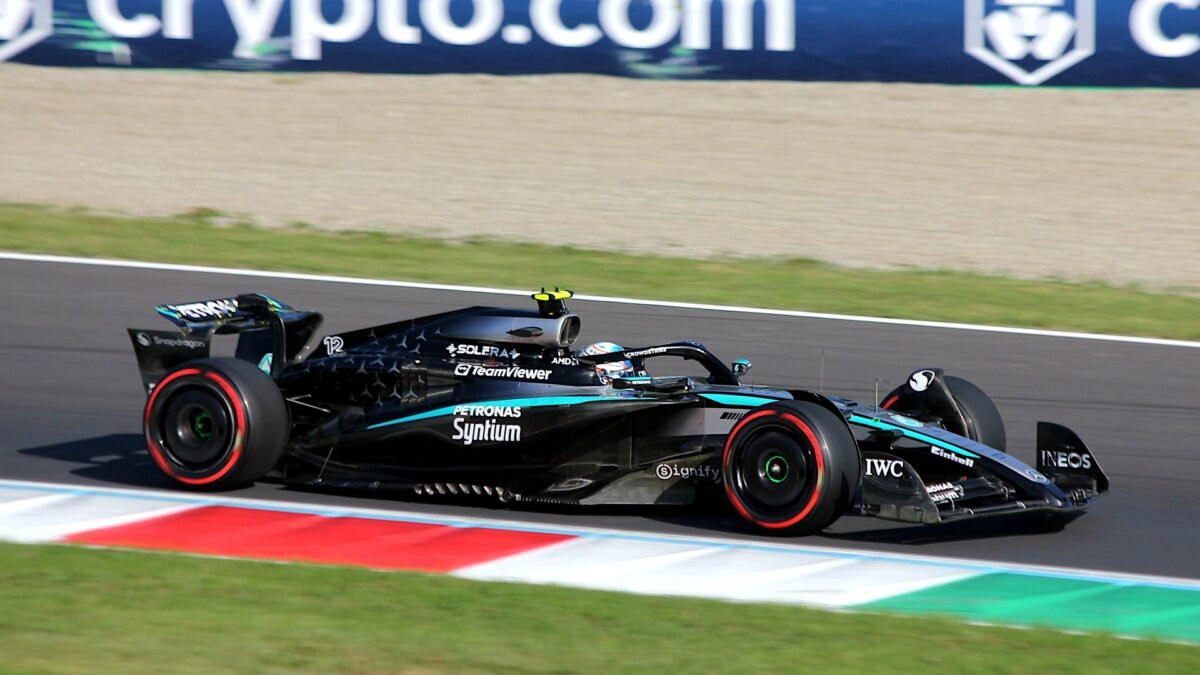
Kimi Antonelli won the United States Grand Prix on Sunday to move to within two points of the Formula One world championship, leaving the 20-year-old Mercedes driver needing only a ninth-place finish in Mexico to become the youngest champion in the sport’s history.
Antonelli, who started from pole position at the Circuit of the Americas in Austin, Texas, controlled the race from the front and crossed the line 13.078 seconds clear of Ferrari’s Charles Leclerc, according to the official results reported by Formula 1. Red Bull’s Max Verstappen finished third, with Ferrari’s Lewis Hamilton fourth and McLaren’s reigning champion Lando Norris fifth.
It was Antonelli’s ninth victory of the season, and it stretched his championship lead to 123 points over his Mercedes team-mate George Russell, who finished eighth, and 124 points over Hamilton. With five races remaining and a maximum of 125 points still available, Antonelli needs to score only two points — the reward for ninth place — in Mexico City to be certain of the title whatever his rivals do, according to Reuters.
Put another way, as Formula 1 itself framed it, Antonelli will be crowned champion in Mexico as long as he does not lose more than 23 points to Russell, or more than 24 to Hamilton, at the next round. A win for Russell in Mexico would still not be enough if Antonelli finishes ninth.
Antonelli did everything in his power to settle the championship in Austin itself. Before the race he led Russell by 102 points, and the mathematics were demanding: he needed a win, Russell ninth or lower, and Hamilton fifth or lower. He delivered the win, in commanding fashion, but Hamilton’s fourth place and Russell’s eighth kept the contest alive for at least one more weekend.
“It was the result we needed,” Antonelli said after the race, as quoted by Formula 1. “The whole team deserves it so much and all this time putting in so much work on bringing this new package and finally seeing the result is very pleasant. It was also perfect execution from strategy to call the one-stop so I’m really happy we made it stick, and it was a great team effort.”
“We’re very close but we’ll try to finish on a high, and hopefully we can clinch it very soon,” he added. “I’m very excited. I would love to clinch the title in style with a great result.”
How the race was won
Antonelli had already done much of the hard work on Saturday, soaring to pole position as the sun dropped over the Circuit of the Americas, with Hamilton fifth and Russell sixth on the grid. From there, the start was decisive. Antonelli blasted away cleanly, while Verstappen, who had started second, made a poor getaway and was swallowed up by the fast-starting Leclerc and others.
Mercedes started Antonelli on medium tyres and committed to a one-stop strategy, switching him to hard tyres on lap 25. It was a call that required both pace and tyre management, and Antonelli repaid the faith. According to Formula 1, he built on his strong start, led Verstappen in the early stages, and then controlled the race as the pit-stop cycle played out around him.
Verstappen briefly led during the pit stops, but he was forced into a second stop on lap 32 after struggling with engine braking, according to race reports. That left the path clearer for Antonelli, whose one-stop gamble held up even as his rivals on fresher rubber closed in during the final laps.
Leclerc, also on a two-stop strategy, proved the strongest of the chasers. He passed Norris and Verstappen in the closing laps on fresher tyres to claim second place for the second successive week, finishing 13.078 seconds behind Antonelli. Verstappen held on for third, 17.485 seconds back, with Hamilton 18.515 seconds behind the winner in fourth, according to USA Today.
A late virtual safety car slowed a chasing Hamilton, who finished one second behind Verstappen, according to BusinessWorld’s account of the race. Hamilton had passed Norris late to take fourth, with Norris fifth after his own one-stop strategy faded in the closing laps. Red Bull’s Isack Hadjar was sixth, McLaren’s Oscar Piastri seventh, and Russell eighth, ahead of Racing Bulls driver Liam Lawson in ninth and Alpine’s Pierre Gasly in tenth.
Three drivers failed to finish: Valtteri Bottas of Cadillac, Franco Colapinto of Alpine and Oliver Bearman of Haas, according to USA Today.
Russell’s difficult afternoon
For Russell, Austin was a day to forget — and a further illustration of the strange split that has opened up inside the Mercedes garage this season. He started sixth, collected a five-second penalty for an incident with Piastri, and finished eighth, just enough to keep the championship mathematically alive.
Speaking afterwards, Russell was searching for answers, according to Reuters. “I need to try and understand why it is. It’s strange when you’re so far off, so hopefully there’s some answers somewhere. But, anyway, I don’t have one,” he told Sky Sports television.
“The pace wasn’t good on the first stint,” he told reporters, according to Reuters. “But when I came out of the pits on the hard tyres, I probably did six laps where I was lapping the same pace as Kimi. But then I caught up with Oscar and I just couldn’t overtake. Six good laps, 50 bad laps. I want to understand why the pace was so bad on the first stint.”
Team principal Toto Wolff defended his driver while acknowledging the problem. “George for all of us in the team is a champion and has won in every category and I think he merits to be put in the group of the very best ones,” Wolff said, according to Reuters. “This year we see this variability in results. When we land the car in a way that suits him, he’s absolutely fast. But when it drops out of that operational window, he struggles. And he struggles more than maybe Kimi. We just have to work it out with him, how there can be such a difference in driving, in performance. Because George is not half a second slower, three tenths slower than Kimi. That’s just absolutely not the case.”
Wolff was, however, unstinting in his praise of the race winner. “On Kimi’s side the main headline is that for me that’s the best race that he’s delivered so far,” he said, according to Reuters. “Getting off the start with the inferior tyre and then controlling it at all times. The race of a champion who isn’t the champion yet, but exceptional. I think he’s outperformed the car. His driving style just glues with the car.”
Antonelli agreed with his boss’s assessment of the weekend. “I think it was one of the best, because of how we built up during the weekend,” he told reporters, according to Reuters. “And, you know, it was a great team effort as well today, especially with the strategy, believing in the one-stop. And, yeah, it was a really great team effort, and they all deserve this result today.”
The championship picture
The updated standings underline how close Antonelli now is. He leads with 365 points, followed by Russell on 242, Hamilton on 241, Verstappen on 236 and Leclerc on 233, according to USA Today. After Mexico, the maximum available will fall from 125 points to 100, with Brazil, Las Vegas, Qatar and Abu Dhabi still to come.
The arithmetic is therefore brutally simple for Mexico City on 1 November. If Antonelli finishes ninth or better, the title is his regardless of what anyone else does. If he finishes tenth or lower, or fails to finish, Russell and Hamilton remain in contention — but only if they also produce near-perfect weekends of their own, and only for a little longer.
What makes the situation remarkable is not just the size of the lead but the speed with which it has been built. Antonelli is in only his second season at the pinnacle of motorsport, according to Reuters. He was four years old when Sebastian Vettel became the youngest champion to that point, aged 23 with Red Bull in 2010. Should Antonelli seal the title in Mexico, he will break that record by three years — and become Italy’s first world champion since Alberto Ascari in 1953, a gap of 73 years.
Before Austin, the talk around the paddock was of “match points”, a tennis comparison that Mercedes deputy principal Bradley Lord used in a team podcast ahead of the race. Lord put the chance of Antonelli clinching in Texas at roughly one in 25, given everything that had to go his way. In the end, Antonelli won the point he could control and watched the other two slip away by the narrowest of margins: Hamilton one place too high, Russell one place too high.
That is the cruelty and the comfort of a dominant season. The title was not won in Austin, but the race still felt like a coronation rehearsal. Antonelli led from pole, managed his tyres, trusted his team’s strategy, and finished more than 13 seconds clear. The only thing missing was the trophy itself.
Analysis: Why It Matters
A coronation deferred, not denied
It is tempting to describe Austin as a missed opportunity, but that would misread the race. Championships are rarely won on a single afternoon, and they are almost never won by a driver who needs three separate results to fall his way. Antonelli controlled the one result he could control, and he did so emphatically. The fact that Hamilton and Russell did just enough to survive is a footnote, not a reprieve: they need Antonelli to stumble badly, repeatedly, in the remaining five races, while they themselves win almost everything. The odds have not merely shortened; they have collapsed to a formality awaiting a date.
There is also a psychological dimension worth noting. A driver who clinches a title with races to spare carries a different kind of pressure into the final rounds than one who scrapes over the line at the finale. Antonelli now goes to Mexico knowing that ninth place is enough. That knowledge can liberate a driver — or it can tighten him up, as the whole paddock watches for the moment history is made. His comments after Austin, calm and focused on the team rather than the record, suggest he understands the difference between chasing a title and managing one.
Strategy, not just speed, won this race
The one-stop strategy deserves more attention than it usually gets in a race report dominated by the championship mathematics. Antonelli started on the theoretically inferior tyre, in Wolff’s phrase, and still controlled the race. The decision to stop once, on lap 25, and make the hard tyres last was a vote of confidence in both driver and car — and it was vindicated as Verstappen’s two-stop approach unravelled and Leclerc’s late charge ran out of laps.
This is where modern Formula One is often decided: not in a single overtaking move, but in the quiet arithmetic of tyre life, pit windows and track position. Antonelli’s ability to build a gap early, preserve his tyres through the middle stint, and still have enough pace at the end to hold off fresher rubber is the mark of a complete driver. Speed alone wins qualifying; management wins championships. Austin showed both.
The Russell puzzle is now Mercedes’ biggest question
For all the celebration around Antonelli, Russell’s afternoon raises a genuine and unresolved question for Mercedes. Wolff’s insistence that Russell is “not half a second slower, three tenths slower than Kimi” is both a defence and an admission: the gap on Sunday was not about talent, but about the car falling out of its operating window for one driver and not the other.
That distinction matters. If the problem is set-up sensitivity — the car suiting one driving style in certain conditions and punishing another — then it is a problem the team can engineer its way out of. If it is something subtler, about confidence or feedback, it may linger. Russell’s own description of “six good laps, 50 bad laps” is the most honest summary of the weekend: flashes of matching pace buried inside a race that never came together. Mercedes will need to solve that puzzle not just for Russell’s sake, but because a team chasing future titles cannot afford to have one car regularly operating below its potential.
What a 20-year-old champion would change
A title for Antonelli would be more than a personal milestone. It would reset the sport’s sense of what is possible at a young age, just as Vettel’s 2010 title did, and just as Verstappen’s early success did after him. Each generation produces a driver who makes the previous record look cautious, and each one forces teams to rethink how early they are willing to bet on youth. Mercedes bet on Antonelli when he was still a teenager; a championship in his second season would be the most emphatic vindication of that gamble imaginable.
For Italy, the significance is harder to overstate. No Italian has won the drivers’ title since Ascari, in an era when Formula One was a fundamentally different sport. An Italian champion driving a Mercedes — a German team with deep Italian connections through its power unit and personnel — would be a story that transcends the paddock, and it would give the sport a new hero in one of its most passionate markets. The scenes at Monza, where Antonelli has already been celebrated as a homecoming star, offer a preview of what Mexico or Brazil might unleash.
Mexico is about nerve, not arithmetic
Finally, it is worth remembering that the arithmetic of Mexico is the easy part. The hard part is the human part. Antonelli will arrive in Mexico City as the overwhelming favourite, with the whole sport expecting him to finish the job. Every practice session, every qualifying lap and every pit stop will be watched for signs of nerves. His rivals, meanwhile, have nothing to lose: Russell and Hamilton can drive freely, knowing that only a miracle keeps them alive, and free drivers are dangerous drivers.
That is why Wolff’s phrase — “the race of a champion who isn’t the champion yet” — is so apt. Antonelli has already driven like a champion in Austin. In Mexico, he must do it again with the title itself sitting in the garage, waiting to be collected. The great champions are defined not by the races they win when the pressure is off, but by the ones they win when everyone is watching. Mexico is that race.
What to Watch Next
- The Mexico City permutations: Ninth place or better in Mexico on 1 November seals the title for Antonelli regardless of other results. Anything less keeps Russell and Hamilton alive — but only just — and pushes the decision to Brazil at the earliest.
- Can Russell find his Austin answers? Mercedes will spend the week before Mexico digging into why Russell’s pace vanished on the first stint and why only a handful of laps matched Antonelli’s. A competitive Russell in Mexico is the last realistic obstacle to an early coronation.
- Ferrari’s late-season momentum: Leclerc has now finished second in two successive races. If Ferrari can carry that form to Mexico City’s high altitude, where engine and cooling demands are unique, Hamilton and Leclerc could yet shape the title race even if they cannot win it.
- Verstappen and Norris in the chasing pack: Verstappen’s third place and Norris’s fifth in Austin kept both in the top five of the standings, but neither can now win the title without an extraordinary collapse from Antonelli. Their battle for pride, podiums and second place in the constructors’ fight remains live.
- The remaining calendar: After Mexico come Brazil, Las Vegas on 19–21 November, Qatar and Abu Dhabi. If Antonelli clinches early, those races become a showcase for the new champion — and an audition for 2027, when every team will be trying to work out how to stop him.
Sources
- Reuters — Antonelli wins US Grand Prix but must wait for title
- Formula 1 — ‘It was the result we needed’: Antonelli hoping to win title ‘very soon’ after ‘perfect’ United States Grand Prix
- Reuters — Russell searching for F1 answers after off day in Austin
- USA Today — Kimi Antonelli wins US Grand Prix, but must wait for Formula 1 championship

About the Author — Abdul Mannan
Related Articles

Palmer Sees Red as Tottenham End Stamford Bridge Hoodoo With 2-0 Win Over Chelsea
Tottenham Hotspur beat Chelsea 2-0 at Stamford Bridge on Saturday — only their second Premier League win at…
Jackson Double Ends Manchester City’s Perfect Start as Aston Villa Win 2-1 at Villa Park
Nicolas Jackson scored twice as Aston Villa ended Manchester City's perfect Premier League start with a 2-1 win…
Brewers Survive Ninth-Inning Scare to Edge Rays 3-2 in World Series Opener
The Milwaukee Brewers survived a ninth-inning scare to beat the Tampa Bay Rays 3-2 in Game 1 of…