
Aramco Administrative Building Hit in Dhahran as Saudi-Houthi Strikes Escalate to Energy Targets

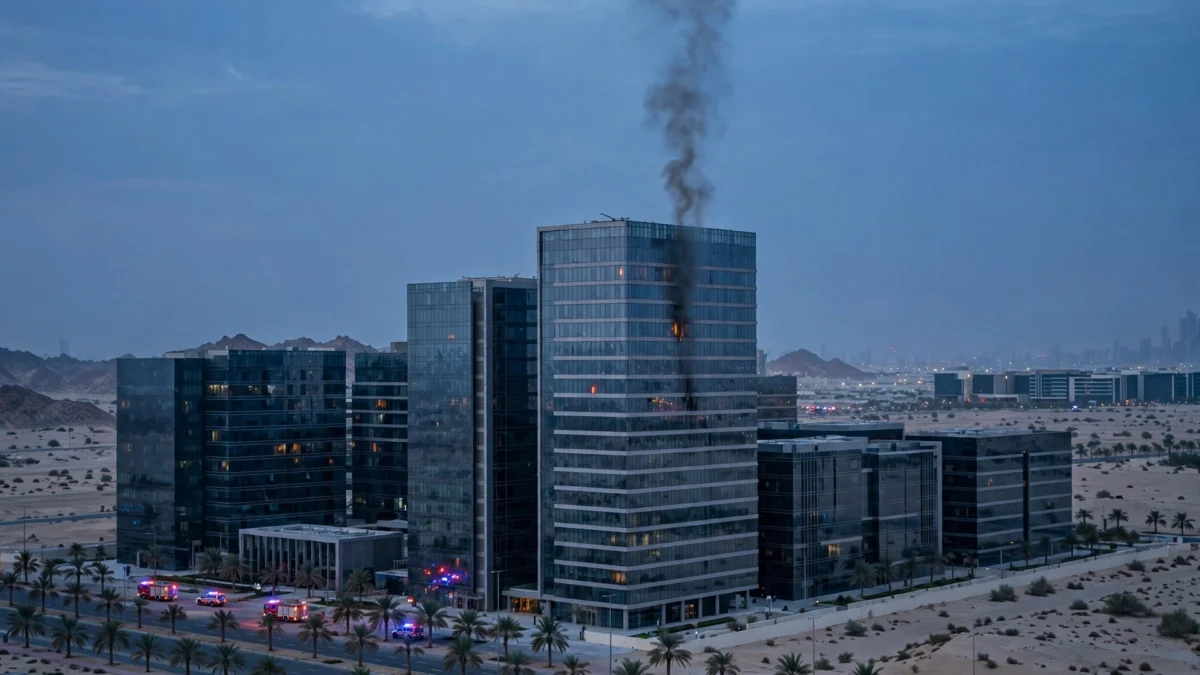
An administrative building belonging to Saudi Aramco in the eastern city of Dhahran was hit on Tuesday night, causing a limited fire but no injuries, according to Saudi Arabia’s Energy Ministry, in the most direct strike yet on the kingdom’s oil industry during a week of rapidly escalating exchanges between Saudi Arabia and Yemen’s Houthi movement.
The incident capped a day in which the two sides traded blows against energy infrastructure on both sides of the border: Saudi-led coalition warplanes struck a fuel depot in the Houthi-held Yemeni capital, Sanaa, while Houthi missiles and drones targeted cities across Saudi Arabia, including the capital, Riyadh. According to Reuters, Gulf stock markets slipped in early trading on Wednesday as investors weighed the risk that the confrontation could widen further.
What exactly struck the Aramco building remains unclear. Saudi authorities confirmed that an administrative building inside the company’s Dhahran compound was hit and that a limited fire broke out, with no injuries reported. According to CNN, it was not clear whether the fire was caused by a direct hit or by falling debris. A company source told Reuters that a ballistic missile had struck an office tower at the complex, damaging its upper three floors. Neither Aramco nor Saudi authorities had officially identified the specific building, and reports differed over whether the target was the company’s executive headquarters or another building inside its headquarters complex, according to The National’s summary of the conflicting accounts.
Dhahran, on the Persian Gulf coast, sits at the heart of Saudi Arabia’s oil economy. It is home to Aramco’s headquarters, a university specialising in petroleum engineering, and a major air base, according to Bloomberg. The kingdom’s biggest oil fields lie in the deserts of the Eastern Province and in the Persian Gulf. A strike that reaches an office building inside that compound, whatever the precise mechanism, carries a significance that goes well beyond the limited physical damage reported.
Interceptions over Riyadh and the Eastern Province
The Dhahran incident was part of a broader barrage on Tuesday. According to CNN, the Saudi-led coalition said it had intercepted and destroyed three cruise missiles and two drones targeting the Riyadh region and southern Saudi Arabia. At least four people were injured by falling debris, according to Saudi authorities.
More detail emerged on Wednesday, when the state news agency SPA, citing the Civil Defence spokesperson, reported that debris from two intercepted missiles had fallen on Riyadh, injuring four people — a man, two women and a child — and causing limited damage to 15 homes, according to Reuters. Emergency procedures were carried out following the incident, according to Anadolu’s account carried by AnewZ.
Earlier on Tuesday, according to CNN, the coalition said it had intercepted a ballistic missile launched toward the kingdom’s Eastern Province and another aimed at Haradh, near the Yemeni border. It also reported intercepting three Houthi drones north of Riyadh. According to Bloomberg, the coalition said it intercepted missiles targeting Kharj in the kingdom’s southern region, as well as Dhahran and Haradh, and that shrapnel from an interception fell in a residential area in Dhahran.
The pattern of the evening’s attacks — missiles aimed at the capital, the Eastern Province, and the southern border region simultaneously — pointed to an attempt to stretch Saudi air defences across multiple axes at once, rather than a single symbolic strike.
Strikes on Sanaa’s fuel infrastructure
Hours before the Dhahran incident, the Saudi-led coalition struck energy-related targets inside Yemen. According to CNN, Saudi Arabia attacked a key fuel depot in Sanaa on Tuesday, which it claims was being used by Houthi rebels to support strikes on the kingdom’s airports and energy facilities, as well as attacks on shipping in the Red Sea.
The coalition had warned civilians in advance. According to Bloomberg, the coalition told people in the vicinity of an oil site in the Houthi-held capital to leave the area “for their safety” before the strike. The Yemen Petroleum Company later said the Al Sabah facilities and a refuelling station were hit, and that it had emptied the fuel tanks prior to the attack, according to Bloomberg. The Houthi-controlled Yemen Oil Company had said earlier that the facility held no stocks of petroleum products and that an attack would not affect fuel reserves or supplies, according to CNN.
The strikes killed two civilians and injured two, according to the Houthis, though the Saudi-led coalition insisted it had warned civilians to leave the area beforehand, according to CNN. Coalition spokesperson Maj. Gen. Turki al-Maliki said in a statement that the operation focused on neutralising the capabilities the Houthi militia uses to threaten the kingdom, Yemen, the southern Red Sea and maritime corridors, according to CNN.
According to The National’s summary, the coalition said it had also attacked fuel-loading piers at the Red Sea port of Hodeidah, while Houthi-run Al Masirah TV reported strikes in Saada and Al Jouf. Houthi-run Al Masirah TV also reported that artillery fire by the Saudi-led coalition in Saada province wounded three Yemenis and two African residents in Baqim district, and later reported that two civilians were killed and two others wounded by artillery fire on residential villages in the border district of Shada, according to CNN. CNN said it could not independently verify those reports, and this article treats the claims from both sides about casualties inside Yemen as unverified.
Markets react as Gulf trading opens
The market reaction arrived quickly. According to Reuters, major Gulf stock markets were mixed in early trade on Wednesday, with Saudi shares falling after the attack on the Aramco site heightened concerns over the escalating conflict between the kingdom and Yemen’s Houthis.
Saudi Arabia’s benchmark index fell 0.7 percent, dragged down by a 1.3 percent drop in Saudi National Bank, the country’s biggest lender by assets, according to Reuters. Aramco shares shed 0.5 percent. Elsewhere in the Gulf, Qatar’s index slipped 0.4 percent, weighed down by a 1.4 percent drop in petrochemical maker Industries Qatar, according to Reuters. The United Arab Emirates moved the other way: Dubai’s main share index edged up 0.1 percent, helped by a 1.4 percent gain in top lender Emirates NBD, while the Abu Dhabi index rose 0.3 percent, according to Reuters.
The moves were modest in absolute terms, but their direction mattered: the strike on an Aramco facility had translated, within hours, into a repricing of Saudi risk. According to Bloomberg, Brent crude oil has traded at or above 100 dollars a barrel for more than a month, contributing to inflationary pressure globally.
According to Reuters, regional tensions rose further as two senior Iranian officials told the news agency that Tehran is using new tactics to target ships sailing through the Strait of Hormuz. They said the aim is to keep oil prices high and to influence the United States midterm elections. Those claims about Iranian intentions come from Iranian officials speaking to Reuters and have not been independently confirmed.
Trump warns the Houthis as Washington weighs its role
On Tuesday, United States President Donald Trump issued what Bloomberg described as a veiled threat to the Houthi movement on social media, saying the group was purposefully trying to drive up oil prices at the behest of Iran ahead of the US midterm elections on November 3. In the same message, Trump wrote that he thought the group had learned its lesson a year ago, and added: “I’ll be there after the Elections, and I will never forget!”
According to Bloomberg, Trump said over the weekend that he was considering joining the Saudi-backed campaign against the Houthis. The United States is already assisting Riyadh with intelligence, targeting and aerial refuelling, but has so far resisted direct involvement, according to Bloomberg.
The American posture matters because Washington’s support shapes what the coalition can sustain. Intelligence and refuelling help keep the air campaign going; direct American strikes would change the character of the conflict entirely. Trump’s message left both possibilities open — a warning framed around the election calendar rather than a commitment to a specific course of action.
Separately, according to CNN, the US State Department on Tuesday expanded travel restrictions for US government personnel in the kingdom, saying employees now require special authorisation from the chief of mission to use any airport in Saudi Arabia. The US, UK, Spain and Canada are among countries now warning their citizens against using Riyadh’s King Khalid International Airport, according to CNN.
A week of escalation
Tuesday’s exchange did not come out of nowhere. According to Bloomberg, the fighting has killed at least 18 people and injured hundreds more in Saudi Arabia over the past week. The deadliest single incident came on Saturday, when a strike on Riyadh’s King Khalid International Airport killed 13 people and wounded more than 300, according to CNN — the deadliest attack on Saudi Arabia in more than a decade. According to Reuters, the capital’s international airport has been hit four times in the past week.
The airport attacks have had cascading effects. According to Bloomberg, flights at Riyadh’s main airport have been halted and the capital’s primary financial centre switched to remote work, just as the kingdom prepares to host a number of high-profile international events, including its flagship investor gathering, the Future Investment Initiative. Organisers are now planning to make the FII conference a hybrid event, giving executives the option to attend remotely, Reuters reported on Tuesday, citing two unidentified people familiar with the matter, according to Bloomberg.
On the ground in Yemen, according to CNN, Yemeni government forces claimed continued advances in a military operation dubbed “Dawn of Yemen.” The forces said that in the past 24 hours they had carried out 2,200 strikes against Houthi positions, killing about 1,200 fighters and destroying or disabling more than 440 military vehicles and other assets. CNN said it could not independently verify those figures, and this article repeats them only as the Yemeni government’s claims.
Meanwhile, according to CNN, the Houthis vowed further attacks against economic and aviation targets within Saudi Arabia, warning that they would target facilities belonging to Aramco as well as King Khalid International Airport if Saudi forces continued attacking them. That vow, made before Tuesday night’s Dhahran incident, now reads as a statement of intent already acted upon.
Energy infrastructure already under pressure
The Aramco strike is the latest in a series of attacks on Saudi energy infrastructure. According to Bloomberg, a refinery at Jazan in the west of the kingdom has been shut since an earlier attack, while a key oil export port on the Red Sea coast has also been targeted. A cross-country pipeline that has been the main means for Aramco to get its oil to markets was temporarily shut last month following an attack launched from Iraq, according to Bloomberg.
Each incident on its own has been absorbed: a refinery closed, a pipeline paused and restarted, a port targeted. Taken together, they describe a campaign aimed not at a single spectacular disruption but at the steady erosion of confidence that Saudi energy infrastructure is insulated from the war in Yemen. The Dhahran strike fits that pattern — a limited fire in an office building, but inside the compound of the company that sits at the centre of the world’s largest oil-exporting economy.
Earlier, the Saudi cabinet warned that the Houthis would “bear the consequences” of repeated “heinous attacks” on airports, civilian and economic sites, according to Bloomberg. The language signalled that Riyadh views the airport and energy strikes as a single campaign, not as separate incidents, and that its response will be framed accordingly.
Background: a war reignited
The conflict between Saudi Arabia and the Houthis is more than a decade old. According to Bloomberg, Riyadh has been in conflict with the Houthis ever since they took control of the Yemeni capital, Sanaa, in 2014 and forced the internationally recognised government backed by Saudi Arabia to resign the following year.
After years of relative calm, tensions flared again in July, when Saudi jets struck the runway of the airport in Sanaa to prevent a Houthi delegation returning from Iran from landing, according to Bloomberg. Hostilities intensified over the last week as Saudi-led forces in Yemen launched a new campaign to take back control of Houthi-held areas, according to Bloomberg.
According to CNN, the conflict has been intensifying since the Houthis announced in July that — in response to what they say is retaliation for a Saudi blockade on the Yemeni capital — they would target Saudi shipping in the Red Sea as well as infrastructure inside the kingdom. That announcement redefined the scope of the war: from a fight over territory in Yemen to a campaign against the economic arteries of Saudi Arabia itself.
Tuesday’s exchange also comes amid a wider regional crisis. According to CNN, the long-running conflict reignited this summer and intensified last month after years of relative calm. The war in Yemen now overlaps with the confrontation over the Strait of Hormuz, the US-Iran tensions that have shaped the region all year, and the stalled diplomacy that has repeatedly failed to produce a durable settlement in Yemen.
Analysis: Why It Matters
The Dhahran strike matters less for what it destroyed — a limited fire in an administrative building, no injuries — than for what it demonstrated: that the Houthis can now reach the symbolic and operational centre of Saudi Arabia’s oil industry, and that they are willing to do so.
That is a threshold crossing. Airport strikes kill civilians and paralyse travel, and they are grave in their own right. A strike inside the Aramco compound speaks to a different audience: oil traders, insurers, investors, and the governments that depend on Saudi crude. The market reaction on Wednesday morning — modest, orderly, but unmistakably negative for Saudi shares — shows that the audience heard the message. The question now is whether the message stays symbolic or becomes a sustained campaign.
Second, the exchange exposed the arithmetic of missile defence. The coalition intercepted multiple missiles and drones on Tuesday, according to its own statements carried by CNN and Bloomberg. Yet debris from intercepted missiles still injured four people and damaged 15 homes in Riyadh, and something — a missile or its debris — still reached the Aramco compound in Dhahran. Interception is not the same as immunity. Every defensive success still produces falling debris over a city, and every salvo forces defenders to be right everywhere, every time, while attackers need to be right only once.
Third, the advance warnings on both sides deserve attention. The coalition warned civilians to leave the Sanaa fuel facility before striking it; the Yemen Petroleum Company said it had emptied the tanks. The Houthis, for their part, announced their targets in advance. This is not restraint in any moral sense — civilians still died, according to Houthi claims that could not be independently verified — but it is a form of signalling. Both sides are calibrating: hitting infrastructure while trying to control the political narrative about who endangers civilians. The warnings are part of the warfare, not an exception to it.
Fourth, the oil-price politics are now explicit. Trump framed the Houthi campaign as an attempt to drive up oil prices at Iran’s behest ahead of the American midterms, and Iranian officials told Reuters that keeping oil prices high and influencing the midterms was indeed part of Tehran’s aim in the Strait of Hormuz. Whether either claim is fully accurate, the framing itself shapes decisions: energy infrastructure is no longer just a target in a regional war; it is a lever in an American election. That raises the stakes for every actor, because it invites Washington to treat attacks on Saudi oil facilities as attacks on American domestic politics.
Fifth, the episode is a stress test for Saudi Arabia’s economic transformation project. According to Bloomberg, the fighting poses a challenge to Crown Prince Mohammed bin Salman’s efforts to transform the kingdom’s oil-rich economy into a centre for everything from tourism to finance. The Future Investment Initiative going hybrid is a small, concrete symbol of that challenge: the event designed to pitch Saudi Arabia as a safe destination for global capital now has to offer remote attendance because the capital’s airport has been repeatedly hit. The transformation agenda depends on an image of stability; the Houthi campaign is aimed precisely at that image.
Finally, the fog matters. It is still unclear whether the Aramco building suffered a direct hit or damage from debris. Casualty claims from inside Yemen cannot be independently verified. The Yemeni government’s battlefield claims are unverified. The Iranian officials’ statements about Hormuz come from anonymous sources. In a conflict where every side has an incentive to exaggerate or minimise, the verified core is narrow: an Aramco building was hit and caught fire; four people in Riyadh were hurt by debris; markets dipped; both sides promise more. Everything beyond that core should be read as claim, not fact — including in this article’s own analysis, which rests on the attributed reporting cited throughout.
What to Watch Next
- Aramco’s own account: Whether Aramco issues a detailed statement clarifying what struck the Dhahran building, the extent of the damage, and whether any operations were affected. Silence or vagueness would itself be informative.
- The Houthi claim: Whether the Houthis formally claim the Dhahran strike and specify the weapon used. A claim would confirm the targeting logic; continued ambiguity would suggest a preference for letting uncertainty do the work.
- The coalition’s response: Whether Saudi-led strikes expand to new categories of targets in Yemen, and whether the “bear the consequences” warning from the Saudi cabinet translates into a wider air campaign.
- Washington’s decision: Whether Trump moves from warnings to direct American military involvement, or whether US support stays limited to intelligence, targeting and refuelling. The election calendar he invoked will shape the timing.
- Oil and the FII: Whether Brent crude holds above 100 dollars a barrel, whether Saudi shares recover or keep sliding, and whether the Future Investment Initiative proceeds as a hybrid event — the clearest real-world measure of how much confidence the strikes have cost Riyadh.
Sources
- CNN — Headquarters of Saudi Aramco hit as Houthis and Riyadh trade strikes
- Reuters — Saudi stocks slip after attack on Aramco building; Gulf markets mixed
- Moneyweb / Bloomberg — Aramco headquarters hit as Houthis widen attacks on Saudi Arabia
- The Business Standard — Saudi Aramco headquarters targeted in Houthi missile strike
- AnewZ — Saudi Aramco building attacked, limited fire reported

About the Author — Abdul Mannan
Related Articles
Saudi Arabia Intercepts Three Houthi Ballistic Missiles as Air-Raid Sirens Sound Over Riyadh
Saudi Arabia says it intercepted and destroyed three Houthi ballistic missiles on Monday evening — one over Riyadh…
Iran Offers to Mediate Between Saudi Arabia and the Houthis as Airport Attacks Escalate
Tehran says it is ready to facilitate dialogue between Riyadh and the Houthis after a week of deadly…
Houthi Campaign Widens to Dammam as Riyadh Death Toll Rises to 13, Trump Weighs US Strikes
King Fahd International Airport in Dammam came under attack on Sunday evening as the Houthi campaign spread 400…