
After Eight Years and Six Billion Miles, BepiColombo Finally Reaches Mercury

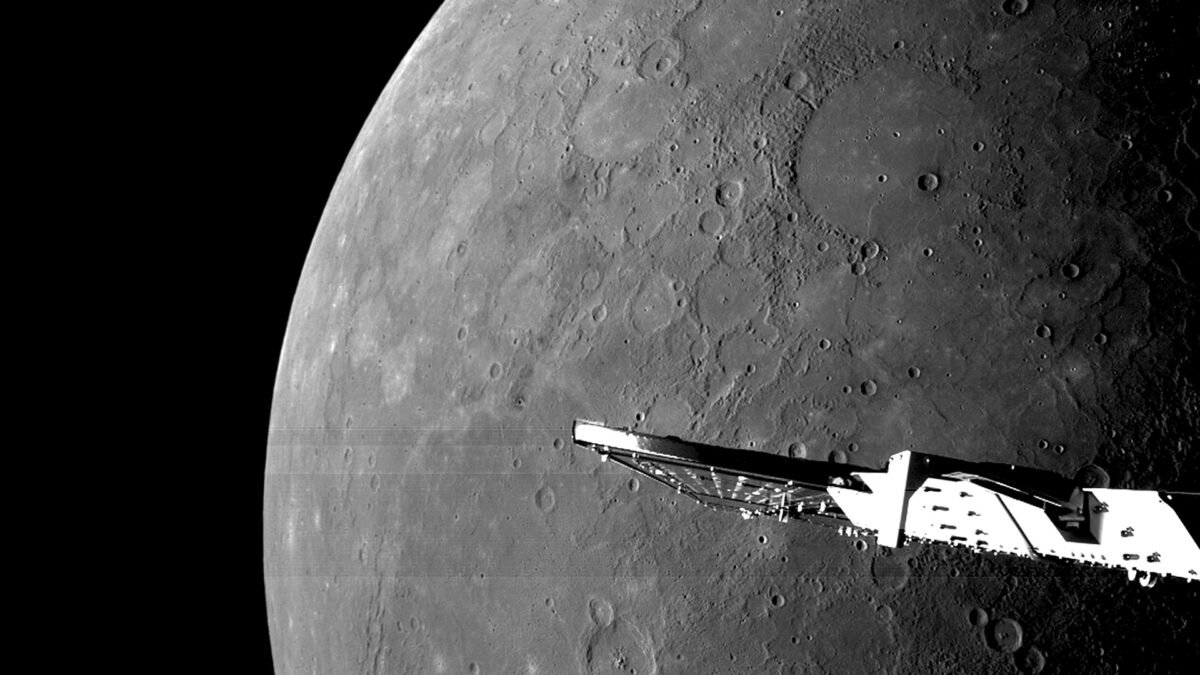
After eight years in space, nine planetary flybys and a journey of some six billion miles, the joint European-Japanese BepiColombo mission is about to arrive at Mercury. On Saturday, 21 November, the spacecraft will be captured by the gravity of the solar system’s innermost planet, becoming only the second mission ever to orbit Mercury and the first to visit the planet in more than a decade.
The arrival marks the end of one of the longest and most intricate voyages in the history of planetary exploration, according to the European Space Agency (ESA), which operates the mission together with the Japan Aerospace Exploration Agency (JAXA). BepiColombo launched from Earth in October 2018. It has spent the years since threading its way through the inner solar system, using the gravity of Earth, Venus and Mercury itself to shed speed, so that it can slip gently into orbit around a world that sits just 36 million miles from the Sun.
Two spacecraft are making the journey together. ESA’s Mercury Planetary Orbiter, known as the MPO, will study the planet’s surface and interior, while JAXA’s Mercury Magnetospheric Orbiter, called Mio, will investigate the magnetic field and the space environment around the planet. The pair have travelled bolted together for eight years. In the weeks after arrival they will separate and take up different orbits, giving scientists something no Mercury mission has ever had before: two sets of eyes on the planet at the same time.
The last spacecraft to orbit Mercury was NASA’s MESSENGER, which circled the planet from 2011 until it ran out of fuel and crashed into the surface in 2015. Before that, the only other visitor was NASA’s Mariner 10, which flew past Mercury three times in 1974 and 1975. BepiColombo will be the first mission to return to Mercury in more than a decade, and it carries far more capable instruments than either of its predecessors.
A gentle arrival, not a dramatic burn
Despite the scale of the moment, the arrival itself will be comparatively quiet. There will be no single, spectacular engine burn of the kind that usually announces a spacecraft’s arrival at another planet. Instead, ESA has planned what it calls a weak stability boundary capture, in which the spacecraft edges towards Mercury so slowly that the planet’s gravity can take hold of it with only modest help from its chemical thrusters.
“We are approaching the planet with a very slow speed,” Ignacio Clerigo, the spacecraft operations manager for BepiColombo, told NPR. He said the spacecraft was travelling at about 670 miles per hour as it closed in on Mercury, a crawl by interplanetary standards.
According to Space.com, the capture on Saturday opens a sequence of 16 engine firings spread over the coming weeks and months, gradually lowering and stabilising the spacecraft’s orbit. Clerigo told NPR that BepiColombo would fire its engines 16 times over the coming weeks to adjust its orbit so that it can carry out its scientific mission. ESA has not published a precise clock time for the capture, and the agency has said that exact dates may change for operational reasons, so Saturday should be treated as the planned moment rather than a fixed appointment.
The transfer module that powered the long cruise, the Mercury Transfer Module, has already done its job. Its solar-electric propulsion system, which provided the gentle but relentless thrust for most of the journey, was switched off for the last time on 15 June 2026. The module itself was jettisoned on 3 September 2026, leaving the two orbiters to make the final approach on their own.
The most difficult destination in the solar system
Mercury is, by most measures, the hardest planet in the solar system to reach. It is not the distance that defeats spacecraft, but the Sun. A probe travelling towards Mercury falls deeper into the Sun’s gravity well and picks up enormous speed, so the challenge is not getting there but slowing down enough to stay there. Without careful braking, a spacecraft would simply shoot past the planet and fall towards the Sun.
“For a long time, people didn’t think it was possible to get to Mercury orbit,” Shoshana Weider, Mercury science lead at NASA headquarters in Washington, told Scientific American. The solution, worked out decades ago by the Italian mathematician and engineer Giuseppe Colombo, after whom the mission is named, was to use a sequence of planetary flybys to bleed off speed. BepiColombo has completed nine of them: one of Earth, two of Venus and six of Mercury itself.
The journey was supposed to take seven years, with arrival in December 2025. In September 2024, however, engineers discovered a power-related anomaly that limited the thrust available from the solar-electric propulsion system. Unexpected electrical currents were found between the solar array and the power unit, and the arrival had to be pushed back by almost a year, to November 2026. The delay was a serious setback, but the mission team redesigned the remaining trajectory and kept the mission on course.
Colombo, who died in 1984, also worked out one of Mercury’s strangest features: the planet rotates on its axis once every 58 days while circling the Sun every 88 days, locked in a 3:2 resonance that means a single solar day on Mercury lasts 176 Earth days. The mission that bears his nickname, Bepi, is the first large joint Europe-Japan planetary mission.
Two spacecraft, two very different jobs
Once captured into orbit, the two orbiters will spend several months being manoeuvred into their working positions. The most delicate moment comes on 9 and 10 December, when the MPO and Mio will separate. The two spacecraft, which have been joined together for eight years, will be unlatched, the wires connecting them cut, and a spring will push them apart at slower than walking speed. ESA’s head of inner solar system mission operations, Ignacio Tanco, told Scientific American that it was the most complex mission he had worked on by far, and probably the most complex mission ESA had ever operated.
After separation, Mio will settle into an elliptical polar orbit lasting about nine hours, while the MPO will be moved over about three months into a tighter orbit of roughly two hours, coming as low as 300 miles above the planet’s surface. Both spacecraft will loop over Mercury’s poles, allowing them to see most of the planet as it rotates beneath them. A protective sunshield structure, known as MOSIF, will be released on 16 December. Science operations are due to begin in April 2027, and the mission is expected to study Mercury for at least a year, with a possible extension.
The division of labour is clear. The MPO, built and operated by ESA, carries a camera and a suite of instruments to map the surface, measure its composition and probe the interior. Mio, built and operated by JAXA, is a spin-stabilised spacecraft designed to measure the magnetic field and the magnetosphere, the bubble of charged particles around the planet.
One of the MPO’s instruments has already produced its first results. The Mercury Imaging X-ray Spectrometer, known as MIXS, was built in Britain by a team led by the University of Leicester. In September 2026, with the spacecraft still on its way to Mercury, the team used the instrument to observe the Crab Nebula, the remains of a star whose explosion was seen by astronomers on Earth in July 1054. The observation, which involved 55 slews of the spacecraft and 39 hours of measurements over 11 and 12 September, was a calibration test, but it also gave astronomers a fresh view of one of the brightest X-ray sources in the sky. At Mercury, MIXS will map the chemical make-up of the surface by measuring fluorescent X-rays given off by rocks after they are struck by X-rays from the Sun.
A planet that does not fit
Mercury is, in the words of NASA’s Shoshana Weider, “a strange little oddball” that does not fit with the rest of the solar system. It is only about a third of the width of Earth, roughly the size of Mars, yet it has a bafflingly large iron-rich core that extends about 85 per cent of the way from the centre to the surface. Earth’s core, by comparison, extends only about 55 per cent of the way out. How a small planet came to have such an oversized core is one of the central questions BepiColombo was built to answer.
The planet’s surface is equally extreme. Temperatures swing from about 800 degrees Fahrenheit in daylight to minus 290 degrees Fahrenheit at night, a range of more than a thousand degrees. Mercury has almost no atmosphere, only a whisper-thin exosphere of particles knocked off the surface by the solar wind, which follow ballistic trajectories and fall back down. And yet, impossibly, there is ice in craters at the poles, trapped in permanent shadow where sunlight never reaches. The leading theory, according to Carolyn Ernst, a planetary scientist at Johns Hopkins University Applied Physics Laboratory, is that the water arrived on a volatile-rich asteroid or comet, a finding that could also shed light on how Earth got its water.
Mercury is also shrinking. As the planet cools, its surface has contracted, forming vast escarpments, cliffs a couple of kilometres high where chunks of the crust have been pushed over one another. Some of these thrust faults are still moving, according to David Rothery, a planetary geoscientist at the Open University who works on two of the MPO’s instruments, which means that Mercury’s tectonics have not finished. The planet also shows signs of volcanism stretching back billions of years, possibly linked to strange pits known as hollows, where parts of the surface appear to have collapsed. Scientists do not yet understand what causes them.
Then there is the magnetic field. Mercury is the only rocky planet in the solar system besides Earth that generates a global magnetic field from its core, although its field is about a hundred times weaker than Earth’s. That a small, apparently cooling planet should still have a liquid iron core generating a magnetic field was a surprise when Mariner 10 first detected traces of it in the 1970s, and it remains unexplained. BepiColombo’s two spacecraft will measure the field simultaneously from two locations, showing how it responds to the solar wind and helping scientists work out how it is generated deep inside the planet.
Why Mercury matters now
BepiColombo is arriving at a moment when Mercury has become newly important to astronomy. Most of the planets discovered around other stars so far orbit very close to their suns, and Mercury is the solar system’s own example of such a world. “There’s a lot of interest in exoplanets right now, and it’s our example in our solar system of a planet that’s close to the sun,” Catherine Johnson, a geophysicist at the University of British Columbia and the Planetary Science Institute, told National Geographic. What BepiColombo learns about how Mercury formed and survived so close to the Sun could help explain the thousands of similar worlds now being found elsewhere.
The mission will also fill a gap left by MESSENGER. Although that spacecraft mapped most of Mercury’s surface, it saw the south pole only poorly, because its orbit kept it far from the southern hemisphere. BepiColombo’s polar orbits will give scientists their first detailed look at the south, including a search for ice in its shadowed craters. “It will tell us whether what we saw in the north is also found in the south,” Sean Solomon of Columbia University, the former lead scientist for MESSENGER, told Scientific American.
The mission has also been an exercise in endurance and cost. According to SpaceNews, ESA’s share of the mission alone was estimated at 970 million euros, about 50 per cent more than originally approved, and that figure excludes payload contributions from individual European governments and Japan’s separate orbiter. The total cost of the mission runs well into the billions of euros. It is a reminder that planetary exploration at this scale is measured not in years but in decades: BepiColombo was approved in the 2000s, launched in 2018, and will not begin its main science work until 2027.
Analysis: Why It Matters
The arrival is the achievement, not just the science
It is easy to treat Saturday’s capture as a formality, the quiet moment before the real work begins in April 2027. That would be a mistake. Getting to Mercury orbit is itself the hardest thing this mission has had to do, and the reason the mission exists at all. For decades, planetary scientists regarded Mercury as effectively unreachable in orbit: the Sun’s gravity made the journey too punishing, the heat too extreme, the braking manoeuvres too delicate. Mariner 10 could only fly past, and MESSENGER needed a decade of planning and its own long sequence of flybys to get there. That BepiColombo is about to succeed where so few have even tried is a measure of how far deep-space navigation has come, and it is the reason the mission’s engineers, rather than its scientists, have had the hardest eight years. The science that follows will be built entirely on the fact that this capture works.
Two spacecraft are worth more than twice one
The decision to fly two orbiters instead of one was not a luxury. Mercury’s magnetic field cannot be understood from a single point, because a lone spacecraft can never tell whether a change in the field comes from the planet itself or from the solar wind blowing past it. With MPO and Mio measuring the same field from two places at once, scientists will be able to separate the planet’s own magnetism from the short-lived fluctuations caused by solar storms. The same logic applies to the exosphere: one spacecraft can sample particles, but two can show where they came from and where they are going. The twin-spacecraft design is what turns BepiColombo from a better MESSENGER into a genuinely new kind of Mercury mission, and it is also what makes the December separation the riskiest moment of the whole endeavour. Two spacecraft that have been bolted together for eight years must be pulled apart, in orbit around another planet, without either of them being damaged. There is no second chance.
The delay was a warning, not just a setback
The year-long delay caused by the propulsion anomaly in 2024 deserves more attention than it has received. It was not a minor scheduling slip: unexpected electrical currents between the solar array and the power unit limited the thrust of the system that the entire mission depended on, and the arrival date had to be rebuilt from scratch. That the mission survived is a credit to the team at ESA’s operations centre, but it is also a reminder of how little margin these missions carry. BepiColombo spent eight years in space before it even arrived; a fault that could not be fixed by hand, in an environment no engineer can visit, had to be worked around with software and trajectory design alone. As space agencies plan more ambitious missions to more hostile places, the lesson of BepiColombo is that resilience has to be designed in from the start, because there is no roadside assistance at 36 million miles from the Sun.
Mercury is a test case for a thousand other worlds
The most important reason BepiColombo matters may have nothing to do with Mercury itself. Astronomers have now found thousands of planets around other stars, and most of the ones they can detect orbit extremely close to their suns, in conditions very like Mercury’s. Until now, scientists have had to guess how such planets form, whether they keep their atmospheres, and how their interiors behave under constant bombardment from their stars. Mercury is the one example they can actually visit, and BepiColombo will study it in more detail than any mission before it. If the mission can explain why Mercury has an oversized iron core, or how water ice survives a few dozen million miles from the Sun, those answers will be applied to planets that no spacecraft will ever reach. Mercury, the oddball of our own solar system, may turn out to be the most typical planet in the galaxy.
The next step is the surface
Even before BepiColombo has arrived, scientists are already looking past it. As Sean Solomon told Scientific American, once this mission has done its work, there will be little left to learn from orbit, and the only way to answer the remaining questions is to go down to the surface. A lander on Mercury would be immensely difficult: the planet has no atmosphere to slow a descent, and a spacecraft would have to survive temperatures that swing by more than a thousand degrees. But proposals already exist, including a NASA study drawn up in 2020, and BepiColombo itself once had a lander attached to the plan before it was removed for reasons of cost and complexity. If a future lander could also launch samples back to Earth, scientists would hold pieces of Mercury in their hands for the first time. BepiColombo is not the end of Mercury exploration. It is the mission that makes the next one possible.
What to Watch Next
- Saturday, 21 November: confirmation from ESA that BepiColombo has been captured into Mercury orbit, and the first indication of the shape of its initial orbit.
- 9 and 10 December: the separation of the MPO and Mio orbiters, the most delicate manoeuvre of the mission, when the two spacecraft will be pushed apart at slower than walking speed.
- 16 December: release of the MOSIF sunshield structure, clearing the way for Mio to take up its own orbit.
- Early 2027: the series of thruster burns that will move the MPO into its final two-hour science orbit, coming as low as 300 miles above Mercury’s surface.
- April 2027: the start of full science operations, including the first high-resolution images of Mercury’s south pole and the first simultaneous magnetic field measurements from two spacecraft.
- Mid-2027: the first scientific results, including the global map of the surface’s chemical composition from the MIXS X-ray spectrometer and new data on the shrinking crust and the polar ice.
- Beyond 2027: whether ESA, JAXA and NASA move from studying BepiColombo’s results towards a formal proposal for the first-ever lander on Mercury.
Sources
- Scientific American — “Two probes are about to arrive at Mercury for an up-close look at this puzzling planet”
- National Geographic — “A New Mission Arrives at Mercury, the Solar System’s Most Mysterious Planet”
- NPR / Public Radio East — “European-Japanese space mission will soon reach its final destination — Mercury”
- USA Today — “Twin orbiters become 1st to reach Mercury in more than a decade”
- BBC Sky at Night Magazine — “An X-ray camera on a spaceship bound for Mercury has captured the remnants of an exploded star seen by our ancestors”
- Wikipedia — “BepiColombo” (mission timeline and spacecraft details, citing ESA)

About the Author — Abdul Mannan
Related Articles

Britain Quietly Took Tens of Thousands of Fridges Offline in Secret Race to Stop Hackers Spoiling the Food Supply
Supermarkets, warehouses and restaurants across Britain have spent weeks quietly disconnecting tens of thousands of fridges and freezers…

TfL Data Breach Exposes Details of 265,000 Oyster Photocard Customers in Second Cyber Incident in Two Years
Transport for London says around 265,000 Oyster photocard customers may have had their account details accessed after suspicious…

California Wants a Kill Switch for Rogue AI — and History Says It Is Already Late
On 18 November 2026, California unveiled a plan to give the state the power to order a dangerous…