
The Night the Empire Fell: Milwaukee’s ‘Gamers’ Ended a $432 Million Dynasty Dream

The Last Fly Ball
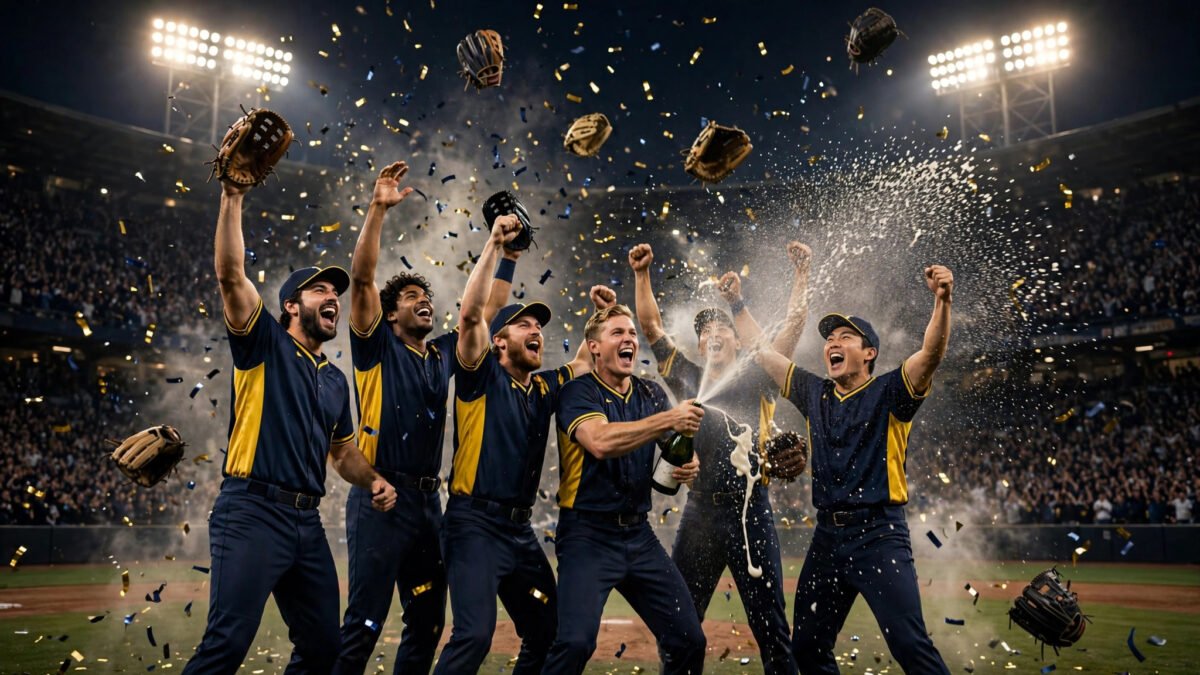
At 8:08 p.m. on Thursday night, Kiké Hernández swung his bat one final time, and the ball rose into the Los Angeles dark — a long, tired fly ball to left field. Jackson Chourio ran under it, the glove closed, and in that single motion, an empire fell.
The Milwaukee Brewers had just swept the Los Angeles Dodgers out of the 2026 National League Championship Series, four games to none, winning Game 4 by 6-4 at Dodger Stadium. The two-time defending champions would not get their three-peat. The dream of baseball immortality died the way all empires die: not in a grand final battle, but in a quiet fly ball, in front of a stadium that could not even sell out.
I have been asking myself since that night: what exactly did we witness? A baseball series, yes. But also something older than baseball — something I have seen in the pages of history and on the streets of politics, the same drama, repeated, because men never learn. When was the last time money, the biggest payroll ever assembled in the history of the sport — $432 million, a sum that could buy small nations’ cricket boards — was humiliated this publicly by a team that simply wanted it more?
Milwaukee’s manager Pat Murphy said it best after the game, with the cruelty that only a winner can afford: “They may have a bunch of Hall of Famers, but we have a bunch of gamers, and the gamers won this week.”
Hall of Famers. Gamers. Read that sentence again, reader, because it contains the entire philosophy of power. It is the story of every empire that ever collapsed under its own gold.
The Company Bahadur of Baseball
Let me tell you a story you already know. In the eighteenth century, the East India Company — a trading firm, remember, a business — built an army and a treasury so large that it began to think of itself as invincible. It bought loyalties, it purchased crowns, it outspent every rival on the subcontinent. And then it met Tipu Sultan at Seringapatam — a smaller state, fewer guns, less gold, but men who had decided that they would rather die fighting than live as accountants of someone else’s empire. The Company won in the end, yes — but it bled, and the world remembered who fought and who merely paid.
The Dodgers were baseball’s Company Bahadur this October. They entered the year coming off back-to-back championships. They amassed the league’s most talented — and most expensive — roster. They won 100 games in the regular season. They captured their 13th National League West crown in 14 years. Their rotation was filled with Cy Young winners, All-Stars, and World Series MVPs. Their lineup featured nine players with at least one All-Star selection. Shohei Ohtani — the most famous athlete on the planet — played through knee and biceps discomfort just to be on the field.
And in the four games that mattered most, that rotation posted a 6.50 ERA. That galaxy of stars went 4-for-27 with runners in scoring position. Four hits. In four games. With the season on the line.
Money, dear reader, buys Hall of Famers. It cannot buy the hunger in a man’s chest.
The Four Nights of the Small Army
Consider how the Brewers actually did it — because the how is the sermon.
They did not win one game comfortably. They trailed in all four games of the sweep — the first team in major league history to trail in every game of a best-of-seven series they swept. Let that absurd sentence sit in your mind. They were behind, every single night, and they refused to lose.
On Wednesday, in Game 3, Garrett Mitchell homered in a 6-2 victory. On Thursday, in Game 4, the Dodgers finally showed their teeth: a 4-0 lead in the second inning, on an RBI single from Andy Pages and then a towering, 428-foot three-run blast from Ohtani — his first home run since August 18, his first of this postseason, the kind of swing that makes 49,104 people believe the tide is turning. (Note that number: 49,104. Not even a sellout. The empire’s own subjects had stopped believing.)
And then the small army went to work, the way small armies always do — not with thunder, but with patience. Jake Bauers, the NLCS MVP, lashed a two-run ground-rule double in the fourth. In the fifth, the Brewers played the pure, beautiful, unglamorous baseball the old men call “small ball”: Sal Frelick walked, stole second, scored on a David Hamilton single; Bauers walked with the bases loaded to tie it. Four straight balls from Alex Vesia. The mighty Dodgers bullpen could not find the strike zone.
In the sixth, Mitchell — down 0-2 in the count — turned on a Tanner Scott pitch and sent it 409 feet to center field, the go-ahead homer, the first of his career on an 0-2 count. In the ninth, Hamilton, the No. 9 hitter, a man with four home runs all regular season, took Dodgers closer Edwin Díaz deep for the insurance run.
And behind them, the bullpen: JoJo Romero striking out Max Muncy with a runner at third to end the sixth. Aaron Ashby — “I was just praying for a little peace in the chaos,” he told Fox Sports afterward — working the final three innings, stranding the tying run, striking out Ohtani swinging with a man on third in the seventh, extending his postseason scoreless streak to 12⅓ innings. Four Milwaukee pitchers held the $432 million lineup scoreless over the final seven innings of the season.
Christian Yelich, the Brewers’ captain, said it plainly: “We got down early tonight and we were like, it’s going to be a great story. We’re going to come back and win this. Like, stay together, start chipping away.”
Stay together. Start chipping away. That is not a baseball strategy, reader. That is the entire philosophy of every underdog who ever toppled an empire — from the muddy fields of Agincourt to the miracle ice of Lake Placid in 1980, when American college boys beat the Soviet machine. It is David’s sling. It is Leicester City winning the Premier League in 2016 at 5000-to-1 odds. The empire plans the parade. The underdog plans the next pitch.
Revenge, Forty-Four Years in the Making
There is a delicious cruelty in the symmetry of it. Last October, these same Dodgers swept these same Brewers in the NLCS, en route to their second straight title. Milwaukee became the first club in major league history to complete a postseason sweep after being swept by that same opponent the previous postseason. Revenge, served at Dodger Stadium, in four courses.
And the wait! Forty-four years. The Brewers had not reached the World Series since 1982, when “Harvey’s Wallbangers” — Robin Yount, Paul Molitor, Rollie Fingers — lost Game 7 to the St. Louis Cardinals. They had reached the NLCS three times in the last 15 years and fallen short every time. This October, they played with the memory of Bob Uecker — the voice of the Brewers, gone now — hanging over every inning like a blessing.
Forty-four years of waiting, and then four nights of refusing to lose. There is a lesson there for every person who has ever been told their time has passed: the calendar does not decide. Hunger decides.
The Winter of the Empire
Now look at the other dugout, because the moral of this story has two faces.
The Dodgers’ veteran core — Miguel Rojas likely to retire, Kiké Hernández headed for free agency, an aging roster about to be a year older — just played what everyone in that clubhouse knew might be the last dance. A looming labor battle and a new collective-bargaining agreement could bring profound changes to the sport’s financial structure. The empire that bought everything may find the rules of buying rewritten.
This is how empires always end, reader — not with a single catastrophe, but with a slow arithmetic of decay: the aging soldiers, the empty treasury of trust, the subjects who stop filling the stadium, the rivals who stop fearing you. Rome did not fall in a day. It fell the day its legions became mercenaries and its citizens stopped believing the eagles were worth following. The Dodgers won 100 games and a division and lost the only thing that mattered — and you could see it in the eighth inning, in the face of that fan the cameras found, staring down at nothing, while Milwaukee celebrated on his field.
No three-peat. No team has won three straight World Series since the 1998–2000 Yankees. The last dance ended before the music did.
What the Gamers Teach Us
So what do we carry home from Los Angeles, those of us who will never swing a bat in October?
We carry this: that there are two kinds of teams in this world, and two kinds of nations, and two kinds of men. The Hall of Famers and the gamers. The Hall of Famers have the résumés, the contracts, the bronze plaques waiting. The gamers have the next pitch. History, I have noticed, is almost always written by the gamers — the hungry, the overlooked, the ones who were swept last year and remembered it every morning.
The Brewers were the best team in baseball this year — 103 wins, 59 losses, the best record in the sport, home-field advantage through the World Series. The oddsmakers finally bowed: for the first time since 2011, Milwaukee is the favorite to win it all. They open the Fall Classic at home on Friday, October 23, against the winner of the American League Championship Series — the Cleveland Guardians, who hold a 2-1 lead over the Tampa Bay Rays and carry the longest championship drought in the sport, having not won since 1948, or the Rays, still chasing their first title.
Either way, a new champion will be crowned. The empire is gone. The gamers remain.
And if you are sitting tonight in some small office, some small shop, some small city, being told that the giants have already won — remember Thursday night in Los Angeles. Remember the 4-0 lead that meant nothing. Remember the $432 million that could not buy four hits with men on base. Remember that empires do not fall because the small become strong. Empires fall because the strong forget what made them strong — and the small never forgot.
The gamers won this week. Let the Hall of Famers read their plaques.
Sources & References
New York Post — Game 4 account: Dodgers’ 4-0 second-inning lead, Ohtani’s 428-foot homer, the Brewers’ comeback, $432M payroll, 100-win season, 6.50 rotation ERA, 4-for-27 with runners in scoring position, 49,104 attendance.
Reuters — 6-4 Game 4 final, Bauers’ two-run double and bases-loaded walk, Mitchell’s go-ahead homer, Ashby’s three-inning save, Guardians’ 2-1 ALCS lead.
NBC Sports — Yelich’s “great story” quote, first club swept one postseason and sweeping the same opponent the next, 1982 World Series history.
Milwaukee Journal Sentinel — Game 4 box score and live account: Ashby’s 12⅓ scoreless postseason innings, Hamilton’s ninth-inning insurance homer off Díaz.
New York Post — Pat Murphy’s “gamers vs. Hall of Famers” quote, Rojas retirement and Hernández free agency, looming CBA battle.
theScore — Ashby’s “peace in the chaos” quote, NLCS MVP Jake Bauers, revenge narrative after the 2025 sweep.
USA Today — 2026 World Series schedule: Game 1 Friday, Oct. 23 at Milwaukee; Brewers’ 103-59 record and home-field advantage.

About the Author — Abdul Mannan
Related Articles
Shai Hope’s Unbeaten Century Powers West Indies to Series-Levelling 24-Run Win Over India
Shai Hope's unbeaten 102 off 50 balls and Keemo Paul's five-wicket haul gave West Indies a 24-run win…
Guardiola Gets Heroes’ Welcome on Etihad Return as PSG Spoil the Night With 4-2 Champions League Win Over Manchester City
Pep Guardiola received a heroes' welcome on his first return to the Etihad since leaving Manchester City, but…

Six Kings Slam Postponed to December as Houthi Missile Strikes Batter Riyadh Airport
The $6 million exhibition's third edition, set for October 21–24, has been moved to December 27–30 after missile…