
FBI Most Wanted Drug Lord ‘El Chapo Isidro’ Captured in Mexico After Gun Battle in Sinaloa

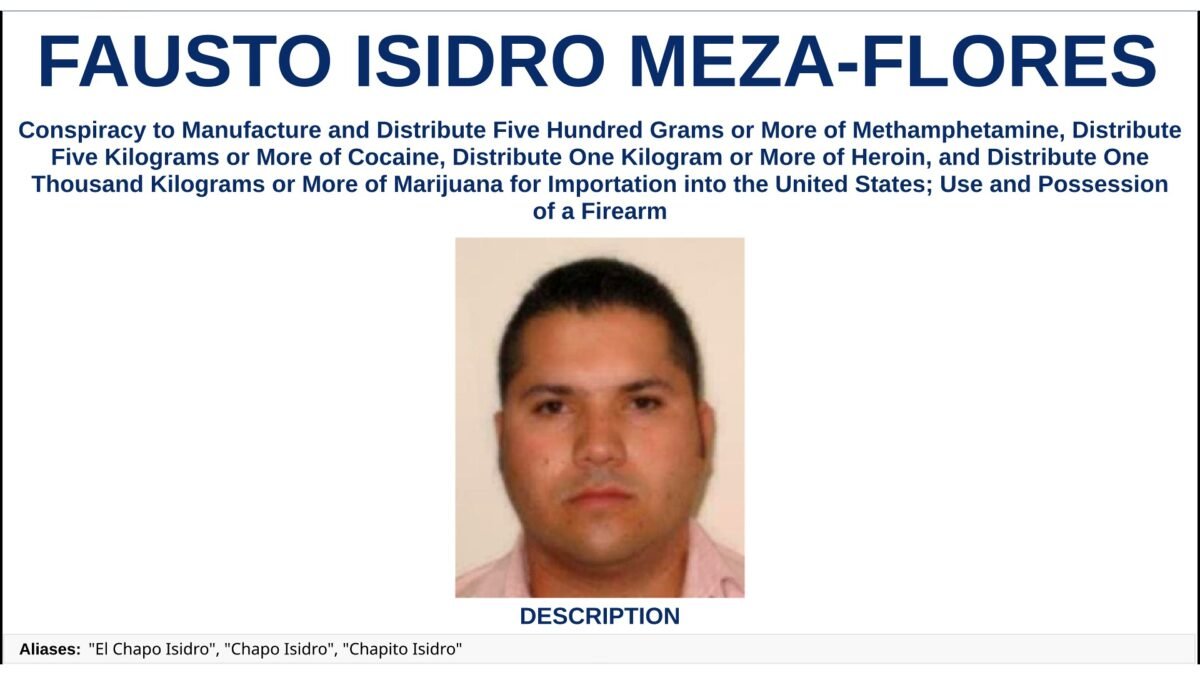
Mexican special forces have captured one of the FBI’s Ten Most Wanted fugitives, Fausto Isidro Meza-Flores, known as “El Chapo Isidro”, in a night-time operation in the state of Sinaloa that set off hours of cartel gunfire, burning roadblocks and panic in a packed baseball stadium. The arrest, announced by Mexico’s government on Saturday morning, is the latest in a run of high-profile blows against the country’s drug cartels and comes as Washington keeps up intense pressure on Mexico to deliver results against the organisations flooding the United States with fentanyl and other drugs.
Meza-Flores, 44, was detained on Friday night in the city of Guasave, in northern Sinaloa, along with two other alleged leaders of his organisation, according to Mexico’s security chief, Omar García Harfuch. The operation was carried out by elite military forces using what the Defence Ministry described as “stealth and surprise”, and intelligence provided by the United States helped Mexican forces locate their target, according to the Associated Press, citing a Mexican government report. The detainees were flown to Mexico City aboard a Mexican Air Force aircraft and placed at the disposal of federal prosecutors.
For more than two decades, according to the US State Department, Meza-Flores and his criminal organisation smuggled vast quantities of heroin, methamphetamine, cocaine and marijuana into the United States. The FBI, which had placed him on its Ten Most Wanted list and offered a reward of up to $5 million for information leading to his arrest, says he is also allegedly responsible for moving fentanyl, the synthetic opioid at the centre of America’s overdose crisis. He was first indicted in the United States in 2012 and again in 2019, on drug-trafficking and firearms charges.
The capture is a significant prize for the government of President Claudia Sheinbaum, who has taken a far more aggressive line against the cartels than her predecessors, and for the Trump administration, which has made the cartels a central target of its second term. But the violence that erupted around the arrest was a reminder of the price such operations exact on ordinary Mexicans: gunmen set up flaming roadblocks across several towns, attacked federal forces, and forced a professional baseball game to be abandoned as fans fled for cover.
The operation in Guasave
According to Mexico’s Defence Ministry, the operation unfolded in three phases. First, elite forces moved into the target area by land, using stealth and surprise to reach the building where Meza-Flores was believed to be hiding. Then they established an inner and outer security perimeter around the site to prevent his escape and block reinforcements from reaching him. Finally, once the detainees’ identities had been confirmed, they were evacuated to Mexico City.
The ministry said the arresting force “came under attack with gunfire and explosives” as the operation began, and had to fight its way into the building. Two other men were arrested alongside Meza-Flores: his second-in-command, identified only as Germán “N”, alias “Serafín”, and the organisation’s alleged financial operator, José “N”. The operation was carried out by Mexican Army and National Guard special forces, with US intelligence agencies involved in the coordination beforehand, according to reports.
Mexico’s security secretary, Omar García Harfuch, announced the arrests in a post on social media on Saturday morning, and the Defence Ministry published a statement setting out the phases of the operation. Neither the US State Department nor the FBI immediately commented on the capture, according to Reuters.
A night of gunfire in Sinaloa
The arrest set off a wave of retaliatory violence across Sinaloa that lasted into the night. According to Reuters, armed clashes broke out between Mexican security forces and cartel gunmen, who set up flaming roadblocks across parts of the city. Dramatic footage verified by CNN showed Mexican military helicopters firing bursts of gunfire at the ground as they circled over Guasave.
The most striking scenes came at Kuroda Park, the baseball stadium in Guasave, where a professional game between the Venados de Mazatlán and the Algodoneros de Guasave was under way. The game, part of Mexico’s premier summer professional baseball league, had begun at 9:30 p.m. Eastern time. As gunfire rang out nearby, fans scrambled out of the stands, clambering over barriers as a baby could be heard crying off-camera. “Get down, duck down, down, down!” one person shouted in the panic, according to footage geolocated by CNN. Players from both teams fled the field mid-game, and the broadcasters suspended the match. “It’s being suspended… there’s a situation happening off the field,” the announcers told viewers. “We wish first and foremost to ask God that everything is OK… there is a national security incident, it may be better for us to go to break now.”
A local resident who was running errands when the violence erupted told CNN that armed men had taken over private hospitals and set businesses on fire, including convenience stores and petrol stations. “I had to take shelter inside some shops that pulled down their security shutters well before closing time,” he said, speaking on condition of anonymity. “People are still trapped inside. Just meters away from where I was, a convoy of heavily armed civilians passed by, firing shots.”
Sinaloa’s state government urged residents of Guasave to stay indoors and avoid travelling on the roads in a statement late on Friday, and said an interagency group had been deployed to restore order. Cartel gunmen also set fire to cargo trucks and set up roadblocks in the nearby municipalities of Ahome, Guamúchil and Navolato, according to local reports. No official casualty toll from the operation and the violence that followed had been released by Saturday morning.
Who is ‘El Chapo Isidro’?
Fausto Isidro Meza-Flores was born on 19 June 1982 in Navojoa, in the neighbouring state of Sonora, according to his FBI wanted poster. He is the alleged leader of the Meza-Flores Transnational Criminal Organization, also known as the Guasave Cartel or Los Mazatlecos, which is based in the Guasave, Los Mochis and Mazatlán region of Sinaloa and in the state of Nayarit. The FBI describes the organisation as a heavily armed, major drug-trafficking group that has predominantly controlled drug production, transportation and distribution in several locations across Mexico.
Meza-Flores was considered one of the leaders of the Beltrán Leyva cartel, according to Reuters, which reported that the group had allied itself with the Los Mayos faction of the powerful Sinaloa Cartel. His nicknames, listed on the FBI poster, are “El Chapo Isidro”, “Chapo Isidro” and “Chapito Isidro” — a play on the alias of Joaquín “El Chapo” Guzmán, the former Sinaloa Cartel leader now serving a life sentence in a US prison. The resemblance in name is no accident: Meza-Flores built his reputation in the shadow of the older kingpin, and at one point his organisation fought an “extremely violent turf war” with the Sinaloa Cartel then led by Guzmán, according to a 2013 statement by the US Treasury Department cited by CNN.
The US government says Meza-Flores has been moving drugs into the United States for more than twenty years. The FBI’s wanted poster accuses him of conspiracy to manufacture and distribute 500 grams or more of methamphetamine, distribute five kilograms or more of cocaine, one kilogram or more of heroin, and one thousand kilograms or more of marijuana for importation into the United States, as well as use and possession of a firearm. The poster warns that he “should be considered armed and dangerous and an international flight risk”.
The American case against him
Meza-Flores was originally indicted on 2 May 2012 in the United States District Court for the District of Columbia, according to the FBI. On 26 November 2019, a federal superseding indictment and a federal arrest warrant were issued for him in the same court after he was charged with multiple counts of drug-trafficking violations and use and possession of a firearm.
The US State Department’s Narcotics Rewards Program offered a reward of up to $5 million for information leading directly to his arrest or conviction. He was added to the FBI’s Ten Most Wanted Fugitives list, the bureau’s most publicised roster of fugitives, reserved for the most dangerous and elusive suspects in federal law enforcement. His capture removes one of the last major cartel figures from that list.
An arrest warrant for organised crime and crimes against health also weighs against him in Mexico, and the United States is seeking his extradition to face the drug-trafficking charges, according to reports. Whether Mexico hands him over quickly, as it has done with dozens of other accused cartel figures in the past two years, will be one of the first tests of what his capture means in practice.
A string of blows against the cartels
Meza-Flores’s arrest is the latest in a series of major successes for the Sheinbaum government, which has pursued the cartels far more aggressively than previous Mexican administrations. The most dramatic came in February 2026, when Mexican special forces killed Nemesio Oseguera Cervantes, known as “El Mencho”, the leader of the Jalisco New Generation Cartel and Mexico’s most powerful cartel boss. That operation, like this one, set off a burst of retaliatory violence and burning cars across the country. According to Bloomberg, nearly three dozen people were killed in the operation and the violence that followed, including 25 members of the National Guard.
The crackdown has also reached into the very top of the Sinaloa Cartel. Ismael “El Mayo” Zambada, the cartel’s co-founder, who had evaded capture for decades, was arrested in El Paso, Texas, in July 2024 after being flown there on a private plane with one of El Chapo’s sons. In July 2026, he was sentenced to life in prison by a federal judge in Brooklyn, after pleading guilty to racketeering conspiracy and running a continuing criminal enterprise, and was ordered to forfeit $15 billion in drug-trafficking profits, according to the US Justice Department.
Alongside the arrests and killings, Mexico has transferred dozens of accused cartel figures to the United States in a series of mass handovers since February 2025, including 29 in the first group, among them Rafael Caro Quintero, the founder of the Guadalajara Cartel, who is accused of the 1985 murder of a US drugs agent. According to reports, a further 37 were sent north in January 2026, the largest group yet, bringing the total transferred to 92. The men were expelled by executive action under Mexican law rather than through the formal extradition treaty, a mechanism the Justice Department has described as expulsions.
The political context has also changed. In February 2025, the Trump administration designated the Sinaloa Cartel as a Foreign Terrorist Organization, along with seven other criminal groups, through a State Department action authorised by an executive order signed on President Donald Trump’s first day back in office. The designation, announced by Secretary of State Marco Rubio, opened the way for US prosecutors to charge cartel members with material support of terrorism and narcoterrorism, and it raised the stakes of every capture: cartel leaders are no longer pursued only as drug traffickers, but as terrorists.
Pressure from Washington
The capture comes under relentless pressure from Washington. President Donald Trump has repeatedly threatened to take unilateral military action inside Mexico if the Sheinbaum administration does not do more to crack down on the cartels, and he made stopping drugs crossing the southern border one of his central promises. The Associated Press reported that Sheinbaum has gone after illegal groups more aggressively than her predecessors, and that homicides have dipped significantly in her two years in office.
The dynamic is delicate for both governments. Sheinbaum has insisted that Mexican forces conduct all operations themselves, with the United States providing intelligence but no troops on the ground. After the killing of El Mencho, she stressed that “all operations are carried out by federal forces. There is no involvement by US forces, but rather a significant exchange of information.” The Chapo Isidro operation followed the same pattern: Mexican special forces carried out the raid, with US intelligence helping to locate the target.
For Trump, the capture is evidence that the pressure is producing results, and it arrives at a moment when his administration is touting a broader offensive against the cartels, including the FTO designations and a series of high-profile prosecutions in US courts. For Sheinbaum, it is proof that Mexico can deliver major cartel figures without American boots on Mexican soil — the argument she has used to resist Trump’s threats of unilateral action.
Analysis: Why It Matters
The capture of El Chapo Isidro matters for three reasons, and each of them reaches beyond the man himself.
First, it removes a major supplier from the pipeline that carries fentanyl and other drugs into the United States. The FBI says Meza-Flores’s organisation was responsible for the possession, distribution and importation of large quantities of heroin, methamphetamine, cocaine, fentanyl and marijuana, and that it controlled production, transport and distribution across several regions of Mexico. No single arrest will end the flow of drugs across the border — the history of the drug war is a long record of kingpins replaced within weeks — but the removal of a figure who had operated for more than twenty years, and who sat on the FBI’s Ten Most Wanted list, disrupts networks, money flows and alliances that took years to build. The question, as always, is whether the organisation fractures into smaller, more violent pieces, or whether a successor consolidates control quickly.
Second, the capture is a test of the new model of US-Mexico security cooperation. The operation was Mexican in execution and American in intelligence, a division of labour that both governments can present as a success. If the model keeps producing results — El Mencho in February, El Mayo’s life sentence in July, and now Chapo Isidro — it strengthens Sheinbaum’s argument that Mexico can handle the cartels itself and weakens the case, made repeatedly by Trump, for unilateral American military action on Mexican soil. But the model depends on trust, and trust has been strained before: El Mayo’s arrest in 2024, after he said he had been lured onto a plane under false pretences, became a point of friction between the two governments, with Mexico demanding that the United States clarify the circumstances and alleging a possible violation of sovereignty. The Chapo Isidro operation, by contrast, was announced openly by Mexico’s own government, with the American role acknowledged but kept in the background. That is the version of cooperation both sides prefer.
Third, the violence that followed the arrest is a reminder of the costs that fall on civilians. The scenes at Kuroda Park — families fleeing a baseball game as gunfire echoed outside, a baby crying as people clambered over barriers — are the human face of the kingpin strategy. Every major capture or killing in Mexico in recent years has been followed by the same pattern: roadblocks, burning vehicles, attacks on security forces, and ordinary people sheltering behind shuttered shops. The Sheinbaum government can point to falling homicide figures as evidence that its strategy is working, but the terror of a night like Friday in Guasave is not captured in a murder statistic. The political durability of the crackdown will depend not only on how many kingpins are captured, but on whether the state can protect the towns where the captures happen.
There is also a narrower, more immediate question: what happens to Los Mazatlecos now. Meza-Flores’s second-in-command and financial operator were arrested with him, which suggests the operation was designed to take out the organisation’s leadership in a single blow rather than leaving a deputy free to take over. But the history of the Beltrán Leyva organisation, which splintered into warring factions after the killing of its leader Arturo Beltrán Leyva in 2009, is a warning. Decapitation can produce not peace but a succession war, as lieutenants fight over routes, territory and the loyalty of gunmen. The Los Mayos faction of the Sinaloa Cartel, with which Meza-Flores’s group had allied, will be watching closely, as will the rival Chapitos faction, the sons of El Chapo, who are themselves facing prosecution in the United States.
What to watch next
The first thing to watch is whether Mexico moves quickly to extradite Meza-Flores to the United States, where he faces the 2012 and 2019 indictments in Washington. The pattern of the past two years — 92 accused cartel figures transferred north, many of them by executive expulsion rather than formal extradition — suggests a handover could come sooner than the years that extradition cases once took. But his Mexican charges, and the politics of appearing to hand a prize catch straight to Washington, could slow the process.
The second is the security situation in Sinaloa. The state government has deployed an interagency force to restore order in Guasave, but retaliatory violence after major captures has a habit of spreading before it subsides. The roadblocks in Ahome, Guamúchil and Navolato, and the attacks on hospitals and businesses reported by residents, will be watched for signs of whether the backlash is contained or escalating.
The third is the reaction in Washington. The Trump administration has treated each cartel capture as a measure of Mexico’s cooperation, and the Chapo Isidro arrest — carried out with American intelligence help, and announced within hours — is likely to be presented as vindication of the pressure strategy. Whether it buys Sheinbaum breathing room against the threat of unilateral US action, or simply raises the bar for the next delivery, will become clear in the coming weeks.
Finally, there is the question of what Meza-Flores himself may offer prosecutors. The most valuable cartel figures are not only those who are captured, but those who talk. El Mayo’s guilty plea, and the cooperation of his son Vicente, helped build the case against El Chapo. If Meza-Flores, facing the prospect of life in an American prison, chooses to cooperate, his knowledge of two decades of smuggling routes, money flows and official corruption could be worth as much to US prosecutors as his capture. That, as much as the gunfire in Guasave, is what will determine the lasting significance of Friday night.
Sources
Reuters — Mexico captures top drug lord “El Chapo Isidro,” latest in string of captures
CNN — Cartel kingpin on FBI’s most wanted list captured in dramatic Mexican military operation
Federal Bureau of Investigation — FAUSTO ISIDRO MEZA-FLORES, Ten Most Wanted Fugitives poster

About the Author — Abdul Mannan
Related Articles
Search Resumes at Indonesian Candy Factory as Dozens Remain Missing After Deadly Fire
Rescue teams returned to the burned-out PT Fonusa Agung Mulia candy factory in Cikande on Monday morning, with…

Trump Pushes Ukraine Peace Deal by Early January as Zelensky Pleads for Patriot Missiles After a Week of 2,700 Russian Drones
Washington wants a Ukraine peace deal by early January, before Democrats take Congress — but as Zelensky pleads…

Russian Corvette Merkury ‘Almost Certainly Destroyed’ in Suspected Drone Strike at Libya’s Benghazi Port
Libya's eastern government says a suspected drone attack caused an explosion aboard a Russian ship at Benghazi naval…