
Congo Ebola Outbreak Passes 12,000 Cases as Fighting Forces Responders to Evacuate

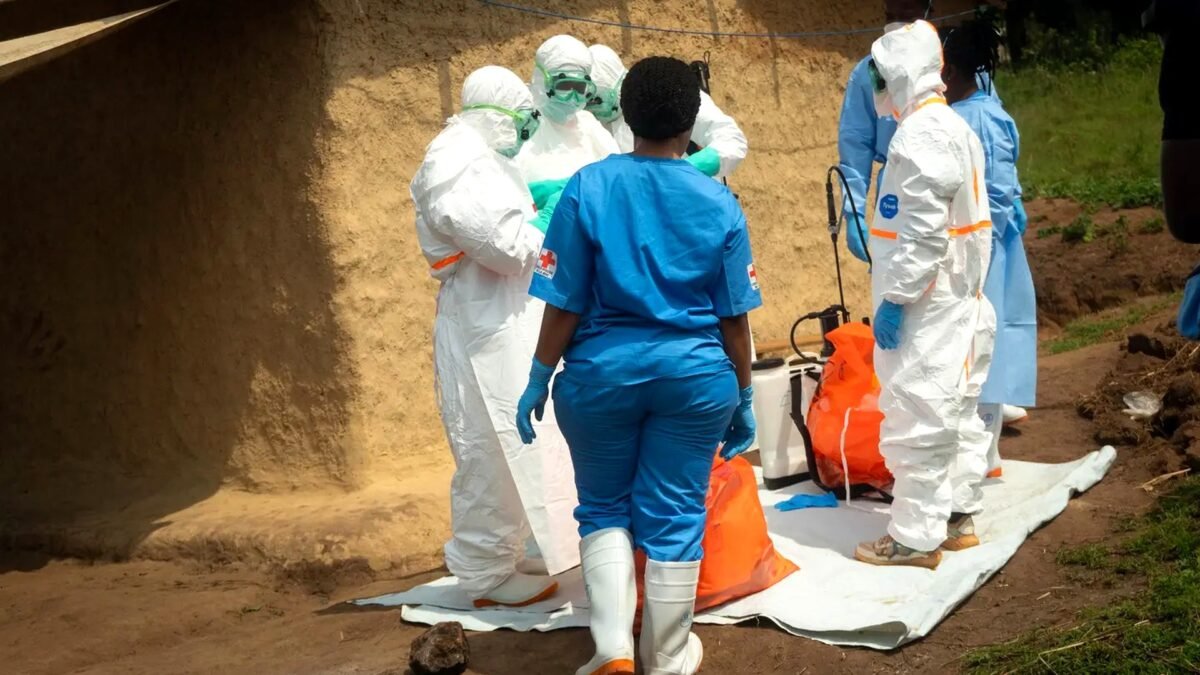
The Ebola outbreak in the eastern Democratic Republic of Congo has passed 12,000 confirmed cases, according to government data released on Thursday, as fighting between rebels and the army forced health workers to evacuate and left parts of the response unable to reach the communities where the virus is spreading fastest.
Confirmed infections now total 12,021, and 5,904 people have died, according to data from Congo’s Ministry of Health reported by Reuters and The Associated Press. Nearly half of everyone confirmed to have the virus has died. The figures make this the second-largest Ebola outbreak ever recorded, and the fastest-growing in history.
The outbreak, caused by the rare Bundibugyo species of the Ebola virus, was declared in mid-May in Ituri province in the country’s northeast. It has since spread to eight of Congo’s 26 provinces. According to AP, it is already the deadliest of Congo’s 17 Ebola outbreaks, and it is on track to surpass the death toll of the West African outbreak of 2014 to 2016, which killed more than 11,000 people after infecting more than 28,600.
The milestone arrives at the worst possible moment for the response. Fighting between the army and the Convention pour la révolution populaire, known as the CRP, resumed on Thursday morning in Iga-Barrière, a mining town about 25 kilometres north of Bunia, the capital of Ituri province and a major hub for the Ebola response. The clashes sent new waves of displaced people towards the city, according to AP.
It was the second blow in a week. Fighting earlier in the week had already prevented response teams from reaching some communities, disrupted the monitoring of people exposed to the virus, and left some treatment centres short of staff, Dr Catherine Smallwood, the World Health Organization’s Ebola incident manager, said on Wednesday.
Smallwood said about a dozen people, including two WHO personnel and Congolese health officials, were evacuated to Bunia on Tuesday after spending three full days trapped in a hospital in Akwe, northeast of the provincial capital, amid intense crossfire. The WHO said earlier in the week that heavy fighting near a hospital in Ituri province had disrupted the Ebola response and that its team had been temporarily relocated from the Mongbwalu area until the situation calms.
Fighting in Ituri Is Strangling the Response
The CRP is one of more than 100 armed groups operating in eastern Congo, where conflict has created one of the world’s most severe humanitarian crises, according to AP. The group was founded last year by former warlord Thomas Lubanga, who was convicted by the International Criminal Court in 2012 of recruiting children under 15 and using them in fighting.
That a rebel group founded by a convicted war criminal is now deciding whether Ebola teams can reach sick people is the central fact of this outbreak. Ebola is not defeated in hospitals alone. It is defeated by speed: finding the sick quickly, isolating them, listing every person they may have exposed, watching those contacts for 21 days, and burying the dead safely. Every one of those steps requires health workers to move freely through villages, to be trusted by residents, and to return day after day. Gunfire breaks all three conditions at once.
The disruption is not new, but it is getting worse. Earlier this month, the Africa Centres for Disease Control and Prevention warned that the outbreak was “still not under control” as cases passed 11,200. The WHO warned in mid-November that violence threatened to undo six months of progress. Now, with cases past 12,000 and response teams being evacuated from the field, the warnings are becoming visible in the daily numbers.
The WHO and the Africa CDC this week unveiled an updated continental preparedness and response plan for the Bundibugyo virus, running from November 2026 through May 2027, according to reports of the announcement. The plan is an acknowledgement that this outbreak will not be over quickly, and that neighbouring countries need to be ready for the possibility that the virus crosses a border.
A Virus With No Approved Vaccine or Treatment
What makes the Bundibugyo species so dangerous is not only how it spreads but what medicine cannot yet do about it. There are no approved treatments or vaccines for this species of the virus, according to Reuters. That is a sharp contrast with the better-known Zaire species, for which vaccines and antibody treatments were developed during and after the West African epidemic.
Ebola spreads through direct contact with the blood or other bodily fluids of people who are sick with the disease or have died from it, according to AP. Containing it requires quickly identifying and treating patients in isolation, monitoring people who may have been exposed, and safely burying the dead. When any link in that chain breaks, the virus finds new hosts.
There is movement on the medical front. Earlier this month, the WHO backed trials for two new Ebola vaccines aimed at the Bundibugyo species, as the outbreak passed 10,000 cases. But trials take time, and a trial is not a vaccine in a nurse’s hands. For now, the response still rests on the oldest tools in epidemic control: isolation, contact tracing, community trust, and safe burials, all of them carried out by people in heavy protective suits in villages where gunfire can start without warning.
The outbreak began in Ituri in May, but it has not stayed there. According to health ministry data reported this week, confirmed cases have now been recorded in eight provinces: Haut-Uele, Ituri, North Kivu, South Kivu, Bas-Uele, Tshopo, South-Ubangi and North Ubangi. The geographic spread matters because each new province means new health systems under strain, new communities to win over, and new roads along which the virus can travel.
Why the Case Count Keeps Climbing
The numbers explain why the outbreak is accelerating rather than slowing. Only 15 percent of new cases come from contacts already known to health authorities, according to data presented by the Africa CDC earlier this month and cited by Reuters. That means most new infections are appearing in people nobody was watching, and many chains of transmission continue to be missed entirely.
Delayed detection, conflict and strained health services have led to a more rapid spread than in previous outbreaks, according to Reuters. And the official toll may itself be an underestimate. A Reuters analysis of satellite imagery found that the official death toll may be largely underestimated in two of Congo’s hardest-hit areas, suggesting that the true scale of the disaster is greater than the 12,021 cases and 5,904 deaths in the ministry’s figures.
The comparison with the West African epidemic of 2014 to 2016 is sobering. That outbreak infected more than 28,600 people and killed more than 11,000 across Guinea, Liberia and Sierra Leone, and it took more than two years to end. The current outbreak in Congo is smaller in total cases but is growing faster, is killing a higher proportion of those infected, and is doing so in a war zone where responders cannot always work. AP reports that it is already on track to surpass the West African death toll, a threshold that would make it the deadliest Ebola outbreak the world has ever seen.
Community resistance has compounded the problem. Response teams are battling armed conflict, poor roads and violence from residents fuelled by mistrust and misinformation, according to AP. In past Congolese outbreaks, rumours that treatment centres were places where people went to die, or that the disease itself was a fabrication, led to attacks on health workers and to families hiding the sick. Every hidden patient is a new chain of transmission that contact tracers never see.
Analysis: Why It Matters
The 12,000-case milestone is not just a number. It is a verdict on the idea that an epidemic can be fought in isolation from the war around it. For six months, the response has been asked to do something close to impossible: run a textbook Ebola operation, built on trust, speed and daily human contact, in a region where more than 100 armed groups operate and where the army and rebels are fighting within kilometres of the treatment centres.
The evacuation from Akwe captures the dilemma precisely. Twelve people, including two WHO staff, spent three days trapped in a hospital by crossfire. They were not treating patients during those three days. They were surviving. Multiply that by every clinic and every village in Ituri, and the 15 percent contact-tracing figure starts to make sense. A response that cannot move cannot trace, and a virus that is not traced spreads in the dark.
There is also a hard question about the world’s attention. An outbreak that has killed nearly 6,000 people, that is the fastest-growing in history, and that involves a virus species with no approved vaccine should be commanding sustained international focus and funding. Instead it competes for notice with wars, elections and markets, and it unfolds in a part of the world whose suffering rarely leads the news. The WHO and Africa CDC preparedness plan running to May 2027 is a welcome recognition of the scale of the task, but a plan is only as strong as the money, the staff and the security that back it.
The comparison with 2014 to 2016 should concentrate minds. The West African epidemic was eventually beaten by a combination of massive international deployment, community engagement, and, crucially, the development of a vaccine for the Zaire species. None of those elements is yet in place at the necessary scale for Bundibugyo. The two vaccine trials backed by the WHO are a start, but they are a start measured in months, while the virus is measured in days. Every week that passes without control adds hundreds of cases and hundreds of funerals.
There is one more reason this milestone matters beyond Congo’s borders. The virus has already reached eight provinces, and the preparedness plan covers the continent, not just one country. Eastern Congo’s borders are porous, its people move for trade, for safety and for family, and displacement driven by fighting pushes people towards cities like Bunia and across provincial lines. An outbreak that cannot be contained where it is becomes a risk everywhere it can reach.
None of this means the outbreak is unbeatable. Ebola has been beaten before in Congo, most recently in outbreaks that were stopped with the same basic tools now being used: rapid isolation, relentless contact tracing, safe burials and honest engagement with communities. What those successes had, and this outbreak increasingly lacks, is the space to work. The single most important intervention in Ituri right now may not be medical at all. It is a pause in the fighting long enough for health workers to reach the sick.
What to Watch Next
Several things will determine whether the next milestone is a turning point or simply a larger number. The first is the fighting around Bunia. If the clashes in Iga-Barrière and elsewhere in Ituri continue, more response teams will be pulled back, more contacts will go unmonitored, and the share of cases found among known contacts will fall further. A ceasefire, even a local and temporary one, would be the most effective public health measure available.
The second is contact tracing. The Africa CDC’s figure, that only 15 percent of new cases come from known contacts, is the clearest single indicator of whether the response is winning or losing. If that share rises, it means teams are finding the virus faster than it spreads. If it falls, the outbreak is outrunning them.
The third is the vaccine trials. The two new vaccines backed by the WHO earlier this month are the best hope of changing the arithmetic of this outbreak, but only if the trials move quickly and the results are strong enough to justify wider use. Any announcement of trial progress will be one of the most consequential developments of the coming weeks.
The fourth is geography. The spread to eight provinces is already wide; a ninth, or confirmed cases in a neighbouring country, would change the character of the crisis and the scale of the response required. The continental preparedness plan suggests health authorities are already thinking in those terms.
Finally, watch the death toll against the West African benchmark. At 5,904 deaths, the outbreak is more than halfway to the 11,000 killed between 2014 and 2016. If the current pace continues, that grim threshold could be crossed in the months ahead, making this the deadliest Ebola outbreak in history. That is a milestone nobody wants to report, and the surest way to avoid it is to give the responders in Ituri the security and the support they need to do their work.
Sources
- Reuters — Congo’s Ebola cases exceed 12,000 as responders struggle to contain outbreak
- The Associated Press (via NPR) — Congo Ebola outbreak reaches 12,000 cases as some responders evacuate
- The Associated Press (via Glasgow Times) — Ebola outbreak in DR Congo reaches 12,000 cases
- Cumhuriyet Daily — Ebola cases cross 12,000 in DR Congo

About the Author — Abdul Mannan
Related Articles
Wisconsin Reports Third Measles Death as Outbreak Reaches 920 Cases and US Toll Climbs to 14
Wisconsin has reported a third measles death — an adult in Lafayette County — as the state's outbreak…

FDA Approves Roche’s Wilserdly for Early-Stage Breast Cancer, First New Hormone Therapy in Over 20 Years
The FDA has approved Roche's once-daily pill Wilserdly for early-stage breast cancer after surgery, the first new hormone…

Pancreatic Cancer Pill Makes Tumours Vanish in One in 12 Patients in Trial Hailed as Biggest Leap in Decades
In a 61-patient trial, daraxonrasib with chemotherapy stopped tumour growth in 90 per cent of patients — and…