
Democrats Clinch Historic House Majority of 258 Seats, Largest Since 1992, as Hubbard Ousts Foxx in North Carolina Recount


House Democrats have secured at least 258 seats in the United States House of Representatives, giving the party its largest majority in more than three decades and completing a midterm sweep that has redrawn the balance of power in Washington. According to the Associated Press, the milestone was reached on Sunday, 22 November, when Democrat Chuck Hubbard was declared the winner of a recount in North Carolina’s Fifth Congressional District, defeating the veteran Republican Representative Virginia Foxx by just 330 votes out of nearly 287,000 cast.
The result, confirmed by the Associated Press and reported by multiple outlets, means Democrats will hold their biggest House majority since 1992, the year Bill Clinton was first elected president. Republicans will hold at least 173 seats. Four House races remain uncalled — one each in Minnesota and Tennessee, and two in Louisiana that will be decided by runoffs in December — so the Democratic total could still rise before the new Congress convenes in January.
Democrats have now gained 44 House seats in the 2026 elections, according to the Associated Press, four more than the 40 they picked up in President Donald Trump’s first midterm in 2018. The scale of the victory has left the party in control of both chambers of Congress, with a 56-seat majority in the 100-member Senate, while a Republican president remains in the White House. The result sets up two years of divided government, with Democrats preparing an ambitious legislative agenda and a sweeping programme of investigations into the Trump administration.
The recount that decided history
The seat that carried Democrats past the historic mark was decided by one of the narrowest margins of the entire election cycle. In North Carolina’s Fifth District, Hubbard, a 64-year-old former journalist, finished with 139,769 votes, or 48.7 per cent, against 139,439 votes, or 48.6 per cent, for Foxx, according to the Associated Press election results. The Libertarian candidate, Robert Luffman, took 7,578 votes, or 2.6 per cent. The Associated Press called the race for Hubbard just before 1:00 pm on Sunday, with 99 per cent of the vote counted.
Foxx, 83, conceded on Sunday after a machine recount failed to close the gap. According to the Associated Press, she telephoned Hubbard to concede, saying in a statement that the recount had confirmed his victory. The recount, requested by Foxx under North Carolina law because the margin was within one per cent, was completed on Saturday.
The count had tightened and loosened for weeks. Hubbard led by 99 votes on election night, stretched his lead to 335 votes once provisional and cured ballots were tallied, and sat 331 votes ahead after the county canvasses, close enough for Foxx to demand a recount. The recount shaved a single vote off his lead, leaving the final margin at 330 votes, or about one tenth of one per cent.
Foxx had represented the district since 2005, a tenure of 22 years, and chaired the powerful House Rules Committee, which decides which bills reach the House floor for a vote. Her defeat removes one of the most senior Republicans in the chamber and hands the seat to a Democrat for the first time since 1995. Hubbard carried Watauga County and the district’s portion of Guilford County, while Foxx carried eight of the district’s ten counties, according to an analysis of the state board’s results. The same two candidates had faced each other in 2024, when Foxx won by 59.5 per cent to 40.5 per cent, a swing that underlines how far the political ground moved in two years.
Hubbard’s victory was the capstone of a wider Democratic rout in North Carolina. According to the Associated Press, Democratic candidates won 11 of the state’s 14 House seats, despite a redistricting effort that had been designed to favour Republicans. The result in the state mirrored the national picture: voters angry over high prices, the war with Iran and concerns about corruption delivered a sweeping rebuke to the party in power.
A majority not seen since 1992
The 258-seat figure carries real historical weight. The last time Democrats held 258 seats was in 1992, when the party won the same number under the then Speaker, Tom Foley, in the election that brought Bill Clinton to the White House. The party’s next-largest showing in the modern era came in 2008, when Barack Obama was elected president and Democrats won 257 seats. The majority is still well short of the Franklin D. Roosevelt era, when Democratic majorities in the House swelled past 300 seats, but it is the largest of any party in the 21st century.
For comparison, Republicans won 247 seats in the 2014 election and 230 seats in 1994, the year Newt Gingrich led the party to its first House majority in four decades. The Republican high-water mark in the House came in 1920, when the party won 301 seats. The Democrats’ new majority, by contrast, will be larger than any the party has held since the early 1990s, and it gives the incoming leadership far more room to manoeuvre than the narrow single-digit majority that the former Speaker, Mike Johnson, struggled to manage over the past two years.
Johnson, a Louisiana Republican, stepped aside after the midterm defeat, and House Republicans have since elected Jim Jordan of Ohio as their leader in the minority, in a 106-73 vote over Steve Scalise. Jordan has vowed that Republicans will fight their way back to power over the next two years, telling colleagues that the party will fight for American families. The contrast with the Democrats’ position is stark: the new Democratic leadership will be able to lose dozens of its own members on any given vote and still reach the 218 votes needed for passage, even in the face of united Republican opposition.
That arithmetic matters because the Democratic caucus is not a monolith. It spans progressives and centrists, and its members arrived in Washington with different ideas about what the majority should do first. Representative Troy Carter of Louisiana, who is expected to lead the Congressional Black Caucus, told reporters that the diversity of views inside the caucus was a strength, saying that people come to the caucus with different ideas and that this is acceptable. The leadership’s challenge will be to hold that coalition together while delivering on the promises that won the election.
What the new majority plans to do
According to the Associated Press, emboldened Democrats are preparing a 100-day agenda to address the high cost of living, alongside a vast oversight agenda aimed at the remainder of Trump’s second term. The legislative priorities are built around affordability, the issue that dominated the campaign. Democrats are planning swift votes to reverse the Republicans’ cuts to Medicaid and to restore the Affordable Care Act tax credits that Republicans allowed to expire, measures that the party argues will bring down household costs for millions of Americans.
The oversight agenda is equally ambitious. Democrats have vowed to use their subpoena powers to launch a flurry of investigations, reasserting the role of Congress as a check on presidential power. That includes plans to examine how Trump and his family have grown wealthier since he returned to office. The incoming House Oversight chairman, Representative Robert Garcia of California, has already sent document-preservation letters to members of the Trump family and senior administration officials, covering four lines of inquiry that include the family’s cryptocurrency business, corporate corruption, misconduct at the Department of Homeland Security, and the handling of the Jeffrey Epstein files.
The Democratic leader, Hakeem Jeffries of New York, is in line to become Speaker of the House when the new Congress convenes on 3 January 2027, and would make history as the first Black speaker in American history. Jeffries, who was nominated by his colleagues as their candidate for the post, has not ruled out seeking to impeach Trump for a third time, a possibility that hangs over the coming session and that Republicans have denounced.
The White House has already issued a warning to Democrats over their planned investigations, going so far as to claim that such inquiries — a standard oversight function of Congress — may amount to what it called “blatant criminality”. The warning, reported by the Associated Press, suggests that the administration intends to resist the coming scrutiny, setting up a confrontation between the executive branch and a Congress that is now controlled by the opposition party.
Inside the caucus, the debate is about balance. Representative Tom Suozzi, a centrist Democrat from New York, has argued that House Democrats should devote 75 per cent of their time to affordability and 25 per cent to accountability, tying every investigation back to the effect on people’s lives. “Everything should be tied back to the people — and how it’s affecting the people,” he said, adding that as Democrats investigate the president’s financial dealings, they should be connecting the dots to voters’ pocketbooks.
Representative Alexandria Ocasio-Cortez of New York, one of the party’s leading progressive voices, described the size of the victory as a mandate. “This is a historic moment for our country. This is one of the largest classes we have seen,” she said at the Capitol, calling the numbers “a mandate for change”. Representative Jason Crow of Colorado, a former Army Ranger, spoke of the pressure the majority now carries. “Like, hell yeah, we should feel pressure,” he said. “There are people dying in this country and people losing their healthcare, losing their livelihoods, losing their farms, being terrorized from ICE,” he said, referring to US Immigration and Customs Enforcement. “If you don’t feel a sense of urgency and pressure in this job, and a desperation to deliver for folks, then you don’t belong under this Capitol dome.”
The view from the other side
For Republicans, the result is a reckoning. The party’s House numbers have fallen to one of the lowest tallies in decades, and the defeat has already triggered a leadership contest and a round of recriminations about the direction of the party. The midterm results have also reshaped the wider political landscape: Democrats control the Senate, the House, and a series of governorships, while Trump retains the White House and the veto power that comes with it.
The president has responded to the defeat by moving to work with the incoming Democratic Congress on at least one issue, telling reporters that he would cooperate with Democrats to cap credit card interest rates at 10 per cent. The offer, made as Americans carry record levels of household debt, is one of the few areas where the two sides have signalled a willingness to legislate together. Whether that cooperation extends to other areas remains to be seen, and the early signs point to confrontation rather than compromise.
The administration has also moved to shield itself from congressional scrutiny. Trump has directed federal contractors to consult the White House before answering inquiries from Congress, and to withhold communications that the administration considers privileged, a step that Democrats have condemned as an attempt to obstruct oversight before it begins. The order, and the White House’s warning about “blatant criminality”, suggest that the coming months will feature legal and constitutional fights over the scope of Congress’s investigative powers.
Republicans, for their part, argue that the Democratic investigations are politically motivated and that the party’s majority was built on promises it cannot keep. Jordan, the new Republican leader, has promised an aggressive opposition, and the party’s remaining members are expected to use every procedural tool available to slow the Democratic agenda. With at least 173 seats, Republicans retain enough votes to sustain a presidential veto and to force Democrats to hold their own coalition together on every major vote.
Analysis: Why It Matters
A mandate, and a deadline
The 258-seat figure is more than a historical curiosity. It is the difference between a majority that must beg for every vote and a majority that can govern. Mike Johnson’s single-digit margin meant that a handful of Republican members could derail the agenda at will, and the past two years were marked by repeated standoffs, failed votes and leadership crises. Jeffries will be able to lose dozens of Democrats and still pass legislation, which changes the entire dynamic of the House. It means the Democratic leadership can afford internal disagreement, can let vulnerable members vote against controversial measures, and can still deliver. That breathing room is what turns a majority from a fragile arithmetic fact into a governing instrument, and it is the single most important consequence of the Hubbard victory.
But the same arithmetic creates a political trap. A majority this large was won on a promise to lower the cost of living, and voters will judge it quickly. The 100-day agenda — Medicaid, the Affordable Care Act credits, and other affordability measures — is designed to produce visible results before the public’s patience runs out. If those measures stall in the Senate, or are vetoed by the president, Democrats will have to explain why a historic majority could not deliver on its central promise. The pressure that Crow described is real, and it will only grow as the 2028 election cycle begins to take shape.
The recount as a warning about the system
There is a second lesson in the way this seat was decided. A 330-vote margin out of 287,000 cast, a recount that changed the lead by a single vote, and a concession that came only after weeks of counting — this is how thin the line between the two parties has become in competitive districts. North Carolina’s redistricting was designed to favour Republicans, yet Democrats won 11 of 14 seats. That outcome says something about the limits of map-drawing as a political tool when the national mood moves sharply enough. It also says something about the resilience of the counting process: the margin moved by 99 votes, then 335, then 331, then 330, as provisional ballots were cured and canvasses completed, and the system produced a result that both sides ultimately accepted. In a year when the legitimacy of elections has been contested from the highest levels, the quiet, procedural conclusion of this race is worth noting.
Oversight versus affordability: the tension at the heart of the majority
The most consequential argument inside the Democratic Party over the next two years will be the one Suozzi has already framed: how much of the majority’s energy should go to investigating Trump, and how much to lowering prices. The oversight agenda is popular with the party’s base, and the Garcia letters show that the machinery is already moving. But investigations are slow, their findings are often contested, and they rarely change the price of groceries. Suozzi’s 75-25 formula is an attempt to discipline the caucus, to force every probe to answer the question of how it affects ordinary people’s lives. Ocasio-Cortez’s “mandate for change” points in a different direction, towards using the majority boldly and without apology. Jeffries will have to manage both impulses, and the balance he strikes will define whether the majority is remembered as a governing success or as a missed opportunity.
Divided government, and what it means for the world
The consequences extend beyond American domestic politics. A Democratic Congress changes the context for the wars and crises that have dominated the past year. The Senate has already voted on war powers resolutions, and the House will now have a majority that is far more sceptical of the administration’s foreign policy. Aid to Ukraine, the confrontation with Iran, and the naval standoff in the Gulf will all be debated in a Congress that is no longer controlled by the president’s party. That does not mean a sudden reversal of policy — the president retains command of the armed forces and the veto — but it does mean that the administration will face sustained questioning, subpoenas and public hearings on decisions that were previously made with little congressional scrutiny. For allies and adversaries watching from abroad, the message is that American foreign policy is about to become more contested, more public, and less predictable.
What to Watch Next
The first test comes on 3 January 2027, when the new Congress convenes and the House elects its Speaker. Jeffries is expected to win the post, but the vote will reveal the state of the Democratic coalition and the size of the Republican opposition. The four uncalled House races — in Minnesota, Tennessee and Louisiana — will be resolved in the coming weeks, and the final Democratic total could reach 259 or 260.
The second test will be the 100-day agenda. The planned votes on Medicaid and the Affordable Care Act tax credits will show whether Democrats can move quickly from campaign promises to legislation, and whether the Senate, where Democrats hold a 56-44 majority, can pass the same measures. Any bill that reaches the president’s desk will face the question of a veto, and the search for common ground — on issues such as the credit card interest cap, where Trump has already signalled a willingness to cooperate — will be watched closely.
The third test will be the oversight programme. The Garcia preservation letters carry a December deadline for some responses, and the first subpoenas of the new Congress are expected early in the new year. The White House’s response — cooperation, resistance, or legal challenge — will set the tone for the next two years. The administration’s warning that investigations could amount to “blatant criminality” suggests that the fight will be sharp, and that the courts may ultimately be asked to decide the limits of congressional power.
Finally, the North Carolina result itself may not be the last word. The state board of elections is due to certify the results, and the narrowness of the margin means that any challenge, however unlikely, would attract enormous attention. For now, though, the result stands: Democrats have 258 seats, their largest majority since 1992, and the shape of American politics for the next two years has been set.
Sources
- Associated Press, “Democrats secure biggest House majority in decades with affordability agenda ahead” (via WVLT), 22 November 2026
- Associated Press, “Chuck Hubbard defeats Rep. Virginia Foxx after a recount in their North Carolina House race” (via The Daily Reflector), 22 November 2026
- Washington Examiner, “Democrats clinch 258 House seats to mark largest majority in over three decades”, 22 November 2026
- CNN, “Republican chair of the House Rules Committee loses reelection in Democrats’ largest majority this century”, 22 November 2026
- Associated Press, 2026 Elections Hub

About the Author — Abdul Mannan
Related Articles

Trump Vows to Work With Democrats to Cap Credit Card Interest at 10% as Americans Carry Record $1.29 Trillion in Debt
President Donald Trump said on Saturday he would work with the incoming Democratic Congress to cap credit card…
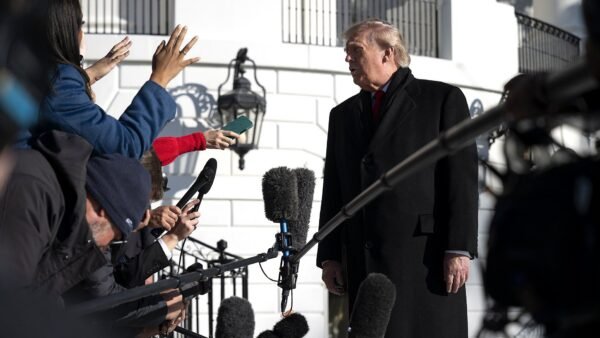
Trump Orders Federal Contractors to Check With White House Before Answering Congress, Threatening Their Contracts
President Donald Trump has ordered federal contractors to clear congressional inquiries with the White House first, threatening their…

US Warns Airlines of Al-Qaeda Calls for Copycat Aviation Attacks Ahead of Thanksgiving Travel
US security agencies have warned airlines and airports to stay alert after al-Qaeda affiliates praised September's attempted flydubai…